
Installation of a GREE All Match Slim Duct R32 Ducted Unit in Sainte-Julie: Slim Duct Unit Integrated into an Attic with Compact HVAC Connections
AirGreen installs a GREE Gainable Slim Duct R32 system in Sainte-Julie: compact connections, attic unit, discreet comfort, and HVAC expertise on the South Shore.
Take a tour of the installation
Each number is a point we check on site. Switch between summer and winter to watch air and heat move.
In summer, the outdoor unit rejects the house's heat outside.
Generic illustration of this type of installation, not a survey of this job site. Tap a number.
It captures or rejects heat outside. It sits on a level base, above the snow, with free space all around.
The insulated refrigerant lines enter the house through a sealed opening and run to the indoor coil.
A shut-off switch near the outdoor unit isolates it safely for service.
Sitting on the indoor module, it moves heat between the house air and the refrigerant.
Electric furnace or air handler: its fan pushes air through the ducts. The electric backup takes over in extreme cold.
Supply ducts bring air to the rooms; returns bring it back to the unit. Their condition matters as much as the unit's.
It protects the coil and the fan. A dirty filter cuts airflow, so it gets checked regularly.
It runs the heat pump and the backup heat. It must be compatible with the installed system.
A GREE ducted installation carried out in a narrow technical space in Sainte-Julie
In Sainte-Julie, this installation by AirGreen represents a type of HVAC project increasingly requested on the South Shore: integrating a GREE ducted heat pump in a discreet space, without a visible wall unit, while ensuring effective air distribution in the rooms of the house. The chosen system is part of the GREE Ducted – Slim Duct – Ductable family, a solution designed to offer stable comfort from an indoor unit hidden in an attic, a technical ceiling, or a false ceiling.
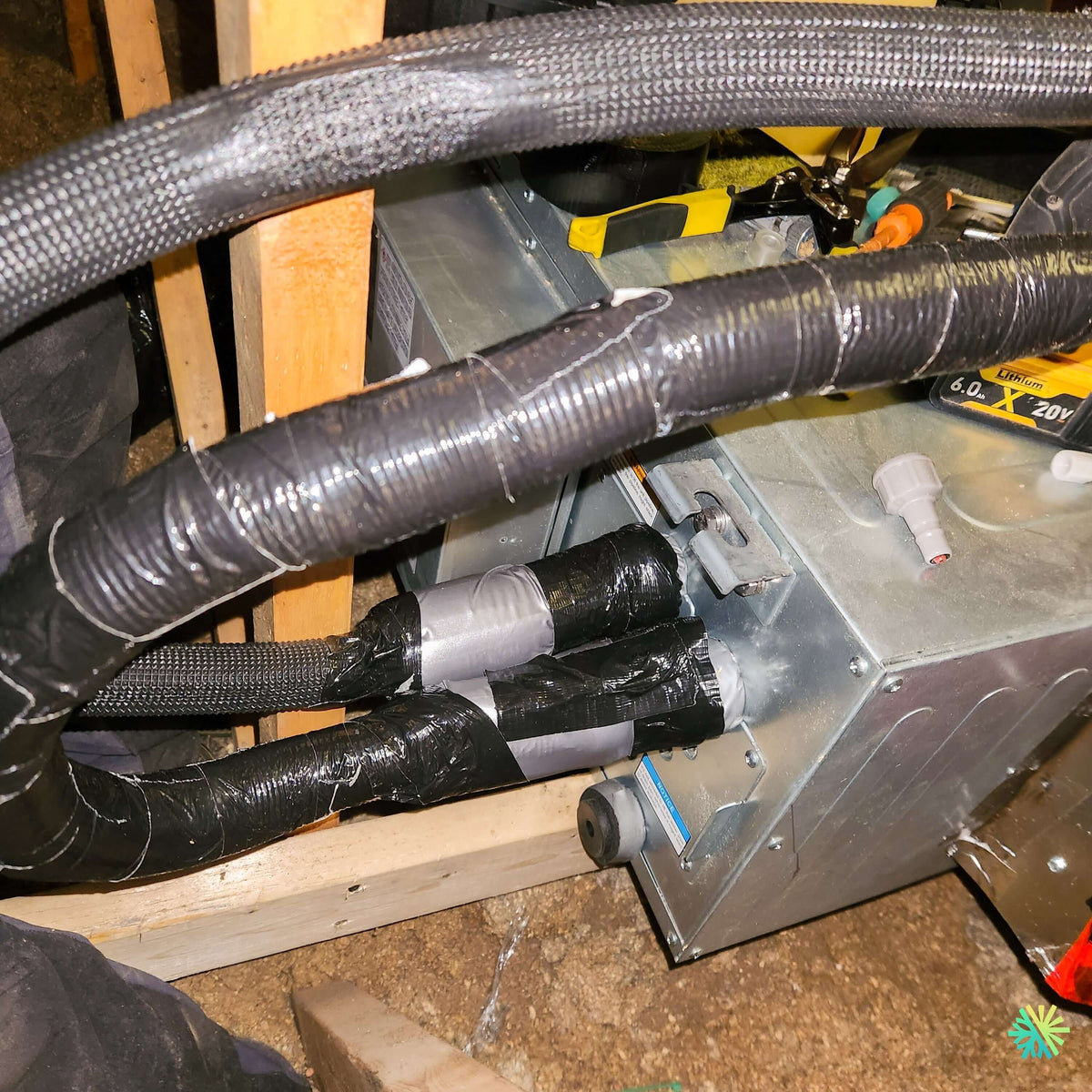
The construction site photo shows a particularly important step: the technical connections around the indoor unit. You can see the device installed in a framing area, surrounded by insulated ducts, protected refrigeration piping, condensate connections, and fastening elements. This is not a decorative installation visible in a finished room, but rather the technical heart of the system. It is here that the quality of the work determines a large part of future comfort: airtightness, drainage, accessibility, line protection, and maintaining a stable airflow.
In a house in Sainte-Julie, where the attic can be low, sloped, and sometimes difficult to access, this kind of installation requires serious planning. The goal is not only to fit the equipment into the available space. It is also necessary to plan for HVAC maintenance, future inspections, proper condensate drainage, pipe protection, and the mechanical stability of the whole system.
Why a ducted heat pump is well suited for this type of house
A classic wall-mounted heat pump is often simple to install and very effective for an open area. However, when a customer wants to cool or heat multiple rooms with a more discreet system, the ducted system becomes a much more interesting solution. The indoor unit is hidden, and the air is distributed through ducts to the targeted rooms.
In this project in Sainte-Julie, the advantage of the GREE All Match Slim Duct R32 system is based on three main benefits:
- a discreet integration, with few visible elements in the rooms;
- air distribution better spread than a single central wall unit;
- a solution compatible with configurations where technical space is limited.
The GREE range offered by AirGreen includes several capacities, notably 9,000 BTU, 12,000 BTU, 18,000 BTU, 21,000 BTU, 24,000 BTU, 30,000 BTU, and 36,000 BTU, depending on the series, static pressure, and chosen combination. For a ducted project, capacity should never be chosen solely based on area. It is also necessary to analyze the ducts, pressure losses, number of grilles, air return, insulation, and actual heating needs.
Visible connections: a detail that makes all the difference
In the construction site image, we notice several essential elements of a ducted HVAC installation. The refrigerant pipes are insulated and protected, the lines are carefully grouped, and the unit is positioned within a wooden structure where access remains limited. This step requires great precision, as the connections must remain strong, clean, and accessible.
The refrigerant lines carry the refrigerant between the indoor and outdoor units. In the case of recent models from the GREE All Match Slim Duct R32 series, the refrigerant R32 is used in certain configurations, reflecting a more current generation of equipment. Mechanical protection of the lines, insulation, and quality of the connection are essential to reduce losses, prevent condensation, and ensure system reliability.
We also see elements related to condensate drainage. In air conditioning, the indoor unit removes moisture from the air. This water must be properly drained. In an attic, poor drainage can cause significant problems: infiltration, ceiling stains, water accumulation, or safety triggers. At AirGreen, we therefore pay special attention to the slope, fastening, connection, and accessibility of the drain.
Low pressure or high static pressure: a mandatory analysis
AirGreen offers GREE FM Ducted Systems in low and high static pressure, as well as GREE All Match Slim Duct R32 configurations according to building needs. This distinction is fundamental.
A low static pressure system may be suitable when the duct network is short, direct, and minimally restrictive. It is often suitable for small areas or compact installations.
A high static pressure system becomes preferable when air must travel longer distances, supply multiple outlets, pass through bends, or cross more complex sections. In a house where the unit is placed in an attic with structural constraints, analyzing static pressure prevents creating a system that lacks airflow at the farthest vents.
For this installation in Sainte-Julie, the focus was on the device’s ability to maintain stable airflow despite limited space. A well-chosen device, but poorly connected, can yield disappointing results. Conversely, a properly sized and well-installed configuration provides more uniform comfort, less noise, and better efficiency.
An attic installation: the real constraints of the site
Installing a GREE ducted system in an attic is nothing like installing a wall unit in an open room. The work is often done in heat, with little space to move around, around the framework, insulation, and existing ducts. Tools must be positioned carefully, service panels must remain accessible, and lines must be protected against friction.
In this project, the indoor unit was integrated into a space where every movement had to be controlled. The ducts and technical lines ran close to the wooden structure, which required a clean and compact installation. Our technicians had to organize the connections to avoid mechanical stress, reduce the risk of vibration, and maintain sufficient access to components.
This rigor is essential for durability. A poorly supported line can vibrate. A poorly positioned drain can block. An inaccessible service panel can make future maintenance complicated. An overly compressed duct can reduce airflow. These details are often invisible to the client once the work is completed, but they make a big difference in long-term performance.
Discreet and lasting comfort thanks to a well-designed HVAC installation
A solution tailored to the expectations of Sainte-Julie homeowners
Owners who choose a gainable heat pump often seek a precise balance: performance, discretion, comfort, and aesthetics. In Sainte-Julie, several homes have attics or technical spaces allowing this type of integration. The gainable system helps preserve the appearance of rooms while ensuring more natural air distribution through well-positioned grilles.
This solution can be particularly useful for:
- upstairs bedrooms;
- hallways and transition zones;
- open areas where a visible unit is to be avoided;
- renovations where interior aesthetics are a priority;
- houses where several rooms need to be served from a single discreet system.
The desired result is not simply to have cold or hot air. The goal is to achieve a better-distributed temperature, fewer variations between rooms, and a system that truly integrates into the home.
The importance of airtightness and insulation
In any gainable duct installation, airtightness is a critical point. An air leak in an attic means that heated or cooled air is lost in an unoccupied space. This reduces efficiency, increases operating load, and can create temperature differences in the house.
Ducts, transitions, and fittings must therefore be carefully sealed. Cold lines must be properly insulated to limit condensation. In a space like the one visible in the photo, where several elements pass through a restricted volume, the organization of materials is as important as their quality.
At AirGreen, we do not consider connections as a simple finish. They are an integral part of the system's performance. A well-connected gainable will be quieter, more stable, and more efficient.
The advantages of GREE gainable systems offered by AirGreen
The GREE Gainable range available at AirGreen meets several residential and commercial needs. It includes solutions of different capacities, with low and high static pressure options, as well as the All Match Slim Duct R32 series. Selected models can offer up to 12 years of warranty, depending on applicable conditions and the chosen configuration.
These systems are appreciated for their ability to integrate into projects where discretion is important. They can be suitable for installations in ceilings, attics, or false ceilings, with particular attention to airflow balancing and acoustic control.
For clients in Montreal, Laval, Longueuil, the North Shore, and the South Shore, AirGreen also provides field expertise: old houses, condos, complex renovations, tight spaces, condominium constraints, and installation requirements specific to Quebec buildings.
Subsidies and energy efficiency: what needs to be validated
Some heat pump systems may be eligible for subsidies, especially when the indoor and outdoor combination meets current energy efficiency criteria. For GREE ducted systems, this eligibility must be confirmed based on the exact model, capacity, certification, and installed combination.
AirGreen supports clients in this verification before finalizing the project. This is an important step because two systems that look similar can have different data depending on their combination. The goal is to provide clear information to the client without assuming the eligibility of a model before validation.
In an installation like the one in Sainte-Julie, this analysis can influence the comparison between several options, especially when the client hesitates between a wall unit, a multi-zone, or a ducted solution.
Mistakes to avoid with a Slim Duct system
A Slim Duct can deliver excellent results, but it must be installed according to best practices. Here are the mistakes we systematically avoid:
Installing the unit without service access
A hidden unit must remain accessible. Panels, filters, the drain, fittings, and connections must be inspectable during maintenance.
Neglecting drainage
Condensate must be drained reliably. A poor slope or a fragile connection can cause costly problems.
Underestimating pressure losses
Every bend, transition, and length of duct affects the flow. Poor analysis can reduce comfort in certain rooms.
Over-tightening the refrigerant lines
The lines must be protected, but they should not be forced or crushed. Proper routing limits mechanical stress.
Choosing the system based only on price
The initial cost should not overshadow installation quality, noise level, accessibility, and durability. A ducted system is a technical project that must be designed to last.
The AirGreen approach: precision, transparency, and post-installation service
AirGreen is a GREE Elite dealer, with specialized expertise in ducted systems and integrated installations. Our role is not limited to installing a machine. We analyze the building, explain the options, prepare a clear quote, and carry out the work with particular attention to detail.
Our teams regularly work in Sainte-Julie, Boucherville, Saint-Bruno-de-Montarville, Longueuil, Montreal, Laval, on the North Shore and the South Shore. This local experience allows us to better anticipate the constraints of Quebec homes: low attics, difficult access, electrical requirements, variable insulation, partial renovations, and high expectations for comfort.
AirGreen also offers liability insurance of 5 000 000 $, a structured after-sales service, experienced refrigeration technicians, and clear support for customers who want to understand their installation. For a ducted system, this transparency is essential because much of the work is in non-visible areas.
A technical result that improves comfort without weighing down the interior
This installation of a GREE All Match Slim Duct R32 Ducted system in Sainte-Julie demonstrates the value of a discreet, well-integrated HVAC system designed for longevity. The indoor unit is installed in a technical space, the lines are protected, connections are organized, and the network is designed to distribute air efficiently.
For owners who want a less visible heating and air conditioning solution than a wall unit, while maintaining a high level of comfort, the GREE ducted system is a serious option. Well designed and well installed, it provides uniform comfort, better architectural integration, and smarter use of available space.
The big day, step by step
The main steps of this kind of job at AirGreen. Every house has its quirks: the estimate brings them out.
We look at the ducts, the current indoor module, the electrical panel and the planned spot for the outdoor unit.
The equipment combination, capacity and price, in writing. We check whether the combination qualifies for assistance programs.
Access protected, old unit disconnected and removed when it is being replaced.
Electric furnace or air handler, with its coil, connected to the supply and return ducts.
On a level base, raised above the snow, with free space all around.
Insulated, they enter through a sealed opening and run to the indoor coil.
Dedicated circuits, accessible disconnect, a thermostat that works with the heat pump and the backup heat.
Leak test, vacuum, start-up, airflow check and a test of both modes.
Filter, thermostat, backup heat in extreme cold: what to know before winter.
- The on-site estimateWe look at the ducts, the current indoor module, the electrical panel and the planned spot for the outdoor unit.
- The quoteThe equipment combination, capacity and price, in writing. We check whether the combination qualifies for assistance programs.
- Getting readyAccess protected, old unit disconnected and removed when it is being replaced.
- The indoor moduleElectric furnace or air handler, with its coil, connected to the supply and return ducts.
- The outdoor unitOn a level base, raised above the snow, with free space all around.
- The refrigerant linesInsulated, they enter through a sealed opening and run to the indoor coil.
- Electrical and thermostatDedicated circuits, accessible disconnect, a thermostat that works with the heat pump and the backup heat.
- Tests and start-upLeak test, vacuum, start-up, airflow check and a test of both modes.
- The walkthroughFilter, thermostat, backup heat in extreme cold: what to know before winter.
What would it look like at your place?
Two quick checks with real numbers: what heat costs, and what your current heaters add up to in BTU/h.
Conversion: 1 W = 3.412 BTU/h. An indication, not a load calculation: baseboards and furnaces are often stronger than the real need, and they can stay as backup. AirGreen confirms the capacity on site.
Four mistakes we do not make
Flip each card to see what we do instead.
Your own project, step by step
What to do, season by season
Three habits per season for this unit. They take a few minutes and prevent many calls.
- Check the indoor module's filter.
- Clear winter debris from the outdoor unit.
- Test cooling before the heat arrives.
- Check the filter more often in peak season.
- Keep registers and returns clear.
- Watch condensate drainage near the coil.
- Change or clean the filter.
- Test heating and backup heat before the cold.
- Book periodic maintenance.
- Clear snow around the outdoor unit.
- Store nothing in front of the indoor module.
- Note any unusual noise or smell and call us.
Is your home ready?
Check what applies at your place. A "no" is not a refusal: it is what we sort out during the estimate.
Four statements: true or false?
It all comes down to details you have just seen.
1. A central heat pump uses the house's ducts.
It connects to the existing ducts to heat and cool everywhere.
2. In extreme cold, electric backup heat can take over.
The indoor module (furnace or air handler) works with the heat pump and takes over in extreme cold.
3. The filter only gets changed when the unit breaks down.
A dirty filter cuts airflow. It gets checked regularly.
4. You can reuse the old unit's size without checking.
The house may have changed: insulation, windows, added rooms. Capacity is confirmed on site.
0 / 4 right answers
What people ask us about this kind of work
Can I keep my current ducts?
What happens in extreme cold?
Furnace, air handler, ducted: what is the difference?
Are there grants?
Do I need a permit?
How much can I save?
How is the LogisVert assistance calculated?
Will my current thermostat work?
Central or wall units: which one?
Does AirGreen hold the required licences?
Is the estimate free?
No question matches. Write to us: we answer.
More jobs to see, near you
By town, by equipment or by region: browse more than 4,700 published projects.
Each dot: a town where AirGreen has published projects. The glowing dot: this job.
Every house has its constraints. We see them before we install.
The on-site estimate is free and the quote follows within 24 hours.
Text and photo: a real AirGreen Climatisation & Chauffage job. The diagrams are generic illustrations of the type of installation, not a survey of this job site. Sources of the added figures: airgreen.ca product pages (NEEP / AHRI performance), Hydro-Québec (Heat pumps page, LogisVert, read on 13 October 2026), Régie de l’énergie (rate D as of 1 April 2026).