
Installation of a CanAir Inverter wall-mounted heat pump in Chomedey
In Chomedey, AirGreen installs a CanAir wall-mounted heat pump on brick facade brackets : protected casing, disconnect switch, demanding commissioning and four-season comfort. HVAC installation Greater Montreal (Montreal, Laval, Longueuil, North Shore, South Shore).
In summer, the outdoor unit rejects the house's heat outside.
Generic illustration of this type of installation, not a survey of this job site. Tap a number.
Mounted level on a wall plate, high enough for the air to reach the whole room, with enough space around it to slide the filters out easily.
The refrigerant lines, the communication cable and the drain go through the wall in a single opening, sealed against water, cold air and insects.
Two insulated copper pipes connect the two units. Outside, a line cover can protect them from sun, knocks and weather.
A shut-off switch near the outdoor unit isolates it safely for service. It must stay accessible at all times.
The compressor and the fan. In heating mode it captures heat from the outdoor air, even in winter, and moves it inside.
On the ground or on the wall, it keeps the unit above accumulated snow. The unit stays clear and defrost water can drain away.
The fan needs to blow freely. Storage, a fence or a wall too close, and efficiency drops while noise goes up.
Installation on brackets on a brick facade: compact, silent and ready for the Laval winter
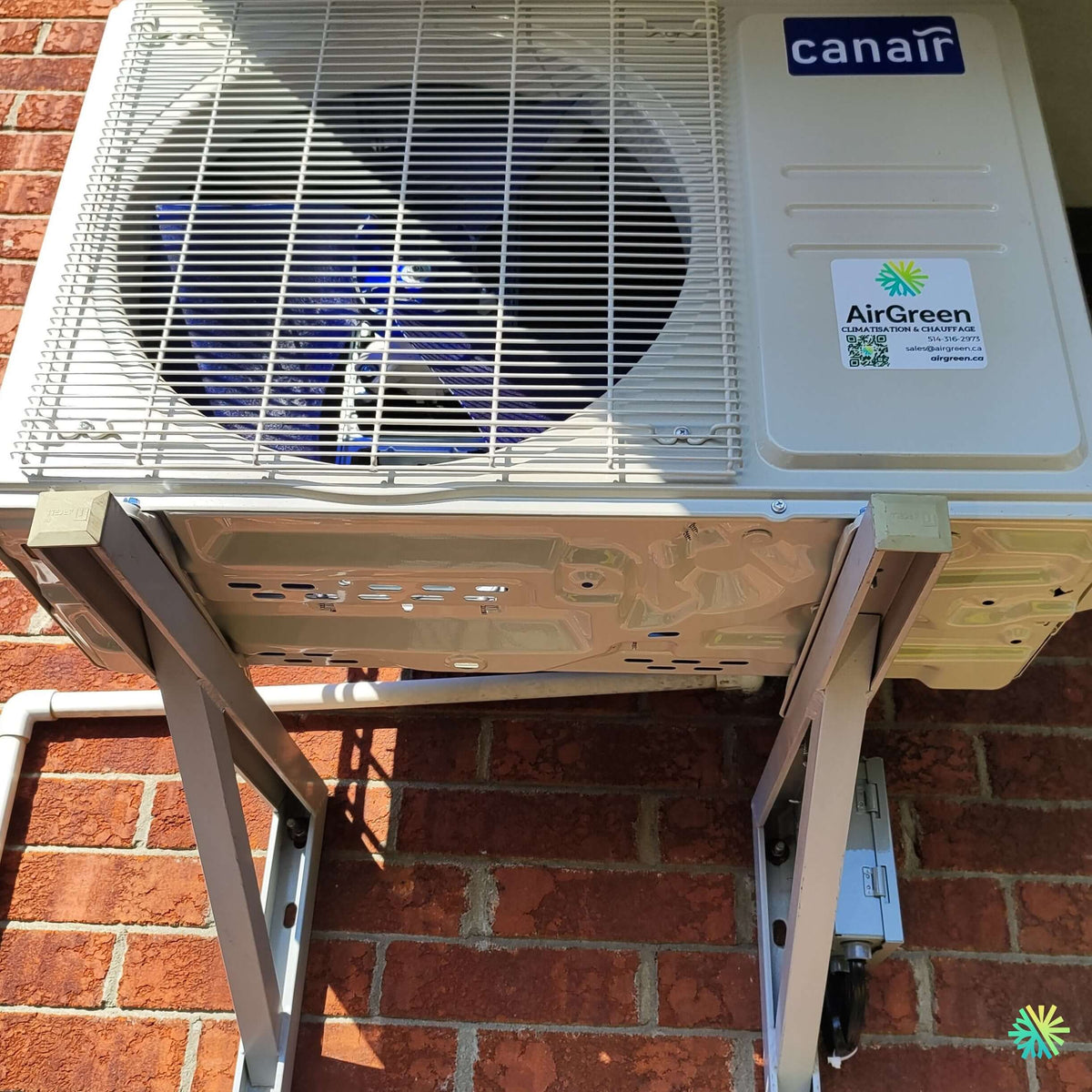
At AirGreen , we treat every HVAC installation as a full-scale engineering project. In Chomedey (Laval) , we have just equipped a brick house with a CanAir inverter wall-mounted heat pump . The outdoor unit is mounted on wall brackets , clear of the ground to avoid snow and shocks, with a discreet UV cover on the connections and an outdoor disconnect switch within easy reach. The result: a solution that frees up the parking area, reduces perceived noise and improves four-season efficiency.
Client background and objectives
The owner wanted:
-
effectively air-condition the living area in summer;
-
heat stably and economically in winter in order to limit the use of baseboards;
-
maintain ground clearance for snow removal and traffic.
After a thermal assessment and inspection of the facade, we selected a CanAir monosplit configuration , sized in the usual capacities of 9,000 / 12,000 / 18,000 BTU according to the calculated loads. Inverter technology allows for fine adjustment of power and lower consumption.
Outdoor installation: sturdy brackets and reliable anchors
Why brackets?
-
They raise the condenser above snow and defrost puddles.
-
They clear the driveway and protect the unit from shovels, bicycles and children playing.
-
They facilitate maintenance : all sides remain accessible.
Our implementation:
-
Galvanized brackets with high load-bearing capacity, with safety margin.
-
Anti-vibration pads under the base to decouple the device from the masonry.
-
Mechanical/adhesive anchors in sound brick (never in the joint alone), tightened to the torque.
-
Level control and service loop behind the unit to eliminate any stress on the flares.
Water and frost management:
In heating mode, defrosting discharges water. The elevation limits the risk of ice on the floor. If the configuration requires it, we add a discreet deflector to channel the drip and prevent streaks on the brick.
Refrigerated and electrical path: short, protected and aesthetic
-
Insulated copper refrigeration lines , most direct path possible to reduce pressure losses.
-
UV-resistant rigid cover on the front; clip-on covers for quick maintenance .
-
External disconnector installed in the immediate vicinity of the condenser to make interventions safer .
-
Grouped communication and power cable , bending radii respected to preserve the insulation.
-
Core drilling, closed cell foam and sealant to ensure airtightness .
Notable technical details of this installation
-
Fan guard to prevent debris intrusion.
-
Blue fins with hydrophilic/anti-corrosion coating on the exchanger, useful against humidity and de-icing salt.
-
Cladding and brackets chosen in a neutral shade for visual integration with the brick.
-
Disconnector mounted on rigid support, with waterproof conduit to protect the wiring.
Commissioning: rigor and traceability
Our technicians apply a constant protocol which ensures the reliability of the refrigeration circuit :
-
Calibrated flares and torques checked by dynamometer.
-
Nitrogen pressurization and control with foaming solution then electronic detector .
-
Deep vacuum (≤ 500 microns ), maintenance and ascent test .
-
Refrigerant release, superheat/subcooling validation.
-
Intensity measurements, supply/return temperatures , and noise and vibration verification.
-
Comfort settings (modes, speeds, settings) according to occupant usage.
Each step is recorded to provide traceability useful for after-sales service and grant programs .
Everyday comfort and performance
-
Continuous modulation : the heat pump adjusts its speed to maintain the temperature smoothly.
-
Improved dehumidification in summer thanks to long and stable cycles.
-
Maintains useful capacity at low temperatures (depending on version), adapted to the climate of Montreal and Laval .
-
Reduced noise level both outside and inside, appreciable in close proximity.
HVAC Maintenance: Simple, But Critical
To maintain performance and low consumption:
-
Indoor unit filters : Clean every 4–8 weeks during use.
-
Condenser : visual inspection every season; removal of leaves, dust, snow.
-
Condition of brackets and buffers : annual check, tighten if necessary after the first winter.
-
Batteries : Gentle washing and temperature/pressure checks as part of an annual HVAC maintenance visit.
-
Hood : check the integrity of the covers, especially after very cold weather.
AirGreen offers maintenance plans adapted to the realities of Montreal, Laval, Longueuil, North Shore and South Shore .
Common Mistakes Avoided by AirGreen
-
Anchoring in the joint : random hold. We fix in the solid brick .
-
Undersized brackets : vibrations and noise. We select certified brackets with a safety margin.
-
Incomplete cover : UV and birds damage the insulation; we closed each segment .
-
Insufficient drain slope on the interior side: risk of flow; we guarantee a continuous slope and service access .
-
Oversizing : short cycles and discomfort; we size to the real needs of the accommodation.
Grants and support
Many CanAir inverter heat pumps meet the energy efficiency criteria required by current grant programs (e.g., provincial and federal initiatives where available). We support:
-
eligibility verification (measured yields, low temperature maintenance, Energy Star where applicable);
-
documentation (detailed invoice, AHRI number , installation photos if necessary);
-
support until receiving help.
Bottom line: a clean, sustainable facility ready for the local climate
This CanAir wall-mounted heat pump, installed on brackets , delivers the expected four-season comfort while preserving floor space and the integrity of the facade. The short refrigeration path , careful sealing and rigorous vacuuming guarantee optimized operating costs and increased longevity .
AirGreen operates daily in Montreal, Laval, Longueuil, on the North Shore and the South Shore for heat pump installations, replacements and HVAC maintenance . We provide clear advice , controlled installation and measurable follow-up .
How it goes, from the first call to the end
The main steps of this kind of job at AirGreen. Every house has its quirks: the estimate brings them out.
We look at the room, the outside wall, the line route and where the outdoor unit will go. That is where the capacity gets chosen.
Model, capacity and price, in writing. We also check whether the model qualifies for assistance programs.
Floors and furniture protected, wall plate position marked level, wall opening located.
A single opening, with the slope the drain needs to flow outside.
Set on a stand raised above the snow, with the clearances the manufacturer requires.
Connected, insulated and protected. The opening is then sealed against water, cold air and insects.
A dedicated circuit and an accessible disconnect near the outdoor unit.
Leak test, vacuum, then start-up and a check of heating and cooling.
Remote, modes, filters: we show you the essentials before we leave.
- The on-site estimateWe look at the room, the outside wall, the line route and where the outdoor unit will go. That is where the capacity gets chosen.
- The quoteModel, capacity and price, in writing. We also check whether the model qualifies for assistance programs.
- Getting readyFloors and furniture protected, wall plate position marked level, wall opening located.
- The wall openingA single opening, with the slope the drain needs to flow outside.
- The outdoor unitSet on a stand raised above the snow, with the clearances the manufacturer requires.
- Lines, cable and drainConnected, insulated and protected. The opening is then sealed against water, cold air and insects.
- The electrical workA dedicated circuit and an accessible disconnect near the outdoor unit.
- Tests and start-upLeak test, vacuum, then start-up and a check of heating and cooling.
- The walkthroughRemote, modes, filters: we show you the essentials before we leave.
And at your place?
Two quick checks with real numbers: what heat costs, and what your current heaters add up to in BTU/h.
Conversion: 1 W = 3.412 BTU/h. An indication, not a load calculation: baseboards and furnaces are often stronger than the real need, and they can stay as backup. AirGreen confirms the capacity on site.
What to do, season by season
Three habits per season for this unit. They take a few minutes and prevent many calls.
- Clean the indoor unit's filters.
- Clear leaves and debris left on the outdoor unit by winter.
- Test cooling before the first hot days.
- Clean the filters more often when the unit runs a lot.
- Keep plants away from the outdoor unit.
- Check that no water drips from the indoor unit.
- Rake the leaves around the outdoor unit.
- Test heating before the first cold days.
- Book periodic maintenance before winter.
- Keep snow away from the stand and the front of the unit.
- Let the unit defrost: it is normal.
- Never hit the ice on the fins; call us if the unit stays iced up.
Which type of equipment for your project?
Pick what looks like your need.
Four mistakes we do not make
Flip each card to see what we do instead.
What people ask us about this kind of work
Does a wall-mounted heat pump heat in winter?
Wall-mounted or multi-zone: how do I choose?
Where does the outdoor unit go?
Are there grants?
Do I need a permit?
How cold can it heat?
How much can I save?
How is the LogisVert assistance calculated?
Is it noisy?
The outdoor unit is covered in ice: is that normal?
Does AirGreen hold the required licences?
Is the estimate free?
No question matches. Write to us: we answer.
Useful pages for what comes next
More jobs to see, near you
By town, by equipment or by region: browse more than 4,700 published projects.
Each dot: a town where AirGreen has published projects. The glowing dot: this job.
Tell us about your house. We come and see it for free.
The on-site estimate is free and the quote follows within 24 hours.
Text and photo: a real AirGreen Climatisation & Chauffage job. The diagrams are generic illustrations of the type of installation, not a survey of this job site. Sources of the added figures: airgreen.ca product pages (NEEP / AHRI performance), Hydro-Québec (Heat pumps page, LogisVert, read on 13 October 2026), Régie de l’énergie (rate D as of 1 April 2026).