
Installation of a GREE FLEXX Electric Air Handler Furnace in Ville Mont-Royal – Central HVAC System with Existing Ducts
AirGreen installs a GREE FLEXX electric Air Handler furnace in Ville Mont-Royal: central system with existing ducts, neat transitions, and lasting HVAC comfort.
In summer, the outdoor unit rejects the house's heat outside.
Generic illustration of this type of installation, not a survey of this job site. Tap a number.
It captures or rejects heat outside. It sits on a level base, above the snow, with free space all around.
The insulated refrigerant lines enter the house through a sealed opening and run to the indoor coil.
A shut-off switch near the outdoor unit isolates it safely for service.
Sitting on the indoor module, it moves heat between the house air and the refrigerant.
Electric furnace or air handler: its fan pushes air through the ducts. The electric backup takes over in extreme cold.
Supply ducts bring air to the rooms; returns bring it back to the unit. Their condition matters as much as the unit's.
It protects the coil and the fan. A dirty filter cuts airflow, so it gets checked regularly.
It runs the heat pump and the backup heat. It must be compatible with the installed system.
A central GREE FLEXX integration in a technical basement in Ville Mont-Royal
In Ville Mont-Royal, AirGreen carried out the installation of an GREE FLEXX Air Handler electric furnace in a mechanical environment typical of established homes in the area: a functional basement, metal ducts already in place, an older interior structure, limited access around the equipment, and several technical elements to coordinate in the same space. This type of project requires much more than a simple unit replacement. It is necessary to analyze the existing network, adapt duct transitions, plan line routing, maintain service clearances, and prepare a durable installation for years to come.
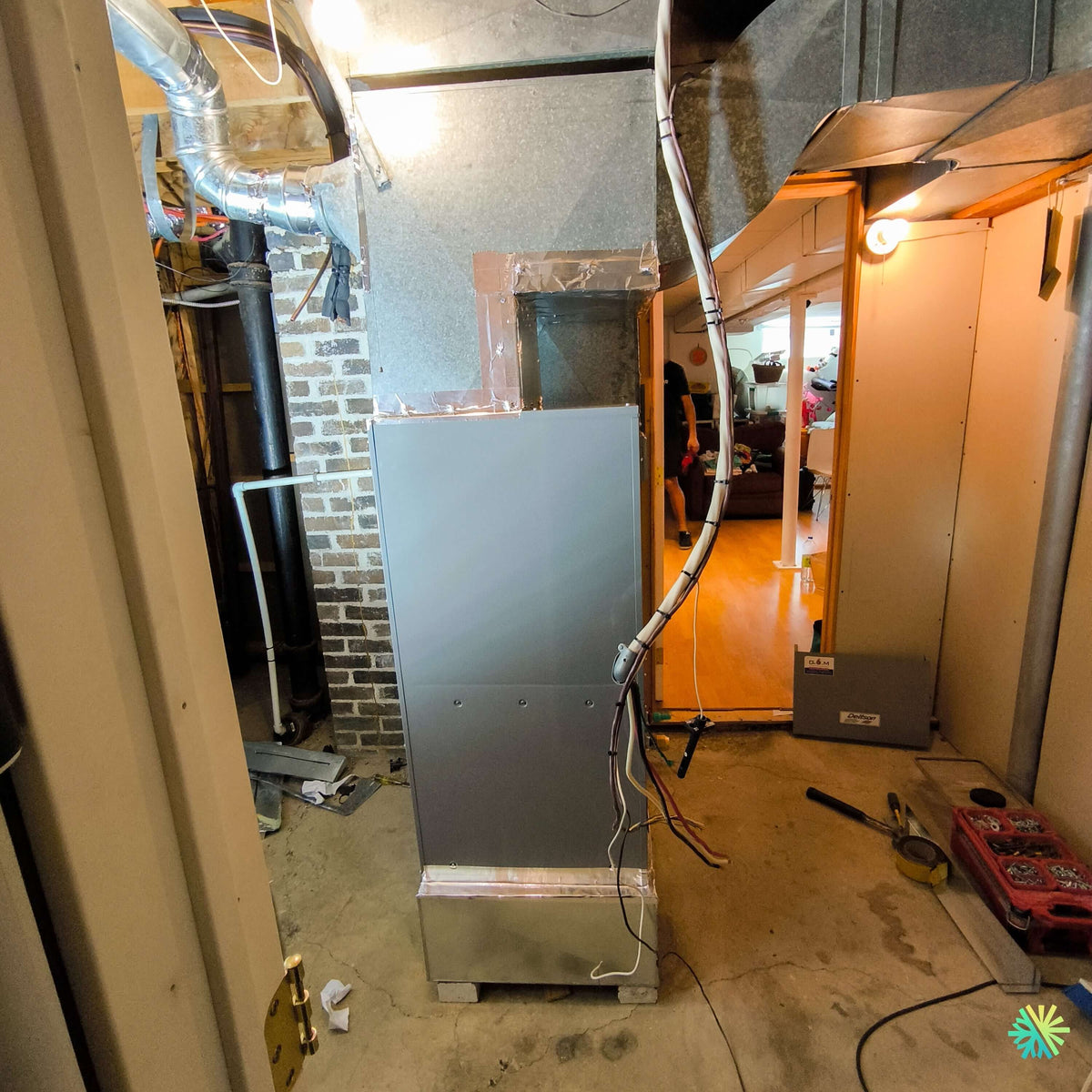
In the photo, you can clearly see the new central unit installed at the bottom of the plenum, with a metal transition above and a connection to the existing distribution network. The workspace is limited, surrounded by walls, ducts, wiring being organized, and an electrical panel nearby. This situation is common in Ville Mont-Royal, where many properties have older central systems, sometimes modified over time. In these homes, modernizing comfort does not necessarily mean starting from scratch. It is rather about building a smart solution around the existing infrastructure.
The GREE FLEXX is a particularly interesting option for homeowners who want to keep a central ducted system while improving their comfort and energy efficiency. Unlike a wall-mounted heat pump or a wall-mounted air conditioner, the Air Handler distributes air through the existing grilles in the house. The goal is to achieve a more uniform temperature in several rooms without adding visible wall units in living spaces.
In this project, the client wanted to modernize their central system while keeping the air distribution through ducts. Our team therefore worked with an integration approach: keep what could be preserved, adapt what needed to be, and install the new unit in a clean, safe, and accessible way for future HVAC maintenance.
Why a GREE FLEXX Air Handler was suitable for this house
Choosing a GREE FLEXX electric furnace Air Handler is relevant when a house already has a functional duct network. In this type of configuration, the installation allows for centralized distribution of heated or cooled air using the existing grilles. For a homeowner in Ville Mont-Royal, this represents a significant advantage: comfort is integrated into the home without altering the appearance of the main rooms.
The GREE FLEXX can be combined with a compatible outdoor unit to create a central system with a heat pump. Depending on the chosen configuration, the BTU capacity, energy performance, and eligibility for a subsidy must be confirmed based on the exact indoor/outdoor pair, the AHRI number, and the criteria in effect at the time of the project. At AirGreen, we avoid promising financial aid before this validation. We prefer to precisely verify the model, installed capacity, and applicable requirements so the client knows what to expect.
In this installation, the goal was not just to replace a mechanical component. It was necessary to ensure good air circulation, a reliable connection to the existing ducts, proper electrical compatibility, and sufficient accessibility for future interventions. These are the details that make the difference between an installation that simply works and one that works well.
What the photo reveals: a technical site in a real space
The photo shows a particularly telling stage of work. The unit is already positioned, the duct connections are in place, and several elements around the system are still visible during the installation phase. Notably, we see:
- a metal plenum connected above the unit;
- a transition to the existing duct network;
- round and rectangular ducts in a compact space;
- a brick wall and a typical basement structure of an older house;
- wiring being finalized;
- tools on the floor and mechanical elements nearby;
- an electrical panel located in the same technical area.
These details clearly explain why a central HVAC installation must be carefully planned. In a clear mechanical room, the installation is simpler. Here, every decision counts: the height of the unit, alignment with the ducts, front access, side clearance, wiring path, and the position of the connections.
An error of a few inches can complicate access to the service panel, create air restrictions, or make maintenance more difficult. Our technicians must therefore work precisely while taking into account the actual condition of the building.
The importance of duct transitions
In a central installation, the duct network is as important as the unit. A high-performance Air Handler cannot deliver good results if the air is restricted by a tight transition, a major leak, or poor alignment. In Ville Mont-Royal, we adapted the upper connection to properly link the new unit to the existing network.
This transition work requires experience. Unnecessary angles must be avoided, pressure losses reduced, and joints sealed to limit air leaks. A poorly sealed duct can send part of the conditioned air into the basement or an unused cavity instead of directing it to living spaces. This reduces comfort and increases consumption.
In homes in Montreal, Laval, Longueuil, the North Shore, and the South Shore, we often encounter ducts built at different times. Some have been modified during renovations, others adapted for an older unit, and many no longer perfectly meet current needs. A successful Air Handler installation must therefore start with a careful assessment of the existing system.
Electric furnace and central heat pump: a combination to understand well
The term electric furnace is often used by customers to refer to the central indoor unit that handles auxiliary heating and air circulation. In the case of a GREE FLEXX system, the Air Handler can be part of a more complete solution when paired with a compatible outdoor heat pump.
The principle is simple: the heat pump provides most of the heating and air conditioning, while the Air Handler ensures distribution through the ducts. Depending on the setup, electric elements can support heating during colder periods or when demand exceeds the heat pump’s capacity. This is a very popular approach in homes where you want to keep a central system while reducing reliance on an older, less efficient unit.
However, sizing must be done correctly. It is not enough to choose a device at random based on the size of the old furnace. One must consider the area, insulation, windows, number of floors, available airflow, electrical capacity, heat loss, and the configuration of the duct network.
The challenge of limited space in Ville Mont-Royal
Installations in the basements of Ville Mont-Royal often present a common constraint: the mechanical space was not designed for today's modern equipment. Older houses sometimes have low ceilings, beams, load-bearing walls, ducts added over time, and technical areas shared with storage.
In this installation, the unit's position had to allow:
- access to the front panel;
- clean connection to the plenum;
- safe passage of wiring;
- maintaining reasonable clearance around the unit;
- integration with the existing duct network;
- the possibility to perform HVAC maintenance without unnecessarily dismantling neighboring components.
This way of working is essential. A central system must be maintained: filters, electrical components, coils, condensate drain when applicable, connections, and performance checks. An installation that is too tight can become costly to maintain, even if it seems correct at first glance.
An installation designed for efficiency, access, and long-term comfort
The concrete benefits for the owner
For the client in Ville Mont-Royal, the new GREE FLEXX system brings a significant improvement in indoor comfort. Distribution through ducts allows multiple zones of the house to be treated without multiplying visible devices. The air circulates through the central network, which suits families looking for a discreet and integrated solution.
The main benefits are as follows:
- more uniform comfort in the served rooms;
- possibility of central air conditioning with a compatible outdoor unit;
- central heating managed by Air Handler;
- integration with existing ducts;
- reduction of clutter in living spaces;
- centralized maintenance in the mechanical room;
- modernization of an old system without major renovation of parts.
This type of installation is especially interesting for owners who hesitate between a wall air conditioner, a wall heat pump, and a central system. When ducts already exist and are usable, a central solution can offer a more discreet finish and better distributed airflow.
What we check before installing a central Air Handler
Before installing an electric furnace or an Air Handler, we check several technical points. This step is essential to avoid unpleasant surprises after the work.
We analyze in particular:
- required BTU capacity according to the building's actual needs;
- the condition of the duct network;
- available return air;
- the power supply;
- service clearances;
- compatibility with an outdoor unit;
- the thermostat and controls;
- the possibility to add or keep accessories;
- filtration options;
- eligibility criteria for a subsidy, when the complete system allows it.
This analysis is especially important in neighborhoods like Ville Mont-Royal, Outremont, Côte-des-Neiges, Notre-Dame-de-Grâce, and some older areas of Montreal, where houses have often been renovated in stages.
Mistakes to avoid in a central installation
A poorly executed central installation can cause problems that are difficult to fix later. Here are the mistakes we always try to avoid:
Installing without checking airflow
Airflow is fundamental. If the return is insufficient or the distribution too restrictive, the unit can become noisy, less efficient, or unable to maintain the desired comfort.
Neglecting duct joints
Air leaks around transitions reduce efficiency. Joints must be well sealed, especially in a basement where losses can go unnoticed.
Blocking access to components
A central unit needs space for maintenance. Installing the unit too close to a wall, panel, or other equipment complicates inspections and increases service time.
Choosing capacity based only on the old device
An old furnace is not always a good reference. The home's needs may have changed with insulation, windows, renovations, or room usage.
Forgetting the overall system compatibility
An Air Handler must operate with the right thermostat, the right fittings, the right outdoor unit, and an appropriate power supply. Performance depends on the whole system.
Why AirGreen places so much importance on mechanical finishing
In an installation like this, much of the work remains hidden after the project is completed. The ducts are closed up, wires are organized, panels are put back in place, and the client mainly sees the final device. Yet, it is the details behind this finish that ensure reliability.
At AirGreen, we pay special attention to the cleanliness of connections, the sturdiness of transitions, duct sealing, and future access. A clean installation also makes it easier to diagnose a problem if intervention becomes necessary several years later.
This attention to detail is an important part of our work in residential HVAC. Clients often look for the best device, but the device is only part of the equation. The quality of the installation directly affects comfort, noise, energy consumption, and the system’s lifespan.
A solution tailored to Ville Mont-Royal homeowners
Ville Mont-Royal has several homes where owners want to improve their comfort without compromising the interior character of their residence. A central solution like the GREE FLEXX meets this expectation well. It allows for discreet duct distribution, modernizes the mechanical system, and prepares the home for better energy efficiency.
In many cases, clients call us because their old system no longer meets current needs. Some rooms remain too hot in summer, others are hard to heat, or the existing system becomes too expensive to operate. Installing a central Air Handler, when properly sized and well integrated, can fix many of these problems.
We also carry out similar projects in Laval, Longueuil, on the North Shore and the South Shore, in homes where owners want to keep their ducts while upgrading to newer technology. Each project is different, but the same principles always apply: thorough analysis, selection of suitable equipment, clean installation, and clear support.
Recommended maintenance after installation
After installing a GREE FLEXX central system, a few simple practices help preserve performance:
- replace or clean filters according to the recommended frequency;
- keep the space around the unit clear;
- avoid storing objects against service panels;
- have the system checked before periods of high demand;
- monitor any changes in noise, airflow, or performance;
- schedule periodic HVAC maintenance with a qualified team.
These actions are simple, but they extend the equipment's lifespan and reduce the risk of unexpected service.
A lasting result for a modern central system
This installation of a GREE FLEXX electric Air Handler furnace in Ville Mont-Royal clearly shows the value of work adapted to the building. The unit was integrated into a tight space, connected to the existing duct network, and installed with particular attention to access, airflow, and durability.
For homeowners evaluating different options for a heat pump, wall air conditioner, central system, or electric furnace replacement, this project illustrates an important reality: the best solution is not always the one that seems simplest on paper. In a home with ducts, a central Air Handler can offer an excellent balance between comfort, discretion, and performance, provided the installation is carried out with rigor.
AirGreen supports homeowners in Montréal, Laval, Longueuil, the North Shore, and the South Shore in this type of project, with an approach based on analysis, installation quality, and transparency. In Ville Mont-Royal, this project confirms that a well-modernized central system can transform the comfort of a home while respecting its existing layout.
How it goes, from the first call to the end
The main steps of this kind of job at AirGreen. Every house has its quirks: the estimate brings them out.
We look at the ducts, the current indoor module, the electrical panel and the planned spot for the outdoor unit.
The equipment combination, capacity and price, in writing. We check whether the combination qualifies for assistance programs.
Access protected, old unit disconnected and removed when it is being replaced.
Electric furnace or air handler, with its coil, connected to the supply and return ducts.
On a level base, raised above the snow, with free space all around.
Insulated, they enter through a sealed opening and run to the indoor coil.
Dedicated circuits, accessible disconnect, a thermostat that works with the heat pump and the backup heat.
Leak test, vacuum, start-up, airflow check and a test of both modes.
Filter, thermostat, backup heat in extreme cold: what to know before winter.
- The on-site estimateWe look at the ducts, the current indoor module, the electrical panel and the planned spot for the outdoor unit.
- The quoteThe equipment combination, capacity and price, in writing. We check whether the combination qualifies for assistance programs.
- Getting readyAccess protected, old unit disconnected and removed when it is being replaced.
- The indoor moduleElectric furnace or air handler, with its coil, connected to the supply and return ducts.
- The outdoor unitOn a level base, raised above the snow, with free space all around.
- The refrigerant linesInsulated, they enter through a sealed opening and run to the indoor coil.
- Electrical and thermostatDedicated circuits, accessible disconnect, a thermostat that works with the heat pump and the backup heat.
- Tests and start-upLeak test, vacuum, start-up, airflow check and a test of both modes.
- The walkthroughFilter, thermostat, backup heat in extreme cold: what to know before winter.
And at your place?
Two quick checks with real numbers: what heat costs, and what your current heaters add up to in BTU/h.
Conversion: 1 W = 3.412 BTU/h. An indication, not a load calculation: baseboards and furnaces are often stronger than the real need, and they can stay as backup. AirGreen confirms the capacity on site.
What to do, season by season
Three habits per season for this unit. They take a few minutes and prevent many calls.
- Check the indoor module's filter.
- Clear winter debris from the outdoor unit.
- Test cooling before the heat arrives.
- Check the filter more often in peak season.
- Keep registers and returns clear.
- Watch condensate drainage near the coil.
- Change or clean the filter.
- Test heating and backup heat before the cold.
- Book periodic maintenance.
- Clear snow around the outdoor unit.
- Store nothing in front of the indoor module.
- Note any unusual noise or smell and call us.
Which type of equipment for your project?
Pick what looks like your need.
Four mistakes we do not make
Flip each card to see what we do instead.
What people ask us about this kind of work
Can I keep my current ducts?
What happens in extreme cold?
Furnace, air handler, ducted: what is the difference?
Are there grants?
Do I need a permit?
How much can I save?
How is the LogisVert assistance calculated?
Will my current thermostat work?
Central or wall units: which one?
Does AirGreen hold the required licences?
Is the estimate free?
No question matches. Write to us: we answer.
Useful pages for what comes next
More jobs to see, near you
By town, by equipment or by region: browse more than 4,700 published projects.
Each dot: a town where AirGreen has published projects. The glowing dot: this job.
Tell us about your house. We come and see it for free.
The on-site estimate is free and the quote follows within 24 hours.
Text and photo: a real AirGreen Climatisation & Chauffage job. The diagrams are generic illustrations of the type of installation, not a survey of this job site. Sources of the added figures: airgreen.ca product pages (NEEP / AHRI performance), Hydro-Québec (Heat pumps page, LogisVert, read on 13 October 2026), Régie de l’énergie (rate D as of 1 April 2026).