
Installation of a MIDEA EVOX G3 5-ton electric furnace with central air handler system in Pont-Viau, Laval
AirGreen installs a 5-ton MIDEA EVOX G3 electric furnace in Pont-Viau, Laval, with a central Air Handler system, clean drainage, and professional HVAC finishing.
- City
- Region
- Equipment
- Brand
- Challenges
- Published
The job on one screen
The article, chapter by chapter
A central installation designed for stability, clean drainage, and long-term performance
In Pont-Viau, in the Laval area, our AirGreen team installed a 5-ton MIDEA EVOX G3 electric furnace, integrated into a central Air Handler system. This type of equipment is designed to ensure uniform air distribution throughout the property, with particular attention to connection quality, duct sealing, condensate drainage, and future accessibility for HVAC maintenance.
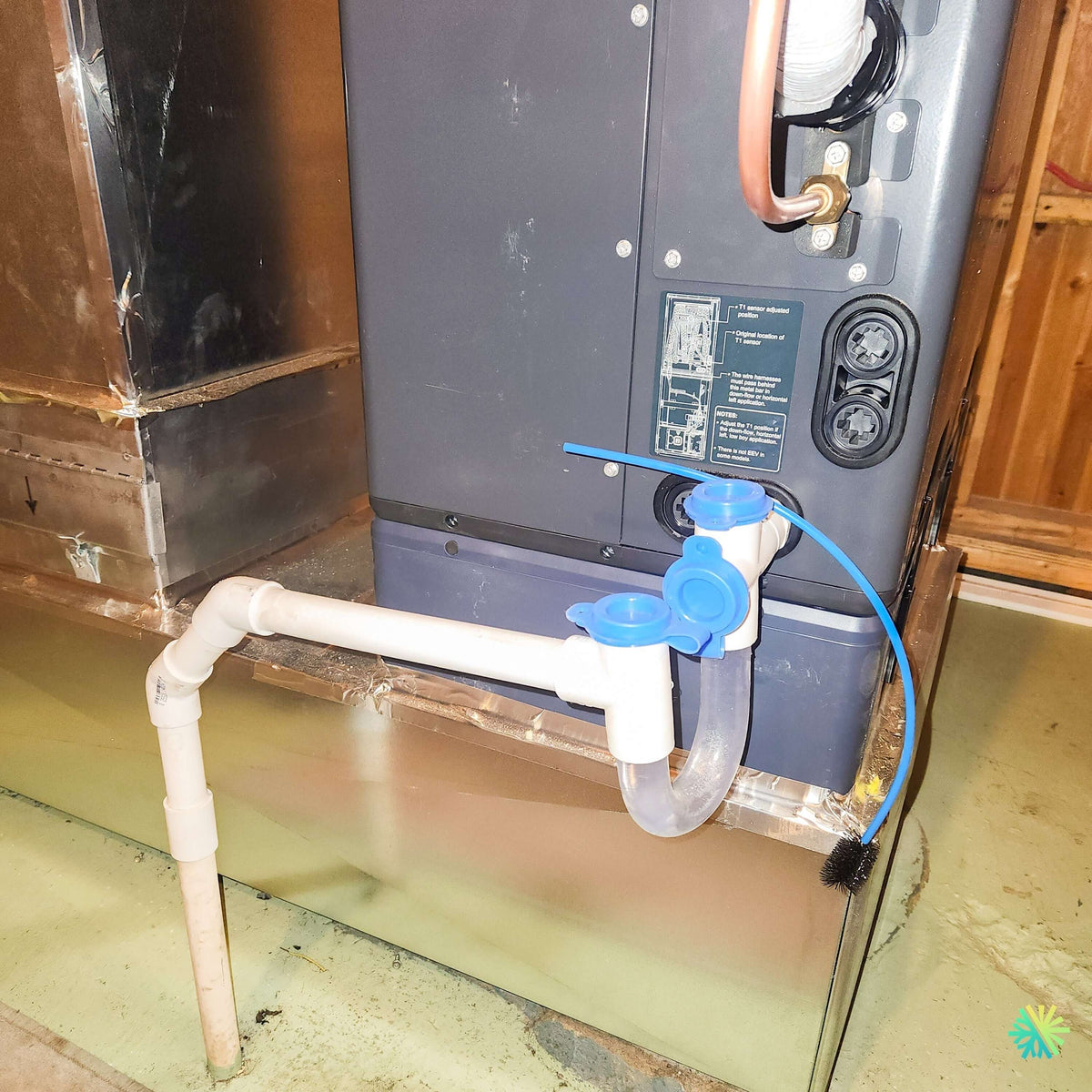
In this installation, one of the most visible elements is the care taken with the drainage system. The photo shows a clean setup with PVC piping, an accessible clean-out trap, a transparent trap section, and integrated cleaning brushes. This detail may seem secondary to a homeowner, but it plays a major role in the system's reliability. A poorly designed drain can cause backups, safety shutdowns, odors, excessive humidity, or even water damage.
At AirGreen, we know that a successful HVAC installation isn't just about placing a machine in the right spot. It must be conceived as a complete system: appliance, ducts, electrical supply, exhaust, service access, calibration, and finishing.
Why a 5-ton MIDEA EVOX G3 for this project in Pont-Viau?
The 5-ton MIDEA EVOX G3 is a central solution suitable for properties requiring significant airflow. In a neighborhood like Pont-Viau, where there are many homes with existing central systems, compact mechanical basements, and established duct networks, integrating an Air Handler requires a thorough site assessment.
This installation primarily aimed to provide:
- better air distribution throughout the property;
- a solution compatible with a central system;
- a 5-ton capacity, adapted to the building's heating and cooling needs;
- a clean and accessible installation for future maintenance;
- reliable condensate management;
- a professional finish around the unit and connections.
The MIDEA brand is gaining increasing importance in the residential HVAC market in Quebec. For many clients in Montreal, Laval, Longueuil, the North Shore, and the South Shore, it represents an interesting option when the project requires a good balance of performance, cost, parts availability, and modern technology.
A narrow mechanical room: precision is mandatory
The image shows a relatively tight mechanical space, with existing ducts in close proximity, wooden walls, a metal base, and the unit installed near a return air duct. This type of configuration requires precise execution. Each connection must be positioned so as not to block access to service panels, maintenance ports, and internal components.
During the installation of an electric furnace or a central Air Handler, we pay particular attention to several points:
-
Alignment with existing ducts
A poorly adjusted transition can create pressure losses, noise, or uneven air distribution. -
Access to service panels
A unit installed too close to an obstacle makes maintenance longer, more costly, and sometimes incomplete. -
Condensate drainage
The trap must be well-positioned, accessible, and cleanable. -
Sealing of connections
Air leaks in a basement or mechanical room reduce the overall efficiency of the system. -
Mechanical stability
A solid base limits vibrations and protects connections long-term.
The detail that changes everything: an accessible and cleanable drain
On this installation in Pont-Viau, the drainage system deserves special attention. The visible setup includes a clean-out trap with blue covers, a transparent section for quick visual inspection, and an immediate cleaning brush.
This choice is very practical for the homeowner and for our technicians during future maintenance. In a central system, especially when air conditioning produces condensate in the warm season, the drain can accumulate dust, biofilm, residues, or deposits. When the system is difficult to clean, the risk of blockage increases.
With a well-thought-out configuration, maintenance becomes simpler:
- quick inspection of the trap;
- direct access to the cleaning point;
- reduced risk of obstruction;
- faster diagnosis in case of a safety shutdown;
- better prevention of water leaks.
This is exactly the type of detail that distinguishes a standard installation from a durable one.
A clean installation around an existing network
In central replacement or integration projects in Laval, it is common to have to work with an existing duct network. Here, the connection had to respect the existing configuration without compromising the performance of the new 5-ton MIDEA EVOX G3.
Our team worked with a methodical approach: checking clearances, ensuring alignment, limiting stress on connections, and protecting access to important components. In this type of project, speed should never take precedence over the quality of assembly. A small error in the drain's inclination, in the air transition, or in panel access can have consequences for several years.
What homeowners often forget with a central system
When a client shops for an electric furnace, a central heat pump, or an Air Handler, they often focus on the brand, price, and tonnage capacity. These elements are important, but they are not enough. The quality of the installation plays just as important a role as the machine itself.
Here are some common mistakes we see in central installations:
- choosing capacity without analyzing the duct network;
- neglecting condensate drainage;
- blocking access to filters or service panels;
- forgetting the importance of return air;
- installing the unit without checking the condition of existing ducts;
- using improvised connections;
- not planning for future maintenance.
In this project in Pont-Viau, our work specifically involved preventing these issues from the outset. A well-designed installation not only improves comfort but also reduces unnecessary service calls.
Why the 5-ton capacity must be taken seriously
A 5-ton central unit is not a small appliance. It must move a significant volume of air. This means that the ducts, return air, filter, static pressure, and connections must be compatible with this capacity.
A system that is too powerful for a poorly adapted network can become noisy, uncomfortable, or inefficient. Conversely, a well-integrated system can offer excellent comfort in different areas of the house. This is why our AirGreen installations are always based on a complete assessment of the existing configuration.
In Greater Montreal, we often work on properties where the ducts have been modified over the years. Some additions have been made quickly, some return air ducts are insufficient, some basements have been renovated around the HVAC equipment. Our role is to adapt the installation to the reality of the building, not just to the technical specifications of the appliance.
The importance of maintenance after installation
A quality HVAC installation must also facilitate maintenance. On this MIDEA EVOX G3 in Pont-Viau, access to the drain, service panel, and visible connections has been maintained logically. This makes future interventions simpler.
For a central system, we generally recommend paying attention to:
- the filter's condition;
- the cleanliness of the condensate drain;
- the absence of water around the unit;
- unusual noises;
- the quality of airflow at the registers;
- periodic maintenance of the central system.
A homeowner who properly maintains their system protects their investment. A contractor who correctly installs the system makes this maintenance possible.
Local expertise for Laval, Montreal, Longueuil, North Shore, and South Shore
AirGreen regularly undertakes projects involving electric furnaces, central heat pumps, central air conditioners, Air Handlers, and complete HVAC systems in Montreal, Laval, Longueuil, on the North Shore, and the South Shore. Each area has its specific characteristics: older buildings, condos, single-family homes, duplexes, restricted mechanical spaces, difficult access, or existing ducts that need correction.
In Pont-Viau, this installation perfectly illustrates our approach: a suitable machine, clean execution, well-designed drainage, and attention to detail that makes the client's life easier after we leave.
Subsidies and eligibility: a point to check based on the complete configuration
For central systems, eligibility for certain subsidies generally depends on the entire installed configuration, exact model numbers, indoor/outdoor combination, recognized performance, and criteria in force at the time of application. In the case of a 5-ton MIDEA EVOX G3, it is therefore essential to validate the complete system information before confirming eligibility.
At AirGreen, we assist our clients with this verification when the project includes an eligible central heat pump or a combination recognized by available programs. We avoid vague promises: we prefer to confirm technical data, exact models, and applicable program requirements.
What this installation demonstrates
This achievement in Pont-Viau demonstrates that a good HVAC project relies on concrete details. Quality is evident in the alignment of the unit, the logic of the drainage, access to components, and the cleanliness of connections. These elements influence daily comfort, reliability, and ease of maintenance.
A 5-ton MIDEA EVOX G3 electric furnace can provide an excellent foundation for a high-performance central system, but it's the installation that transforms the equipment into a durable solution. This is precisely AirGreen's philosophy: to install with rigor, explain clearly, plan for maintenance, and adapt each project to the actual building.
A successful central installation always begins with the right details
For this project in Pont-Viau, Laval, our team installed a 5-ton MIDEA EVOX G3 with particular attention to drainage, connections, and accessibility. The photo shows a simple, clean, and functional installation, where each element has been placed to serve the system's performance and facilitate its maintenance.
In a market where many clients compare prices, brands, and deadlines, we always remind them: the choice of contractor is as important as the choice of machine. A central installation requires experience, method, and a complete understanding of the building.
At AirGreen, we carry out HVAC installations designed to last, whether in Laval, Montreal, Longueuil, on the North Shore, or the South Shore.
The job tools
Two quick checks with real numbers: what heat costs, and what your current heaters add up to in BTU/h.
Conversion: 1 W = 3.412 BTU/h. An indication, not a load calculation: baseboards and furnaces are often stronger than the real need, and they can stay as backup. AirGreen confirms the capacity on site.
How the job unfolds
The main steps of this kind of job at AirGreen. Every house has its quirks: the estimate brings them out.
We look at the ducts, the current indoor module, the electrical panel and the planned spot for the outdoor unit.
The equipment combination, capacity and price, in writing. We check whether the combination qualifies for assistance programs.
Access protected, old unit disconnected and removed when it is being replaced.
Electric furnace or air handler, with its coil, connected to the supply and return ducts.
On a level base, raised above the snow, with free space all around.
Insulated, they enter through a sealed opening and run to the indoor coil.
Dedicated circuits, accessible disconnect, a thermostat that works with the heat pump and the backup heat.
Leak test, vacuum, start-up, airflow check and a test of both modes.
Filter, thermostat, backup heat in extreme cold: what to know before winter.
- The on-site estimateWe look at the ducts, the current indoor module, the electrical panel and the planned spot for the outdoor unit.
- The quoteThe equipment combination, capacity and price, in writing. We check whether the combination qualifies for assistance programs.
- Getting readyAccess protected, old unit disconnected and removed when it is being replaced.
- The indoor moduleElectric furnace or air handler, with its coil, connected to the supply and return ducts.
- The outdoor unitOn a level base, raised above the snow, with free space all around.
- The refrigerant linesInsulated, they enter through a sealed opening and run to the indoor coil.
- Electrical and thermostatDedicated circuits, accessible disconnect, a thermostat that works with the heat pump and the backup heat.
- Tests and start-upLeak test, vacuum, start-up, airflow check and a test of both modes.
- The walkthroughFilter, thermostat, backup heat in extreme cold: what to know before winter.
What we check on a job like this one
Each number is a point we check on site. Switch between summer and winter to watch air and heat move.
In summer, the outdoor unit rejects the house's heat outside.
Generic illustration of this type of installation, not a survey of this job site. Tap a number.
It captures or rejects heat outside. It sits on a level base, above the snow, with free space all around.
The insulated refrigerant lines enter the house through a sealed opening and run to the indoor coil.
A shut-off switch near the outdoor unit isolates it safely for service.
Sitting on the indoor module, it moves heat between the house air and the refrigerant.
Electric furnace or air handler: its fan pushes air through the ducts. The electric backup takes over in extreme cold.
Supply ducts bring air to the rooms; returns bring it back to the unit. Their condition matters as much as the unit's.
It protects the coil and the fan. A dirty filter cuts airflow, so it gets checked regularly.
It runs the heat pump and the backup heat. It must be compatible with the installed system.
Is your home ready?
Check what applies at your place. A "no" is not a refusal: it is what we sort out during the estimate.
Good habits, once the unit is in place
Six simple habits that keep the unit going. Your list stays on this device.
What to do, season by season
Three habits per season for this unit. They take a few minutes and prevent many calls.
- Check the indoor module's filter.
- Clear winter debris from the outdoor unit.
- Test cooling before the heat arrives.
- Check the filter more often in peak season.
- Keep registers and returns clear.
- Watch condensate drainage near the coil.
- Change or clean the filter.
- Test heating and backup heat before the cold.
- Book periodic maintenance.
- Clear snow around the outdoor unit.
- Store nothing in front of the indoor module.
- Note any unusual noise or smell and call us.
The right pages, at the right time
Four statements: true or false?
It all comes down to details you have just seen.
1. A central heat pump uses the house's ducts.
It connects to the existing ducts to heat and cool everywhere.
2. In extreme cold, electric backup heat can take over.
The indoor module (furnace or air handler) works with the heat pump and takes over in extreme cold.
3. The filter only gets changed when the unit breaks down.
A dirty filter cuts airflow. It gets checked regularly.
4. You can reuse the old unit's size without checking.
The house may have changed: insulation, windows, added rooms. Capacity is confirmed on site.
0 / 4 right answers
What people ask us about this kind of work
Can I keep my current ducts?
What happens in extreme cold?
Furnace, air handler, ducted: what is the difference?
Are there grants?
Do I need a permit?
How much can I save?
How is the LogisVert assistance calculated?
Will my current thermostat work?
Central or wall units: which one?
Does AirGreen hold the required licences?
Is the estimate free?
No question matches. Write to us: we answer.
More jobs to see, near you
By town, by equipment or by region: browse more than 4,700 published projects.
Each dot: a town where AirGreen has published projects. The glowing dot: this job.
An on-site estimate, the right capacity, the right equipment.
The on-site estimate is free and the quote follows within 24 hours.
Text and photo: a real AirGreen Climatisation & Chauffage job. The diagrams are generic illustrations of the type of installation, not a survey of this job site. Sources of the added figures: airgreen.ca product pages (NEEP / AHRI performance), Hydro-Québec (Heat pumps page, LogisVert, read on 13 October 2026), Régie de l’énergie (rate D as of 1 April 2026).