
Installation of a Fujitsu wall-mounted heat pump in Villeray–Saint-Michel–Parc-Extension
AirGreen installs a Fujitsu wall-mounted heat pump in Villeray–Saint-Michel–Parc-Extension, with a condensate pump, discreet drainpipe, and clean finishes. Four-season comfort and HVAC maintenance for Montreal, Laval, Longueuil, North Shore, and South Shore.
Take a tour of the installation
Each number is a point we check on site. Switch between summer and winter to watch air and heat move.
In summer, the outdoor unit rejects the house's heat outside.
Generic illustration of this type of installation, not a survey of this job site. Tap a number.
Mounted level on a wall plate, high enough for the air to reach the whole room, with enough space around it to slide the filters out easily.
The refrigerant lines, the communication cable and the drain go through the wall in a single opening, sealed against water, cold air and insects.
Two insulated copper pipes connect the two units. Outside, a line cover can protect them from sun, knocks and weather.
A shut-off switch near the outdoor unit isolates it safely for service. It must stay accessible at all times.
The compressor and the fan. In heating mode it captures heat from the outdoor air, even in winter, and moves it inside.
On the ground or on the wall, it keeps the unit above accumulated snow. The unit stays clear and defrost water can drain away.
The fan needs to blow freely. Storage, a fence or a wall too close, and efficiency drops while noise goes up.
A precise HVAC project in a Montreal apartment where every centimeter counts
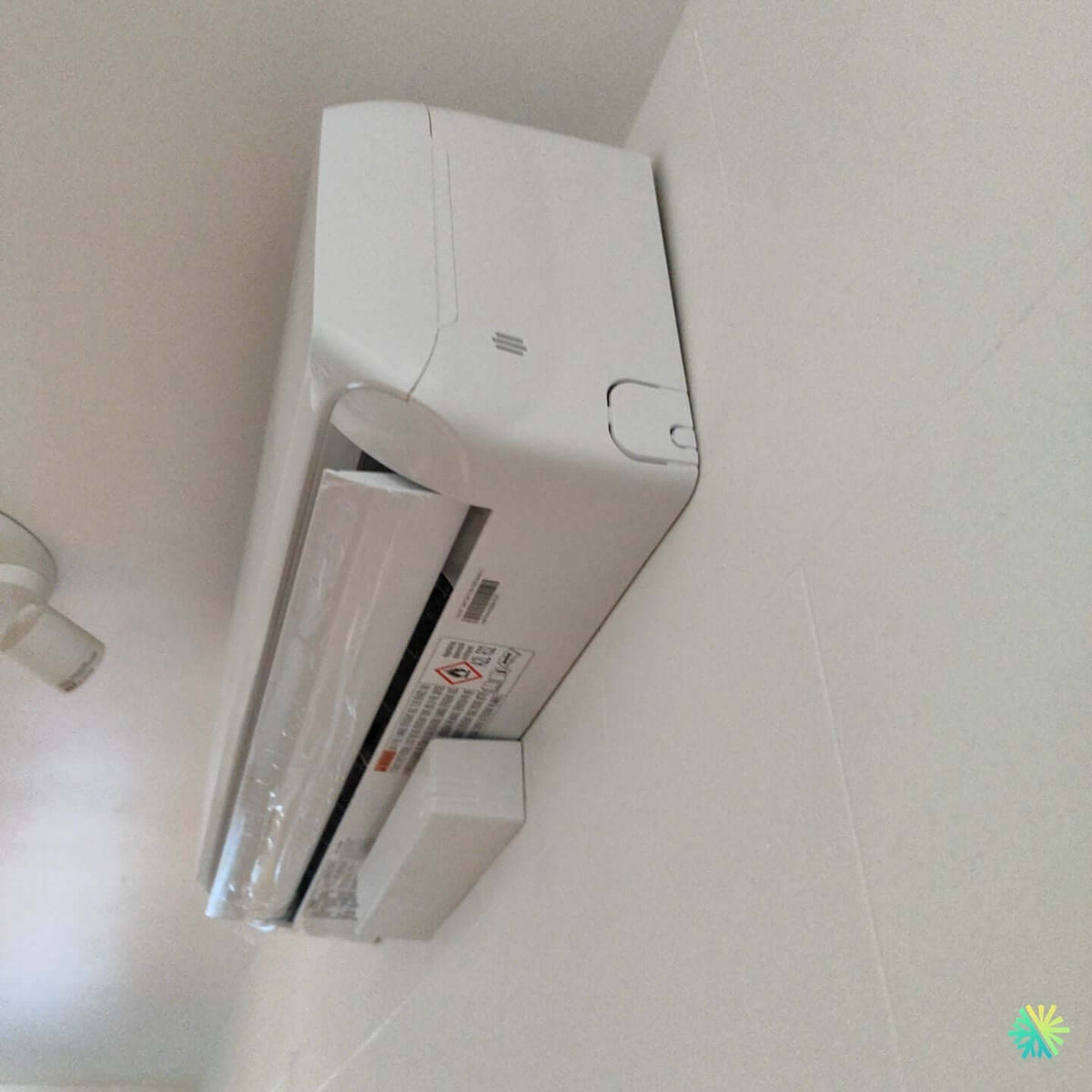
In a home in Villeray–Saint-Michel–Parc-Extension , we are installing a Fujitsu wall-mounted heat pump for a client who wants 4-season comfort, controlled operating costs and clean integration into a space with recently finished walls. The context requires working as close as possible to the ceiling , with discreet routing of connections and condensate evacuation by pump - a common technical choice when a gravity slope is impossible.
The need: stable heat in winter, coolness in summer, without compromising on aesthetics
The client lives in a well-insulated apartment with a south/west exposure. Summer solar gains increase the sensible load in the late afternoon, while the Montreal winter requires reliable heating despite the low temperatures. He prefers a single-zone wall unit of around 9,000 to 12,000 BTU , sufficient for an open living room-kitchen space of approximately 35 to 45 m², while maintaining a minimal visual footprint .
Analysis of location and site constraints
-
Reduced height above the unit : the head is installed very close to the finished ceiling. We respect the manufacturer's required clearances to ensure air intake and avoid any hot/cold recirculation against the ceiling.
-
Right-hand passage : the side access cover and the connection outlet are positioned on the right-hand side, which allows for a short, direct exit to the outside.
-
Drainage by gravity impossible : the absence of a continuous slope on the exterior side leads us to integrate a compact condensate lifting pump , fixed under the hull, with an insulated discharge tube to avoid parasitic condensation in the interior plenum.
-
Wall finish : fresh paint and clean lines. We opted for a low-projecting white chute for the short interior downspout, followed by a aligned exterior passageway, to provide a clean aesthetic and facilitate maintenance.
Equipment selection and performance parameters
-
Brand : Fujitsu — recognized for the reliability of wall units adapted to the Quebec climate.
-
Type : wall-mounted inverter heat pump (mini-split).
-
Target capacity : 12,000 BTU (typical modulating range 3,000–12,000 BTU depending on load).
-
Efficiency : High SEER2 and HSPF2, low temperature heating mode to maintain comfort during cold spells.
-
Refrigerant : low GWP fluid (A2L type safety label visible on the head), helping to reduce the carbon footprint compared to previous generations.
-
Acoustics : modulated fan speed; at cruising speed, the interior noise level remains low, ensuring comfort in an apartment.
In practice, inverter modulation maintains the target temperature without frequent cycles, which reduces consumption and improves comfort stability compared to all-or-nothing units.
Installation Steps — AirGreen Method
-
Preparation and tracing
-
Locating the amounts and checking the clearances.
-
Exact tracing of the mounting plate template so that the unit aligns perfectly with the interior architectural references (joint lines, plumb walls).
-
-
Piercing and processing of the envelope
-
Making the through hole with a slight outward slope; inserting a waterproof sleeve to protect the insulation and the finish.
-
Air barrier control and sealed caulking (compatible mastic) to prevent any air or moisture infiltration.
-
-
Installing the wall head
-
Hooking and locking the head; test opening the blower flap to ensure it does not rub under the ceiling.
-
Communication and power cable management with bend radius respected and retaining clamps.
-
-
Refrigeration connections
-
Flares calibrated to torque; application of compatible POE oil; verification of faces to eliminate the risk of micro-leaks.
-
Continuous insulation (closed cell) on the suction line; clean taping; ducting.
-
-
Condensate pump
-
Installation of the compact sub-sump pump (housing visible under the head in the photo).
-
Installation of the level sensor , float testing and routing of the discharge with collars; priming and extended testing in cooling mode to validate the flow rate and sealing.
-
-
Pressurization and testing
-
Deep vacuum (≤ 500 microns), leak test and time delay to confirm stability.
-
Opening valves, checking superheat/subcooling , checking simulated defrost and drainage .
-
-
Finishes
-
Installation of hoods, white trunking matching the wall, clean joints.
-
Explanations to the customer on maintenance and remote control (modes, temperatures, dehumidification, speeds).
-
Why the condensate pump is the right solution here
In apartments where the outlet wall is far away or where the architecture prevents a continuous slope , the condensate pump prevents overflows and preserves interior finishes . Our practice consists of:
-
select a low vibration and low noise model,
-
add a vibration damper between the housing and the wall,
-
provide an anti-siphon on the discharge line,
-
facilitate access for maintenance (annual cleaning, float check).
This approach ensures reliable drainage even in prolonged cooling conditions during heat waves.
Result: consistent comfort and neat aesthetics
-
Clear airflow under the ceiling: the air stream extends along the length of the room, improving mixing and limiting hot layers.
-
Silence : low mode remains discreet, compatible with teleworking and sleeping.
-
Finish : the linear chute and the white tint make the whole thing almost invisible in the decor.
-
Maintenance : accessible filters; the pump has a simple service point (hatch under the housing).
Grants and Compliance
High-performance wall-mounted heat pumps installed by AirGreen are generally eligible for local programs when efficiency criteria are met. We assist our clients in Montreal, Laval and Longueuil , as well as the North Shore and South Shore , in verifying eligibility , preparing documents and scheduling inspections when applicable. Our installations follow HVAC best practices and safety requirements related to modern low-GWP refrigerants.
Tips for use and maintenance to maintain performance
-
Target temperature : maintain a reasonable difference with the outside to promote modulation and avoid overconsumption.
-
Sunny end of day : anticipate by starting the cooling mode earlier, the machine then operates at a very efficient low speed .
-
Intense cold : leave the heat pump on continuously ; automatic defrosting optimizes heat exchange.
-
Filters : bi-monthly cleaning during peak periods; annual professional inspection (pressure switches, connections, draining and pump test).
-
Winterization : If the accommodation is unoccupied, leave a minimum temperature to protect the materials and avoid extreme cycles when restarting.
What our teams bring in addition
-
Rigorous layout so that the head fits under the ceiling to the nearest millimeter.
-
Clean welding and controlled tightening torques; traceability of leak tests .
-
Complete support : choice of capacity, positioning, options (filters, Wi-Fi, pumps), after-sales service and HVAC maintenance throughout Greater Montreal.
At AirGreen , HVAC installation is never a simple mechanical installation. It is a precision job that combines thermal, acoustic and design , especially when space imposes tight constraints. This intervention in Villeray–Saint-Michel–Parc-Extension illustrates our way of working: clean, methodical and sustainable .
Key points to remember for a similar project
-
When gravity slope is not possible, the condensate pump becomes essential.
-
The closer the head is to the ceiling , the more carefully the clearances and blowing axis must be checked.
-
A properly sized chute protects connections and simplifies future interventions.
-
Selecting a modulating wall-mounted heat pump adapted to the actual load guarantees savings and comfort all year round.
For an apartment, condo or plex in Montreal, Laval, Longueuil, on the North Shore or the South Shore, our team advises, installs and maintains reliable and discreet HVAC solutions.
The big day, step by step
The main steps of this kind of job at AirGreen. Every house has its quirks: the estimate brings them out.
We look at the room, the outside wall, the line route and where the outdoor unit will go. That is where the capacity gets chosen.
Model, capacity and price, in writing. We also check whether the model qualifies for assistance programs.
Floors and furniture protected, wall plate position marked level, wall opening located.
A single opening, with the slope the drain needs to flow outside.
Set on a stand raised above the snow, with the clearances the manufacturer requires.
Connected, insulated and protected. The opening is then sealed against water, cold air and insects.
A dedicated circuit and an accessible disconnect near the outdoor unit.
Leak test, vacuum, then start-up and a check of heating and cooling.
Remote, modes, filters: we show you the essentials before we leave.
- The on-site estimateWe look at the room, the outside wall, the line route and where the outdoor unit will go. That is where the capacity gets chosen.
- The quoteModel, capacity and price, in writing. We also check whether the model qualifies for assistance programs.
- Getting readyFloors and furniture protected, wall plate position marked level, wall opening located.
- The wall openingA single opening, with the slope the drain needs to flow outside.
- The outdoor unitSet on a stand raised above the snow, with the clearances the manufacturer requires.
- Lines, cable and drainConnected, insulated and protected. The opening is then sealed against water, cold air and insects.
- The electrical workA dedicated circuit and an accessible disconnect near the outdoor unit.
- Tests and start-upLeak test, vacuum, then start-up and a check of heating and cooling.
- The walkthroughRemote, modes, filters: we show you the essentials before we leave.
What would it look like at your place?
Two quick checks with real numbers: what heat costs, and what your current heaters add up to in BTU/h.
Conversion: 1 W = 3.412 BTU/h. An indication, not a load calculation: baseboards and furnaces are often stronger than the real need, and they can stay as backup. AirGreen confirms the capacity on site.
Four mistakes we do not make
Flip each card to see what we do instead.
Your own project, step by step
What to do, season by season
Three habits per season for this unit. They take a few minutes and prevent many calls.
- Clean the indoor unit's filters.
- Clear leaves and debris left on the outdoor unit by winter.
- Test cooling before the first hot days.
- Clean the filters more often when the unit runs a lot.
- Keep plants away from the outdoor unit.
- Check that no water drips from the indoor unit.
- Rake the leaves around the outdoor unit.
- Test heating before the first cold days.
- Book periodic maintenance before winter.
- Keep snow away from the stand and the front of the unit.
- Let the unit defrost: it is normal.
- Never hit the ice on the fins; call us if the unit stays iced up.
Is your home ready?
Check what applies at your place. A "no" is not a refusal: it is what we sort out during the estimate.
Four statements: true or false?
It all comes down to details you have just seen.
1. In heating mode, the outdoor unit can produce water.
During defrost cycles. That water must drain away without forming ice.
2. You pick the capacity with a simple square-footage rule.
Windows, insulation, orientation and how the room is used all count. Capacity is chosen on site.
3. A multi-zone connects several indoor heads to a single condenser.
One head per room, all on the same condenser. Each room keeps its own temperature.
4. The disconnect can sit behind the patio furniture.
It must stay accessible: it is what shuts the unit off for service.
0 / 4 right answers
What people ask us about this kind of work
Does a wall-mounted heat pump heat in winter?
Wall-mounted or multi-zone: how do I choose?
Where does the outdoor unit go?
Are there grants?
Do I need a permit?
How cold can it heat?
How much can I save?
How is the LogisVert assistance calculated?
Is it noisy?
The outdoor unit is covered in ice: is that normal?
Does AirGreen hold the required licences?
Is the estimate free?
No question matches. Write to us: we answer.
More jobs to see, near you
By town, by equipment or by region: browse more than 4,700 published projects.
Each dot: a town where AirGreen has published projects. The glowing dot: this job.
Every house has its constraints. We see them before we install.
The on-site estimate is free and the quote follows within 24 hours.
Text and photo: a real AirGreen Climatisation & Chauffage job. The diagrams are generic illustrations of the type of installation, not a survey of this job site. Sources of the added figures: airgreen.ca product pages (NEEP / AHRI performance), Hydro-Québec (Heat pumps page, LogisVert, read on 13 October 2026), Régie de l’énergie (rate D as of 1 April 2026).