
Installation of a Goodman wall-mounted heat pump in Le Sud-Ouest
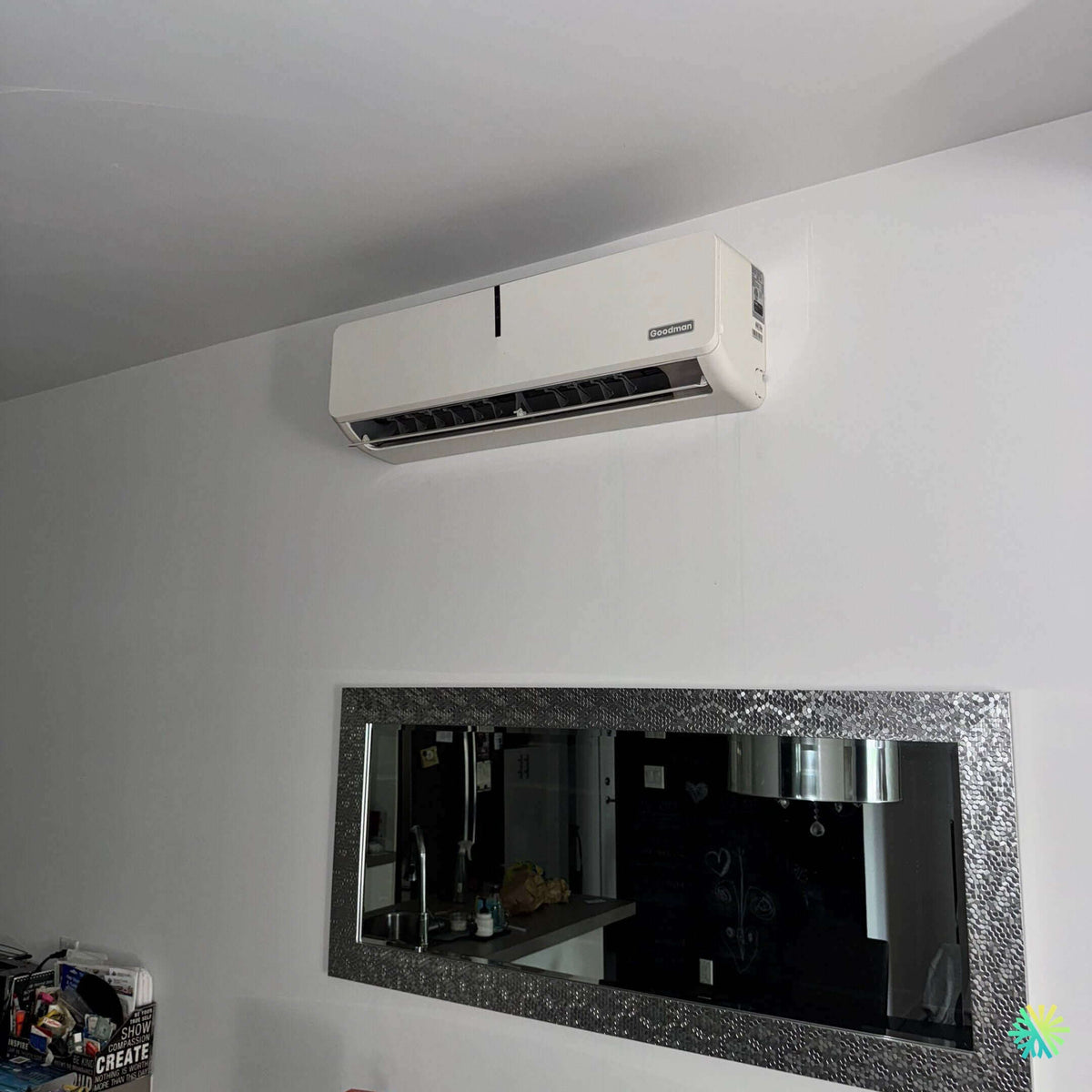
Installation of a Goodman wall-mounted heat pump in Le Sud-Ouest: short cooling path, gravity drain, and meticulous finishing. AirGreen delivers four-season comfort throughout Greater Montreal.
- City
- Region
- Equipment
- Brand
- Challenges
- Published
The job on one screen
The article, chapter by chapter
A careful HVAC modernization in a Montreal condo
At AirGreen , we regularly work in condominiums in Southwest Montreal , where compact spaces require efficient, quiet, and aesthetic HVAC solutions. Here, our mission was to upgrade and install a Goodman wall-mounted heat pump in an open living area (kitchen + living room) while preserving the sobriety of the decor. The indoor unit, positioned above the kitchen's decorative glass roof, had to provide four-season comfort without encroaching on traffic or disturbing the occupants.
Why choose Goodman for a residential mini-split?
The Goodman mini-split range is appreciated for its robustness , the availability of parts and its easy-to-maintain electronics. For an urban condo, the wall-mounted heat pump format allows for air conditioning in the summer and provides additional heating during the off-seasons and in the heart of winter, while reducing the use of electric baseboards.
Highlights of the installed system:
-
Type: wall-mounted heat pump (mini-split)
-
Brand: Goodman
-
Target capacity: 9,000 to 12,000 BTUs to cover the living area (living room + kitchen) of a typical condo
-
Targeted performance: high SEER and efficient COP at low temperatures for the Montreal climate
-
Grants: High-performance mini-split heat pumps may be eligible under current programs; eligibility depends on performance values and final configuration.
Location analysis and air diffusion
The wall chosen above the visual separation with the kitchen has several advantages:
-
Central diffusion: the elevated position allows for air sweeping which benefits the living room, the dining room and the hallway entrance.
-
Distance from heat sources: the appliance remains away from the hood and the oven, avoiding biased thermal readings.
-
Maintenance access: the front panel and filters remain accessible without dismantling furniture or cabinets.
We adjust the angle of the shutters to send fresh air parallel to the ceiling in summer (Coandă effect), then slightly lower in heating in order to circulate the air without direct drafts on the island or the sofa.
Refrigeration route and execution of works
The co-ownership context requires compact, watertight and discreet routes. Our team proceeded as follows:
-
Single wall-to-wall drilling with a crown core drill to penetrate the exterior partition while respecting the 1/4" per foot slope for condensate drainage.
-
Gravity drain routed to the outside: this choice avoids the use of a condensate pump (potential source of noise and maintenance) in a living area.
-
Refrigerant connections in insulated annealed copper, short length (≈ 3 m) to maximize efficiency and limit pressure losses.
-
White capping to match the wall, soft radii at the bends for a clean finish without mechanical tension.
-
Outdoor condenser on galvanized wall brackets (offset from the ground for snow and dirt, compliant peripheral clearance), outdoor circuit breaker and safety switch within easy reach.
-
Deep vacuum < 500 microns , stabilized hold and prior nitrogen test to guarantee watertightness.
-
Vibration management : calibrated silent blocks and tightening torque respected on flare fittings to avoid whistling and refrigerant seepage.
Specific constraints and AirGreen solutions
-
Smooth finished wall and decorative mirror : the visible downspout had to remain linear and discreet . We adjusted the length of the template and the radius of curvature of the chutes to obtain a clean line, perfectly parallel to the mirror frame.
-
Adjoining kitchen : to avoid disturbing the temperature sensors during cooking, we have slightly shifted the air intake point and activated a ventilation mode which avoids short cycles when the thermal load fluctuates.
-
Condominium in co-ownership : coordination with the union for the exterior location, respect for noise pollution (low pressure condenser, orientation of the blowing away from neighboring windows) and management of drilling according to building regulations.
Commissioning and results obtained
After functional tests ( overheating/subcooling measurements, delta-T verification, absorbed intensity control), the heat pump delivers:
-
Rapid cooling of the living area even during summer heat waves.
-
Efficient supplemental heating that reduces the use of baseboards and stabilizes comfort in the off-season.
-
Soft noise level : the indoor unit remains very discreet at low speeds, ideal for teleworking and meals.
-
Aesthetics preserved : no unnecessary visual projection around the mirror and the glass roof.
Good practices for daily use
-
Direction of the flaps : in air conditioning, direct the air towards the ceiling to promote mixing; in heating, lower the flow slightly.
-
Target temperature : aim for 23–24°C in summer and 20–21°C in winter for a comfort/energy balance.
-
Open doors to adjacent rooms when you want to distribute the cool/heat; close them to prioritize the living room.
AirGreen Recommended HVAC Maintenance
To ensure the longevity and performance of the Goodman wall-mounted heat pump :
-
Filters : Rinse every 4–6 weeks during use.
-
Exchanger and turbine : periodic professional cleaning to eliminate biofilm and preserve air flow.
-
Outdoor condenser : clear leaves and snow, check the trim and clearances.
-
Annual inspection : checking pressure switches , probes, vacuum gauge, operating pressures and checking the condensate circuit .
These actions maintain seasonal yields and prevent costly breakdowns.
What makes AirGreen different in Greater Montreal?
-
On-site diagnosis : BTU sizing adapted to your volumes and internal inputs (household appliances, sunlight).
-
Clean execution : aligned capping, sealed holes and impeccable sealing .
-
Electrical compliance : circuit breaker, wiring, grounding and external circuit breaker according to the rules.
-
After-sales service : performance monitoring and advice on the intelligent use of modes (Auto, Dry, Heat).
Whether you are in Montreal, Laval, Longueuil, on the North Shore or the South Shore , we deliver durable, quiet and understated installations that blend into the decor while maximizing comfort.
Location tips if you are renovating
-
Height : Place the unit high enough to free up airflow and avoid obstacles (top of cabinets, light fixtures).
-
Short connections : aim for a distance ≤ 5 m between heads and condenser to preserve the COP.
-
Gravity drain as a priority : less maintenance, no additional noise.
-
Plan the electrical : dedicated conduit and circuit breaker during the work, it's simpler and cleaner.
Conclusion
This Goodman wall-mounted heat pump installation in Le Sud-Ouest exemplifies the AirGreen approach: detailed engineering, rigorous implementation, and respect for interior design . The result: a more comfortable condo year-round, better controlled consumption, and a finish that meets expectations.
The job tools
Two quick checks with real numbers: what heat costs, and what your current heaters add up to in BTU/h.
Conversion: 1 W = 3.412 BTU/h. An indication, not a load calculation: baseboards and furnaces are often stronger than the real need, and they can stay as backup. AirGreen confirms the capacity on site.
How the job unfolds
The main steps of this kind of job at AirGreen. Every house has its quirks: the estimate brings them out.
We look at the room, the outside wall, the line route and where the outdoor unit will go. That is where the capacity gets chosen.
Model, capacity and price, in writing. We also check whether the model qualifies for assistance programs.
Floors and furniture protected, wall plate position marked level, wall opening located.
A single opening, with the slope the drain needs to flow outside.
Set on a stand raised above the snow, with the clearances the manufacturer requires.
Connected, insulated and protected. The opening is then sealed against water, cold air and insects.
A dedicated circuit and an accessible disconnect near the outdoor unit.
Leak test, vacuum, then start-up and a check of heating and cooling.
Remote, modes, filters: we show you the essentials before we leave.
- The on-site estimateWe look at the room, the outside wall, the line route and where the outdoor unit will go. That is where the capacity gets chosen.
- The quoteModel, capacity and price, in writing. We also check whether the model qualifies for assistance programs.
- Getting readyFloors and furniture protected, wall plate position marked level, wall opening located.
- The wall openingA single opening, with the slope the drain needs to flow outside.
- The outdoor unitSet on a stand raised above the snow, with the clearances the manufacturer requires.
- Lines, cable and drainConnected, insulated and protected. The opening is then sealed against water, cold air and insects.
- The electrical workA dedicated circuit and an accessible disconnect near the outdoor unit.
- Tests and start-upLeak test, vacuum, then start-up and a check of heating and cooling.
- The walkthroughRemote, modes, filters: we show you the essentials before we leave.
What we check on a job like this one
Each number is a point we check on site. Switch between summer and winter to watch air and heat move.
In summer, the outdoor unit rejects the house's heat outside.
Generic illustration of this type of installation, not a survey of this job site. Tap a number.
Mounted level on a wall plate, high enough for the air to reach the whole room, with enough space around it to slide the filters out easily.
The refrigerant lines, the communication cable and the drain go through the wall in a single opening, sealed against water, cold air and insects.
Two insulated copper pipes connect the two units. Outside, a line cover can protect them from sun, knocks and weather.
A shut-off switch near the outdoor unit isolates it safely for service. It must stay accessible at all times.
The compressor and the fan. In heating mode it captures heat from the outdoor air, even in winter, and moves it inside.
On the ground or on the wall, it keeps the unit above accumulated snow. The unit stays clear and defrost water can drain away.
The fan needs to blow freely. Storage, a fence or a wall too close, and efficiency drops while noise goes up.
Is your home ready?
Check what applies at your place. A "no" is not a refusal: it is what we sort out during the estimate.
Good habits, once the unit is in place
Six simple habits that keep the unit going. Your list stays on this device.
What to do, season by season
Three habits per season for this unit. They take a few minutes and prevent many calls.
- Clean the indoor unit's filters.
- Clear leaves and debris left on the outdoor unit by winter.
- Test cooling before the first hot days.
- Clean the filters more often when the unit runs a lot.
- Keep plants away from the outdoor unit.
- Check that no water drips from the indoor unit.
- Rake the leaves around the outdoor unit.
- Test heating before the first cold days.
- Book periodic maintenance before winter.
- Keep snow away from the stand and the front of the unit.
- Let the unit defrost: it is normal.
- Never hit the ice on the fins; call us if the unit stays iced up.
The right pages, at the right time
Four statements: true or false?
It all comes down to details you have just seen.
1. In heating mode, the outdoor unit can produce water.
During defrost cycles. That water must drain away without forming ice.
2. You pick the capacity with a simple square-footage rule.
Windows, insulation, orientation and how the room is used all count. Capacity is chosen on site.
3. A multi-zone connects several indoor heads to a single condenser.
One head per room, all on the same condenser. Each room keeps its own temperature.
4. The disconnect can sit behind the patio furniture.
It must stay accessible: it is what shuts the unit off for service.
0 / 4 right answers
What people ask us about this kind of work
Does a wall-mounted heat pump heat in winter?
Wall-mounted or multi-zone: how do I choose?
Where does the outdoor unit go?
Are there grants?
Do I need a permit?
How cold can it heat?
How much can I save?
How is the LogisVert assistance calculated?
Is it noisy?
The outdoor unit is covered in ice: is that normal?
Does AirGreen hold the required licences?
Is the estimate free?
No question matches. Write to us: we answer.
More jobs to see, near you
By town, by equipment or by region: browse more than 4,700 published projects.
Each dot: a town where AirGreen has published projects. The glowing dot: this job.
An on-site estimate, the right capacity, the right equipment.
The on-site estimate is free and the quote follows within 24 hours.
Text and photo: a real AirGreen Climatisation & Chauffage job. The diagrams are generic illustrations of the type of installation, not a survey of this job site. Sources of the added figures: airgreen.ca product pages (NEEP / AHRI performance), Hydro-Québec (Heat pumps page, LogisVert, read on 13 October 2026), Régie de l’énergie (rate D as of 1 April 2026).