
Installation of a GREE Ceiling Cassette – Heat Pump in Fabreville, Laval
AirGreen installs a GREE ceiling cassette in Fabreville: a discreet heat pump, well-integrated into the attic space, with precisely executed drainage, connections, and HVAC finishing.
In summer, the outdoor unit rejects the house's heat outside.
Generic illustration of this type of installation, not a survey of this job site. Tap a number.
Built into the ceiling, it sends air out on four sides. Only the grille shows in the room.
Above the ceiling, there has to be enough height for the unit, its hangers and its connections, with access for service.
In cooling mode the cassette produces water. It leaves through a drain with the right slope, or through a pump when needed.
The lines and the cable reach the outside through an opening sealed against water, cold air and insects.
A shut-off switch near the outdoor unit isolates it safely for service. It must stay accessible.
The compressor and the fan. In heating mode it captures heat from the outdoor air and moves it inside.
It keeps the unit above accumulated snow, so it stays clear and defrost water can drain.
A discreet attic installation for uniform comfort in Fabreville
In Fabreville, in the western sector of Laval, our AirGreen team carried out a particularly interesting HVAC installation: the integration of a GREE ceiling cassette connected to a residential heat pump. This type of system is often chosen when the client wishes to achieve very uniform comfort, without installing a visible wall unit in a main room. The ceiling cassette allows air to be diffused more centrally, more discreetly, and more evenly, making it a very relevant solution for certain homes, condos, extensions, or spaces with clear ceilings.
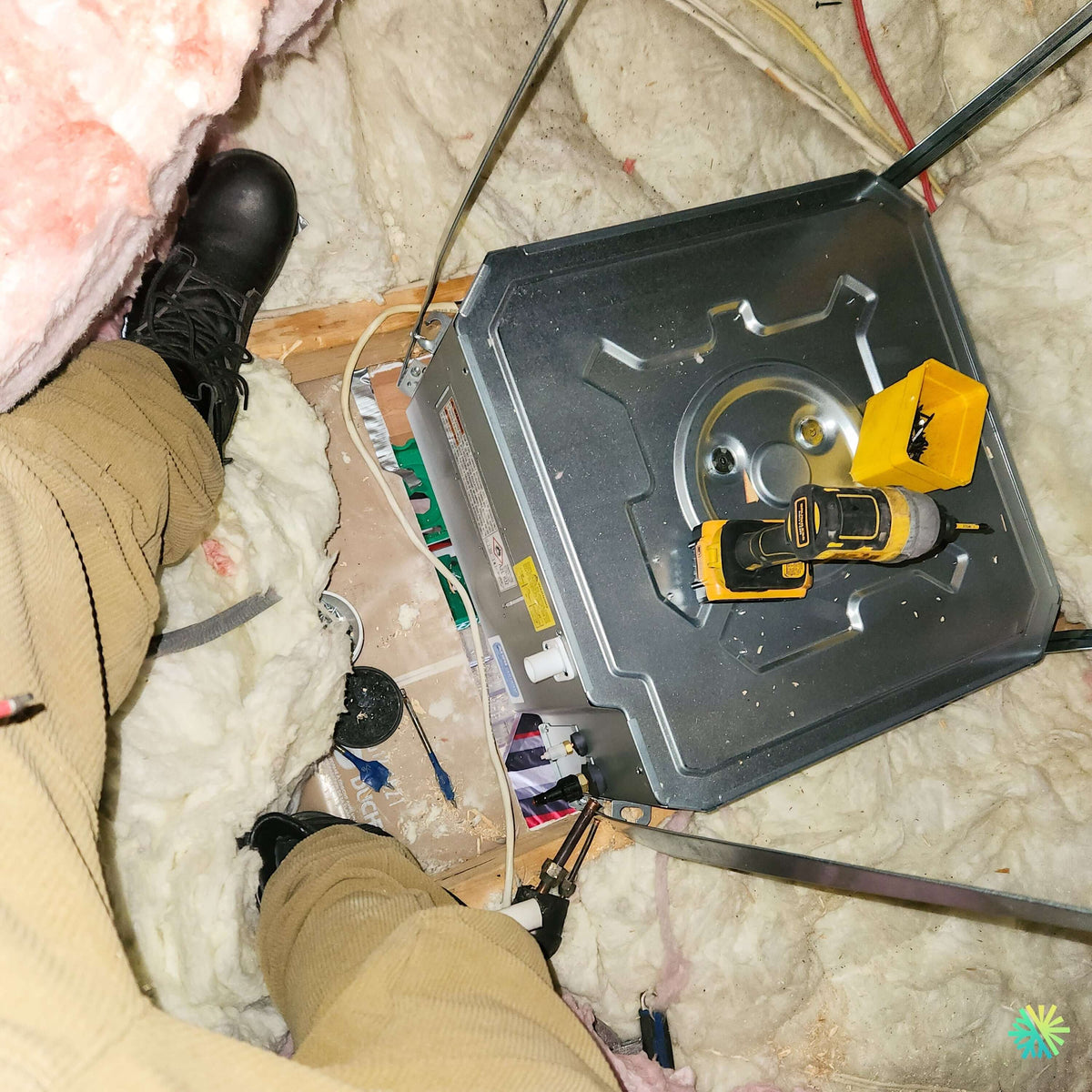
The photo taken during the work shows a key stage of the installation: the indoor unit is positioned in the attic, surrounded by insulation, with the refrigerant lines, drainage, and connections being prepared. It is precisely in this type of environment that the expertise of an HVAC contractor in Laval becomes essential. A ceiling cassette is not simply "placed" in a ceiling: it must be securely suspended, perfectly leveled, precisely connected, protected against condensation risks, and installed in a way that remains accessible for future HVAC maintenance.
At AirGreen, we approach this type of project with a rigorous method, because an attic installation requires excellent coordination between the building structure, insulation, routing of refrigerant lines, positioning of the drain, and interior finishing.
Why a GREE ceiling cassette was a suitable solution for this project
In several Fabreville residences, owners are looking for a more integrated solution than a wall-mounted air conditioner or a classic wall-mounted heat pump. A ceiling cassette offers several concrete advantages:
- more balanced air diffusion in the room;
- a more discreet appearance once the grille is installed on the ceiling;
- better integration into open spaces;
- reduced wall clutter;
- a very useful solution when available walls are limited;
- an excellent compromise between performance, comfort, and aesthetics.
In this project, the attic configuration allowed the indoor unit to be integrated above the ceiling, while maintaining sufficient technical access for connections. This is an important detail: a ceiling cassette must always be installed taking into account the actual space available above the ceiling, the thickness of the insulation, joists, existing cables, and the possible drainage path.
The GREE brand is also well-suited for modern residential installations, thanks in particular to its efficient, reliable, and versatile systems. Depending on the exact model selected, GREE equipment can offer excellent energy efficiency, comfortable temperature modulation, and compatibility with configurations where interior appearance matters as much as performance.
Visible challenges on site: attic, insulation, and installation precision
The site image immediately reveals a reality that clients do not always see once the work is completed: a clean and durable installation depends heavily on the quality of work done in hidden areas.
In this Fabreville attic, our team had to work in a confined space, surrounded by insulating wool. This context imposes several precautions:
-
Protect existing insulation
Insulation must be carefully moved around the work area, then correctly put back in place after installation. Poor insulation management can create thermal losses, cold spots, or condensation problems. -
Ensure solid cassette support
A ceiling cassette should never rest solely on ceiling finishing materials. It must be suspended or supported by a reliable structure, with precise alignment to avoid vibrations, noise, and drainage problems. -
Respect technical clearance
Enough space must be provided for refrigerant connections, electrical connections, condensate drain, and maintenance access. An appliance that is too cramped becomes difficult to maintain and can complicate any future intervention. -
Ensure impeccable drainage
Condensate drainage is one of the most important points for a ceiling cassette. Inadequate slope, a poorly positioned pipe, or a poorly installed pump can lead to water leaks, odors, or operational shutdowns. -
Limit thermal bridges and condensation risks
Refrigerant lines must be properly insulated. In an attic, where temperature fluctuations can be significant, neglected insulation can cause condensation and damage surrounding materials.
This type of installation therefore requires a much more technical approach than a standard wall mounting. The goal is not only to make the appliance work on the day of installation, but to guarantee stable, quiet, and safe performance for several years.
An AirGreen method designed for complex HVAC installations
For this heat pump project in Fabreville, our team followed a precise work sequence.
Before installation, we validated the cassette's location based on the room to be air-conditioned and heated, but also based on what was above the ceiling. This is a step we never neglect. A visually perfect location in the room can be inadequate in the attic if it is near an obstruction, wiring, a joist, or an area impossible to drain correctly.
Next, we prepared the ceiling opening and the unit's positioning. The cassette must be installed with very precise leveling, as the slightest misalignment can affect condensate flow. In the case of a recessed appliance, the final result must be clean, but the aesthetic aspect directly depends on the invisible precision achieved above the ceiling.
The refrigerant connections were then carefully prepared. Copper lines must be routed without excessive tension, crushing, and with continuous insulation. Particular attention is paid to bends, contact points with the structure, and protection of connections.
Drainage was treated as a priority. In a cassette installation, we always check the condensate water evacuation path and the slope or pump logic depending on the context. This step is critical in residences in Laval, Montreal, Longueuil, on the North Shore and the South Shore, because attics can experience large temperature differences between summer and winter.
Finally, electrical and communication connections were organized to allow reliable system operation. A clean attic installation reduces the risk of confusion during future service and facilitates diagnostics.
What this GREE installation brings to daily comfort
A GREE ceiling cassette offers a different sense of comfort than a traditional wall unit. Air is diffused from the ceiling, which helps to better distribute the temperature in the space. For a living room, family room, open area, or a room where the walls are already occupied by windows, furniture, or decorative elements, this approach can be very advantageous.
More natural air diffusion in the room
Unlike a wall unit that projects air from a fixed point on a wall, the cassette is integrated into the ceiling and can better cover the central area. Depending on the room configuration and the installed model, diffusion can help reduce areas that are too cold during air conditioning or less well heated in heating mode.
In a house in Fabreville, where several rooms have sometimes been renovated, expanded, or opened over time, this type of diffusion can help improve comfort without multiplying visible units.
A discreet solution for clients who do not want an apparent wall unit
One of the great advantages of the ceiling cassette is its visual integration. Once the finishing is completed, only the grille remains visible. For clients who attach great importance to interior appearance, this is a highly appreciated choice.
This discretion is particularly useful in spaces where one wishes to maintain a clean decor, avoid occupying a wall, or maintain symmetry in the room.
An installation that requires real HVAC expertise
However, it must be clear: the ceiling cassette is not the simplest option to install. It requires more planning than a standard wall system. This is why the choice of contractor matters greatly.
A poor installation can create several problems:
- noise or vibration in the ceiling;
- water leakage caused by poor drainage;
- difficult access for maintenance;
- condensation in the attic;
- misaligned interior finish;
- reduced performance due to poor positioning;
- discomfort due to improperly oriented air diffusion.
Our role at AirGreen is precisely to avoid these errors by planning every detail before closing the ceiling or putting the insulation back in place.
Technical points we check before commissioning
Before finalizing a GREE heat pump installation, we check several essential elements:
- the mechanical stability of the indoor unit;
- the level of the cassette;
- the sealing and insulation of the refrigerant lines;
- the quality of the drainage;
- the conformity of electrical connections;
- air circulation;
- the unit's response to commands;
- operation in cooling and heating mode;
- absence of abnormal vibration;
- accessibility for future HVAC maintenance.
These checks are fundamental, especially for a unit installed in a ceiling. The client does not see all these details daily, but they determine the reliability of the installation.
Practical advice for homeowners considering a ceiling cassette
For homeowners in Fabreville, Laval, Montreal, Longueuil, the North Shore, or the South Shore considering a ceiling cassette, here are the points to consider before making a decision.
Check available space above the ceiling
A cassette requires sufficient technical volume. In some houses, the attic is too low, too cluttered, or difficult to access. An on-site visit confirms whether installation is possible.
Consider drainage from the start
Drainage should never be improvised. It is necessary to know where condensate water will be directed and how it will flow. In some cases, a condensate pump may be necessary.
Choose the right location in the room
The geometric center of a room is not always the best place. Furniture, openings, room usage, heat sources, and air circulation must be taken into account.
Do not underestimate the importance of maintenance
A ceiling cassette must remain accessible. Filters, the condensate pump, the drain pan, and connections must be inspectable. An overly tight installation can become costly to maintain.
Compare options with a professional
In some projects, a wall-mounted heat pump remains simpler and more economical. In others, a ceiling cassette offers a much more elegant and comfortable result. The right choice always depends on the house, budget, desired aesthetics, and expected performance level.
Subsidies and energy efficiency: what to check
Heat pump systems may sometimes be eligible for subsidy programs, depending on the exact model, capacity, certification, installed configuration, and criteria in effect at the time of work. For a GREE installation, we always validate relevant information with the client, including potential eligibility according to applicable programs in Quebec.
It is important not to rely solely on the brand. Eligibility generally depends on the precise model, its energy performance, and program requirements. At AirGreen, we guide our clients in understanding these elements so they can make a clear decision before installation.
The importance of an experienced local contractor in Laval
An attic installation in Fabreville is by no means trivial. Laval houses often have very different configurations: older constructions, successive renovations, modified ceilings, variable insulation, restricted access, existing wires, drainage constraints, and particular aesthetic requirements.
Our experience in air conditioning, heat pump, ceiling cassette, and HVAC system installations in the greater Montreal area allows us to anticipate these constraints. We have carried out similar projects in Laval, on the North Shore, in Longueuil, on the South Shore, and in several districts of Montreal, where available space and interior finishing required a tailor-made approach.
In this project in Fabreville, the objective was clear: to integrate an efficient, discreet, and durable solution without compromising insulation or technical accessibility. The final result relies on this invisible but essential work: a well-positioned unit, clean connections, thoughtful drainage, and an installation designed to operate for a long time.
An installation that well illustrates the AirGreen difference
This project perfectly demonstrates what we aim to offer at AirGreen: an HVAC installation that goes beyond simply installing a unit, but takes the entire building into account. Every detail matters, especially when a GREE ceiling cassette is installed in an insulated attic.
We know that customers are looking for reliable comfort, a neat appearance, reasonable consumption, and a contractor capable of clearly explaining the options. Our job is to unite these expectations into a coherent solution, adapted to the reality of the building and installed with the necessary seriousness.
For homeowners in Fabreville and Laval who are considering a discreet, high-performance, and well-integrated heat pump, the ceiling cassette represents an option to be seriously considered. When properly planned and installed by an experienced team, it can transform the comfort of a room while preserving the aesthetics of the space.
How it goes, from the first call to the end
The main steps of this kind of job at AirGreen. Every house has its quirks: the estimate brings them out.
We look at the room, the outside wall, the line route and where the outdoor unit will go. That is where the capacity gets chosen.
Model, capacity and price, in writing. We also check whether the model qualifies for assistance programs.
Floors and furniture protected, wall plate position marked level, wall opening located.
A single opening, with the slope the drain needs to flow outside.
Set on a stand raised above the snow, with the clearances the manufacturer requires.
Connected, insulated and protected. The opening is then sealed against water, cold air and insects.
A dedicated circuit and an accessible disconnect near the outdoor unit.
Leak test, vacuum, then start-up and a check of heating and cooling.
Remote, modes, filters: we show you the essentials before we leave.
- The on-site estimateWe look at the room, the outside wall, the line route and where the outdoor unit will go. That is where the capacity gets chosen.
- The quoteModel, capacity and price, in writing. We also check whether the model qualifies for assistance programs.
- Getting readyFloors and furniture protected, wall plate position marked level, wall opening located.
- The wall openingA single opening, with the slope the drain needs to flow outside.
- The outdoor unitSet on a stand raised above the snow, with the clearances the manufacturer requires.
- Lines, cable and drainConnected, insulated and protected. The opening is then sealed against water, cold air and insects.
- The electrical workA dedicated circuit and an accessible disconnect near the outdoor unit.
- Tests and start-upLeak test, vacuum, then start-up and a check of heating and cooling.
- The walkthroughRemote, modes, filters: we show you the essentials before we leave.
And at your place?
Two quick checks with real numbers: what heat costs, and what your current heaters add up to in BTU/h.
Conversion: 1 W = 3.412 BTU/h. An indication, not a load calculation: baseboards and furnaces are often stronger than the real need, and they can stay as backup. AirGreen confirms the capacity on site.
What to do, season by season
Three habits per season for this unit. They take a few minutes and prevent many calls.
- Clean the indoor unit's filters.
- Clear leaves and debris left on the outdoor unit by winter.
- Test cooling before the first hot days.
- Clean the filters more often when the unit runs a lot.
- Keep plants away from the outdoor unit.
- Check that no water drips from the indoor unit.
- Rake the leaves around the outdoor unit.
- Test heating before the first cold days.
- Book periodic maintenance before winter.
- Keep snow away from the stand and the front of the unit.
- Let the unit defrost: it is normal.
- Never hit the ice on the fins; call us if the unit stays iced up.
Which type of equipment for your project?
Pick what looks like your need.
Four mistakes we do not make
Flip each card to see what we do instead.
What people ask us about this kind of work
Does a wall-mounted heat pump heat in winter?
Wall-mounted or multi-zone: how do I choose?
Where does the outdoor unit go?
Are there grants?
Do I need a permit?
How cold can it heat?
How much can I save?
How is the LogisVert assistance calculated?
Is it noisy?
The outdoor unit is covered in ice: is that normal?
Does AirGreen hold the required licences?
Is the estimate free?
No question matches. Write to us: we answer.
Useful pages for what comes next
More jobs to see, near you
By town, by equipment or by region: browse more than 4,700 published projects.
Each dot: a town where AirGreen has published projects. The glowing dot: this job.
Tell us about your house. We come and see it for free.
The on-site estimate is free and the quote follows within 24 hours.
Text and photo: a real AirGreen Climatisation & Chauffage job. The diagrams are generic illustrations of the type of installation, not a survey of this job site. Sources of the added figures: airgreen.ca product pages (NEEP / AHRI performance), Hydro-Québec (Heat pumps page, LogisVert, read on 13 October 2026), Régie de l’énergie (rate D as of 1 April 2026).