
Installation of a GREE CHARMO R32 Wall-Mounted Heat Pump – Air Conditioner – Mini Split in Outremont, Montreal
AirGreen installs a GREE CHARMO R32 wall-mounted heat pump in Outremont: efficient mini-split, clean wall mount, comfort in air conditioning and heating, with an HVAC installation adapted to Montreal homes.
- City
- Region
- Equipment
- Brand
- Challenges
- Published
The job on one screen
The article, chapter by chapter
A meticulous wall-mounted installation in a typical Outremont residential yard
In an area like Outremont, every HVAC installation project requires particular attention to architecture, available space, external aesthetics, and neighborhood sound comfort. This installation of a GREE CHARMO R32 wall-mounted heat pump perfectly illustrates the precise type of work we carry out at AirGreen when a client wishes to improve their comfort without compromising the appearance of their property.
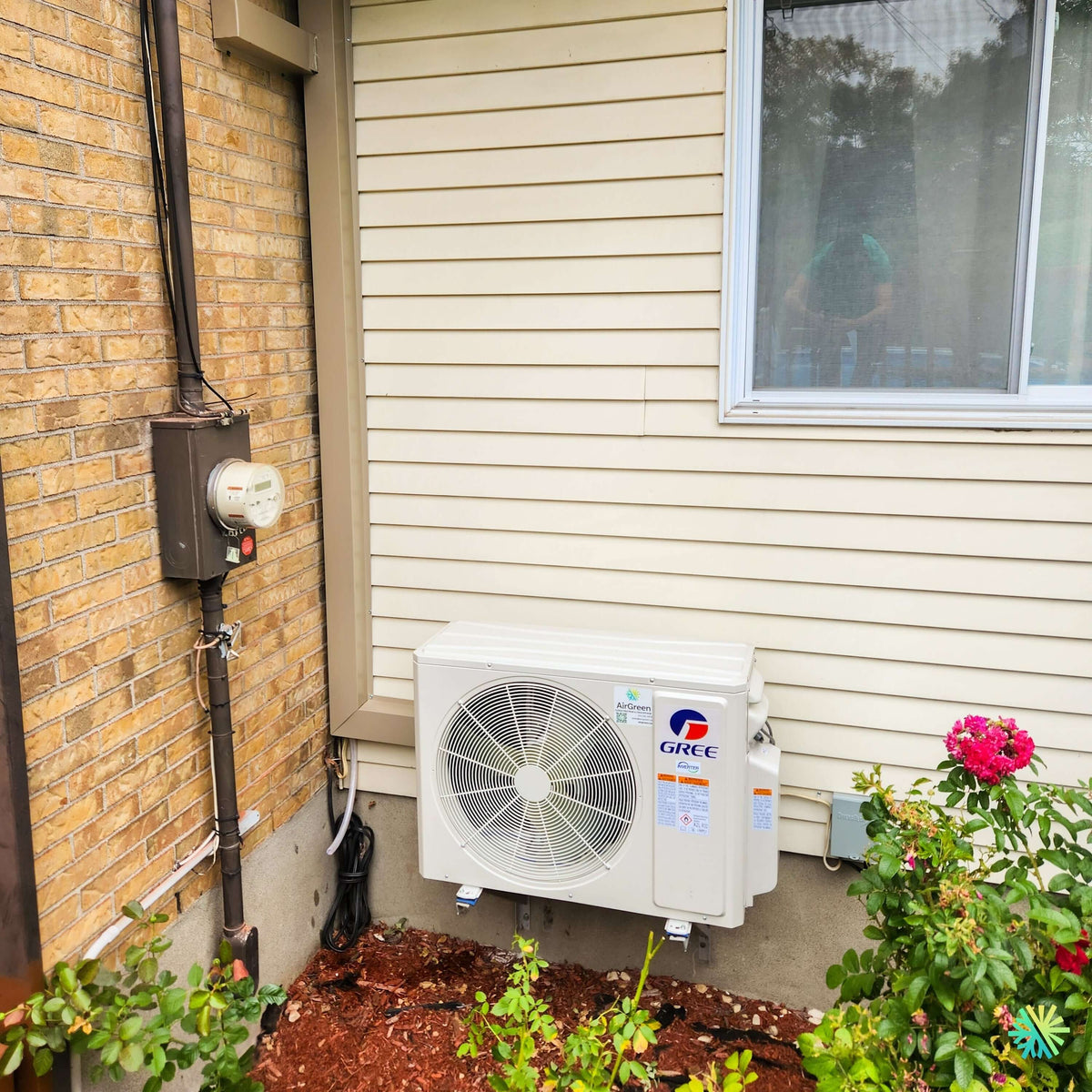
The job site photo shows a GREE outdoor unit neatly installed against the back wall of the residence, in a landscaped area, between a brick wall, light exterior siding, a window, and several existing elements such as the electrical entrance, vertical conduits, and plantings. This context required a compact, stable, well-leveled, visually discreet installation that was also sufficiently accessible for future HVAC maintenance work.
The GREE CHARMO R32 was chosen to meet a very common need in Outremont homes: improving air conditioning in summer, providing efficient supplementary heating during cold periods, reducing reliance on more energy-intensive systems, and providing more evenly distributed comfort in living areas.
A wall-mounted heat pump suitable for Outremont homes
Outremont has a varied housing stock: semi-detached houses, plexes, condominiums, renovated residences, rear extensions, finished basements, and upper floors where heat easily accumulates during the summer. In this type of building, a well-selected wall-mounted heat pump can transform daily comfort.
The GREE CHARMO R32 is an interesting solution for homeowners looking for a good balance between performance, efficiency, price, and reliability. Its operation with R32 refrigerant aligns with current market standards, with inverter technology that adjusts power according to the home's actual needs. This modulation is important because it avoids sudden and repeated starts, helps stabilize indoor temperature, and improves comfort.
In this installation in Outremont, the objective was not simply to place a device against a wall. It was necessary to integrate the system into a space already occupied by several constraints: a window located directly above, plants to preserve, a limited passageway, a nearby brick wall, existing conduits, and a visible electrical entrance on the left side. These are precisely the details that distinguish a quick installation from an installation designed to last.
An outdoor unit precisely positioned
The positioning of the outdoor unit is one of the most important elements of a heat pump installation. On this job site, we opted for a wall-mounted installation on metal supports, rather than direct ground installation. This decision offers several advantages:
- better protection against ground moisture, fallen leaves, and debris;
- cleaner clearance above mulch and plantings;
- reduced risks associated with snow accumulation;
- simpler access for inspection and maintenance;
- neater appearance in a landscaped yard;
- better stability of the unit over time.
The unit is installed at a practical height, without obstructing the window or access to existing elements on the wall. The clearance around the front fan has also been respected to allow for good air circulation. A heat pump should never be installed in too confined a space, as this can negatively affect performance, increase duty cycles, and reduce compressor lifespan.
A discreet installation despite visible constraints
The difficulty of this project lay in integrating the unit into a highly structured space. To the left, the brick wall already features several components: vertical conduits, electrical box, wires, and connection elements. To the right, the window imposes a natural limit. On the ground, the flowerbed and plants must be protected. In this context, every inch counts.
Our technicians therefore worked with a clean finishing logic. Refrigerant lines were carefully routed to limit visual clutter. The outdoor unit was positioned to remain accessible without dominating the space. The result visible in the photo demonstrates a neat, balanced, and consistent installation with the immediate environment of the house.
In Montreal, and particularly in neighborhoods like Outremont, this attention to exterior appearance is essential. Homeowners want an efficient system, but they also want to avoid a cluttered installation that draws the eye or detracts from the exterior landscaping.
Why location choice influences performance
A good HVAC installation always begins with an analysis of the location. The outdoor unit must dissipate heat in cooling mode and capture outdoor energy in heating mode. If air does not circulate well around the unit, performance decreases.
In this project, the chosen location allows the GREE CHARMO R32 to operate with adequate front clearance. Plantings remain at a reasonable distance from the fan, and the unit is not enclosed in a tight corner. This approach reduces the risk of overheating in summer and promotes more stable operation.
We also pay attention to the following elements:
- the distance between the outdoor unit and the indoor unit;
- the slope and protection of the conduits;
- potential noise near windows;
- the presence of obstacles in front of the fan;
- the required clearance for cleaning;
- protection against snow and debris;
- the visual impact in the yard.
These considerations are sometimes invisible to the client at the time of installation, but they become essential over the years.
An effective solution for summer air conditioning
Outremont residences can become very hot during the summer, especially when certain rooms receive a lot of sun or when air circulation between floors is poor. A GREE CHARMO R32 wall-mounted heat pump can quickly cool the targeted area while maintaining a more stable temperature.
Unlike some portable air conditioners or window systems, a wall-mounted mini split offers quieter, more consistent, and more aesthetic comfort. The indoor unit distributes air in a controlled manner, while the outdoor unit expels heat without occupying a window or reducing building security.
For homeowners, the benefits are concrete:
- better temperature control;
- quieter operation;
- more precise humidity control;
- better energy efficiency;
- no bulky device in a window;
- neater interior appearance.
This installation therefore meets a very frequent need in the sector: obtaining real residential air conditioning without major work throughout the house.
Useful supplementary heating for a good part of the year
A heat pump is not just an air conditioning unit. It can also contribute to heating during transitional seasons and several cold periods. In a well-insulated house, it can reduce the use of primary heating when conditions are favorable.
The GREE CHARMO R32 is designed to offer excellent heating performance, with inverter technology that adapts power to demand. This adjustment capability is useful in homes where needs vary greatly between morning, afternoon, and evening.
In Outremont, where several buildings have been renovated in stages over the years, heating can be uneven from one room to another. A well-positioned wall-mounted heat pump can improve comfort in a specific area, for example, a living room, family room, floor, or open-plan area.
Attention to vibrations and noise
In dense residential areas of Montreal, noise is an important criterion. A poorly secured outdoor unit can transmit vibrations into the wall, produce undesirable sounds, or disturb occupants and neighbors.
On this installation, the unit was mounted on wall supports with anti-vibration pads. This detail reduces the transmission of vibrations and contributes to quieter operation. We also check that the unit is level, as a slightly tilted unit can create noise, affect drainage, or accelerate the wear of certain components.
Acoustic comfort is an integral part of a good installation. A high-performance but poorly installed machine can become a source of irritation. Conversely, a well-executed installation allows the system to operate more smoothly and quietly.
Connections: a technical task that should never be improvised
Installing a wall-mounted air conditioner or wall-mounted heat pump requires precise skills. Refrigerant connections must be made methodically, conduits must be protected, drainage must be well thought out, and commissioning must follow industry best practices.
In this project, the connections were made to maintain a discreet and functional finish. The proximity of the brick wall and the exterior siding required particular attention to avoid unnecessary routes and maintain a clean presentation.
A quality installation includes, in particular:
- planning of conduit routing;
- secure fastening of the outdoor unit;
- refrigerant connection;
- line insulation;
- condensation drain management;
- electrical checks;
- vacuuming;
- functional tests;
- basic explanation to the client.
These steps ensure that the system operates correctly from the outset and maintains its performance over time.
Subsidies and eligibility: a point to check depending on the exact model
Homeowners in Montreal, Laval, Longueuil, on the North Shore and the South Shore are often interested in financial aid available for heat pump installation. Certain models may be eligible for programs like LogisVert, depending on current lists, technical criteria, and the exact model installed.
At AirGreen, we assist our clients in understanding the necessary documents: invoice, model numbers, proof of installation, and technical information. It is important to validate eligibility before making a final decision, as recognized amounts and models can vary.
In the case of a GREE CHARMO R32, this verification must be done using the exact references of the indoor and outdoor units. A simple range mention is not always sufficient; precise combinations are what count.
Mistakes to avoid in a yard like this
An installation in a landscaped residential yard may seem simple, but several mistakes can harm the result:
- installing the unit too close to the ground;
- neglecting vibrations transmitted to the wall;
- blocking access for maintenance;
- placing the unit too close to a window;
- ignoring future plant growth;
- improperly protecting the conduits;
- leaving visible wires or pipes without adequate finishing;
- choosing a location solely to simplify the work, without considering performance.
On this Outremont job site, the presence of plants and existing mechanical elements required more careful consideration. The goal was to keep the unit accessible, stable, and efficient, without damaging the landscaping or creating an unpleasant visual focal point in the yard.
The importance of maintenance after installation
Even an excellent wall-mounted heat pump requires maintenance. Cleaning the indoor unit's filters, inspecting the outdoor unit, clearing the area around the fan, and checking the drains directly contribute to the system's performance.
In an installation like this, located near plantings and mulch, particular attention must be paid to leaves, dust, organic debris, and small branches that can accumulate around the outdoor unit. Clearances help the unit operate efficiently and limit avoidable service calls.
We recommend that homeowners keep the area in front of the unit clear, not allow plants to grow too close to the fan, and schedule periodic HVAC maintenance to preserve system performance.
AirGreen expertise adapted to Greater Montreal's realities
AirGreen installs wall-mounted heat pumps, wall-mounted air conditioners, and mini split systems in a wide variety of contexts: single-family homes, condos, plexes, businesses, offices, and multi-residential buildings. Each sector has its peculiarities. In Outremont, aesthetics, discretion, respect for the building, and the neatness of the work are particularly important.
This installation of a GREE CHARMO R32 demonstrates our ability to adapt the project to the actual available space. We don't just aim to install a machine; we aim to create a comfortable, durable, and well-integrated solution.
Our experience in Greater Montreal also allows us to better anticipate challenges: restricted access, condominium regulations, old walls, fragile siding, close neighbors, finishing requests, limited clearances, and electrical constraints.
A clean, durable, and consistent result with the building
The final result of this installation in Outremont reflects a methodical approach: the outdoor unit is securely fixed, clear of the ground, well-aligned, and positioned to maintain a clean and functional yard. The unit remains accessible for maintenance, while staying relatively discreet in its environment.
For the client, this installation brings a concrete improvement in indoor comfort. In summer, air conditioning becomes more stable and pleasant. During colder periods, the heat pump can support heating and help to better control the temperature in the targeted area. All with a modern, compact solution adapted to the reality of a Montreal home.
Practical tips before installing a GREE CHARMO R32 in Outremont
Before planning a similar installation, several points deserve evaluation:
- choosing a capacity adapted to the area and insulation;
- avoiding overly enclosed or low locations;
- planning maintenance from the start;
- considering windows, balconies, and neighbors;
- protecting conduits against bad weather;
- checking for subsidy possibilities;
- entrusting connections to qualified technicians;
- prioritizing a finish that respects the house's appearance.
These tips apply to Outremont, but also to several sectors of Montreal, Laval, Longueuil, the North Shore and the South Shore where properties have similar constraints.
An installation that perfectly summarizes our approach
This HVAC installation of a GREE CHARMO R32 wall-mounted heat pump in Outremont demonstrates that the quality of a project relies as much on the choice of equipment as on how it is integrated into the building. A well-placed, securely fixed, properly connected, and clear unit will offer better comfort, greater durability, and a more satisfying experience for the owner.
At AirGreen, we place great importance on these details, as they make the difference between a merely functional installation and a truly professional one. This project is a good example: an efficient, clean solution, adapted to the existing yard and designed for the Quebec seasons.
The job tools
Two quick checks with real numbers: what heat costs, and what your current heaters add up to in BTU/h.
Conversion: 1 W = 3.412 BTU/h. An indication, not a load calculation: baseboards and furnaces are often stronger than the real need, and they can stay as backup. AirGreen confirms the capacity on site.
How the job unfolds
The main steps of this kind of job at AirGreen. Every house has its quirks: the estimate brings them out.
We look at the room, the outside wall, the line route and where the outdoor unit will go. That is where the capacity gets chosen.
Model, capacity and price, in writing. We also check whether the model qualifies for assistance programs.
Floors and furniture protected, wall plate position marked level, wall opening located.
A single opening, with the slope the drain needs to flow outside.
Set on a stand raised above the snow, with the clearances the manufacturer requires.
Connected, insulated and protected. The opening is then sealed against water, cold air and insects.
A dedicated circuit and an accessible disconnect near the outdoor unit.
Leak test, vacuum, then start-up and a check of heating and cooling.
Remote, modes, filters: we show you the essentials before we leave.
- The on-site estimateWe look at the room, the outside wall, the line route and where the outdoor unit will go. That is where the capacity gets chosen.
- The quoteModel, capacity and price, in writing. We also check whether the model qualifies for assistance programs.
- Getting readyFloors and furniture protected, wall plate position marked level, wall opening located.
- The wall openingA single opening, with the slope the drain needs to flow outside.
- The outdoor unitSet on a stand raised above the snow, with the clearances the manufacturer requires.
- Lines, cable and drainConnected, insulated and protected. The opening is then sealed against water, cold air and insects.
- The electrical workA dedicated circuit and an accessible disconnect near the outdoor unit.
- Tests and start-upLeak test, vacuum, then start-up and a check of heating and cooling.
- The walkthroughRemote, modes, filters: we show you the essentials before we leave.
What we check on a job like this one
Each number is a point we check on site. Switch between summer and winter to watch air and heat move.
In summer, the outdoor unit rejects the house's heat outside.
Generic illustration of this type of installation, not a survey of this job site. Tap a number.
Mounted level on a wall plate, high enough for the air to reach the whole room, with enough space around it to slide the filters out easily.
The refrigerant lines, the communication cable and the drain go through the wall in a single opening, sealed against water, cold air and insects.
Two insulated copper pipes connect the two units. Outside, a line cover can protect them from sun, knocks and weather.
A shut-off switch near the outdoor unit isolates it safely for service. It must stay accessible at all times.
The compressor and the fan. In heating mode it captures heat from the outdoor air, even in winter, and moves it inside.
On the ground or on the wall, it keeps the unit above accumulated snow. The unit stays clear and defrost water can drain away.
The fan needs to blow freely. Storage, a fence or a wall too close, and efficiency drops while noise goes up.
Is your home ready?
Check what applies at your place. A "no" is not a refusal: it is what we sort out during the estimate.
Good habits, once the unit is in place
Six simple habits that keep the unit going. Your list stays on this device.
What to do, season by season
Three habits per season for this unit. They take a few minutes and prevent many calls.
- Clean the indoor unit's filters.
- Clear leaves and debris left on the outdoor unit by winter.
- Test cooling before the first hot days.
- Clean the filters more often when the unit runs a lot.
- Keep plants away from the outdoor unit.
- Check that no water drips from the indoor unit.
- Rake the leaves around the outdoor unit.
- Test heating before the first cold days.
- Book periodic maintenance before winter.
- Keep snow away from the stand and the front of the unit.
- Let the unit defrost: it is normal.
- Never hit the ice on the fins; call us if the unit stays iced up.
The right pages, at the right time
Four statements: true or false?
It all comes down to details you have just seen.
1. In heating mode, the outdoor unit can produce water.
During defrost cycles. That water must drain away without forming ice.
2. You pick the capacity with a simple square-footage rule.
Windows, insulation, orientation and how the room is used all count. Capacity is chosen on site.
3. A multi-zone connects several indoor heads to a single condenser.
One head per room, all on the same condenser. Each room keeps its own temperature.
4. The disconnect can sit behind the patio furniture.
It must stay accessible: it is what shuts the unit off for service.
0 / 4 right answers
What people ask us about this kind of work
Does a wall-mounted heat pump heat in winter?
Wall-mounted or multi-zone: how do I choose?
Where does the outdoor unit go?
Are there grants?
Do I need a permit?
How cold can it heat?
How much can I save?
How is the LogisVert assistance calculated?
Is it noisy?
The outdoor unit is covered in ice: is that normal?
Does AirGreen hold the required licences?
Is the estimate free?
No question matches. Write to us: we answer.
More jobs to see, near you
By town, by equipment or by region: browse more than 4,700 published projects.
Each dot: a town where AirGreen has published projects. The glowing dot: this job.
An on-site estimate, the right capacity, the right equipment.
The on-site estimate is free and the quote follows within 24 hours.
Text and photo: a real AirGreen Climatisation & Chauffage job. The diagrams are generic illustrations of the type of installation, not a survey of this job site. Sources of the added figures: airgreen.ca product pages (NEEP / AHRI performance), Hydro-Québec (Heat pumps page, LogisVert, read on 13 October 2026), Régie de l’énergie (rate D as of 1 April 2026).