
Installation of a Gree R-32 wall-mounted heat pump in Villeray
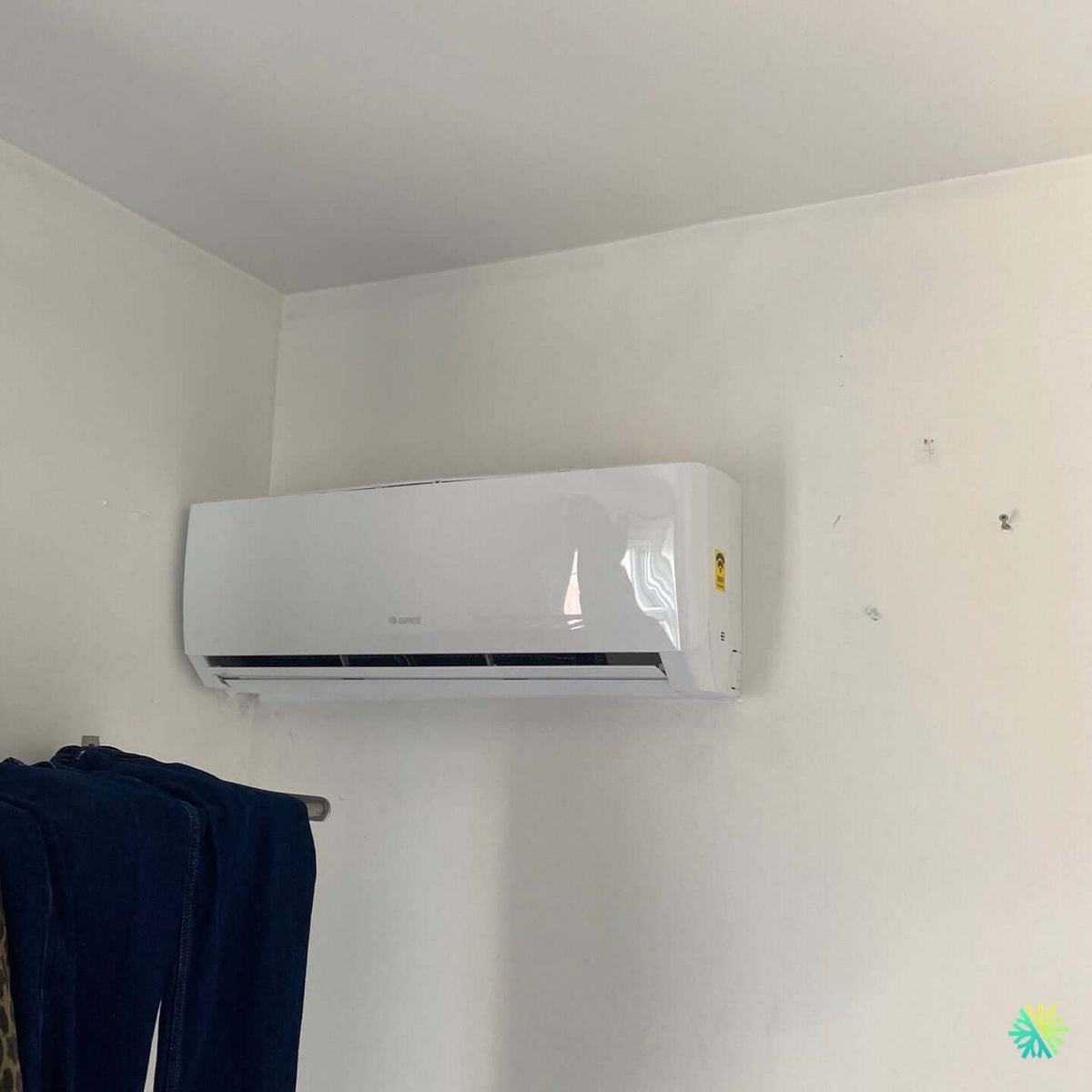
In Villeray , we are installing a Gree R-32 : a 9,000 BTU wall-mounted heat pump with a short path, gravity drain, and discreet white enclosure. Quiet comfort and savings, with support for efficiency programs for Montreal and the surrounding area.
Take a tour of the installation
Each number is a point we check on site. Switch between summer and winter to watch air and heat move.
In summer, the outdoor unit rejects the house's heat outside.
Generic illustration of this type of installation, not a survey of this job site. Tap a number.
Mounted level on a wall plate, high enough for the air to reach the whole room, with enough space around it to slide the filters out easily.
The refrigerant lines, the communication cable and the drain go through the wall in a single opening, sealed against water, cold air and insects.
Two insulated copper pipes connect the two units. Outside, a line cover can protect them from sun, knocks and weather.
A shut-off switch near the outdoor unit isolates it safely for service. It must stay accessible at all times.
The compressor and the fan. In heating mode it captures heat from the outdoor air, even in winter, and moves it inside.
On the ground or on the wall, it keeps the unit above accumulated snow. The unit stays clear and defrost water can drain away.
The fan needs to blow freely. Storage, a fence or a wall too close, and efficiency drops while noise goes up.
Controlled comfort in a small bedroom: our signature finish and performance
In this apartment in the Villeray neighborhood, we are installing a new-generation Gree R-32 wall-mounted heat pump to cool and heat a room used daily. The space is tight, the indoor head is located near a wall corner, above a clothes rail: all constraints that require a precise HVAC installation to preserve air circulation, aesthetics and silence. Our approach favors fine sizing ( 9,000 BTU profile for this room), soft distribution and a nearly invisible finish to provide four-season comfort while reducing operating costs compared to electric baseboard heaters.
Why choose Gree R-32 in a Villeray bedroom?
-
High seasonal efficiency and R-32 refrigerant, better suited to today's efficiency requirements.
-
Compactness and sober facade: the head fits neatly into a short section of wall.
-
Very low noise level at low speed, essential near a rest area.
-
Useful heating in cold weather typical of Greater Montreal, with stable inverter regulation.
-
Potential eligibility for efficiency support (depending on file), which we help to document for Montreal, Laval, Longueuil, North Shore, South Shore .
From thermal study to commissioning: our AirGreen method
Exact implantation of the inner head
-
Positioned close to the corner but with clearances compliant to avoid recirculation to the ceiling.
-
Shutter orientation: flow directed beyond the rod to avoid blowing onto textiles and to sweep the room to the sleeping area.
-
Height optimized to maximize jet reach without creating a head-height air current.
Refrigeration and drainage path
-
Through drilling at the gravity slope , immediately behind the mounting plate: short route (~1.5 to 2.5 m) limiting pressure losses and connection points.
-
Flush white capping , concealed fittings and airtight seals (vapor barrier).
-
Gravity drain prioritized towards the exterior; if the architecture requires a rise, we integrate a silent condensate pump with anti-overflow alarm contact.
Power supply and communication
-
Dedicated circuit as per nameplate (115V for some 9k BTU or 208/240V depending on configuration), appropriate circuit breaker, shielded communication cable.
-
Discreet electrical routing along the finishes, with no visible cables.
Outdoor unit: silence and durability
-
Installation on level slab or brackets with silentblocs (depending on facade), clearances respected for suction and discharge.
-
Protection of connections by UV covers and closed cell insulation.
-
Brazing under nitrogen , pressure test, deep vacuum , then validation of the operating parameters.
Commissioning: Fine adjustments for a room
-
Fan/shutter curve configured to limit the “direct blow” effect on the sleeper.
-
Activation of Eco/Night scenes to stabilize humidity and reduce consumption.
-
Control of blowing temperatures , pressures and absorbed intensity to guarantee the expected performance.
Result for the customer
-
Uniform and stable climate , without cold spots or excessive noise.
-
Lower heating bills compared to baseboards.
-
Discreet finish : no visible wires, aligned covers, intact wall outside the drilling area.
Best practices and pitfalls to avoid (AirGreen feedback)
-
Oversizing a room: generates short cycling and discomfort. We aim for 9,000 BTU where the load justifies it, after taking measurements (orientation, glazing, sealing).
-
Insufficient clearances at angles: they stifle air intake. We respect the manufacturer's distances and adapt the installation template.
-
Poorly designed drain : slope too low = risk of dripping or odors. We secure it by gravity or pump with detector.
-
Too long a route for the lines: losses and reduced yields. We place our heads on a wall that quickly leads outwards .
-
Misused mode in the off-season: alternating heat and cold disrupt humidity. We provide simple instructions for use without surprises.
HVAC maintenance: maintaining performance over time
Regular HVAC maintenance prevents invisible performance losses and extends lifespan:
-
Clean filters every 4–8 weeks during heavy use.
-
Seasonal inspection of drain (gravity/pump), pan and line insulation.
-
Electrical check and update settings if necessary.
-
Professional cleaning of the exchanger when dust accumulates (urban areas of Montreal and Laval / South Shore highways in particular).
Grants and support
Depending on the current criteria and configuration, the R-32 wall-mounted heat pump may be eligible for efficiency programs (e.g., Hydro-Québec LogisVert ). We guide our clients in Montreal, Laval, Longueuil, North Shore, and South Shore to maximize their investment, with supporting documents.
This project in figures and key facts
-
Location : bedroom in Villeray, load-bearing wall leading quickly to the outside.
-
Type : Gree R-32 wall-mounted heat pump (recent residential range).
-
Route : short lines, discreet white cover , single waterproof drilling.
-
Drain : gravity prioritized (controlled slope).
-
Comfort : blowing directed above the rod, minimal noise level at night.
AirGreen Tips for Similar Rooms in Montreal and Surrounding Areas
-
Choose the right capacity : the average room often requires 9,000 BTUs ; the load (insulation, orientation, floor) takes precedence over the surface area alone.
-
Favor R-32 / R-454B : better performance and improved environmental trajectory.
-
Pay attention to the installation height : higher = increased range, but respect the clearances to avoid recirculation.
-
Anticipate maintenance : easy access to filters = regular cleaning = constant performance.
-
Verify program eligibility before purchase; we prepare supporting documents and submission.
In summary : in a compact room, a well-sized Gree R-32 , installed with a short path and controlled drainage , provides a quiet and economical climate . It is the typical example of an AirGreen HVAC installation : clean, durable and designed for daily comfort, in Villeray and throughout Greater Montreal .
The big day, step by step
The main steps of this kind of job at AirGreen. Every house has its quirks: the estimate brings them out.
We look at the room, the outside wall, the line route and where the outdoor unit will go. That is where the capacity gets chosen.
Model, capacity and price, in writing. We also check whether the model qualifies for assistance programs.
Floors and furniture protected, wall plate position marked level, wall opening located.
A single opening, with the slope the drain needs to flow outside.
Set on a stand raised above the snow, with the clearances the manufacturer requires.
Connected, insulated and protected. The opening is then sealed against water, cold air and insects.
A dedicated circuit and an accessible disconnect near the outdoor unit.
Leak test, vacuum, then start-up and a check of heating and cooling.
Remote, modes, filters: we show you the essentials before we leave.
- The on-site estimateWe look at the room, the outside wall, the line route and where the outdoor unit will go. That is where the capacity gets chosen.
- The quoteModel, capacity and price, in writing. We also check whether the model qualifies for assistance programs.
- Getting readyFloors and furniture protected, wall plate position marked level, wall opening located.
- The wall openingA single opening, with the slope the drain needs to flow outside.
- The outdoor unitSet on a stand raised above the snow, with the clearances the manufacturer requires.
- Lines, cable and drainConnected, insulated and protected. The opening is then sealed against water, cold air and insects.
- The electrical workA dedicated circuit and an accessible disconnect near the outdoor unit.
- Tests and start-upLeak test, vacuum, then start-up and a check of heating and cooling.
- The walkthroughRemote, modes, filters: we show you the essentials before we leave.
What would it look like at your place?
Two quick checks with real numbers: what heat costs, and what your current heaters add up to in BTU/h.
Conversion: 1 W = 3.412 BTU/h. An indication, not a load calculation: baseboards and furnaces are often stronger than the real need, and they can stay as backup. AirGreen confirms the capacity on site.
Four mistakes we do not make
Flip each card to see what we do instead.
Your own project, step by step
What to do, season by season
Three habits per season for this unit. They take a few minutes and prevent many calls.
- Clean the indoor unit's filters.
- Clear leaves and debris left on the outdoor unit by winter.
- Test cooling before the first hot days.
- Clean the filters more often when the unit runs a lot.
- Keep plants away from the outdoor unit.
- Check that no water drips from the indoor unit.
- Rake the leaves around the outdoor unit.
- Test heating before the first cold days.
- Book periodic maintenance before winter.
- Keep snow away from the stand and the front of the unit.
- Let the unit defrost: it is normal.
- Never hit the ice on the fins; call us if the unit stays iced up.
Is your home ready?
Check what applies at your place. A "no" is not a refusal: it is what we sort out during the estimate.
Four statements: true or false?
It all comes down to details you have just seen.
1. In heating mode, the outdoor unit can produce water.
During defrost cycles. That water must drain away without forming ice.
2. You pick the capacity with a simple square-footage rule.
Windows, insulation, orientation and how the room is used all count. Capacity is chosen on site.
3. A multi-zone connects several indoor heads to a single condenser.
One head per room, all on the same condenser. Each room keeps its own temperature.
4. The disconnect can sit behind the patio furniture.
It must stay accessible: it is what shuts the unit off for service.
0 / 4 right answers
What people ask us about this kind of work
Does a wall-mounted heat pump heat in winter?
Wall-mounted or multi-zone: how do I choose?
Where does the outdoor unit go?
Are there grants?
Do I need a permit?
How cold can it heat?
How much can I save?
How is the LogisVert assistance calculated?
Is it noisy?
The outdoor unit is covered in ice: is that normal?
Does AirGreen hold the required licences?
Is the estimate free?
No question matches. Write to us: we answer.
More jobs to see, near you
By town, by equipment or by region: browse more than 4,700 published projects.
Each dot: a town where AirGreen has published projects. The glowing dot: this job.
Every house has its constraints. We see them before we install.
The on-site estimate is free and the quote follows within 24 hours.
Text and photo: a real AirGreen Climatisation & Chauffage job. The diagrams are generic illustrations of the type of installation, not a survey of this job site. Sources of the added figures: airgreen.ca product pages (NEEP / AHRI performance), Hydro-Québec (Heat pumps page, LogisVert, read on 13 October 2026), Régie de l’énergie (rate D as of 1 April 2026).