
Installation of a Midea wall-mounted heat pump in Villeray–Saint-Michel–Parc-Extension
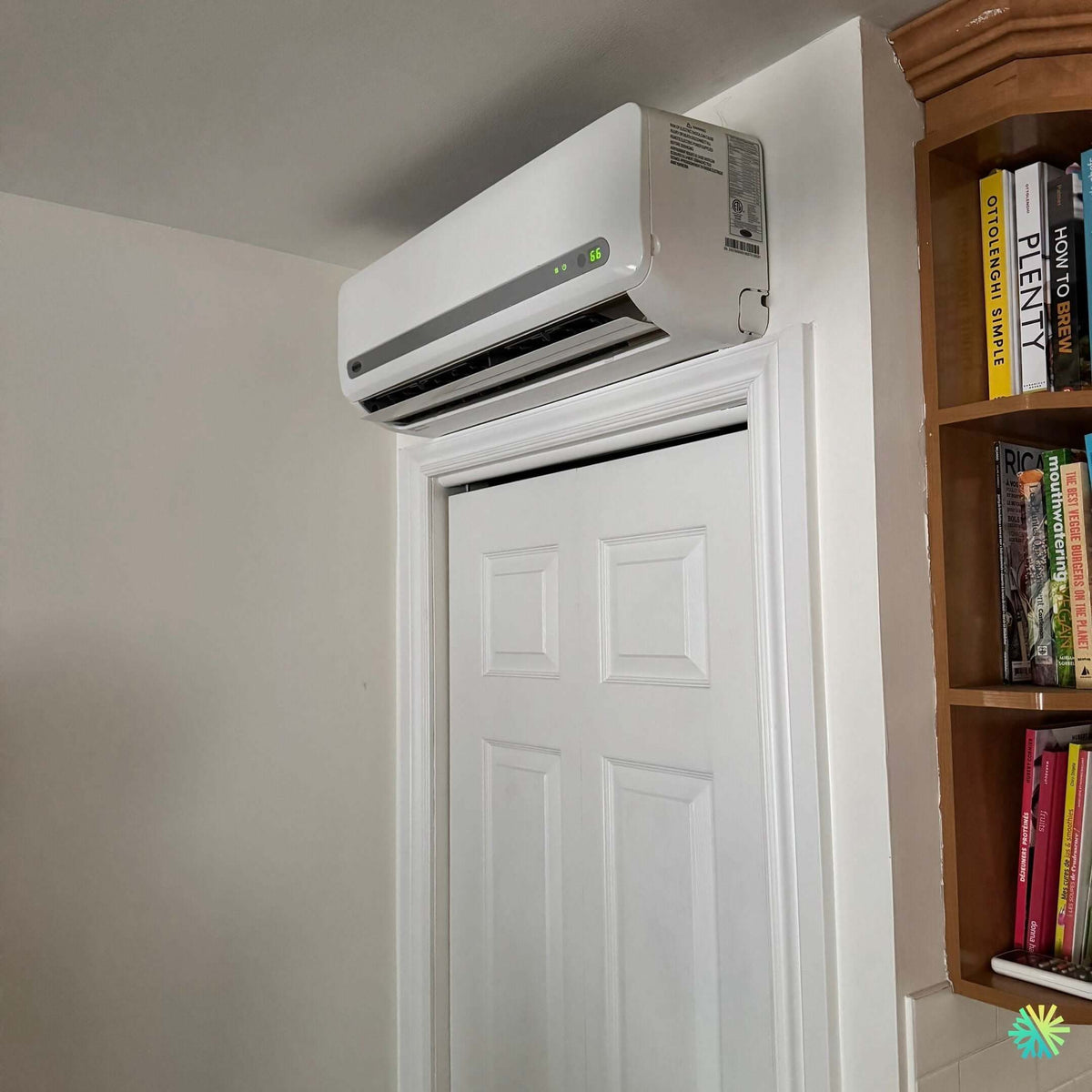
Installation of a Midea wall-mounted heat pump above a door frame in Villeray: compact HVAC installation , short cooling path, simple HVAC maintenance and four-season comfort for Montreal and its surrounding areas.
Take a tour of the installation
Each number is a point we check on site. Switch between summer and winter to watch air and heat move.
In summer, the outdoor unit rejects the house's heat outside.
Generic illustration of this type of installation, not a survey of this job site. Tap a number.
Mounted level on a wall plate, high enough for the air to reach the whole room, with enough space around it to slide the filters out easily.
The refrigerant lines, the communication cable and the drain go through the wall in a single opening, sealed against water, cold air and insects.
Two insulated copper pipes connect the two units. Outside, a line cover can protect them from sun, knocks and weather.
A shut-off switch near the outdoor unit isolates it safely for service. It must stay accessible at all times.
The compressor and the fan. In heating mode it captures heat from the outdoor air, even in winter, and moves it inside.
On the ground or on the wall, it keeps the unit above accumulated snow. The unit stays clear and defrost water can drain away.
The fan needs to blow freely. Storage, a fence or a wall too close, and efficiency drops while noise goes up.
Precise comfort in a Montreal apartment with narrow passages
In this Villeray–Saint-Michel–Parc-Extension apartment, we are installing a Midea wall-mounted heat pump in a transom above a door frame . The layout of the space—narrow hallway, frequent traffic, adjoining library—requires a compact, quiet layout capable of serving two adjoining rooms without disrupting traffic flow. Our mandate: to deliver a clean, durable HVAC system optimized for Montreal's climate.
Client background and objectives
The client wanted to replace an energy-intensive electric heater with a four-season solution that stabilizes the temperature, reduces noise, and limits visual clutter. The high installation above the door meets these criteria: it frees up wall space, promotes destratification in heating, and facilitates airflow to the next room.
Equipment selection and sizing
We chose a Midea single-zone inverter rated at 12,000 BTU/h (ideal range for 40–55 m² depending on insulation). The reasons for this choice:
-
Fine modulation of the compressor to maintain the setpoint smoothly;
-
Low noise level suitable for passage areas;
-
High seasonal efficiency ( Energy Star profile in AHRI certified combinations) with efficient heating capacity down to approximately −25°C , relevant for Montreal .
This selection opens the door to subsidies when the indoor/outdoor unit pair meets the program criteria: we provide the AHRI references and accompany the file.
Interior installation: millimeter precision above a door
Positioning and fixings. We place the bracket on studs located behind the plasterboard, with suitable anchors and level control on two axes. The lateral and upper clearances prescribed by Midea are respected to avoid air recycling . The height above the molding preserves the full opening of the door.
Air diffusion. To cover two volumes, we program:
-
a vertical shutter slightly lowered in winter to bring the heat back to the level of the occupants;
-
a wide horizontal sweep in summer to distribute fresh air into the adjacent room, with the door open;
-
an average flow rate limiting air currents during passage.
Finishes. The unit fits flush with the cornice line ; no interior sheathing is visible. The proximity of a bookcase requires the shutter to be wedged to prevent it from pushing back onto the shelves.
Refrigeration path, drilling and evacuation of condensates
Short route. The copper connections and the communication cable exit directly behind the unit through a single outwardly inclined hole (Ø ~65–75 mm), which reduces pressure losses and simplifies maintenance. The total route of the lines remains less than 10 m , preserving the nominal fluid load.
Gravity drainage. Condensate is drained by gravity , silent and reliable, without an internal pump . The pipe is insulated up to the discharge point to prevent parasitic condensation in the partition. Outside, the outlet is protected and oriented to prevent any runoff onto passageways.
Exterior capping. The connections are covered on the facade with a discreet cladding in a matching light color ; the cuts are sealed (mastic + weatherstripping) to prevent air and moisture infiltration .
Power supply and compliance
-
Dedicated circuit to the panel with circuit breaker sized according to the nominal intensity of the Midea;
-
Grounding checked, tightening checked, clear identification of conductors;
-
Service switch and maintenance socket near the outdoor unit;
-
Compliance with applicable RBQ requirements and CSA best practices.
AirGreen Commissioning Methodology
-
Flaring and brazing of copper connections, visual inspection of the spans.
-
Nitrogen test (350–400 psi) and electronic detector control.
-
Deep vacuum ≤ 300 microns and resistance test.
-
Opening the valves , checking for superheat and subcooling according to the actual length.
-
Air settings : vane angle, speeds, seasonal settings.
-
Transfer to the customer : HVAC usage and maintenance instructions.
Construction site constraints and solutions
-
Limited clearance above the doorframe: choice of a compact template , precise positioning of the bracket and orientation of the insufflation plenum to avoid turbulence at the right of the molding.
-
High- traffic area : moderate flow setting and sweeping that avoids any direct blowing on the occupants while carrying the air to the next room.
Measurable results
-
Thermal stability : reduced temperature range between the two parts;
-
Silence : low and eco modes preferred in the evening, noise core attenuated by the high installation;
-
Savings : in mid-season, the heat pump covers most of the heating needs, limiting the use of baseboards ;
-
Aesthetics : no interior sheathing , discreet exterior cladding, sealed drilling.
Good HVAC Maintenance Practices
-
Filters : vacuum every 4–6 weeks, wash quarterly;
-
Exchanger : annual gentle cleaning to maintain efficiency ;
-
Drain : spring flushing and slope control;
-
Outdoor unit : clear of snow and debris, check silent blocks ;
-
Annual AirGreen inspection : refrigeration parameters, electrical tightening, health of insulation.
Pitfalls to avoid
-
Undersize the device: high speed, premature wear, noise ;
-
Neglecting clearance above a door: air recycling and reduced performance;
-
Uncontrolled drainage : risks of odors, backflow and stains;
-
Too long a route or tight bends: pressure losses and reduced efficiency .
Support for subsidies and AirGreen service
We manage the eligibility verification (low temperature range, AHRI references), the creation and submission of files for clients in Montreal , Laval , Longueuil , North Shore and South Shore . Our commitment: advice, compliant HVAC installation , HVAC maintenance and rapid troubleshooting for the longevity of your equipment.
Assessment and operating advice
This Midea wall-mounted heat pump installed above a door makes the most of every available centimeter, ensures efficient distribution between two rooms, and reduces annual consumption. To get the most out of the package:
-
in winter , turn the shutter downwards and use a moderate setting ;
-
in summer , favor a wide sweep and a medium flow ;
-
Activate the semi-annual maintenance reminders : a clean exchanger means lasting performance .
The big day, step by step
The main steps of this kind of job at AirGreen. Every house has its quirks: the estimate brings them out.
We look at the room, the outside wall, the line route and where the outdoor unit will go. That is where the capacity gets chosen.
Model, capacity and price, in writing. We also check whether the model qualifies for assistance programs.
Floors and furniture protected, wall plate position marked level, wall opening located.
A single opening, with the slope the drain needs to flow outside.
Set on a stand raised above the snow, with the clearances the manufacturer requires.
Connected, insulated and protected. The opening is then sealed against water, cold air and insects.
A dedicated circuit and an accessible disconnect near the outdoor unit.
Leak test, vacuum, then start-up and a check of heating and cooling.
Remote, modes, filters: we show you the essentials before we leave.
- The on-site estimateWe look at the room, the outside wall, the line route and where the outdoor unit will go. That is where the capacity gets chosen.
- The quoteModel, capacity and price, in writing. We also check whether the model qualifies for assistance programs.
- Getting readyFloors and furniture protected, wall plate position marked level, wall opening located.
- The wall openingA single opening, with the slope the drain needs to flow outside.
- The outdoor unitSet on a stand raised above the snow, with the clearances the manufacturer requires.
- Lines, cable and drainConnected, insulated and protected. The opening is then sealed against water, cold air and insects.
- The electrical workA dedicated circuit and an accessible disconnect near the outdoor unit.
- Tests and start-upLeak test, vacuum, then start-up and a check of heating and cooling.
- The walkthroughRemote, modes, filters: we show you the essentials before we leave.
What would it look like at your place?
Two quick checks with real numbers: what heat costs, and what your current heaters add up to in BTU/h.
Conversion: 1 W = 3.412 BTU/h. An indication, not a load calculation: baseboards and furnaces are often stronger than the real need, and they can stay as backup. AirGreen confirms the capacity on site.
Four mistakes we do not make
Flip each card to see what we do instead.
Your own project, step by step
What to do, season by season
Three habits per season for this unit. They take a few minutes and prevent many calls.
- Clean the indoor unit's filters.
- Clear leaves and debris left on the outdoor unit by winter.
- Test cooling before the first hot days.
- Clean the filters more often when the unit runs a lot.
- Keep plants away from the outdoor unit.
- Check that no water drips from the indoor unit.
- Rake the leaves around the outdoor unit.
- Test heating before the first cold days.
- Book periodic maintenance before winter.
- Keep snow away from the stand and the front of the unit.
- Let the unit defrost: it is normal.
- Never hit the ice on the fins; call us if the unit stays iced up.
Is your home ready?
Check what applies at your place. A "no" is not a refusal: it is what we sort out during the estimate.
Four statements: true or false?
It all comes down to details you have just seen.
1. In heating mode, the outdoor unit can produce water.
During defrost cycles. That water must drain away without forming ice.
2. You pick the capacity with a simple square-footage rule.
Windows, insulation, orientation and how the room is used all count. Capacity is chosen on site.
3. A multi-zone connects several indoor heads to a single condenser.
One head per room, all on the same condenser. Each room keeps its own temperature.
4. The disconnect can sit behind the patio furniture.
It must stay accessible: it is what shuts the unit off for service.
0 / 4 right answers
What people ask us about this kind of work
Does a wall-mounted heat pump heat in winter?
Wall-mounted or multi-zone: how do I choose?
Where does the outdoor unit go?
Are there grants?
Do I need a permit?
How cold can it heat?
How much can I save?
How is the LogisVert assistance calculated?
Is it noisy?
The outdoor unit is covered in ice: is that normal?
Does AirGreen hold the required licences?
Is the estimate free?
No question matches. Write to us: we answer.
More jobs to see, near you
By town, by equipment or by region: browse more than 4,700 published projects.
Each dot: a town where AirGreen has published projects. The glowing dot: this job.
Every house has its constraints. We see them before we install.
The on-site estimate is free and the quote follows within 24 hours.
Text and photo: a real AirGreen Climatisation & Chauffage job. The diagrams are generic illustrations of the type of installation, not a survey of this job site. Sources of the added figures: airgreen.ca product pages (NEEP / AHRI performance), Hydro-Québec (Heat pumps page, LogisVert, read on 13 October 2026), Régie de l’énergie (rate D as of 1 April 2026).