
Installation of a Midea wall-mounted heat pump in Villeray–Saint-Michel–Parc-Extension
Midea wall-mounted heat pump installed on the landing of a house in Villeray–Saint-Michel–Parc-Extension : optimal air diffusion, integrated finish and simplified HVAC maintenance. AirGreen covers Montreal, Laval, Longueuil, North Shore, South Shore .
Take a tour of the installation
Each number is a point we check on site. Switch between summer and winter to watch air and heat move.
In summer, the outdoor unit rejects the house's heat outside.
Generic illustration of this type of installation, not a survey of this job site. Tap a number.
Mounted level on a wall plate, high enough for the air to reach the whole room, with enough space around it to slide the filters out easily.
The refrigerant lines, the communication cable and the drain go through the wall in a single opening, sealed against water, cold air and insects.
Two insulated copper pipes connect the two units. Outside, a line cover can protect them from sun, knocks and weather.
A shut-off switch near the outdoor unit isolates it safely for service. It must stay accessible at all times.
The compressor and the fan. In heating mode it captures heat from the outdoor air, even in winter, and moves it inside.
On the ground or on the wall, it keeps the unit above accumulated snow. The unit stays clear and defrost water can drain away.
The fan needs to blow freely. Storage, a fence or a wall too close, and efficiency drops while noise goes up.
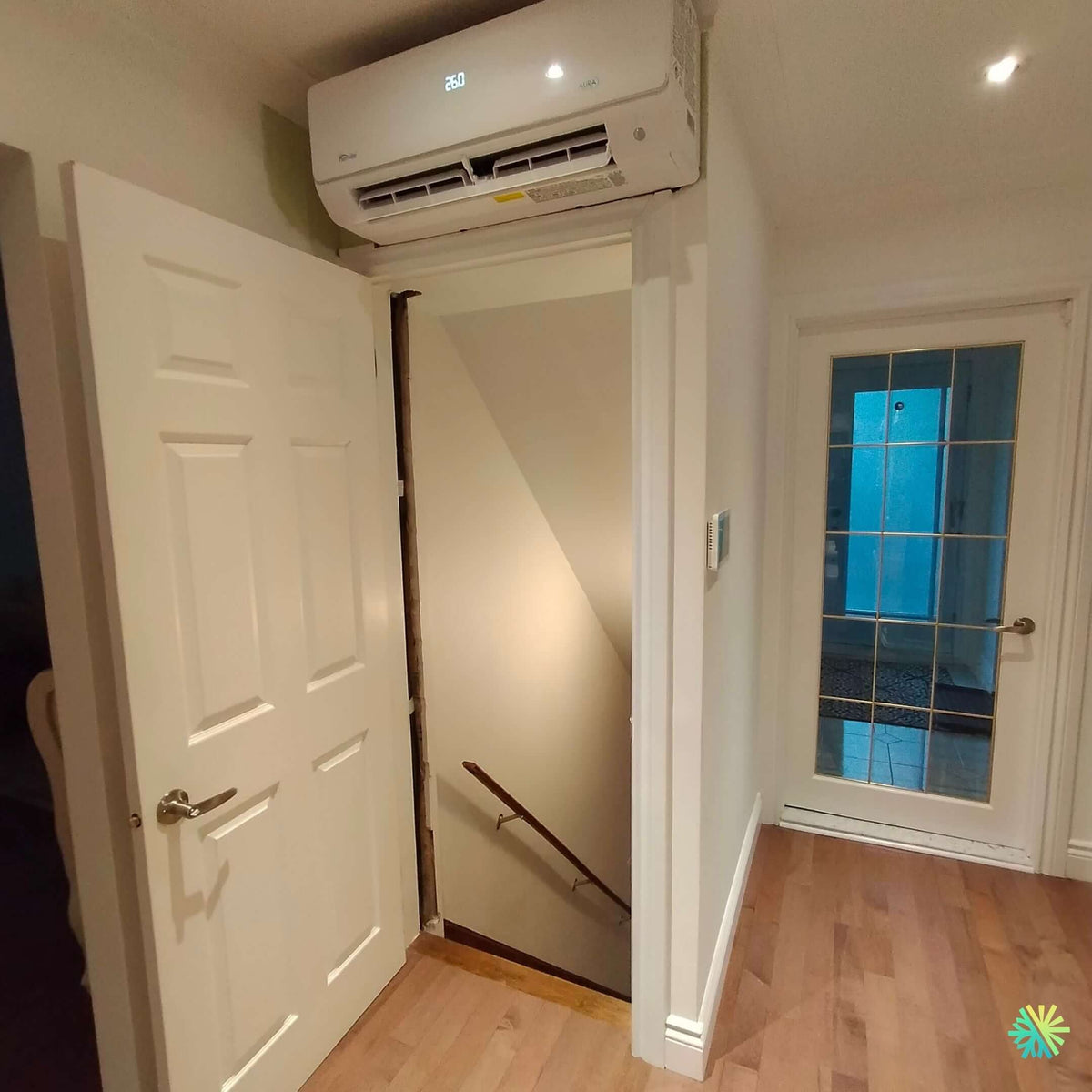
An indoor head positioned on the landing to heat and air condition the entire floor
In a renovated cottage in Montreal , Villeray–Saint-Michel–Parc-Extension district, we are installing aMidea wall-mounted heat pump to provide efficient cooling in the summer and economical supplemental heating the rest of the year. The client is looking for a discreet system, capable of supplying several rooms without invasive work or visible ducts. Our proposal: an interior head at the staircase landing , a strategic location to circulate air towards the bedrooms and living room, with careful installation that respects the existing moldings and openings.
Indoor Head Positioning: The Key to Airflow
The wall unit is installed high under the ceiling , directly above the stairwell. This choice allows:
-
controlled stratification : the cooled air descends naturally in summer;
-
a sweep that pushes conditioned air towards the corridor and adjacent rooms;
-
easy air return from the staircase, limiting dead zones;
-
aesthetic integration : clearance preserved around door frames.
We maintain the manufacturer's recommended clearance above and to the sides (free space to promote air intake and for maintenance access). The directional vanes are adjusted to avoid any direct jet onto the passageway and to direct the air towards the corridor and bedrooms.
Finishing details and integration into the envelope
The hallway features moldings and an adjacent door frame . The headboard layout takes into account:
-
full opening of the doors without interference with the housing;
-
from a minimalist technical channel to the drilling point;
-
clean filling of the crossings with vapor barrier sealant and paint finish.
A section of wall is opened along the frame to take up the refrigeration connections and the electrical supply ; after leak tests and functional tests, it is closed and pulled at the joint to preserve the aesthetics of the corridor.
Condensate management: gravity when possible
The inner head is installed with a slight outward flow slope . When gravity is not sufficient, we integrate a silent condensate pump , equipped with a check valve and a vibration damper. Here, the layout favors a natural flow for reliability and silence, with an extended evacuation test at the end of the installation.
Midea Equipment Specifications
The Midea wall-mounted unit selected is one of the latest generations with inverters that finely modulate power. Depending on the surface area served, we generally offer:
-
9,000 to 12,000 BTUs for a bedroom or office;
-
12,000 to 18,000 BTU for a landing serving several rooms;
-
18,000 to 24,000 BTUs for a more generous open area.
For projects aiming for maximum efficiency and a better environmental footprint, we recommend the Midea28 range (R-454B) or the R-32 series (Midea25/Midea35) when the sizing justifies it. The final choice is validated by calculation (losses/loads), taking into account insulation, sunlight and ceiling height.
Midea’s advantages for Montreal:
-
Efficient heating at low temperatures in the off-season;
-
Inverter compressor for temperature stability and low noise ;
-
Easy filtration and maintenance (washable filters);
-
Discreet temperature display on the front;
-
Compatibility with the criteria of several grant programs when the model meets the required performance thresholds.
Refrigerated and electrical journey: cleanliness and sustainability
The drilling is done with an outward slope to avoid any risk of infiltration. The insulated copper tubes are sheathed and protected against abrasion at the crossing points. On the outside, the connections are capped in a UV-resistant capping; on the inside, they are boxed for a clean finish.
On the electrical side, the line is dedicated from the main panel and protected by an appropriate circuit breaker. The external disconnect switch is positioned within easy reach of the technician. Everything complies with the Canadian Electrical Code and the manufacturer's specifications.
Noise, vibrations and acoustic comfort
The Midea head operates at low speed in maintenance mode thanks to inverter modulation. We configure:
-
silent night mode ;
-
auto speed with comfort priority;
-
the orientation of fins to avoid whistling against the frames.
The indoor unit is anchored to a solid, level plate ; the dowels are adapted to the support to eliminate unwanted vibrations.
Defrosting and winter behavior
In heating, the machine manages intelligent defrost cycles . The condenser's location (courtyard side) provides sufficient clearances to allow the evacuation of condensation and defrost water without hindering circulation. In periods of intense cold, the heat pump provides very economical backup , and the residence retains its main system as needed.
Result: uniform comfort on two levels
The landing installation acts as a broadcast hub :
-
Rapid cooling of rooms and corridor;
-
Comfortable additional heating when getting up and in the evening;
-
Intuitive controls with clear display of the instructions;
-
The aesthetics of the corridor are maintained thanks to the integrated path and the clean plasterwork.
HVAC Maintenance: Simple Actions, Long-Lasting Benefits
To maintain yields :
-
Rinse filters every 4 to 8 weeks during the season;
-
Carry out annual maintenance : pressure check, electrical check, inspection of the condensate pump, gentle cleaning of the exchanger;
-
Clear snow from the outdoor condenser in winter (if there is accumulation);
-
Check the capping and sealing of the crossings every spring.
Regular maintenance stabilizes consumption and extends lifespan.
Grants and Eligibility
In Greater Montreal ( Montreal, Laval, Longueuil, North Shore, South Shore ), some high-efficiency heat pumps meet provincial/federal program criteria. Eligibility depends on seasonal performance and low-temperature capacity maintenance. We validate these points upon submission and provide the required documentation (serial numbers, technical data sheets, AHRI certificates when requested).
Layout advice for landings and corridors
-
Leave ≥ 10–15 cm above the unit for air intake;
-
Position the head perpendicular to the flow towards the corridor to extend the reach;
-
Avoid obstacles (piers, partition returns) which create vortices ;
-
In the presence of glass doors , direct the air to break up solar radiation in summer;
-
Provide maintenance access without dismantling permanent structures.
What we deliver to every installation
-
Clear and transparent sizing (BTUs adapted to the room);
-
Careful finishing of drillings and rework;
-
Compliant electrical measurements and accessible disconnector;
-
Commissioning with surveys and rapid user training;
-
HVAC maintenance plan and recommended schedule.
AirGreen: your HVAC partner in Montreal, Laval, Longueuil, North Shore and South Shore
Our team supports owners of plexes, cottages, and condos in Greater Montreal . Our preferred brands— Midea, Gree, Fujitsu, Sharp , among others—allow us to precisely tailor the solution to the layout of the premises and the budget. A successful HVAC installation starts with a good location and impeccable execution : this is exactly what we implement on every project.
Technical FAQ (selection)
Why install the head on the landing rather than in a bedroom?
To serve multiple rooms with a single head and maximize natural air circulation between levels.
Does the wall unit replace a main heating system?
It provides a very economical and comfortable backup . Depending on the house, a main system is still required for cold peaks .
Can existing connections be reused?
Only if they meet the diameters and condition required by the new model. Otherwise, we replace them to guarantee performance and durability.
What noise to expect?
In steady state, the Midea head operates at a low noise level ; the adjustment of the vanes and the automatic speed optimize the acoustic comfort of the corridor and bedrooms.
AirGreen responds quickly throughout Greater Montreal and offers detailed quotes with BTU recommendations, site evaluation and support for grants where applicable.
The big day, step by step
The main steps of this kind of job at AirGreen. Every house has its quirks: the estimate brings them out.
We look at the room, the outside wall, the line route and where the outdoor unit will go. That is where the capacity gets chosen.
Model, capacity and price, in writing. We also check whether the model qualifies for assistance programs.
Floors and furniture protected, wall plate position marked level, wall opening located.
A single opening, with the slope the drain needs to flow outside.
Set on a stand raised above the snow, with the clearances the manufacturer requires.
Connected, insulated and protected. The opening is then sealed against water, cold air and insects.
A dedicated circuit and an accessible disconnect near the outdoor unit.
Leak test, vacuum, then start-up and a check of heating and cooling.
Remote, modes, filters: we show you the essentials before we leave.
- The on-site estimateWe look at the room, the outside wall, the line route and where the outdoor unit will go. That is where the capacity gets chosen.
- The quoteModel, capacity and price, in writing. We also check whether the model qualifies for assistance programs.
- Getting readyFloors and furniture protected, wall plate position marked level, wall opening located.
- The wall openingA single opening, with the slope the drain needs to flow outside.
- The outdoor unitSet on a stand raised above the snow, with the clearances the manufacturer requires.
- Lines, cable and drainConnected, insulated and protected. The opening is then sealed against water, cold air and insects.
- The electrical workA dedicated circuit and an accessible disconnect near the outdoor unit.
- Tests and start-upLeak test, vacuum, then start-up and a check of heating and cooling.
- The walkthroughRemote, modes, filters: we show you the essentials before we leave.
What would it look like at your place?
Two quick checks with real numbers: what heat costs, and what your current heaters add up to in BTU/h.
Conversion: 1 W = 3.412 BTU/h. An indication, not a load calculation: baseboards and furnaces are often stronger than the real need, and they can stay as backup. AirGreen confirms the capacity on site.
Four mistakes we do not make
Flip each card to see what we do instead.
Your own project, step by step
What to do, season by season
Three habits per season for this unit. They take a few minutes and prevent many calls.
- Clean the indoor unit's filters.
- Clear leaves and debris left on the outdoor unit by winter.
- Test cooling before the first hot days.
- Clean the filters more often when the unit runs a lot.
- Keep plants away from the outdoor unit.
- Check that no water drips from the indoor unit.
- Rake the leaves around the outdoor unit.
- Test heating before the first cold days.
- Book periodic maintenance before winter.
- Keep snow away from the stand and the front of the unit.
- Let the unit defrost: it is normal.
- Never hit the ice on the fins; call us if the unit stays iced up.
Is your home ready?
Check what applies at your place. A "no" is not a refusal: it is what we sort out during the estimate.
Four statements: true or false?
It all comes down to details you have just seen.
1. In heating mode, the outdoor unit can produce water.
During defrost cycles. That water must drain away without forming ice.
2. You pick the capacity with a simple square-footage rule.
Windows, insulation, orientation and how the room is used all count. Capacity is chosen on site.
3. A multi-zone connects several indoor heads to a single condenser.
One head per room, all on the same condenser. Each room keeps its own temperature.
4. The disconnect can sit behind the patio furniture.
It must stay accessible: it is what shuts the unit off for service.
0 / 4 right answers
What people ask us about this kind of work
Does a wall-mounted heat pump heat in winter?
Wall-mounted or multi-zone: how do I choose?
Where does the outdoor unit go?
Are there grants?
Do I need a permit?
How cold can it heat?
How much can I save?
How is the LogisVert assistance calculated?
Is it noisy?
The outdoor unit is covered in ice: is that normal?
Does AirGreen hold the required licences?
Is the estimate free?
No question matches. Write to us: we answer.
More jobs to see, near you
By town, by equipment or by region: browse more than 4,700 published projects.
Each dot: a town where AirGreen has published projects. The glowing dot: this job.
Every house has its constraints. We see them before we install.
The on-site estimate is free and the quote follows within 24 hours.
Text and photo: a real AirGreen Climatisation & Chauffage job. The diagrams are generic illustrations of the type of installation, not a survey of this job site. Sources of the added figures: airgreen.ca product pages (NEEP / AHRI performance), Hydro-Québec (Heat pumps page, LogisVert, read on 13 October 2026), Régie de l’énergie (rate D as of 1 April 2026).