
Installation of a Sharp Eco Inverter wall-mounted heat pump in Saint-Laurent
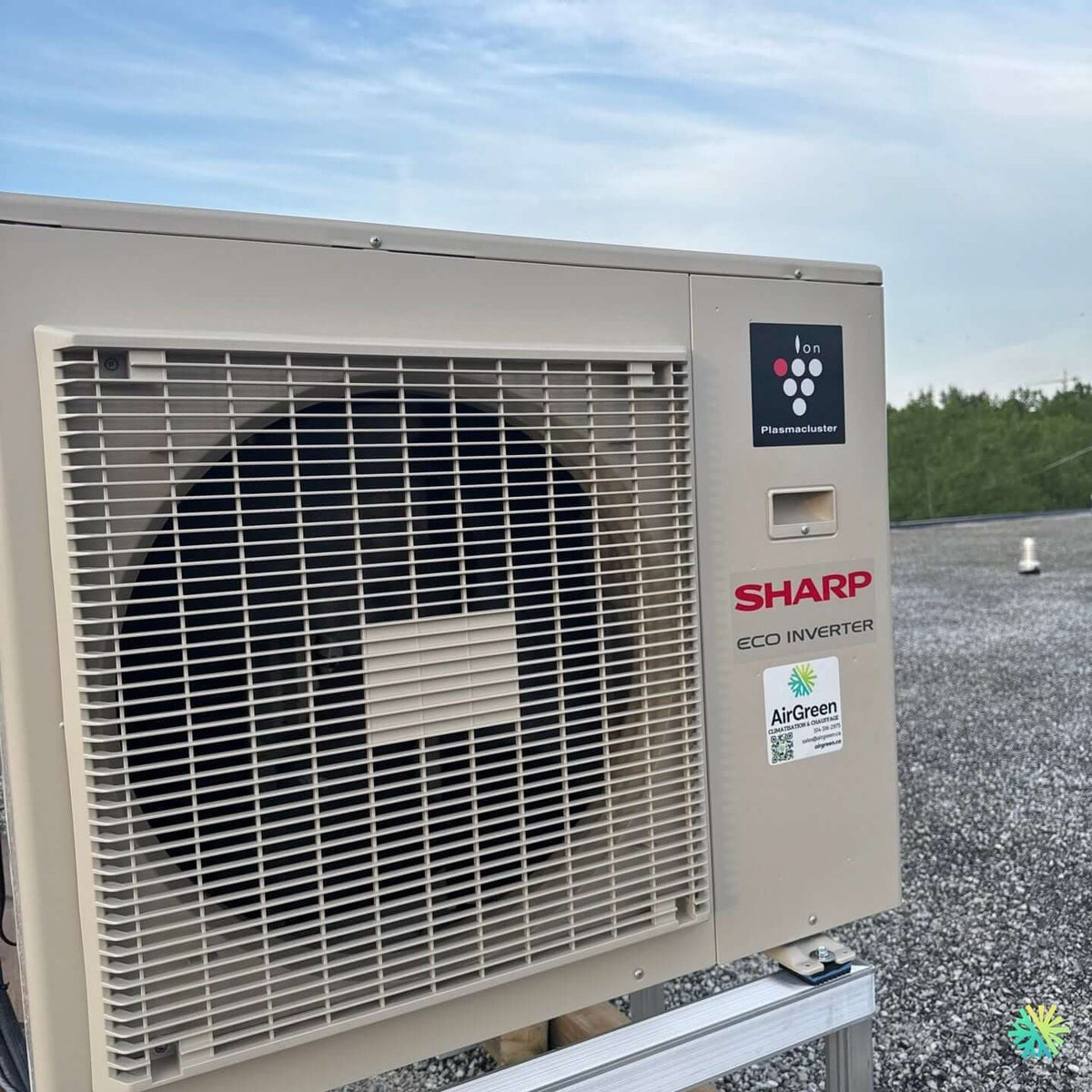
AirGreen installs a Sharp Eco Inverter wall-mounted heat pump on a flat roof in Saint-Laurent . Anti-vibration mounting, hooded path, rigorous commissioning for four-season comfort. HVAC service in Greater Montreal.
- City
- Region
- Equipment
- Brand
- Challenges
- Published
The job on one screen
The article, chapter by chapter
A flat roof construction site designed to last
At AirGreen , we have just completed the installation of a Sharp Eco Inverter wall-mounted heat pump for a rental building in the Saint-Laurent sector (Montreal) . The outdoor condenser is positioned on the gravelled flat roof , an environment that requires rigorous methodology: membrane protection, load management, air circulation, safety clearances and maintenance access. Our intervention highlights what we do every day: deliver a safe, clean HVAC installation perfectly adapted to the Montreal climate .
From the planning stage, we evaluated the ideal route for the refrigeration lines and wiring between the indoor and outdoor units. The goal: reduce pressure losses, limit bends, protect the pipes from UV rays and frost, and ensure a neat appearance both inside and out. The result is a stable, quiet, and efficient system, ready to provide comfort in both heating and cooling.
Why the Sharp wall-mounted heat pump is an excellent choice in Montreal
The wall-mounted heat pump is a must-have in many homes in Montreal, Laval, Longueuil, on the South Shore and the North Shore thanks to its high efficiency and installation flexibility . Sharp's Eco Inverter range is distinguished by:
-
variable speed technology that continuously adjusts power and reduces electricity consumption;
-
discreet operation , ideal for living rooms;
-
even air distribution thanks to the design of the blower;
-
reliability in cold climates when commissioning and defrosting are configured according to the rules of the art.
In the chosen configuration, the interior head serves a main living space. Typical capacities for such a unit are between 12,000 and 18,000 BTU , a relevant sizing for open spaces such as Montreal living room-kitchen. Comfort is guaranteed in both summer and winter, with fine modulation that avoids jolts and temperature variations.
Design and roof mounting: stability, watertightness and silence
The Sharp outdoor unit sits on a galvanized steel frame attached to anti-vibration feet to:
-
protect the roof membrane and distribute the loads;
-
limit the transmission of vibrations to the structure;
-
raise the condenser above snow and runoff water;
-
maintain sufficient clearances around the fan for optimal air circulation.
We plan service paths around the unit to facilitate maintenance (exchanger cleaning, seasonal checks). The fasteners are sized to withstand the gusts and wind loads specific to the Saint-Laurent plateau, and the metal elements are treated against corrosion .
Refrigeration path and power supply: cleanliness and compliance
The refrigerant connections (liquid/gas) are thermally insulated along their entire length and capped as soon as they become visible. The path follows a direct route to the inner head to minimize:
-
the number of elbows (better compressor efficiency);
-
heat losses in heating mode;
-
the risks of infiltration (all crossings are sealed).
The power supply includes an accessible proximity disconnect switch , compliant with RBQ/CSA requirements. The communication cable is separated from the power lines to avoid interference. Condensate is managed by gravity with a controlled slope; when pumping is necessary, we install a condensate pump with a safety tank and alarm. In this project, gravity flow was preferred, which simplifies maintenance and limits wear parts.
Execution details that make the difference
-
Optimized defrosting : In heating mode, the unit periodically enters defrosting mode. We calibrate these cycles to prevent ice buildup under the unit and preserve the membrane thanks to a protective mat under the drain area.
-
Cable Management : Harnesses are secured with UV clamps and sleeved at potential abrasion points.
-
Water drainage : a slight slope of the support promotes flow and prevents stagnation near electrical parts.
-
Maintenance access : clearance provided on the exchanger side and electrical box side for reading pressures, leak testing, adding charge if necessary.
Commissioning and performance checks
A deep vacuum is applied before opening the valves to ensure a moisture- and air-free circuit. Checks include:
-
Nitrogen leak test ;
-
Vacuum draw to the required threshold;
-
Checking the load currents and voltages;
-
Measurement of supply/return temperatures to validate the delta T in heating and cooling;
-
Setting user functions (speeds, shutters, night mode).
These steps determine the system's durability and energy performance . A well-commissioned device offers controlled consumption and a stable temperature, even during cold peaks.
Interior aesthetics and comfort of use
Inside, the wall head is placed on a metal mounting plate with anti-vibration mounts . The white cover of the connections fits in with most decors. We ensure:
-
position the air outlet so as to sweep the living area without blowing directly on the occupants;
-
clear the top of the unit (at least 10–15 cm) for good air intake;
-
avoid obstacles (rods, cornices, high furniture) which would impair diffusion.
The customer benefits from simple control (remote control) and, if desired, a Wi-Fi module to program temperatures and schedules. In summer, the dehumidification function improves perceived comfort while limiting consumption.
HVAC Maintenance: Maintaining Efficiency Year After Year
An annual maintenance is recommended, ideally in the spring. Our service includes:
-
cleaning of filters, coils and tank ;
-
checking pressures and defrost cycle;
-
checking connections (tightening torques, terminal blocks);
-
inspection of the roof support (condition of the feet, screws, membrane);
-
energy assessment with usage advice.
In addition to air quality , this maintenance extends the life of the compressor and maintains seasonal performance , which determines eligibility for certain financial assistance . Our team supports owners with the procedures applicable in Greater Montreal (Montreal, Laval , Longueuil , South Shore , North Shore ).
Common Mistakes to Avoid (and How We Prevent Them)
-
Undersizing or oversizing : we carry out a simplified load calculation in order to adjust the capacity (BTU) to the thermal reality of the housing.
-
Too long connection path : we optimize the length and check the manufacturer's limits (length/height) to preserve the COP.
-
Absence of disconnector or inaccessible position: always present, visible and reachable .
-
Support directly on the membrane : prohibited. We use anti-vibration feet and suitable interfaces.
-
Hazardous condensate drainage : slopes respected, insulation against frost in exposed sections.
Results: comfort, silence and savings
As soon as it was put into service, the occupants noticed:
-
even blowing and rapid temperature rise ;
-
a contained noise level of the condenser thanks to the anti-vibration support;
-
smoothed consumption via the inverter, favorable to savings compared to electric baseboards.
Beyond immediate comfort, the installation increases the energy value of the building while preparing for the future: modularity, compatibility with good efficiency practices and simplified maintenance .
Summary sheet
| Element | Details |
|---|---|
| Place | Saint-Laurent, Montreal |
| Device type | Wall-mounted heat pump (outdoor unit on flat roof) |
| Brand | Sharp – Eco Inverter |
| Recommended capacity | 12,000 to 18,000 BTU depending on the room |
| Support | Galvanized steel frame on anti-vibration feet |
| Course | Isolated and covered connections, direct route, sealed crossings |
| Food | Proximity disconnect switch , RBQ/CSA compliant wiring |
| Condensates | Gravity with controlled slope |
| Special features | Optimized defrosting, air releases, secure maintenance access |
AirGreen, your HVAC partner in Greater Montreal
We support building owners and managers in Montreal, Laval, Longueuil, the South Shore, and the North Shore . Our promise: clean, compliant, and durable installations , meticulous commissioning , and maintenance monitoring that protects your investment. Do you have a flat roof or a constrained urban context? We design a custom HVAC installation that is as reliable as it is aesthetically pleasing.
The job tools
Two quick checks with real numbers: what heat costs, and what your current heaters add up to in BTU/h.
Conversion: 1 W = 3.412 BTU/h. An indication, not a load calculation: baseboards and furnaces are often stronger than the real need, and they can stay as backup. AirGreen confirms the capacity on site.
How the job unfolds
The main steps of this kind of job at AirGreen. Every house has its quirks: the estimate brings them out.
We look at the room, the outside wall, the line route and where the outdoor unit will go. That is where the capacity gets chosen.
Model, capacity and price, in writing. We also check whether the model qualifies for assistance programs.
Floors and furniture protected, wall plate position marked level, wall opening located.
A single opening, with the slope the drain needs to flow outside.
Set on a stand raised above the snow, with the clearances the manufacturer requires.
Connected, insulated and protected. The opening is then sealed against water, cold air and insects.
A dedicated circuit and an accessible disconnect near the outdoor unit.
Leak test, vacuum, then start-up and a check of heating and cooling.
Remote, modes, filters: we show you the essentials before we leave.
- The on-site estimateWe look at the room, the outside wall, the line route and where the outdoor unit will go. That is where the capacity gets chosen.
- The quoteModel, capacity and price, in writing. We also check whether the model qualifies for assistance programs.
- Getting readyFloors and furniture protected, wall plate position marked level, wall opening located.
- The wall openingA single opening, with the slope the drain needs to flow outside.
- The outdoor unitSet on a stand raised above the snow, with the clearances the manufacturer requires.
- Lines, cable and drainConnected, insulated and protected. The opening is then sealed against water, cold air and insects.
- The electrical workA dedicated circuit and an accessible disconnect near the outdoor unit.
- Tests and start-upLeak test, vacuum, then start-up and a check of heating and cooling.
- The walkthroughRemote, modes, filters: we show you the essentials before we leave.
What we check on a job like this one
Each number is a point we check on site. Switch between summer and winter to watch air and heat move.
In summer, the outdoor unit rejects the house's heat outside.
Generic illustration of this type of installation, not a survey of this job site. Tap a number.
Mounted level on a wall plate, high enough for the air to reach the whole room, with enough space around it to slide the filters out easily.
The refrigerant lines, the communication cable and the drain go through the wall in a single opening, sealed against water, cold air and insects.
Two insulated copper pipes connect the two units. Outside, a line cover can protect them from sun, knocks and weather.
A shut-off switch near the outdoor unit isolates it safely for service. It must stay accessible at all times.
The compressor and the fan. In heating mode it captures heat from the outdoor air, even in winter, and moves it inside.
On the ground or on the wall, it keeps the unit above accumulated snow. The unit stays clear and defrost water can drain away.
The fan needs to blow freely. Storage, a fence or a wall too close, and efficiency drops while noise goes up.
Is your home ready?
Check what applies at your place. A "no" is not a refusal: it is what we sort out during the estimate.
Good habits, once the unit is in place
Six simple habits that keep the unit going. Your list stays on this device.
What to do, season by season
Three habits per season for this unit. They take a few minutes and prevent many calls.
- Clean the indoor unit's filters.
- Clear leaves and debris left on the outdoor unit by winter.
- Test cooling before the first hot days.
- Clean the filters more often when the unit runs a lot.
- Keep plants away from the outdoor unit.
- Check that no water drips from the indoor unit.
- Rake the leaves around the outdoor unit.
- Test heating before the first cold days.
- Book periodic maintenance before winter.
- Keep snow away from the stand and the front of the unit.
- Let the unit defrost: it is normal.
- Never hit the ice on the fins; call us if the unit stays iced up.
The right pages, at the right time
Four statements: true or false?
It all comes down to details you have just seen.
1. In heating mode, the outdoor unit can produce water.
During defrost cycles. That water must drain away without forming ice.
2. You pick the capacity with a simple square-footage rule.
Windows, insulation, orientation and how the room is used all count. Capacity is chosen on site.
3. A multi-zone connects several indoor heads to a single condenser.
One head per room, all on the same condenser. Each room keeps its own temperature.
4. The disconnect can sit behind the patio furniture.
It must stay accessible: it is what shuts the unit off for service.
0 / 4 right answers
What people ask us about this kind of work
Does a wall-mounted heat pump heat in winter?
Wall-mounted or multi-zone: how do I choose?
Where does the outdoor unit go?
Are there grants?
Do I need a permit?
How cold can it heat?
How much can I save?
How is the LogisVert assistance calculated?
Is it noisy?
The outdoor unit is covered in ice: is that normal?
Does AirGreen hold the required licences?
Is the estimate free?
No question matches. Write to us: we answer.
More jobs to see, near you
By town, by equipment or by region: browse more than 4,700 published projects.
Each dot: a town where AirGreen has published projects. The glowing dot: this job.
An on-site estimate, the right capacity, the right equipment.
The on-site estimate is free and the quote follows within 24 hours.
Text and photo: a real AirGreen Climatisation & Chauffage job. The diagrams are generic illustrations of the type of installation, not a survey of this job site. Sources of the added figures: airgreen.ca product pages (NEEP / AHRI performance), Hydro-Québec (Heat pumps page, LogisVert, read on 13 October 2026), Régie de l’énergie (rate D as of 1 April 2026).