
Installation of a Sharp (ZU1 series) wall-mounted heat pump in Le Sud-Ouest
In Verdun, AirGreen installs a Sharp wall-mounted heat pump : anti-vibration aluminum base, protected connections, external circuit breaker and careful commissioning. Four-season comfort for Montreal, Laval, Longueuil, North Shore and South Shore.
- City
- Region
- Equipment
- Brand
- Challenges
- Published
The job on one screen
The unit’s data sheet
The range as published on airgreen.ca: pick a size to see its capacity in deep cold.
| Size | Heating at −8 °C | Heating at −15 °C | Coldest certified point | COP at −15 °C | SEER | HSPF | Indicative LogisVert aid |
|---|---|---|---|---|---|---|---|
| Sharp ZU1 12 000 | 14,500 | 12,000 | −27 °C: 7,200 | 2.11 | 22.0 | 11.0 | $1,740 |
| Sharp ZU1 15 000 | 18,100 | 15,300 | −27 °C: 10,100 | 2.1 | 24.0 | 11.0 | $2,172 |
| Sharp ZU1 18 000 | 22,000 | 18,000 | −27 °C: 11,500 | 2.2 | 24.0 | 11.0 | $2,640 |
| Sharp ZU1 24 000 | 22,400 | 19,000 | −27 °C: 12,300 | 2.2 | 22.0 | 11.0 | $2,688 |
According to NEEP, it delivers 14,500 BTU/h at −8 °C (17 °F), more than at 8 °C (14,000 BTU/h). It heats as hard in moderate cold as in mild weather.
According to NEEP, its certified maximum capacity at −27 °C (−17 °F) is 7,200 BTU/h, 60% of its nominal 12,000 BTU size.
At 8 °C, its certified maximum capacity reaches 17,100 BTU/h, 42% more than its nominal 12,000 BTU size.
According to NEEP, it delivers 18,100 BTU/h at −8 °C (17 °F), more than at 8 °C (18,000 BTU/h). It heats as hard in moderate cold as in mild weather.
According to NEEP, its certified maximum capacity at −27 °C (−17 °F) is 10,100 BTU/h, 67% of its nominal 15,000 BTU size.
At 8 °C, its certified maximum capacity reaches 21,800 BTU/h, 45% more than its nominal 15,000 BTU size.
According to NEEP, it delivers 22,000 BTU/h at −8 °C (17 °F), more than at 8 °C (21,600 BTU/h). It heats as hard in moderate cold as in mild weather.
According to NEEP, its COP at −27 °C is 1.88: the highest of the ZU1 line, which ranges from 1.79 to 1.82 at that temperature.
According to NEEP, its certified maximum capacity at −27 °C (−17 °F) is 11,500 BTU/h, 64% of its nominal 18,000 BTU size.
At −27 °C, its certified minimum capacity is 3,200 BTU/h (5,500 at 8 °C). It slows down instead of cycling on and off.
According to NEEP, its certified heating capacity at −15 °C (5 °F) is 19,000 BTU/h, 79% of its nominal 24,000 BTU size. Its COP there is 2.20.
Data read live from the airgreen.ca page of each size (NEEP / AHRI certified performance). When the title names the installed size, it is highlighted; otherwise the whole range is shown. The aid shown is today’s, using Hydro-Québec’s rule ($120 per 1,000 BTU/h at −8 °C); amounts quoted in the article date from its publication. Only Hydro-Québec confirms the assistance granted.
The article, chapter by chapter
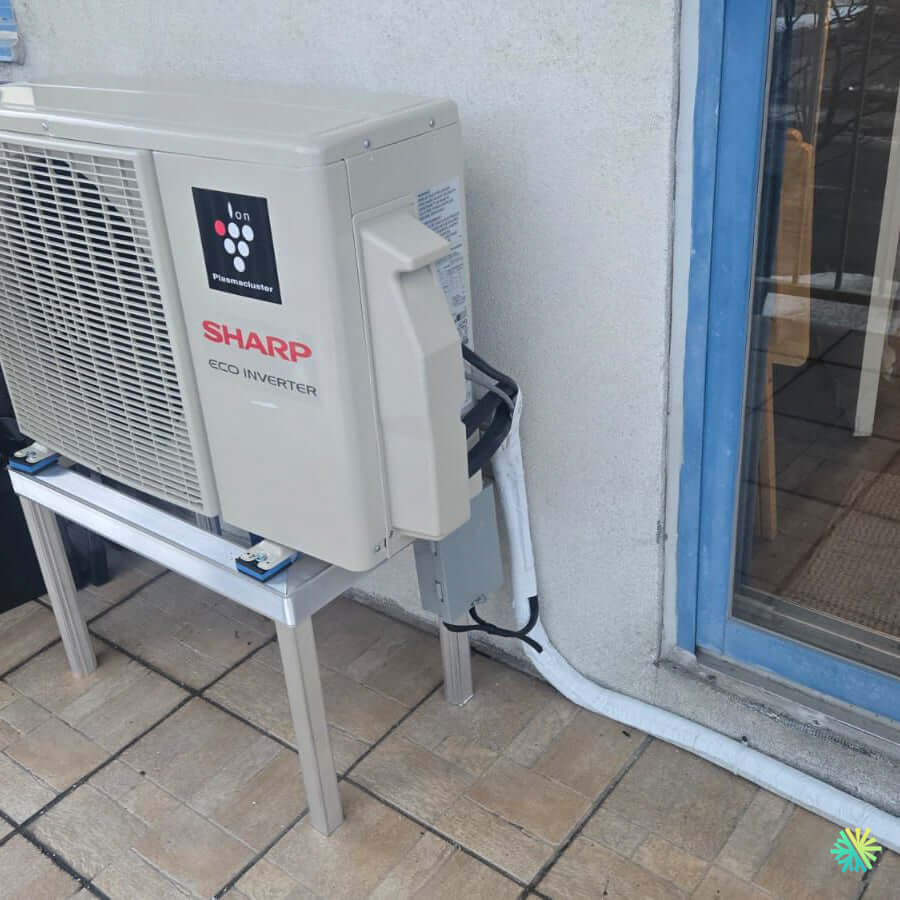
Careful integration on the terrace: condenser on an aluminum base, protected connections, accessible circuit breaker and R-32 performance for 4-season comfort without disturbance.
The context: a garden level in Verdun
In Verdun , a residential neighborhood popular for its plexes and ground-level terraces, we are modernizing a home with direct outdoor access. The goal: to install a recent Sharp wall-mounted heat pump (R-32 range) to provide air conditioning in the summer and efficient supplemental heating in the winter, while maintaining circulation on the patio. The site has a stucco wall , an adjacent patio door , and limited ground clearance due to the layout of the terrace.
Expectations defined with the client
-
Stable and quiet comfort in the main living area.
-
Minimum floor space on the terrace.
-
Easy HVAC maintenance (circuit breakers, clearances).
-
Aesthetics and durability in the face of Montreal's freeze-thaw environment.
Why a wall-mounted Sharp for this type of home?
Sharp's latest-generation units combine high-modulation inverter and Plasmacluster air treatment technology for a healthier interior. In heating mode, the machine maintains useful capacity at low outdoor temperatures, which meets the needs of Greater Montreal . Fine-tuning limits short cycles and lowers consumption in mid-season.
Concrete benefits:
-
Very fast load ramp-up and ramp-down thanks to the inverter compressor .
-
Quiet operation, essential in living rooms adjoining the terrace.
-
R-32 : new generation refrigerant, with lower GWP than R-410A.
-
Controlled interior diffusion via the wall head, with motorized sweep to homogenize the temperature.
Outdoor installation: stability, security, longevity
On the terrace, we install the Sharp condenser on an aluminum base with blue anti-vibration pads . This assembly:
-
Elevates equipment to protect it from snow, runoff and ice deposits.
-
Reduces the transmission of vibrations to the patio floor.
-
Prevents clogging by dust and leaves.
An external circuit breaker is located nearby to provide electrical isolation for maintenance. The refrigeration connections and the control system are sheathed and protected by a UV-resistant white cap . A service loop at the base of the condenser prevents mechanical stress on the connections during thermal expansion.
Clearances and air circulation
We respect the side and front clearances recommended by the manufacturer to guarantee:
-
Free convection through the exchanger.
-
Efficient defrost cycles in winter.
-
Maintenance without heavy disassembly.
Wall passage and interior integration
The drilling is carried out with a slight slope towards the outside to facilitate the evacuation of condensates from the interior head in air conditioning mode (gravity drain). We install a sleeve and elastomeric caulking for air and water tightness, essential on rendered walls.
Route of the connections:
-
Pre-flared and continuously insulated copper pair (taped joints to ensure vapor barrier ).
-
Communication and power cable in the same capping for a clean finish.
-
Estimated total length 2 to 3 m between the head and the condenser: low pressure losses and zero or minimal additional refrigerant quantity depending on the capacity.
Inside, the head is positioned high up for optimal room coverage while avoiding air recycling under the ceiling. The aesthetic is discreet; only the motorized shutter remains visible, ready to direct the flow.
Technical steps of HVAC installation
-
Site preparation : protection of the terrace and patio door, location of networks, validation of the drilling point.
-
Fixing the base : stainless steel anchors on slabs; checking for plumbness and rigidity .
-
Installing the inner plate : checking clearances and level to avoid flow noises.
-
Through drilling and sleeve of the wall; installation of the controlled slope drain .
-
Routing of refrigeration connections and sealing of the capping.
-
Connections : Flare couplers tightened to the prescribed torque ; circuit breaker connected, grounding checked, circuit breaker dedicated to the panel.
-
Long-term vacuum (target < 500 microns) and resistance test; fluid release and controls (intensity, superheat/subcooling, delta T).
-
Settings : mode, fan speed, sweep; recording of commissioning values in the AirGreen file.
Winter management: de-icing, condensates, snow
-
The base elevates the unit to prevent snow from being sucked in and to allow defrost water to drain away without stagnating in front of the patio door.
-
A soil slope profile is considered to divert water away from traffic areas.
-
Instructions for use: Clear the front of the unit of snow if there is a heavy accumulation and keep the rear clear.
Result: comfort and silence every day
The customer benefits from rapid cooling during hot weather and additional heating that relieves the burden on old electric convectors. The noise level remains very low on automatic speeds; the sweep function distributes the air without any perceived drafts.
Maintenance and best practices
-
Filters : clean every 4 to 6 weeks during intensive use.
-
Annual inspection : pressures, connections, condensate drainage, condition of capping.
-
Instructions : avoid extreme instructions; prefer a stable temperature for the heat pump in order to optimize the COP .
-
Winter: Keep clearance in front of the condenser; do not cover the unit.
Sizing: Choosing the Right Capacity
For a garden level of 350 to 550 sq ft with average insulation, a 12,000 BTU is often ideal. We analyze:
-
Orientation and solar gain via the patio door.
-
Building sealing and air renewal.
-
Occupation profile (teleworking days, evenings, weekends).
If several closed rooms need to be served, we offer a MultiZone Sharp or a combination with interior systems (cassette/floor-ceiling) depending on the configuration.
Grants and local compliance
Recent high-efficiency wall-mounted heat pumps may be eligible for programs in Quebec, subject to certifications and performance in extreme cold. We support our customers in Montreal, Laval, Longueuil, the North Shore, and the South Shore for:
-
Check the technical criteria .
-
Estimate the savings .
-
Prepare the file in good and due form.
The installation complies with the Quebec Electrical Code : dedicated circuit breaker , external circuit breaker , compliant grounding and caulking resistant to freeze-thaw cycles.
Common mistakes… avoided by our methodology
-
Condenser placed directly on the ground : here, aluminum base for snow and durability.
-
Exposed capping not watertight : neat joints and outlets; service loop to relieve connections.
-
Insufficient clearances : strict compliance with heat exchange and maintenance.
-
Counter-slope drain : level check and flow test before delivery to the customer.
AirGreen, your local HVAC partner
Our teams are familiar with Verdun terraces and Montreal plexes , as well as their constraints: noise , vibrations , harsh winters , and restricted spaces . Our approach prioritizes a durable, easy-to-maintain, and aesthetically pleasing HVAC installation —a crucial point when the unit is located next to a heavily used patio door .
Next step
Are you looking for a Sharp wall-mounted heat pump or a recent R-32 / R-454B alternative for Verdun and Greater Montreal? We offer a technical visit with sizing, support options (wall, slab, base), and work planning without disrupting your daily life.
The job tools
Two quick checks with real numbers: what heat costs, and what your current heaters add up to in BTU/h.
Baseboards and electric furnaces turn 1 kWh of electricity into 1 kWh of heat. A heat pump delivers more: that is its COP. At Hydro-Québec’s rate D (11.142¢/kWh above 40 kWh a day, since 1 April 2026):
Hydro-Québec: a heat pump can be up to three times more efficient than baseboards for heating in the colder months.
Estimate per kWh of heat, at the chosen temperature, using the certified COP from the product page. Taxes, access charge and backup heat not included.
Conversion: 1 W = 3.412 BTU/h. An indication, not a load calculation: baseboards and furnaces are often stronger than the real need, and they can stay as backup. AirGreen confirms the capacity on site.
How the job unfolds
The main steps of this kind of job at AirGreen. Every house has its quirks: the estimate brings them out.
We look at the room, the outside wall, the line route and where the outdoor unit will go. That is where the capacity gets chosen.
Model, capacity and price, in writing. We also check whether the model qualifies for assistance programs.
Floors and furniture protected, wall plate position marked level, wall opening located.
A single opening, with the slope the drain needs to flow outside.
Set on a stand raised above the snow, with the clearances the manufacturer requires.
Connected, insulated and protected. The opening is then sealed against water, cold air and insects.
A dedicated circuit and an accessible disconnect near the outdoor unit.
Leak test, vacuum, then start-up and a check of heating and cooling.
Remote, modes, filters: we show you the essentials before we leave.
- The on-site estimateWe look at the room, the outside wall, the line route and where the outdoor unit will go. That is where the capacity gets chosen.
- The quoteModel, capacity and price, in writing. We also check whether the model qualifies for assistance programs.
- Getting readyFloors and furniture protected, wall plate position marked level, wall opening located.
- The wall openingA single opening, with the slope the drain needs to flow outside.
- The outdoor unitSet on a stand raised above the snow, with the clearances the manufacturer requires.
- Lines, cable and drainConnected, insulated and protected. The opening is then sealed against water, cold air and insects.
- The electrical workA dedicated circuit and an accessible disconnect near the outdoor unit.
- Tests and start-upLeak test, vacuum, then start-up and a check of heating and cooling.
- The walkthroughRemote, modes, filters: we show you the essentials before we leave.
What we check on a job like this one
Each number is a point we check on site. Switch between summer and winter to watch air and heat move.
In summer, the outdoor unit rejects the house's heat outside.
Generic illustration of this type of installation, not a survey of this job site. Tap a number.
Mounted level on a wall plate, high enough for the air to reach the whole room, with enough space around it to slide the filters out easily.
The refrigerant lines, the communication cable and the drain go through the wall in a single opening, sealed against water, cold air and insects.
Two insulated copper pipes connect the two units. Outside, a line cover can protect them from sun, knocks and weather.
A shut-off switch near the outdoor unit isolates it safely for service. It must stay accessible at all times.
The compressor and the fan. In heating mode it captures heat from the outdoor air, even in winter, and moves it inside.
On the ground or on the wall, it keeps the unit above accumulated snow. The unit stays clear and defrost water can drain away.
The fan needs to blow freely. Storage, a fence or a wall too close, and efficiency drops while noise goes up.
Is your home ready?
Check what applies at your place. A "no" is not a refusal: it is what we sort out during the estimate.
Good habits, once the unit is in place
Six simple habits that keep the unit going. Your list stays on this device.
What to do, season by season
Three habits per season for this unit. They take a few minutes and prevent many calls.
- Clean the indoor unit's filters.
- Clear leaves and debris left on the outdoor unit by winter.
- Test cooling before the first hot days.
- Clean the filters more often when the unit runs a lot.
- Keep plants away from the outdoor unit.
- Check that no water drips from the indoor unit.
- Rake the leaves around the outdoor unit.
- Test heating before the first cold days.
- Book periodic maintenance before winter.
- Keep snow away from the stand and the front of the unit.
- Let the unit defrost: it is normal.
- Never hit the ice on the fins; call us if the unit stays iced up.
The right pages, at the right time
Four statements: true or false?
It all comes down to details you have just seen.
1. In heating mode, the outdoor unit can produce water.
During defrost cycles. That water must drain away without forming ice.
2. You pick the capacity with a simple square-footage rule.
Windows, insulation, orientation and how the room is used all count. Capacity is chosen on site.
3. A multi-zone connects several indoor heads to a single condenser.
One head per room, all on the same condenser. Each room keeps its own temperature.
4. The disconnect can sit behind the patio furniture.
It must stay accessible: it is what shuts the unit off for service.
0 / 4 right answers
What people ask us about this kind of work
Does a wall-mounted heat pump heat in winter?
Wall-mounted or multi-zone: how do I choose?
Where does the outdoor unit go?
Are there grants?
Do I need a permit?
How cold can it heat?
How much can I save?
How is the LogisVert assistance calculated?
Is it noisy?
The outdoor unit is covered in ice: is that normal?
Does AirGreen hold the required licences?
Is the estimate free?
No question matches. Write to us: we answer.
More jobs to see, near you
By town, by equipment or by region: browse more than 4,700 published projects.
Each dot: a town where AirGreen has published projects. The glowing dot: this job.
An on-site estimate, the right capacity, the right equipment.
The on-site estimate is free and the quote follows within 24 hours.
Text and photo: a real AirGreen Climatisation & Chauffage job. The diagrams are generic illustrations of the type of installation, not a survey of this job site. Sources of the added figures: airgreen.ca product pages (NEEP / AHRI performance), Hydro-Québec (Heat pumps page, LogisVert, read on 13 October 2026), Régie de l’énergie (rate D as of 1 April 2026).