
Installation of a Sharp ZU1 series wall-mounted heat pump in Sainte-Dorothée (Laval)
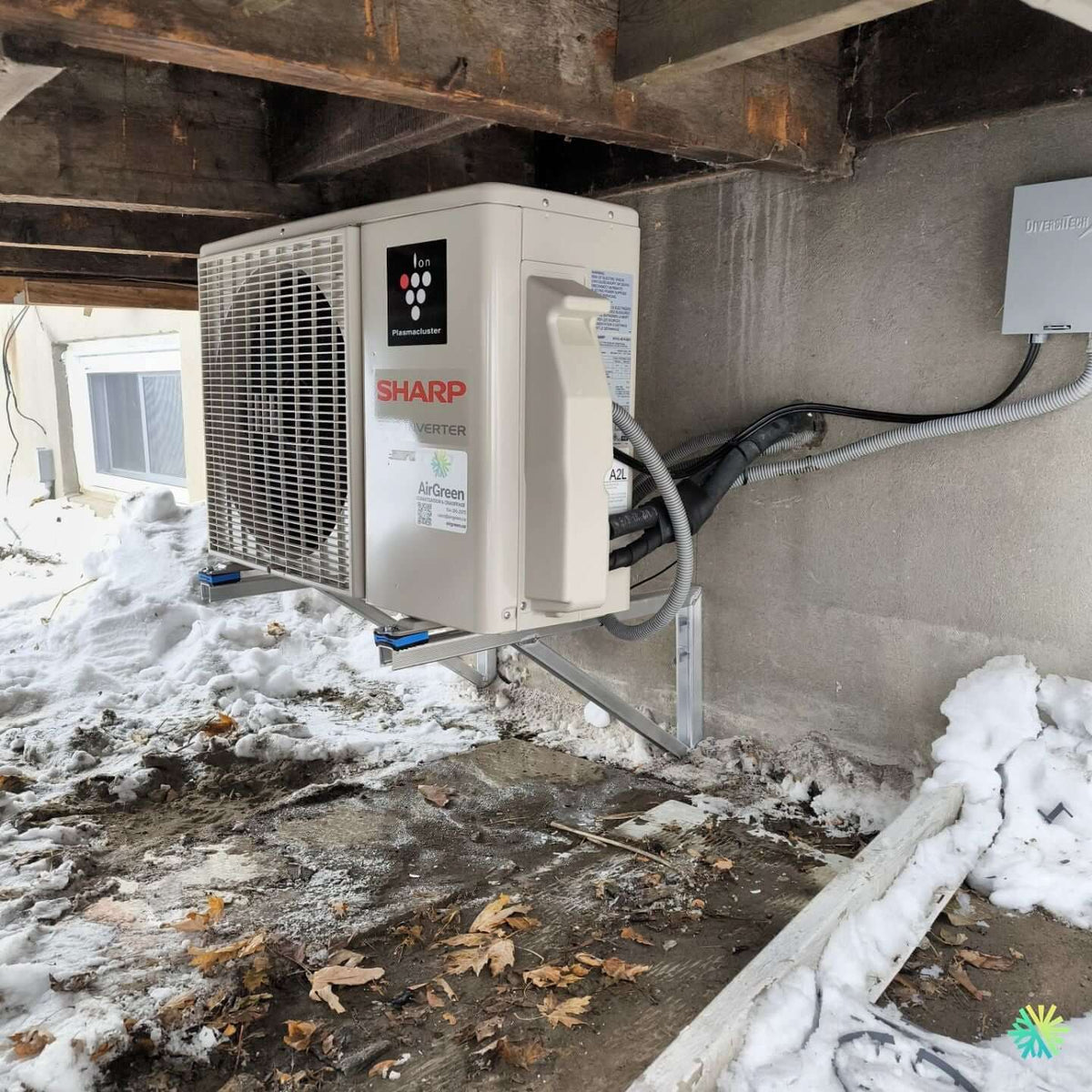
In Sainte-Dorothée (Laval), we are installing a Sharp ZU1 wall-mounted heat pump : wall brackets under the balcony, covered path, outdoor disconnect switch. Clean finish, four-season performance for the greater Montreal area.
- City
- Region
- Equipment
- Brand
- Challenges
- Published
The job on one screen
The unit’s data sheet
The range as published on airgreen.ca: pick a size to see its capacity in deep cold.
| Size | Heating at −8 °C | Heating at −15 °C | Coldest certified point | COP at −15 °C | SEER | HSPF | Indicative LogisVert aid |
|---|---|---|---|---|---|---|---|
| Sharp ZU1 12 000 | 14,500 | 12,000 | −27 °C: 7,200 | 2.11 | 22.0 | 11.0 | $1,740 |
| Sharp ZU1 15 000 | 18,100 | 15,300 | −27 °C: 10,100 | 2.1 | 24.0 | 11.0 | $2,172 |
| Sharp ZU1 18 000 | 22,000 | 18,000 | −27 °C: 11,500 | 2.2 | 24.0 | 11.0 | $2,640 |
| Sharp ZU1 24 000 | 22,400 | 19,000 | −27 °C: 12,300 | 2.2 | 22.0 | 11.0 | $2,688 |
According to NEEP, it delivers 14,500 BTU/h at −8 °C (17 °F), more than at 8 °C (14,000 BTU/h). It heats as hard in moderate cold as in mild weather.
According to NEEP, its certified maximum capacity at −27 °C (−17 °F) is 7,200 BTU/h, 60% of its nominal 12,000 BTU size.
At 8 °C, its certified maximum capacity reaches 17,100 BTU/h, 42% more than its nominal 12,000 BTU size.
According to NEEP, it delivers 18,100 BTU/h at −8 °C (17 °F), more than at 8 °C (18,000 BTU/h). It heats as hard in moderate cold as in mild weather.
According to NEEP, its certified maximum capacity at −27 °C (−17 °F) is 10,100 BTU/h, 67% of its nominal 15,000 BTU size.
At 8 °C, its certified maximum capacity reaches 21,800 BTU/h, 45% more than its nominal 15,000 BTU size.
According to NEEP, it delivers 22,000 BTU/h at −8 °C (17 °F), more than at 8 °C (21,600 BTU/h). It heats as hard in moderate cold as in mild weather.
According to NEEP, its COP at −27 °C is 1.88: the highest of the ZU1 line, which ranges from 1.79 to 1.82 at that temperature.
According to NEEP, its certified maximum capacity at −27 °C (−17 °F) is 11,500 BTU/h, 64% of its nominal 18,000 BTU size.
At −27 °C, its certified minimum capacity is 3,200 BTU/h (5,500 at 8 °C). It slows down instead of cycling on and off.
According to NEEP, its certified heating capacity at −15 °C (5 °F) is 19,000 BTU/h, 79% of its nominal 24,000 BTU size. Its COP there is 2.20.
Data read live from the airgreen.ca page of each size (NEEP / AHRI certified performance). When the title names the installed size, it is highlighted; otherwise the whole range is shown. The aid shown is today’s, using Hydro-Québec’s rule ($120 per 1,000 BTU/h at −8 °C); amounts quoted in the article date from its publication. Only Hydro-Québec confirms the assistance granted.
The article, chapter by chapter
More winter comfort, less noise: careful installation under the balcony that protects the equipment and optimizes performance
Project background
In Sainte-Dorothée, in the west of Laval , we are modernizing the heating and air conditioning of a single-family home with a Sharp wall-mounted heat pump (ZU1 series, R-32 refrigerant) . The client's goal: stable comfort all year round, a lower energy bill and a clean, discreet and durable HVAC installation despite the snowy winters of the greater Montreal area.
Why the Sharp ZU1 series for this home
The ZU1 series is distinguished by:
-
fine modulation inverter technology, ideal for maintaining temperature smoothly;
-
Plasmacluster treatment which contributes to better indoor air quality when combined with the Sharp wall head;
-
capacities adapted to current residential needs: 12,000, 15,000, 18,000 and 24,000 BTU ;
-
the use of R-32 , a new generation refrigerant with a lower GWP than R-410A;
-
quiet operation of the condenser, appreciated in residential areas.
In this house, the load calculation (insulation, surface area, orientation, infiltration) directs us towards a power in the range of 12k–18k BTU for the main zone. We always size the heat pump based on a thermal balance, never “by eye”, in order to ensure optimal efficiency in both heating and cooling.
Chosen configuration: wall-mounted condenser, protected under the terrace
The outdoor condenser is fixed on galvanized steel wall brackets , positioned at a height which:
-
places the unit above the snow and ice level , reducing the risk of clogging in defrost mode;
-
facilitates the flow of defrost water to the ground;
-
limits the projection of debris.
The location, sheltered under the balcony , offers several advantages:
-
attenuation of noise perceived by occupants and neighbors;
-
natural protection against direct weather;
-
better longevity of exposed components.
We add anti-vibration pads to the brackets to eliminate the transmission of resonances to the wall. Clearances around the unit are maintained to ensure proper air intake and safe maintenance.
Refrigeration path and power supply
The refrigeration path is short and straight: the insulated copper connections exit the wall in the immediate vicinity of the condenser. We encase the lines in a UV-resistant gray casing for a clean finish and mechanical protection. The total visible length is approximately 2 to 3 meters , which reduces pressure losses and facilitates future maintenance work.
Electrically, the unit is connected to an approved outdoor disconnect switch (disconnect box) located within easy reach of technicians. The power cable runs in a waterproof flexible conduit to the disconnect switch, then to the indoor panel on a dedicated circuit breaker, in accordance with the Quebec Electrical Code. Circuit identification and safety labeling are carried out during commissioning.
Defrosting and runoff management
In heating mode, the heat pump periodically defrosts the outdoor coil; the water drains to the floor. Under a balcony, it is crucial:
-
to clear the area under the unit to prevent ice buildup;
-
to slightly orient the device for gravity flow ;
-
to avoid any contact of defrosting water with sensitive surfaces (balcony floor, steps).
We leave a clear space in front and recommend, in case of very snowy winters, periodic snow removal of the area under the unit to maintain the free air volume.
Key steps of installation (AirGreen method)
-
Thermal validation and choice of capacity (BTU) according to the area to be treated.
-
Marking the routes: location of the interior head, wall outlet, anchor point of the brackets, position of the disconnector.
-
Anchoring of wall supports (dowels, sealing, leveling) and installation of anti-vibration devices .
-
Passage of refrigeration connections, communication cable and internal condensate drain (towards the outside by gravity when possible, otherwise dedicated pump).
-
Compliant brazing and flaring , deep vacuum, leak testing and refrigerant charging according to the manufacturer's instructions.
-
Electrical connection , polarity checks and grounding.
-
Commissioning : settings, heating and air conditioning testing, temperature differential and superheat/subcooling control.
-
Customer training : basic maintenance, filters, good winter practices (snow removal, defrosting).
Result: stable comfort, controlled consumption
Thanks to inverter modulation, the interior temperature remains uniform without sudden cycles. In mid-season, the heat pump covers most of the heating needs and, in summer, it provides efficient air conditioning with contained electricity consumption. Positioning under a balcony limits exposure to precipitation and extends the life of the components.
Best winter practices for Laval, the North Shore and all of Greater Montreal
-
Maintain 15 to 30 cm of free space under the base of the condenser for frost drainage.
-
Avoid accumulation of snow blown directly onto the unit.
-
Schedule occasional snow removal after storms.
-
Do not cover the unit when in operation; instead, use a correctly sized snow shield if the site is very exposed.
Recommended HVAC maintenance
Annual maintenance protects the compressor and maintains performance:
-
cleaning of the outdoor coil, inspection of the fan;
-
pressure , insulation and fittings checks;
-
checking the disconnector and the tightness of the connections;
-
washing and replacing the inner head filters ;
-
updating parameters (e.g. defrost curves if available).
We offer HVAC maintenance plans tailored to residences in Montreal , Laval , Longueuil , South Shore and North Shore to preserve the manufacturer's warranty and ensure consistent performance.
Grants and Eligibility
High-efficiency wall-mounted heat pumps using R-32 and performing well in cold weather are generally eligible for certain assistance programs in Quebec. Eligibility depends on power, low-temperature performance, and installation by a qualified contractor. We assist our clients with pre-verification and document preparation (detailed invoices, serial numbers, installation photos).
Technical details of this pose
-
Machine type : single-zone wall-mounted heat pump .
-
Brand : Sharp , ZU1 series (R-32) .
-
Mounting : galvanized wall brackets with anti-vibration pads .
-
Power supply : dedicated circuit with accessible external disconnect switch .
-
Refrigerated route : short, grey hood, approximately 2–3 m visible.
-
Environment : under balcony, clear area for air intake and exhaust.
-
Customer objective : four-season comfort, reduced consumption and acoustic discretion.
What this achievement says about our approach
Every home in the greater Montreal area has its own constraints: concrete walls, wooden decks, basement windows, winter access. Our team adapts the HVAC design to the building rather than the other way around. Here, choosing a wall rather than a slab on the ground prevents movement due to freeze-thaw and frees up the passageway. The care taken with wiring , covers , and disconnections secures maintenance and keeps the facade clean.
Tips for choosing the right wall-mounted heat pump
-
Have a load calculation done: the correct BTU capacity avoids oversizing, which is a source of discomfort and short cycles.
-
Choose extreme cold models, with R-32 , with solid guarantees.
-
Evaluate the outdoor location : clearances, perceived noise, prevailing wind, defrosting.
-
Request documented commissioning (vacuum, tests, readings) and training in use.
-
Include annual maintenance in your budget: it’s the best lever for longevity.
AirGreen: Your Local HVAC Partner
We operate weekly in Laval , Longueuil , the South Shore , the North Shore and all of Montreal . Our strength: teams specialized in HVAC installation , clear recommendations and impeccable finishes. Whether it's for a Sharp , Gree , Fujitsu , Midea or other recognized brand heat pump, we deliver systems designed for our climate, ready for harsh winters and humid summers.
Want a system as clean and quiet as the one in Sainte-Dorothée? Contact us: we'll assess your home, suggest the right capacity, position the equipment intelligently, and handle grant applications where applicable. Your comfort, our business.
The job tools
Two quick checks with real numbers: what heat costs, and what your current heaters add up to in BTU/h.
Baseboards and electric furnaces turn 1 kWh of electricity into 1 kWh of heat. A heat pump delivers more: that is its COP. At Hydro-Québec’s rate D (11.142¢/kWh above 40 kWh a day, since 1 April 2026):
Hydro-Québec: a heat pump can be up to three times more efficient than baseboards for heating in the colder months.
Estimate per kWh of heat, at the chosen temperature, using the certified COP from the product page. Taxes, access charge and backup heat not included.
Conversion: 1 W = 3.412 BTU/h. An indication, not a load calculation: baseboards and furnaces are often stronger than the real need, and they can stay as backup. AirGreen confirms the capacity on site.
How the job unfolds
The main steps of this kind of job at AirGreen. Every house has its quirks: the estimate brings them out.
We look at the room, the outside wall, the line route and where the outdoor unit will go. That is where the capacity gets chosen.
Model, capacity and price, in writing. We also check whether the model qualifies for assistance programs.
Floors and furniture protected, wall plate position marked level, wall opening located.
A single opening, with the slope the drain needs to flow outside.
Set on a stand raised above the snow, with the clearances the manufacturer requires.
Connected, insulated and protected. The opening is then sealed against water, cold air and insects.
A dedicated circuit and an accessible disconnect near the outdoor unit.
Leak test, vacuum, then start-up and a check of heating and cooling.
Remote, modes, filters: we show you the essentials before we leave.
- The on-site estimateWe look at the room, the outside wall, the line route and where the outdoor unit will go. That is where the capacity gets chosen.
- The quoteModel, capacity and price, in writing. We also check whether the model qualifies for assistance programs.
- Getting readyFloors and furniture protected, wall plate position marked level, wall opening located.
- The wall openingA single opening, with the slope the drain needs to flow outside.
- The outdoor unitSet on a stand raised above the snow, with the clearances the manufacturer requires.
- Lines, cable and drainConnected, insulated and protected. The opening is then sealed against water, cold air and insects.
- The electrical workA dedicated circuit and an accessible disconnect near the outdoor unit.
- Tests and start-upLeak test, vacuum, then start-up and a check of heating and cooling.
- The walkthroughRemote, modes, filters: we show you the essentials before we leave.
What we check on a job like this one
Each number is a point we check on site. Switch between summer and winter to watch air and heat move.
In summer, the outdoor unit rejects the house's heat outside.
Generic illustration of this type of installation, not a survey of this job site. Tap a number.
Mounted level on a wall plate, high enough for the air to reach the whole room, with enough space around it to slide the filters out easily.
The refrigerant lines, the communication cable and the drain go through the wall in a single opening, sealed against water, cold air and insects.
Two insulated copper pipes connect the two units. Outside, a line cover can protect them from sun, knocks and weather.
A shut-off switch near the outdoor unit isolates it safely for service. It must stay accessible at all times.
The compressor and the fan. In heating mode it captures heat from the outdoor air, even in winter, and moves it inside.
On the ground or on the wall, it keeps the unit above accumulated snow. The unit stays clear and defrost water can drain away.
The fan needs to blow freely. Storage, a fence or a wall too close, and efficiency drops while noise goes up.
Is your home ready?
Check what applies at your place. A "no" is not a refusal: it is what we sort out during the estimate.
Good habits, once the unit is in place
Six simple habits that keep the unit going. Your list stays on this device.
What to do, season by season
Three habits per season for this unit. They take a few minutes and prevent many calls.
- Clean the indoor unit's filters.
- Clear leaves and debris left on the outdoor unit by winter.
- Test cooling before the first hot days.
- Clean the filters more often when the unit runs a lot.
- Keep plants away from the outdoor unit.
- Check that no water drips from the indoor unit.
- Rake the leaves around the outdoor unit.
- Test heating before the first cold days.
- Book periodic maintenance before winter.
- Keep snow away from the stand and the front of the unit.
- Let the unit defrost: it is normal.
- Never hit the ice on the fins; call us if the unit stays iced up.
The right pages, at the right time
Four statements: true or false?
It all comes down to details you have just seen.
1. In heating mode, the outdoor unit can produce water.
During defrost cycles. That water must drain away without forming ice.
2. You pick the capacity with a simple square-footage rule.
Windows, insulation, orientation and how the room is used all count. Capacity is chosen on site.
3. A multi-zone connects several indoor heads to a single condenser.
One head per room, all on the same condenser. Each room keeps its own temperature.
4. The disconnect can sit behind the patio furniture.
It must stay accessible: it is what shuts the unit off for service.
0 / 4 right answers
What people ask us about this kind of work
Does a wall-mounted heat pump heat in winter?
Wall-mounted or multi-zone: how do I choose?
Where does the outdoor unit go?
Are there grants?
Do I need a permit?
How cold can it heat?
How much can I save?
How is the LogisVert assistance calculated?
Is it noisy?
The outdoor unit is covered in ice: is that normal?
Does AirGreen hold the required licences?
Is the estimate free?
No question matches. Write to us: we answer.
More jobs to see, near you
By town, by equipment or by region: browse more than 4,700 published projects.
Each dot: a town where AirGreen has published projects. The glowing dot: this job.
An on-site estimate, the right capacity, the right equipment.
The on-site estimate is free and the quote follows within 24 hours.
Text and photo: a real AirGreen Climatisation & Chauffage job. The diagrams are generic illustrations of the type of installation, not a survey of this job site. Sources of the added figures: airgreen.ca product pages (NEEP / AHRI performance), Hydro-Québec (Heat pumps page, LogisVert, read on 13 October 2026), Régie de l’énergie (rate D as of 1 April 2026).