
Installation of a Sharp ZU1 wall-mounted heat pump in Rosemont–La Petite-Patrie
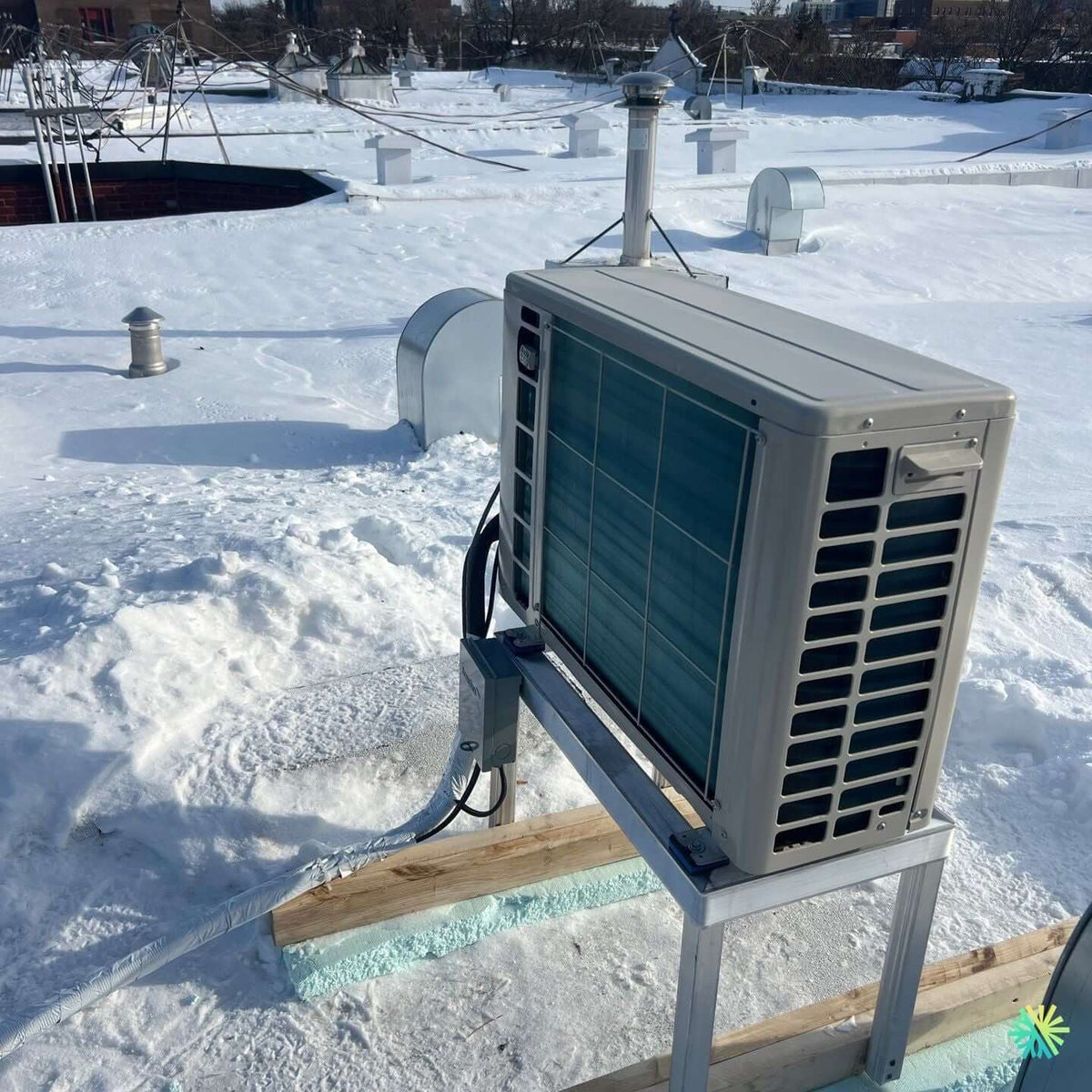
Sharp ZU1 wall-mounted heat pump installed on a roof in Rosemont–La Petite-Patrie by AirGreen: raised support, protected connections, reliable winter performance. HVAC service in Montreal, Laval, Longueuil, North Shore and South Shore.
- City
- Region
- Equipment
- Brand
- Challenges
- Published
The job on one screen
The unit’s data sheet
The range as published on airgreen.ca: pick a size to see its capacity in deep cold.
| Size | Heating at −8 °C | Heating at −15 °C | Coldest certified point | COP at −15 °C | SEER | HSPF | Indicative LogisVert aid |
|---|---|---|---|---|---|---|---|
| Sharp ZU1 12 000 | 14,500 | 12,000 | −27 °C: 7,200 | 2.11 | 22.0 | 11.0 | $1,740 |
| Sharp ZU1 15 000 | 18,100 | 15,300 | −27 °C: 10,100 | 2.1 | 24.0 | 11.0 | $2,172 |
| Sharp ZU1 18 000 | 22,000 | 18,000 | −27 °C: 11,500 | 2.2 | 24.0 | 11.0 | $2,640 |
| Sharp ZU1 24 000 | 22,400 | 19,000 | −27 °C: 12,300 | 2.2 | 22.0 | 11.0 | $2,688 |
According to NEEP, it delivers 14,500 BTU/h at −8 °C (17 °F), more than at 8 °C (14,000 BTU/h). It heats as hard in moderate cold as in mild weather.
According to NEEP, its certified maximum capacity at −27 °C (−17 °F) is 7,200 BTU/h, 60% of its nominal 12,000 BTU size.
At 8 °C, its certified maximum capacity reaches 17,100 BTU/h, 42% more than its nominal 12,000 BTU size.
According to NEEP, it delivers 18,100 BTU/h at −8 °C (17 °F), more than at 8 °C (18,000 BTU/h). It heats as hard in moderate cold as in mild weather.
According to NEEP, its certified maximum capacity at −27 °C (−17 °F) is 10,100 BTU/h, 67% of its nominal 15,000 BTU size.
At 8 °C, its certified maximum capacity reaches 21,800 BTU/h, 45% more than its nominal 15,000 BTU size.
According to NEEP, it delivers 22,000 BTU/h at −8 °C (17 °F), more than at 8 °C (21,600 BTU/h). It heats as hard in moderate cold as in mild weather.
According to NEEP, its COP at −27 °C is 1.88: the highest of the ZU1 line, which ranges from 1.79 to 1.82 at that temperature.
According to NEEP, its certified maximum capacity at −27 °C (−17 °F) is 11,500 BTU/h, 64% of its nominal 18,000 BTU size.
At −27 °C, its certified minimum capacity is 3,200 BTU/h (5,500 at 8 °C). It slows down instead of cycling on and off.
According to NEEP, its certified heating capacity at −15 °C (5 °F) is 19,000 BTU/h, 79% of its nominal 24,000 BTU size. Its COP there is 2.20.
Data read live from the airgreen.ca page of each size (NEEP / AHRI certified performance). When the title names the installed size, it is highlighted; otherwise the whole range is shown. The aid shown is today’s, using Hydro-Québec’s rule ($120 per 1,000 BTU/h at −8 °C); amounts quoted in the article date from its publication. Only Hydro-Québec confirms the assistance granted.
The article, chapter by chapter
A flat roof installation designed for Montreal's extreme cold
In Rosemont–La Petite-Patrie , we installed a Sharp ZU1 wall-mounted heat pump for a typical plex with flat roofs. The client wanted a four-season system combining efficient heating in winter and gentle cooling in summer, with clean and sustainable integration on the roof. Our intervention emphasizes three priorities: performance in extreme cold , longevity of the equipment and respect for the building envelope .
Building context and client objectives
The building, a modernized 1950s triplex, has a recent roof membrane and technical access via a hatch. The serviced apartment is located on the top floor, which reduces connection lengths by positioning the condenser directly on the roof. The mandate:
-
ensure reliable heating even in the intense cold of the Montreal plateau;
-
preserve the integrity of the membrane and limit vibrations transmitted to the structure;
-
obtain a neat HVAC installation , accessible for maintenance, and compliant with the required clearances for snow and wind.
Equipment selection: Sharp, ZU1 range
Sharp's ZU1 range is renowned for its cold climate performance and the use of the more efficient R-32 refrigerant. Inverter modulation adapts power to actual needs, reducing on/off cycles and electricity consumption. For a flat roof exposed to gusts, the mechanical stability of the unit and frost management are essential: the housing design, the high-density fin exchanger and the defrost logic help maintain stable performance during snowfalls.
Key benefits for the customer
Heating and air conditioning with a single device ( heat pump ).
Silent operation inside thanks to modulation and external positioning away from the facades.
High seasonal efficiency , conducive to long-term energy savings.
Eligibility for current grant programs for high-efficiency equipment in Quebec (according to model and installation criteria).
Roof installation: structure, anchoring and protection of the membrane
We have chosen a raised aluminum support , equipped with anti-vibration pads and placed on distribution soles . The objective is twofold:
-
Avoid any punching of the membrane by distributing the load;
-
Elevate the condenser above accumulated snow and runoff areas to ensure free air intake and efficient defrosting.
The highlights of the implementation:
-
Raising : sufficient height to take into account accumulations of snow and snowdrifts created by the wind.
-
Orientation : suction and discharge grilles clear of obstacles (lines, vents, ballast guards) to limit recirculation of cold air during defrosting.
-
Meltwater management : peripheral clearance for flow; no stagnation under the device.
-
Safe paths : clear technical passages for the movement of maintenance technicians, even in winter.
Refrigeration connections and power supply: sobriety and serviceability
The refrigeration lines are routed along the shortest path to the wall of the accommodation. We used:
-
UV insulation resistant to freeze/thaw cycles and radiation;
-
rigid white capping at exposed points, for long-lasting mechanical protection;
-
regularly spaced retaining collars , preventing buckling in the summer sun.
For the power supply, we installed a NEMA 3R disconnect box near the unit, in accordance with safety requirements. The connection is protected by a dedicated circuit breaker in the housing panel. We systematically document: circuit breaker rating, conductor rating, grounding , and compliance with clearances around the disconnect for future work.
Condensate and frost management
On roofs, frost generated during heating mode must be taken seriously. Our approach:
-
Clearance under the unit for defrost water to flow freely to natural drainage areas;
-
Absence of obstacle under the tray to avoid re-glazing around the supports;
-
No external condensate pump required (risk of freezing), everything is managed by gravity and the raised installation.
Inside, the wall head has its gravity drain with controlled slope. We avoid pumps when the site configuration allows it in order to reduce noise and maintenance .
Execution details that make the difference
-
Single sealed penetration with vapor barrier around the crossing.
-
External service loop to avoid mechanical stress on flare fittings.
-
Vacuum check and fluid weighing according to actual line length; load adjustment if required by manufacturer.
-
Operational test on both modes, control of superheating and subcooling , and measurement of temperature differentials on the interior side.
-
Recording of values in the report (pressure, intensity, voltage at load), useful for maintenance monitoring.
Result: stable comfort and controlled aesthetics
The client now benefits from rapid heating at the start of the day and pleasant air conditioning from the first warm days. The outdoor unit, discreet from the street thanks to its rooftop installation , does not disturb the aesthetics of the facade. The wall-mounted heat pump ensures uniform comfort in the main living area, with air diffusion optimized by the installation height of the indoor head.
HVAC Maintenance: Our Simple and Effective Plan
To maintain performance, we recommend:
-
Clean the inner head filters every 4 to 6 weeks during use.
-
Annual AirGreen inspection : pressure check, terminal tightening, defrost test, gentle washing of the exchanger.
-
Autumn check : clearance around the condenser, visual inspection of the support, restart with heating test.
-
Good winter practices : do not obstruct the grilles with stored objects; gently clear the blown snow if necessary (without aggressive tools).
Grants and Compliance
The ZU1 range is one of the most popular energy-efficient solutions in Montreal, Laval and Longueuil , as well as on the North Shore and South Shore . Depending on the configuration chosen (capacity, seasonal efficiency, nominal operating temperature), the installation may be eligible for provincial programs promoting energy efficiency. We assist our clients in producing supporting documents : model number, serial number, detailed invoice, photo evidence and installation diagrams.
Common mistakes… that we avoid
-
Installing the condenser too low on the roof: risk of blockage by snow and recirculation of very cold air during defrosting.
-
Direct anchoring in the membrane without distribution soles: source of infiltration and premature degradation.
-
Insufficient bending radius of the connections and absence of expansion loop: leaks in the medium term.
-
Poorly positioned or unprotected electrical disconnection : non-compliance and maintenance difficulties.
-
Use of external condensate pumps in cold climates: recurring breakdowns.
Our AirGreen method eliminates these risks through design , verification and documentation .
Why AirGreen for your projects in Rosemont–La Petite-Patrie and Greater Montreal
Our team masters the specificities of flat roofs for Montreal plexes: access, security, snow, prevailing winds, technical traffic and neighborhood. Each project is treated as a whole : choice of material, respect for the building, aesthetics , acoustics, ease of maintenance and electrical compliance . We operate in Montreal, Laval, Longueuil, North Shore and South Shore , with controlled deadlines and consistent quality from the first diagnosis to commissioning.
AirGreen — your trusted partner for HVAC installation ** and maintenance of high-efficiency wall-mounted heat pumps in Montreal and surrounding areas.**
The job tools
Two quick checks with real numbers: what heat costs, and what your current heaters add up to in BTU/h.
Baseboards and electric furnaces turn 1 kWh of electricity into 1 kWh of heat. A heat pump delivers more: that is its COP. At Hydro-Québec’s rate D (11.142¢/kWh above 40 kWh a day, since 1 April 2026):
Hydro-Québec: a heat pump can be up to three times more efficient than baseboards for heating in the colder months.
Estimate per kWh of heat, at the chosen temperature, using the certified COP from the product page. Taxes, access charge and backup heat not included.
Conversion: 1 W = 3.412 BTU/h. An indication, not a load calculation: baseboards and furnaces are often stronger than the real need, and they can stay as backup. AirGreen confirms the capacity on site.
How the job unfolds
The main steps of this kind of job at AirGreen. Every house has its quirks: the estimate brings them out.
We look at the room, the outside wall, the line route and where the outdoor unit will go. That is where the capacity gets chosen.
Model, capacity and price, in writing. We also check whether the model qualifies for assistance programs.
Floors and furniture protected, wall plate position marked level, wall opening located.
A single opening, with the slope the drain needs to flow outside.
Set on a stand raised above the snow, with the clearances the manufacturer requires.
Connected, insulated and protected. The opening is then sealed against water, cold air and insects.
A dedicated circuit and an accessible disconnect near the outdoor unit.
Leak test, vacuum, then start-up and a check of heating and cooling.
Remote, modes, filters: we show you the essentials before we leave.
- The on-site estimateWe look at the room, the outside wall, the line route and where the outdoor unit will go. That is where the capacity gets chosen.
- The quoteModel, capacity and price, in writing. We also check whether the model qualifies for assistance programs.
- Getting readyFloors and furniture protected, wall plate position marked level, wall opening located.
- The wall openingA single opening, with the slope the drain needs to flow outside.
- The outdoor unitSet on a stand raised above the snow, with the clearances the manufacturer requires.
- Lines, cable and drainConnected, insulated and protected. The opening is then sealed against water, cold air and insects.
- The electrical workA dedicated circuit and an accessible disconnect near the outdoor unit.
- Tests and start-upLeak test, vacuum, then start-up and a check of heating and cooling.
- The walkthroughRemote, modes, filters: we show you the essentials before we leave.
What we check on a job like this one
Each number is a point we check on site. Switch between summer and winter to watch air and heat move.
In summer, the outdoor unit rejects the house's heat outside.
Generic illustration of this type of installation, not a survey of this job site. Tap a number.
Mounted level on a wall plate, high enough for the air to reach the whole room, with enough space around it to slide the filters out easily.
The refrigerant lines, the communication cable and the drain go through the wall in a single opening, sealed against water, cold air and insects.
Two insulated copper pipes connect the two units. Outside, a line cover can protect them from sun, knocks and weather.
A shut-off switch near the outdoor unit isolates it safely for service. It must stay accessible at all times.
The compressor and the fan. In heating mode it captures heat from the outdoor air, even in winter, and moves it inside.
On the ground or on the wall, it keeps the unit above accumulated snow. The unit stays clear and defrost water can drain away.
The fan needs to blow freely. Storage, a fence or a wall too close, and efficiency drops while noise goes up.
Is your home ready?
Check what applies at your place. A "no" is not a refusal: it is what we sort out during the estimate.
Good habits, once the unit is in place
Six simple habits that keep the unit going. Your list stays on this device.
What to do, season by season
Three habits per season for this unit. They take a few minutes and prevent many calls.
- Clean the indoor unit's filters.
- Clear leaves and debris left on the outdoor unit by winter.
- Test cooling before the first hot days.
- Clean the filters more often when the unit runs a lot.
- Keep plants away from the outdoor unit.
- Check that no water drips from the indoor unit.
- Rake the leaves around the outdoor unit.
- Test heating before the first cold days.
- Book periodic maintenance before winter.
- Keep snow away from the stand and the front of the unit.
- Let the unit defrost: it is normal.
- Never hit the ice on the fins; call us if the unit stays iced up.
The right pages, at the right time
Four statements: true or false?
It all comes down to details you have just seen.
1. In heating mode, the outdoor unit can produce water.
During defrost cycles. That water must drain away without forming ice.
2. You pick the capacity with a simple square-footage rule.
Windows, insulation, orientation and how the room is used all count. Capacity is chosen on site.
3. A multi-zone connects several indoor heads to a single condenser.
One head per room, all on the same condenser. Each room keeps its own temperature.
4. The disconnect can sit behind the patio furniture.
It must stay accessible: it is what shuts the unit off for service.
0 / 4 right answers
What people ask us about this kind of work
Does a wall-mounted heat pump heat in winter?
Wall-mounted or multi-zone: how do I choose?
Where does the outdoor unit go?
Are there grants?
Do I need a permit?
How cold can it heat?
How much can I save?
How is the LogisVert assistance calculated?
Is it noisy?
The outdoor unit is covered in ice: is that normal?
Does AirGreen hold the required licences?
Is the estimate free?
No question matches. Write to us: we answer.
More jobs to see, near you
By town, by equipment or by region: browse more than 4,700 published projects.
Each dot: a town where AirGreen has published projects. The glowing dot: this job.
An on-site estimate, the right capacity, the right equipment.
The on-site estimate is free and the quote follows within 24 hours.
Text and photo: a real AirGreen Climatisation & Chauffage job. The diagrams are generic illustrations of the type of installation, not a survey of this job site. Sources of the added figures: airgreen.ca product pages (NEEP / AHRI performance), Hydro-Québec (Heat pumps page, LogisVert, read on 13 October 2026), Régie de l’énergie (rate D as of 1 April 2026).