
Installation of a Sharp ZU1 wall-mounted heat pump in Rosemont–La Petite-Patrie (Montreal)
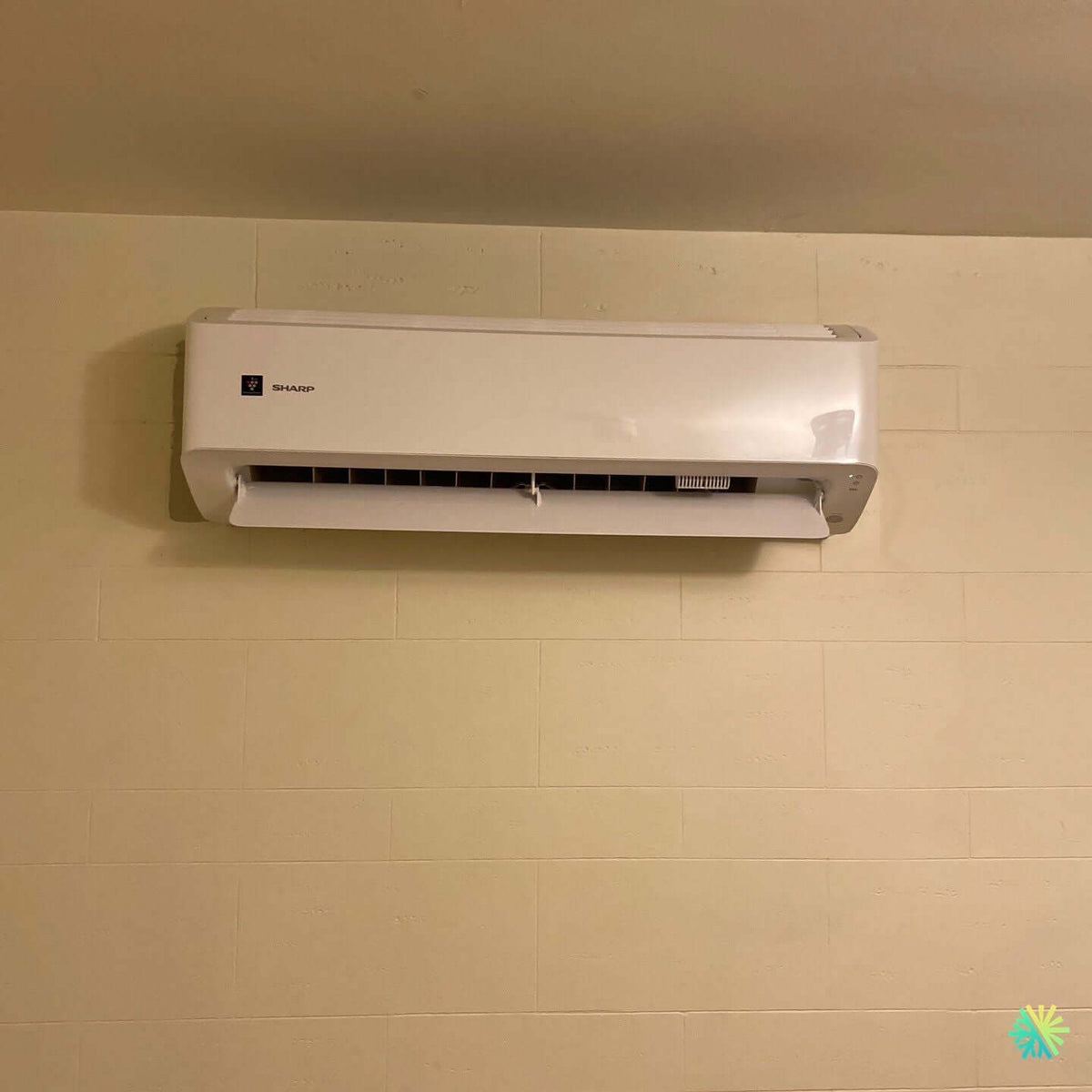
AirGreen installed a Sharp ZU1 (R-32) wall-mounted heat pump in a garden level in Rosemont–La Petite-Patrie: precise mounting on a block wall, gravity drainage, clean capping and complete commissioning — HVAC installation optimized for Greater Montreal.
- City
- Region
- Equipment
- Brand
- Challenges
- Published
The job on one screen
The unit’s data sheet
The range as published on airgreen.ca: pick a size to see its capacity in deep cold.
| Size | Heating at −8 °C | Heating at −15 °C | Coldest certified point | COP at −15 °C | SEER | HSPF | Indicative LogisVert aid |
|---|---|---|---|---|---|---|---|
| Sharp ZU1 12 000 | 14,500 | 12,000 | −27 °C: 7,200 | 2.11 | 22.0 | 11.0 | $1,740 |
| Sharp ZU1 15 000 | 18,100 | 15,300 | −27 °C: 10,100 | 2.1 | 24.0 | 11.0 | $2,172 |
| Sharp ZU1 18 000 | 22,000 | 18,000 | −27 °C: 11,500 | 2.2 | 24.0 | 11.0 | $2,640 |
| Sharp ZU1 24 000 | 22,400 | 19,000 | −27 °C: 12,300 | 2.2 | 22.0 | 11.0 | $2,688 |
According to NEEP, it delivers 14,500 BTU/h at −8 °C (17 °F), more than at 8 °C (14,000 BTU/h). It heats as hard in moderate cold as in mild weather.
According to NEEP, its certified maximum capacity at −27 °C (−17 °F) is 7,200 BTU/h, 60% of its nominal 12,000 BTU size.
At 8 °C, its certified maximum capacity reaches 17,100 BTU/h, 42% more than its nominal 12,000 BTU size.
According to NEEP, it delivers 18,100 BTU/h at −8 °C (17 °F), more than at 8 °C (18,000 BTU/h). It heats as hard in moderate cold as in mild weather.
According to NEEP, its certified maximum capacity at −27 °C (−17 °F) is 10,100 BTU/h, 67% of its nominal 15,000 BTU size.
At 8 °C, its certified maximum capacity reaches 21,800 BTU/h, 45% more than its nominal 15,000 BTU size.
According to NEEP, it delivers 22,000 BTU/h at −8 °C (17 °F), more than at 8 °C (21,600 BTU/h). It heats as hard in moderate cold as in mild weather.
According to NEEP, its COP at −27 °C is 1.88: the highest of the ZU1 line, which ranges from 1.79 to 1.82 at that temperature.
According to NEEP, its certified maximum capacity at −27 °C (−17 °F) is 11,500 BTU/h, 64% of its nominal 18,000 BTU size.
At −27 °C, its certified minimum capacity is 3,200 BTU/h (5,500 at 8 °C). It slows down instead of cycling on and off.
According to NEEP, its certified heating capacity at −15 °C (5 °F) is 19,000 BTU/h, 79% of its nominal 24,000 BTU size. Its COP there is 2.20.
Data read live from the airgreen.ca page of each size (NEEP / AHRI certified performance). When the title names the installed size, it is highlighted; otherwise the whole range is shown. The aid shown is today’s, using Hydro-Québec’s rule ($120 per 1,000 BTU/h at −8 °C); amounts quoted in the article date from its publication. Only Hydro-Québec confirms the assistance granted.
The article, chapter by chapter
Four-season comfort for a garden-level home: impeccably integrated interior installation
At AirGreen , we have just installed a Sharp wall-mounted heat pump – ZU1 range (R-32) in a Rosemont–La Petite-Patrie home. The project is taking place in a garden level/basement type room, with painted block walls and moderate ceiling height . Our mandate: to provide reliable heating in winter and precise air conditioning in summer , while integrating the indoor unit with discretion and technical rigor to preserve the aesthetics of the place and performance over time.
Why a Sharp ZU1 (R-32) wall-mounted heat pump in this context?
The Sharp ZU1 range is particularly well suited to Montreal apartments:
-
R-32 refrigerant : improved efficiency and reduced global warming potential compared to R-410A.
-
Inverter technology : continuous modulation to maintain a stable temperature without overconsumption.
-
Low noise level : ideal for living rooms and bedrooms located near the unit.
-
Capacity range from 12k to 24k BTU : allows precise sizing according to insulation, sunlight and room use.
-
Comfort functions : optimized defrosting, night mode, automatic restart after power cut.
In this accommodation, the choice of a wall unit meets a need for localized comfort : the room serves as both a living room and a workspace, with variable internal loads (IT equipment, intermittent occupancy). The fine modulation of the ZU1 makes it possible to limit temperature variations and reduce operating costs .
Preliminary study and preparation of the installation
Each AirGreen installation begins with a technical validation :
-
Survey of dimensions and clearances around the proposed wall, with verification of the absence of obstacles (lintels, ducts, cables).
-
Choice of location : the interior head is centered in the upper part of the wall , at a sufficient distance from the ceiling to allow air suction and avoid hot/cold recirculation.
-
Route of connections : selection of a route as straight as possible towards the outside, in order to reduce pressure losses and facilitate maintenance .
-
Drainage plan : confirmation of gravity flow with continuous outward slope to evacuate summer condensates.
Fixing and leveling the wall plate
We anchor the mounting plate to the block wall using suitable dowels and a laser level . This point is crucial: a slight controlled slope prevents water from accumulating in the inner head tray and eliminates the risk of droplets on the facade.
-
Tightening torque respected according to the manufacturer's instructions.
-
Spacers if necessary to compensate for any wall outages.
-
Connection passage drilled with clean core and chamfered on the inside to protect the pipe insulation.
Drilling, crossing and sealing
The through hole is made with a controlled exit slope . We install:
-
a protective sleeve for the refrigeration connections and the communication cable;
-
a vapor barrier on the interior side to preserve the airtightness of the envelope;
-
a finishing polymer sealant to prevent any infiltration of air or moisture.
On the outside, the connections are capped up to the condenser in order to protect the insulation against UV rays and bad weather and to obtain a clear visual signature on the facade.
Refrigeration connections and commissioning
Our technicians carry out calibrated flaring with torque control and installation of rings if required. Commissioning follows a strict protocol:
-
Deep vacuum until stabilization, check for possible micro-leaks.
-
Release of R-32 contained in the outdoor unit.
-
Functional tests in heating and cooling modes, control of supply temperatures , superheating/subcooling and intensity .
-
Adjusted fan settings to limit air movement felt in the living area.
Power and Communication: Safety and Compliance
The indoor unit is powered and controlled from the outdoor unit via protected communication wiring . In accordance with the Quebec Electrical Code , the outdoor unit has an accessible disconnect device for maintenance. All wiring is secured and identified , facilitating future interventions.
Aesthetic integration into a room with block walls
The “garden level” context brings two challenges: ceiling height and textured wall surface . We respond to this by:
-
a centered installation that promotes uniform air diffusion ;
-
precise alignment with the visual joints of the wall for a clean reading of the whole;
-
discreet management of the trapdoor cable and removable elements for maintenance.
The result: a visually sober interior unit , perfectly consistent with the simple architecture of the room.
Measurable comfort, tangible savings
In operation, the Sharp ZU1 provides:
-
stable blowing without aggressive air currents thanks to adjustable flaps and fine fan speeds;
-
appreciable responsiveness to changes in occupancy (arrival/departure of occupants, cooking, computer devices);
-
substantial energy savings compared to traditional window units and electric convectors.
Combined with good airtightness of the home and reasonable setting habits , the heat pump allows you to reduce the bill while improving the quality of the air through filtered circulation.
Good practices for use and maintenance
To maintain performance over time, we provide the customer with an AirGreen user guide and recommend:
-
Clean the inner head filters every 4 to 8 weeks during the season.
-
Schedule an annual inspection : cleaning the exchanger, checking the connections, insulation testing, checking the refrigeration parameters.
-
Maintain clearances around the unit and clear any shelves or curtains that could obstruct air intake.
-
Adjust the shutters to avoid blowing directly onto workstations or the sofa area.
-
Monitor the drain when it is restarted in spring: any sign of abnormal flow should lead to a check of the slope or the tank .
AirGreen offers maintenance plans tailored to apartments, plexes and condominiums in Greater Montreal to ensure lasting performance .
Specific challenges of the construction site and solutions provided
-
Support on block walls : choice of suitable anchors and controlled tightening to avoid micro-vibrations and paint peeling.
-
Limited ceiling height : installation low enough to allow the upper intake to breathe , while remaining out of the direct field of vision.
-
Neat crossing : continuous slope of the gravity drain and clean finish around the interior rosette.
These decisions guarantee quiet operation , reliable condensate drainage and neat aesthetics .
Grants and Eligibility
High-efficiency R-32 heat pumps like the Sharp ZU1 range are generally eligible for energy efficiency assistance programs in Quebec. Our team assists with the preparation of the technical file (BTU capacity, performance sheets, proof of commissioning) and advises on the eligibility criteria for residences in Montreal, Laval, Longueuil, North Shore and South Shore .
Why entrust your HVAC installation to AirGreen?
-
Local expertise in Montreal housing (plexes, basements, block walls and brick facades).
-
Standardized procedures : high vacuum, testing, quality control and installation report submitted to the customer.
-
Aesthetics and durability : discreet hood, watertight crossings, short paths to maintain efficiency.
-
Responsive after-sales service : preventive maintenance, original parts and operating advice.
Are you considering a wall-mounted heat pump for your apartment or complex? We size, install, and maintain systems from Sharp, Gree, Fujitsu, Midea , and several other brands throughout Greater Montreal .
The job tools
Two quick checks with real numbers: what heat costs, and what your current heaters add up to in BTU/h.
Baseboards and electric furnaces turn 1 kWh of electricity into 1 kWh of heat. A heat pump delivers more: that is its COP. At Hydro-Québec’s rate D (11.142¢/kWh above 40 kWh a day, since 1 April 2026):
Hydro-Québec: a heat pump can be up to three times more efficient than baseboards for heating in the colder months.
Estimate per kWh of heat, at the chosen temperature, using the certified COP from the product page. Taxes, access charge and backup heat not included.
Conversion: 1 W = 3.412 BTU/h. An indication, not a load calculation: baseboards and furnaces are often stronger than the real need, and they can stay as backup. AirGreen confirms the capacity on site.
How the job unfolds
The main steps of this kind of job at AirGreen. Every house has its quirks: the estimate brings them out.
We look at the room, the outside wall, the line route and where the outdoor unit will go. That is where the capacity gets chosen.
Model, capacity and price, in writing. We also check whether the model qualifies for assistance programs.
Floors and furniture protected, wall plate position marked level, wall opening located.
A single opening, with the slope the drain needs to flow outside.
Set on a stand raised above the snow, with the clearances the manufacturer requires.
Connected, insulated and protected. The opening is then sealed against water, cold air and insects.
A dedicated circuit and an accessible disconnect near the outdoor unit.
Leak test, vacuum, then start-up and a check of heating and cooling.
Remote, modes, filters: we show you the essentials before we leave.
- The on-site estimateWe look at the room, the outside wall, the line route and where the outdoor unit will go. That is where the capacity gets chosen.
- The quoteModel, capacity and price, in writing. We also check whether the model qualifies for assistance programs.
- Getting readyFloors and furniture protected, wall plate position marked level, wall opening located.
- The wall openingA single opening, with the slope the drain needs to flow outside.
- The outdoor unitSet on a stand raised above the snow, with the clearances the manufacturer requires.
- Lines, cable and drainConnected, insulated and protected. The opening is then sealed against water, cold air and insects.
- The electrical workA dedicated circuit and an accessible disconnect near the outdoor unit.
- Tests and start-upLeak test, vacuum, then start-up and a check of heating and cooling.
- The walkthroughRemote, modes, filters: we show you the essentials before we leave.
What we check on a job like this one
Each number is a point we check on site. Switch between summer and winter to watch air and heat move.
In summer, the outdoor unit rejects the house's heat outside.
Generic illustration of this type of installation, not a survey of this job site. Tap a number.
Mounted level on a wall plate, high enough for the air to reach the whole room, with enough space around it to slide the filters out easily.
The refrigerant lines, the communication cable and the drain go through the wall in a single opening, sealed against water, cold air and insects.
Two insulated copper pipes connect the two units. Outside, a line cover can protect them from sun, knocks and weather.
A shut-off switch near the outdoor unit isolates it safely for service. It must stay accessible at all times.
The compressor and the fan. In heating mode it captures heat from the outdoor air, even in winter, and moves it inside.
On the ground or on the wall, it keeps the unit above accumulated snow. The unit stays clear and defrost water can drain away.
The fan needs to blow freely. Storage, a fence or a wall too close, and efficiency drops while noise goes up.
Is your home ready?
Check what applies at your place. A "no" is not a refusal: it is what we sort out during the estimate.
Good habits, once the unit is in place
Six simple habits that keep the unit going. Your list stays on this device.
What to do, season by season
Three habits per season for this unit. They take a few minutes and prevent many calls.
- Clean the indoor unit's filters.
- Clear leaves and debris left on the outdoor unit by winter.
- Test cooling before the first hot days.
- Clean the filters more often when the unit runs a lot.
- Keep plants away from the outdoor unit.
- Check that no water drips from the indoor unit.
- Rake the leaves around the outdoor unit.
- Test heating before the first cold days.
- Book periodic maintenance before winter.
- Keep snow away from the stand and the front of the unit.
- Let the unit defrost: it is normal.
- Never hit the ice on the fins; call us if the unit stays iced up.
The right pages, at the right time
Four statements: true or false?
It all comes down to details you have just seen.
1. In heating mode, the outdoor unit can produce water.
During defrost cycles. That water must drain away without forming ice.
2. You pick the capacity with a simple square-footage rule.
Windows, insulation, orientation and how the room is used all count. Capacity is chosen on site.
3. A multi-zone connects several indoor heads to a single condenser.
One head per room, all on the same condenser. Each room keeps its own temperature.
4. The disconnect can sit behind the patio furniture.
It must stay accessible: it is what shuts the unit off for service.
0 / 4 right answers
What people ask us about this kind of work
Does a wall-mounted heat pump heat in winter?
Wall-mounted or multi-zone: how do I choose?
Where does the outdoor unit go?
Are there grants?
Do I need a permit?
How cold can it heat?
How much can I save?
How is the LogisVert assistance calculated?
Is it noisy?
The outdoor unit is covered in ice: is that normal?
Does AirGreen hold the required licences?
Is the estimate free?
No question matches. Write to us: we answer.
More jobs to see, near you
By town, by equipment or by region: browse more than 4,700 published projects.
Each dot: a town where AirGreen has published projects. The glowing dot: this job.
An on-site estimate, the right capacity, the right equipment.
The on-site estimate is free and the quote follows within 24 hours.
Text and photo: a real AirGreen Climatisation & Chauffage job. The diagrams are generic illustrations of the type of installation, not a survey of this job site. Sources of the added figures: airgreen.ca product pages (NEEP / AHRI performance), Hydro-Québec (Heat pumps page, LogisVert, read on 13 October 2026), Régie de l’énergie (rate D as of 1 April 2026).