
Installation of a Sharp ZU1 wall-mounted heat pump in Villeray–Saint-Michel–Parc-Extension
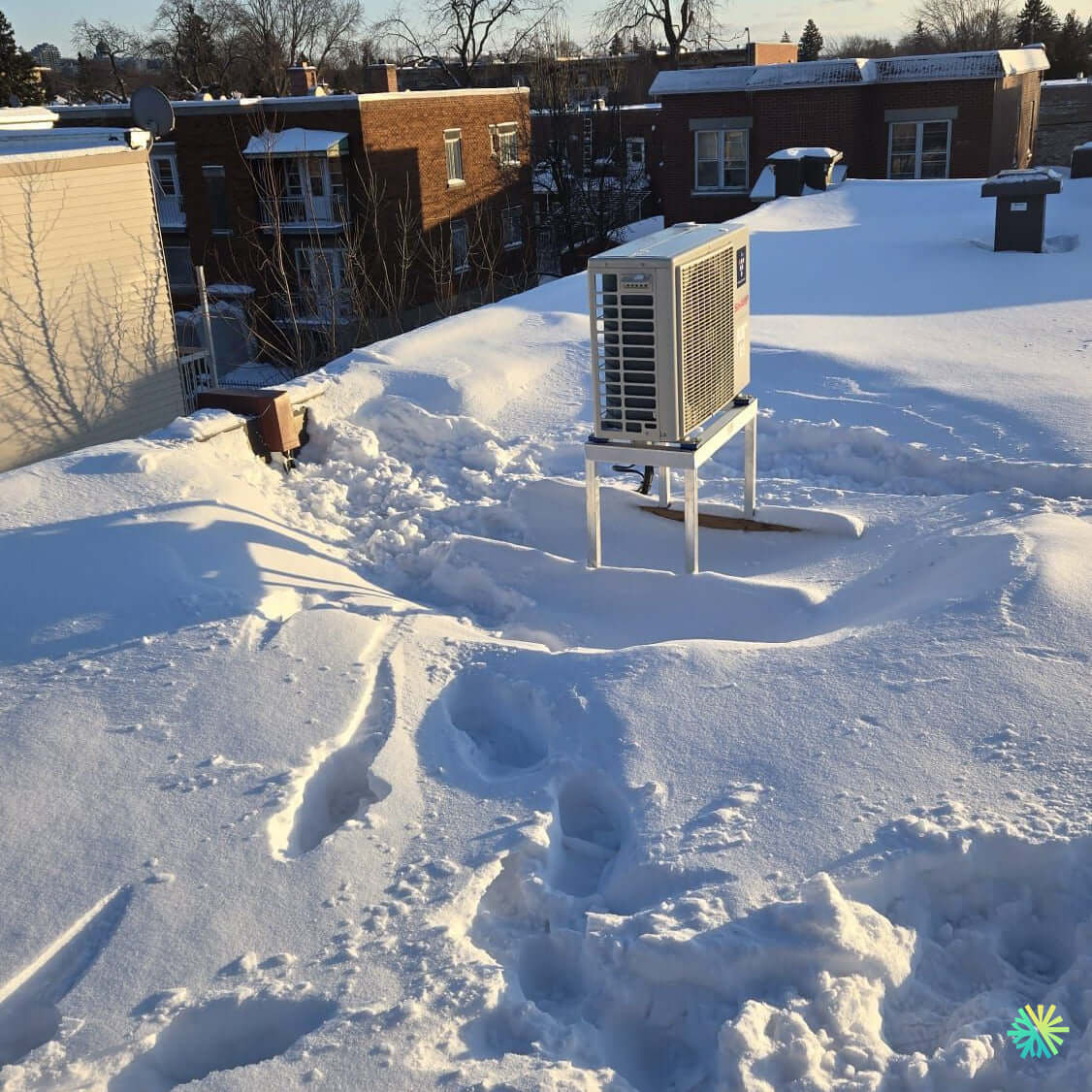
In Villeray–Saint-Michel–Parc-Extension, AirGreen installs a Sharp ZU1 (R-32) wall-mounted heat pump on a flat roof with raised support , careful waterproofing and snow clearances. HVAC service for Montreal, Laval, Longueuil, North Shore, South Shore .
In summer, the outdoor unit rejects the house's heat outside.
Generic illustration of this type of installation, not a survey of this job site. Tap a number.
Mounted level on a wall plate, high enough for the air to reach the whole room, with enough space around it to slide the filters out easily.
The refrigerant lines, the communication cable and the drain go through the wall in a single opening, sealed against water, cold air and insects.
Two insulated copper pipes connect the two units. Outside, a line cover can protect them from sun, knocks and weather.
A shut-off switch near the outdoor unit isolates it safely for service. It must stay accessible at all times.
The compressor and the fan. In heating mode it captures heat from the outdoor air, even in winter, and moves it inside.
On the ground or on the wall, it keeps the unit above accumulated snow. The unit stays clear and defrost water can drain away.
The fan needs to blow freely. Storage, a fence or a wall too close, and efficiency drops while noise goes up.
Condenser on a flat roof, raised for snow: a robust installation designed for Montreal's extreme cold
At AirGreen , we deployed a Sharp ZU1 series wall-mounted heat pump, R-32 refrigerant, Inverter in the heart of Villeray–Saint-Michel–Parc-Extension . The outdoor unit is installed on a flat roof and mounted on a raised support , to ensure reliable operation in winter and safe service access . The objective: to offer the customer stable heating at low temperatures and precise air conditioning in summer, without compromising on the durability or waterproofing of the roof.
The building and its climatic constraints
The accommodation is located in a typical plex of the area, with flat roofs, low acroteria, and various obstacles (air intakes, vents). In winter, the site experiences snow drifts and crosswinds that move powder snow. We designed the layout to:
-
maintain large clearances around the condenser (faces and top),
-
raise the device ~65–75 cm from the roof plane to stay out of the accumulation zone ,
-
preserve the membrane and the building envelope ,
-
simplify HVAC maintenance visits in all seasons.
Why the Sharp wall-mounted heat pump (R-32) here?
-
Inverter technology : fine modulation, optimized consumption and silence .
-
R-32 : better seasonal efficiency and lower GWP than older generations.
-
ZU1 series extreme cold range : capacity maintenance when the mercury drops, adapted to the climate of Montreal , Laval and the North Shore/South Shore .
-
Ideal compactness for installation on a raised roof frame .
Flat roof installation engineering
Galvanized raised support
The condenser rests on a galvanized steel frame with adjustable feet and anti-vibration pads . Distribution pads protect the membrane. This architecture:
-
keeps the exchanger above snow and defrost water ,
-
limits the suction of powder which clogs the fin,
-
prevents encapsulating frost on the ground and stabilizes defrost cycles.
Lashing & sealing
The anchoring takes into account wind loads . The holes are treated with compatible flashings , appropriate mastication and reconstruction of the vapor barrier on the interior side. The structural fixings are bridged on load-bearing elements to avoid stressing the membrane.
Standard clearances and airflow
The unit is oriented to prevent air recirculation toward parapets/obstructions. Top and side clearances exceed the manufacturer's recommendations to ensure flow and heating capacity .
Refrigerated journey and crossings
-
Short path from the interior technical column to reduce losses and fluid load.
-
High-density continuous insulation , UV-stable outdoors, without thermal bridges .
-
Waterproof roof passage with controlled slope , fire-resistant foam if required and clean finish on the ceiling side.
-
Waterproof outdoor disconnect switch installed within easy reach for maintenance.
Frost, snow and wind management
-
Snow-drift height : the free space under the unit allows defrost water to drain away without forming blocks of ice.
-
Drainage path under the chassis to prevent accumulation and deformation of the support.
-
Openwork snow guard (optional) if the building has recurring vortices depending on the wind orientation.
-
Lightweight windbreak (optional) in case of extreme exposure, sized so as not to penalize static pressure .
Inside: wall-mounted headboard and discreet finishes
The wall-mounted head is placed high under the ceiling in the living area, clear of any obstacles. The connections follow a discreet white capping up to the crossing point. The installation respects the gravity slope of the condensate drain; if the configuration requires it, we offer a silent lifting pump integrated into the chute.
Commissioning: AirGreen method
-
Brazing under nitrogen to protect the inside of the tubes.
-
Nitrogen proof and deep vacuum (stable microns).
-
Refrigerant opening and superheat/subcooling control.
-
Heating tests in winter conditions: intensity, modulation, noise level and defrosting .
-
Electrical checks : tightening torque, polarities, operation of the disconnector .
-
Handing over instructions : optimal winter/summer use, HVAC maintenance and roof maintenance around the unit.
Results obtained
-
Stable heating in cold weather thanks to inverter modulation.
-
Reduced noise perceived in the home and from neighbors on adjacent roofs.
-
Simple and secure service access , limiting the duration of interventions.
-
Aesthetics respected on the roof, clean clearances and protected membrane .
Good practices and pitfalls to avoid
-
Never place the unit directly on the membrane : ice forms and performance collapses.
-
Avoid lines that are too long : favor a direct and isolated route , otherwise capacity will be lost.
-
Refuse improvised roof passages : only suitable flashing guarantees longevity.
-
Always allow 60–80 cm of free space around the unit after each storm.
-
Clean the inner head filters every 6–8 weeks in season.
Recommended maintenance
-
Annual inspection : exchanger cleaning, checking defrost cycles , electrical check, mechanical tightening, condition of flashings and chassis .
-
Spring : visual inspection of the installation (pads, galvanized paint, screws).
-
Winter : Gentle manual clearance around the chassis (no metal tools near the finning).
Key project data
-
Type of equipment: wall-mounted heat pump (mini-split) .
-
Brand/Range: Sharp – ZU1 series , R-32 , Inverter .
-
Exterior installation: flat roof on raised galvanized support with anti-vibration pads .
-
Clearance height under unit: ~ 65–75 cm .
-
Cooling path: short , continuous UV-stable insulation.
-
Power supply/control: waterproof disconnect switch nearby, protected sheath.
-
Condensate/defrosting management: dedicated under-chassis drainage, area cleared of snow after storms.
-
Compliance: CSA/RBQ best practices, CNESST working at height safety.
Grants and support
High-efficiency wall-mounted heat pumps may be eligible for assistance programs in effect in Quebec, subject to certified performance and cold climate performance . We support our customers in Montreal, Laval, Longueuil, North Shore and South Shore : eligibility validation, complete file , and quote .
Conclusion
This project in Villeray–Saint-Michel–Parc-Extension illustrates our approach: predicting snow , protecting the envelope , optimizing airflow and delivering a clean, durable and easy-to-maintain HVAC system . The Sharp ZU1 now provides four-season comfort with tangible energy savings for the customer.
How it goes, from the first call to the end
The main steps of this kind of job at AirGreen. Every house has its quirks: the estimate brings them out.
We look at the room, the outside wall, the line route and where the outdoor unit will go. That is where the capacity gets chosen.
Model, capacity and price, in writing. We also check whether the model qualifies for assistance programs.
Floors and furniture protected, wall plate position marked level, wall opening located.
A single opening, with the slope the drain needs to flow outside.
Set on a stand raised above the snow, with the clearances the manufacturer requires.
Connected, insulated and protected. The opening is then sealed against water, cold air and insects.
A dedicated circuit and an accessible disconnect near the outdoor unit.
Leak test, vacuum, then start-up and a check of heating and cooling.
Remote, modes, filters: we show you the essentials before we leave.
- The on-site estimateWe look at the room, the outside wall, the line route and where the outdoor unit will go. That is where the capacity gets chosen.
- The quoteModel, capacity and price, in writing. We also check whether the model qualifies for assistance programs.
- Getting readyFloors and furniture protected, wall plate position marked level, wall opening located.
- The wall openingA single opening, with the slope the drain needs to flow outside.
- The outdoor unitSet on a stand raised above the snow, with the clearances the manufacturer requires.
- Lines, cable and drainConnected, insulated and protected. The opening is then sealed against water, cold air and insects.
- The electrical workA dedicated circuit and an accessible disconnect near the outdoor unit.
- Tests and start-upLeak test, vacuum, then start-up and a check of heating and cooling.
- The walkthroughRemote, modes, filters: we show you the essentials before we leave.
What the unit delivers when it is cold
The range as published on airgreen.ca: pick a size to see its capacity in deep cold.
| Size | Heating at −8 °C | Heating at −15 °C | Coldest certified point | COP at −15 °C | SEER | HSPF | Indicative LogisVert aid |
|---|---|---|---|---|---|---|---|
| Sharp ZU1 12 000 | 14,500 | 12,000 | −27 °C: 7,200 | 2.11 | 22.0 | 11.0 | $1,740 |
| Sharp ZU1 15 000 | 18,100 | 15,300 | −27 °C: 10,100 | 2.1 | 24.0 | 11.0 | $2,172 |
| Sharp ZU1 18 000 | 22,000 | 18,000 | −27 °C: 11,500 | 2.2 | 24.0 | 11.0 | $2,640 |
| Sharp ZU1 24 000 | 22,400 | 19,000 | −27 °C: 12,300 | 2.2 | 22.0 | 11.0 | $2,688 |
According to NEEP, it delivers 14,500 BTU/h at −8 °C (17 °F), more than at 8 °C (14,000 BTU/h). It heats as hard in moderate cold as in mild weather.
According to NEEP, its certified maximum capacity at −27 °C (−17 °F) is 7,200 BTU/h, 60% of its nominal 12,000 BTU size.
At 8 °C, its certified maximum capacity reaches 17,100 BTU/h, 42% more than its nominal 12,000 BTU size.
According to NEEP, it delivers 18,100 BTU/h at −8 °C (17 °F), more than at 8 °C (18,000 BTU/h). It heats as hard in moderate cold as in mild weather.
According to NEEP, its certified maximum capacity at −27 °C (−17 °F) is 10,100 BTU/h, 67% of its nominal 15,000 BTU size.
At 8 °C, its certified maximum capacity reaches 21,800 BTU/h, 45% more than its nominal 15,000 BTU size.
According to NEEP, it delivers 22,000 BTU/h at −8 °C (17 °F), more than at 8 °C (21,600 BTU/h). It heats as hard in moderate cold as in mild weather.
According to NEEP, its COP at −27 °C is 1.88: the highest of the ZU1 line, which ranges from 1.79 to 1.82 at that temperature.
According to NEEP, its certified maximum capacity at −27 °C (−17 °F) is 11,500 BTU/h, 64% of its nominal 18,000 BTU size.
At −27 °C, its certified minimum capacity is 3,200 BTU/h (5,500 at 8 °C). It slows down instead of cycling on and off.
According to NEEP, its certified heating capacity at −15 °C (5 °F) is 19,000 BTU/h, 79% of its nominal 24,000 BTU size. Its COP there is 2.20.
Data read live from the airgreen.ca page of each size (NEEP / AHRI certified performance). When the title names the installed size, it is highlighted; otherwise the whole range is shown. The aid shown is today’s, using Hydro-Québec’s rule ($120 per 1,000 BTU/h at −8 °C); amounts quoted in the article date from its publication. Only Hydro-Québec confirms the assistance granted.
And at your place?
Two quick checks with real numbers: what heat costs, and what your current heaters add up to in BTU/h.
Baseboards and electric furnaces turn 1 kWh of electricity into 1 kWh of heat. A heat pump delivers more: that is its COP. At Hydro-Québec’s rate D (11.142¢/kWh above 40 kWh a day, since 1 April 2026):
Hydro-Québec: a heat pump can be up to three times more efficient than baseboards for heating in the colder months.
Estimate per kWh of heat, at the chosen temperature, using the certified COP from the product page. Taxes, access charge and backup heat not included.
Conversion: 1 W = 3.412 BTU/h. An indication, not a load calculation: baseboards and furnaces are often stronger than the real need, and they can stay as backup. AirGreen confirms the capacity on site.
What to do, season by season
Three habits per season for this unit. They take a few minutes and prevent many calls.
- Clean the indoor unit's filters.
- Clear leaves and debris left on the outdoor unit by winter.
- Test cooling before the first hot days.
- Clean the filters more often when the unit runs a lot.
- Keep plants away from the outdoor unit.
- Check that no water drips from the indoor unit.
- Rake the leaves around the outdoor unit.
- Test heating before the first cold days.
- Book periodic maintenance before winter.
- Keep snow away from the stand and the front of the unit.
- Let the unit defrost: it is normal.
- Never hit the ice on the fins; call us if the unit stays iced up.
Which type of equipment for your project?
Pick what looks like your need.
Four mistakes we do not make
Flip each card to see what we do instead.
What people ask us about this kind of work
Does a wall-mounted heat pump heat in winter?
Wall-mounted or multi-zone: how do I choose?
Where does the outdoor unit go?
Are there grants?
Do I need a permit?
How cold can it heat?
How much can I save?
How is the LogisVert assistance calculated?
Is it noisy?
The outdoor unit is covered in ice: is that normal?
Does AirGreen hold the required licences?
Is the estimate free?
No question matches. Write to us: we answer.
Useful pages for what comes next
More jobs to see, near you
By town, by equipment or by region: browse more than 4,700 published projects.
Each dot: a town where AirGreen has published projects. The glowing dot: this job.
Tell us about your house. We come and see it for free.
The on-site estimate is free and the quote follows within 24 hours.
Text and photo: a real AirGreen Climatisation & Chauffage job. The diagrams are generic illustrations of the type of installation, not a survey of this job site. Sources of the added figures: airgreen.ca product pages (NEEP / AHRI performance), Hydro-Québec (Heat pumps page, LogisVert, read on 13 October 2026), Régie de l’énergie (rate D as of 1 April 2026).