
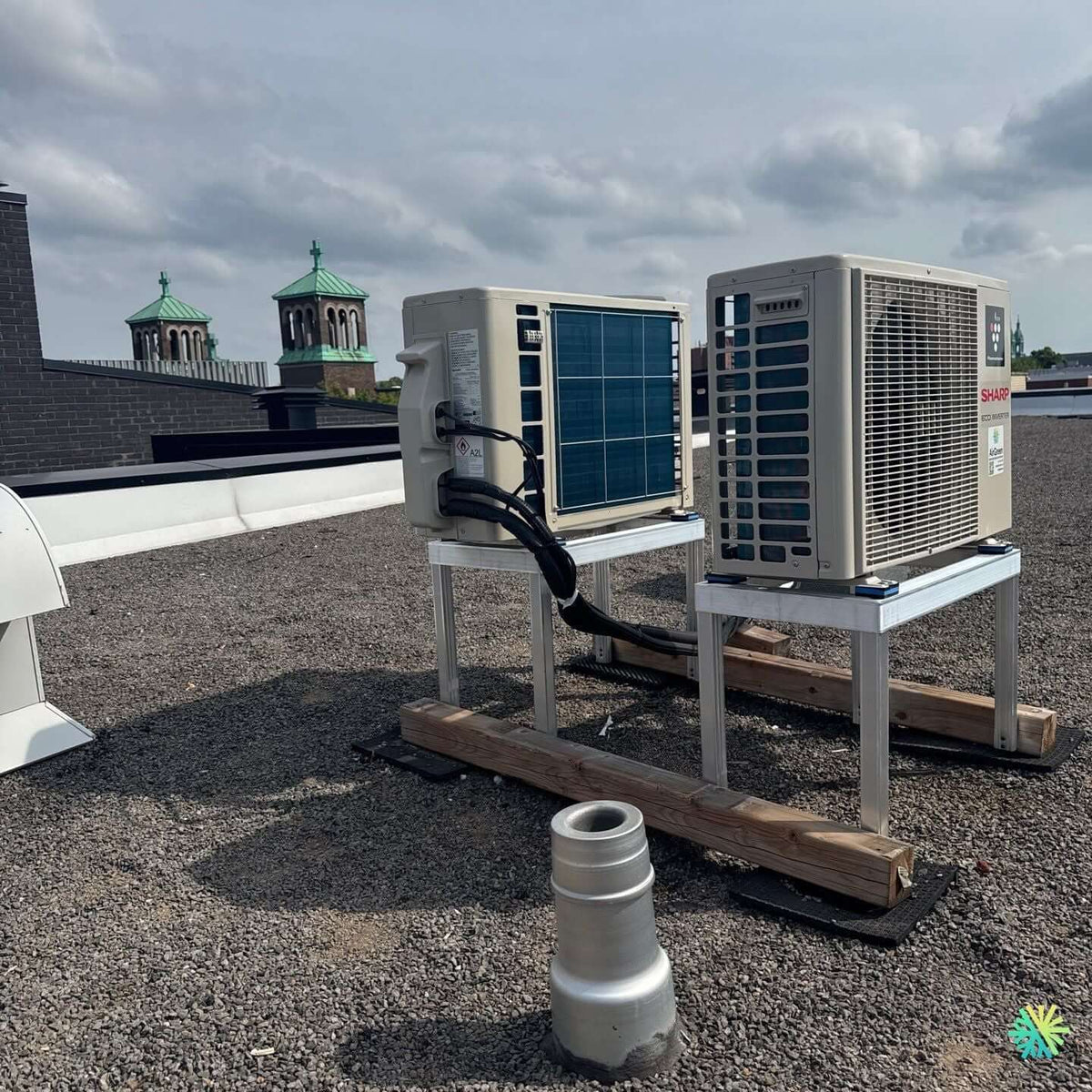
Installation of a Sharp ZU1 wall-mounted heat pump on a flat roof in Rosemont–La Petite-Patrie
AirGreen installs a Sharp ZU1 wall-mounted heat pump on a roof in Rosemont–La Petite-Patrie: raised supports, controlled waterproofing, clean path and extreme cold performance. HVAC service throughout Greater Montreal.
In summer, the outdoor unit rejects the house's heat outside.
Generic illustration of this type of installation, not a survey of this job site. Tap a number.
Mounted level on a wall plate, high enough for the air to reach the whole room, with enough space around it to slide the filters out easily.
The refrigerant lines, the communication cable and the drain go through the wall in a single opening, sealed against water, cold air and insects.
Two insulated copper pipes connect the two units. Outside, a line cover can protect them from sun, knocks and weather.
A shut-off switch near the outdoor unit isolates it safely for service. It must stay accessible at all times.
The compressor and the fan. In heating mode it captures heat from the outdoor air, even in winter, and moves it inside.
On the ground or on the wall, it keeps the unit above accumulated snow. The unit stays clear and defrost water can drain away.
The fan needs to blow freely. Storage, a fence or a wall too close, and efficiency drops while noise goes up.
A roof installation designed for the Montreal climate, longevity and silence
At AirGreen , we have just installed a Sharp wall-mounted heat pump – ZU1 series (R-32) in a residential building in Rosemont–La Petite-Patrie . The outdoor condenser is installed on the gravelled flat roof , a configuration very popular in Montreal plexes to free up courtyard space and limit noise at the windows. This page details our approach: sizing , refrigeration path , supports , electrical , condensate management , roof waterproofing , commissioning and maintenance tips . The objective: four-season comfort with a clean, durable and easy-to-maintain HVAC system.
Why Sharp ZU1 series for this project
The Sharp ZU1 is one of the new generations using R-32 refrigerant , which is more efficient and has a lower GWP than R-410A. It offers:
-
Inverter modulation to precisely adjust capacity according to thermal load.
-
Extreme cold heating range (down to approx. −25/−30°C depending on configuration), suitable for Greater Montreal winters.
-
Low noise levels on the indoor unit and condenser side, highly appreciated in urban environments.
-
Common series capacities available (12k to 24k BTU), allowing fine adjustment to the volume to be treated.
-
Filtration and dehumidification functions that improve comfort in summer.
In this home, the ZU1 has been sized for the main living area , with room for heat peaks. We always favor realistic sizing , which avoids short cycles, protects the compressor and optimizes operating costs.
Built context: flat roof, membrane and point loads
Plexiglas roofs in Rosemont–La Petite-Patrie combine membrane, gravel, and parapets . Successful installation takes into account:
-
Load distribution : we use raised aluminum frames placed on anti-vibration pads and treated wooden beams . The weight is thus distributed, without punching the membrane.
-
Expansions and vibrations : rubber inserts and controlled tightening to protect the structure and the coating.
-
Air clearances : orientation and distance between condensers respected to guarantee free passage and heating performance (defrosting).
-
Service access : easy movement for maintenance, clearance of the hood and electrical panel.
In this case, two condensers coexist in the same technical area. We have optimized the installation of the Sharp ZU1 to maintain standard clearances, suction and discharge, and facilitate any future intervention.
Refrigerated path: cleanliness, insulation and durability
From the interior head, the refrigerant lines rise to the roof via a technical duct . Our team has:
-
Formed a service siphon and an anti-vibration loop to protect the connections.
-
Used deoxidized copper brazed under nitrogen, then continuously insulated (high density cellular, UV-resistant).
-
Cover the exposed sections on the facade with discreet capping , weatherproof and UV-resistant.
-
Checked bend radii and internal cleanliness to preserve oil and compressor.
-
Deep vacuum (< 500 microns) with stabilization, then weighting of refrigerant according to the total length.
The equivalent installation length on this type of building is often between 15 and 25 m . We systematically validate the pressure losses , the required refrigerant top-up and the recalibration of subcooling / superheating .
Electricity: security, compliance and scalability
For the Sharp ZU1, we have planned:
-
Dedicated circuit from the electrical panel, sized to match the unit's MCA/MOCP.
-
Disconnection box near the condenser, waterproof and accessible .
-
Shielded/suitable control wiring between indoor and outdoor unit, chimney protected from mechanical and UV damage.
-
Equipotential bonding and verification of polarity and grounding .
This treatment reduces parasites , prevents unwanted triggers and simplifies diagnosis in the event of subsequent intervention.
Condensate management: gravity when possible, pump when necessary
In the "head under roof" configuration, gravity evacuation is not always possible. We have:
-
Favored gravity for front-mounted heads with direct output.
-
Integrated a silent mini condensate pump when the slope does not allow it. The pipe is insulated and anti-siphon , with odor anti-return shield .
-
Protect roof penetrations with membrane-compatible flashings and sealants to ensure watertightness.
Roof waterproofing: top priority
Each drilling is documented and sealed according to the rules of the art:
-
Sleeves, flashings and additional membranes welded/adhered around penetrations.
-
Mechanical protection under the rails to prevent gravel shearing on the membrane.
-
Raised cable trays to prevent standing water and ice.
We perform a complete post-installation visual inspection and leave a penetration location report for the roofing contractor during future maintenance.
Commissioning: AirGreen quality control
Our commissioning steps include:
-
Nitrogen leak test and electronic detector checks.
-
Deep vacuum with documented vacuum holding .
-
Setting the electronic card, ventilation modes, shutter orientation, airflow adjustment to avoid direct currents.
-
Measurements (internal/external): ΔT, current, operating pressure, superheat and subcooling .
-
Acoustic and vibration validation on the roof.
-
Customer training : filters, seasonal instructions, diagnostic codes, best defrosting practices.
Expected results: comfort, silence and savings
The Sharp ZU1 wall-mounted head + roof-mounted condenser combination allows:
-
Consistent comfort in living areas.
-
A significant reduction in noise perceived from the facade and in the courtyard.
-
Optimized energy bills thanks to the Inverter and R-32 .
-
Minimalist visual integration inside and an orderly technical area on the roof.
Possible grants and eligibilities
Recent R-32 wall-mounted heat pumps that perform well in cold weather are generally eligible for assistance in several Quebec programs promoting energy efficiency. Eligibility depends on the capacity , performance indices and the building profile . We support our clients in Montreal, Laval, Longueuil, the North Shore and the South Shore for:
-
Check the lists of qualified equipment ,
-
Prepare technical documents ,
-
Submit rebate requests, where applicable.
Good practices for use and maintenance
To get the most out of the heat pump :
-
Clean filters every 4 to 8 weeks during peak season.
-
Maintain 1.2 to 1.5 m of clearance around the rooftop condenser and clear snow in winter.
-
Avoid operating in Auto mode during mid-seasons if alternating heating/cooling is not desired.
-
Schedule annual HVAC maintenance : electrical inspection, tightening, pressure, coil/fan cleaning, condensate testing.
Common Mistakes…and How We Avoid Them
-
Supports placed directly on the membrane : risk of punching. We use anti-vibration pads and beams to distribute the load.
-
Insufficient clearances between two condensers: performance losses, icing. We respect the recommended skylights and flow orientation.
-
Unprotected cables and lines : premature aging. Our UV-resistant covers and insulation guarantee longevity.
-
Approximate roof waterproofing : medium-term leaks. Our flashings and sealants are carried out according to industry standards, with traceability.
-
Approximate sizing : discomfort and overconsumption. We calculate the load and adjust the BTU capacity as needed.
What if you have a courtyard, balcony or brick facade?
We adapt the condenser installation: wall brackets , slab on the ground with snow guard, or roof structure . Each context (plex, condo, single-family home) receives a tailor-made solution to maximize durability , accessibility and discretion .
What you gain with AirGreen
-
Independent technical advice on recent brands and series (Sharp, Gree, Fujitsu, Midea, etc.).
-
Careful installation and complete documentation (diagrams, serial numbers, lengths, load).
-
Local, responsive after-sales service with parts and expertise on wall-mounted , multi-zone and central heat pumps.
Our intervention in Rosemont–La Petite-Patrie illustrates an approach that respects the architecture of Montreal buildings while offering four-season comfort . The Sharp ZU1 rooftop unit delivers an ideal balance between performance, silence and visual sobriety—exactly what many households in Greater Montreal are looking for.
Quick Facts (technical summary of the installation)
-
Machine type : Sharp ZU1 wall-mounted heat pump (R-32).
-
Installation : condenser on flat roof , raised frame, anti-vibration bases, clearances respected.
-
Route : technical duct up to the roof, UV-resistant insulated copper connections, clean capping on the facade.
-
Condensate drainage : gravity when possible, silent mini-pump if necessary.
-
Electrical : dedicated circuit, roof disconnection , grounding, protected control cable.
-
Commissioning : deep vacuum , R-32 top-up according to length, ΔT, intensity, pressure, acoustic checks.
Are you considering a flat roof HVAC installation in Montreal, Laval, Longueuil, North Shore or South Shore ? We size, install and maintain Sharp ZU1 , Gree , Fujitsu , Midea and other recent series R-32 / R-454B systems for lasting comfort, winter and summer.
How it goes, from the first call to the end
The main steps of this kind of job at AirGreen. Every house has its quirks: the estimate brings them out.
We look at the room, the outside wall, the line route and where the outdoor unit will go. That is where the capacity gets chosen.
Model, capacity and price, in writing. We also check whether the model qualifies for assistance programs.
Floors and furniture protected, wall plate position marked level, wall opening located.
A single opening, with the slope the drain needs to flow outside.
Set on a stand raised above the snow, with the clearances the manufacturer requires.
Connected, insulated and protected. The opening is then sealed against water, cold air and insects.
A dedicated circuit and an accessible disconnect near the outdoor unit.
Leak test, vacuum, then start-up and a check of heating and cooling.
Remote, modes, filters: we show you the essentials before we leave.
- The on-site estimateWe look at the room, the outside wall, the line route and where the outdoor unit will go. That is where the capacity gets chosen.
- The quoteModel, capacity and price, in writing. We also check whether the model qualifies for assistance programs.
- Getting readyFloors and furniture protected, wall plate position marked level, wall opening located.
- The wall openingA single opening, with the slope the drain needs to flow outside.
- The outdoor unitSet on a stand raised above the snow, with the clearances the manufacturer requires.
- Lines, cable and drainConnected, insulated and protected. The opening is then sealed against water, cold air and insects.
- The electrical workA dedicated circuit and an accessible disconnect near the outdoor unit.
- Tests and start-upLeak test, vacuum, then start-up and a check of heating and cooling.
- The walkthroughRemote, modes, filters: we show you the essentials before we leave.
What the unit delivers when it is cold
The range as published on airgreen.ca: pick a size to see its capacity in deep cold.
| Size | Heating at −8 °C | Heating at −15 °C | Coldest certified point | COP at −15 °C | SEER | HSPF | Indicative LogisVert aid |
|---|---|---|---|---|---|---|---|
| Sharp ZU1 12 000 | 14,500 | 12,000 | −27 °C: 7,200 | 2.11 | 22.0 | 11.0 | $1,740 |
| Sharp ZU1 15 000 | 18,100 | 15,300 | −27 °C: 10,100 | 2.1 | 24.0 | 11.0 | $2,172 |
| Sharp ZU1 18 000 | 22,000 | 18,000 | −27 °C: 11,500 | 2.2 | 24.0 | 11.0 | $2,640 |
| Sharp ZU1 24 000 | 22,400 | 19,000 | −27 °C: 12,300 | 2.2 | 22.0 | 11.0 | $2,688 |
According to NEEP, it delivers 14,500 BTU/h at −8 °C (17 °F), more than at 8 °C (14,000 BTU/h). It heats as hard in moderate cold as in mild weather.
According to NEEP, its certified maximum capacity at −27 °C (−17 °F) is 7,200 BTU/h, 60% of its nominal 12,000 BTU size.
At 8 °C, its certified maximum capacity reaches 17,100 BTU/h, 42% more than its nominal 12,000 BTU size.
According to NEEP, it delivers 18,100 BTU/h at −8 °C (17 °F), more than at 8 °C (18,000 BTU/h). It heats as hard in moderate cold as in mild weather.
According to NEEP, its certified maximum capacity at −27 °C (−17 °F) is 10,100 BTU/h, 67% of its nominal 15,000 BTU size.
At 8 °C, its certified maximum capacity reaches 21,800 BTU/h, 45% more than its nominal 15,000 BTU size.
According to NEEP, it delivers 22,000 BTU/h at −8 °C (17 °F), more than at 8 °C (21,600 BTU/h). It heats as hard in moderate cold as in mild weather.
According to NEEP, its COP at −27 °C is 1.88: the highest of the ZU1 line, which ranges from 1.79 to 1.82 at that temperature.
According to NEEP, its certified maximum capacity at −27 °C (−17 °F) is 11,500 BTU/h, 64% of its nominal 18,000 BTU size.
At −27 °C, its certified minimum capacity is 3,200 BTU/h (5,500 at 8 °C). It slows down instead of cycling on and off.
According to NEEP, its certified heating capacity at −15 °C (5 °F) is 19,000 BTU/h, 79% of its nominal 24,000 BTU size. Its COP there is 2.20.
Data read live from the airgreen.ca page of each size (NEEP / AHRI certified performance). When the title names the installed size, it is highlighted; otherwise the whole range is shown. The aid shown is today’s, using Hydro-Québec’s rule ($120 per 1,000 BTU/h at −8 °C); amounts quoted in the article date from its publication. Only Hydro-Québec confirms the assistance granted.
And at your place?
Two quick checks with real numbers: what heat costs, and what your current heaters add up to in BTU/h.
Baseboards and electric furnaces turn 1 kWh of electricity into 1 kWh of heat. A heat pump delivers more: that is its COP. At Hydro-Québec’s rate D (11.142¢/kWh above 40 kWh a day, since 1 April 2026):
Hydro-Québec: a heat pump can be up to three times more efficient than baseboards for heating in the colder months.
Estimate per kWh of heat, at the chosen temperature, using the certified COP from the product page. Taxes, access charge and backup heat not included.
Conversion: 1 W = 3.412 BTU/h. An indication, not a load calculation: baseboards and furnaces are often stronger than the real need, and they can stay as backup. AirGreen confirms the capacity on site.
What to do, season by season
Three habits per season for this unit. They take a few minutes and prevent many calls.
- Clean the indoor unit's filters.
- Clear leaves and debris left on the outdoor unit by winter.
- Test cooling before the first hot days.
- Clean the filters more often when the unit runs a lot.
- Keep plants away from the outdoor unit.
- Check that no water drips from the indoor unit.
- Rake the leaves around the outdoor unit.
- Test heating before the first cold days.
- Book periodic maintenance before winter.
- Keep snow away from the stand and the front of the unit.
- Let the unit defrost: it is normal.
- Never hit the ice on the fins; call us if the unit stays iced up.
Which type of equipment for your project?
Pick what looks like your need.
Four mistakes we do not make
Flip each card to see what we do instead.
What people ask us about this kind of work
Does a wall-mounted heat pump heat in winter?
Wall-mounted or multi-zone: how do I choose?
Where does the outdoor unit go?
Are there grants?
Do I need a permit?
How cold can it heat?
How much can I save?
How is the LogisVert assistance calculated?
Is it noisy?
The outdoor unit is covered in ice: is that normal?
Does AirGreen hold the required licences?
Is the estimate free?
No question matches. Write to us: we answer.
Useful pages for what comes next
More jobs to see, near you
By town, by equipment or by region: browse more than 4,700 published projects.
Each dot: a town where AirGreen has published projects. The glowing dot: this job.
Tell us about your house. We come and see it for free.
The on-site estimate is free and the quote follows within 24 hours.
Text and photo: a real AirGreen Climatisation & Chauffage job. The diagrams are generic illustrations of the type of installation, not a survey of this job site. Sources of the added figures: airgreen.ca product pages (NEEP / AHRI performance), Hydro-Québec (Heat pumps page, LogisVert, read on 13 October 2026), Régie de l’énergie (rate D as of 1 April 2026).