
Installation of a MIDEA EVOX G3 1.5 ton central heat pump in Candiac on the South Shore
HVAC installation in Candiac of a 1.5-ton MIDEA EVOX G3 central heat pump. Winter performance, subsidy, technical challenges, and AirGreen's expertise on the South Shore.
- City
- Region
- Equipment
- Brand
- Challenges
- Published
The job on one screen
The unit’s data sheet
The range as published on airgreen.ca: pick a size to see its capacity in deep cold.
| Size | Heating at −8 °C | Heating at −15 °C | Coldest certified point | COP at −15 °C | SEER | HSPF | Indicative LogisVert aid |
|---|---|---|---|---|---|---|---|
| Midea EVOX G3 · 1.5 tons | 14,700 | 18,600 | −30 °C: 11,800 | 2.12 | 19.0 | 10.1 | $1,764 |
| Midea EVOX G3 · 2 tons | 20,800 | 20,600 | −30 °C: 12,100 | 2.14 | 18.6 | 10.0 | $2,496 |
| Midea EVOX G3 · 2.5 tons | 24,000 | 33,200 | −30 °C: 17,900 | 1.97 | 17.2 | 10.8 | $2,880 |
| Midea EVOX G3 · 3 tons | 33,000 | 37,400 | −30 °C: 27,600 | 1.9 | 18.0 | 10.0 | $3,960 |
| Midea EVOX G3 · 4 tons | 39,500 | 48,000 | −30 °C: 27,200 | 2.0 | 17.5 | 9.5 | $4,740 |
| Midea EVOX G3 · 5 tons | 45,000 | 54,000 | −30 °C: 37,300 | 1.9 | 17.5 | 9.5 | $5,400 |
Data read live from the airgreen.ca page of each size (NEEP / AHRI certified performance). When the title names the installed size, it is highlighted; otherwise the whole range is shown. The aid shown is today’s, using Hydro-Québec’s rule ($120 per 1,000 BTU/h at −8 °C); amounts quoted in the article date from its publication. Only Hydro-Québec confirms the assistance granted.
The article, chapter by chapter
A Strategic HVAC Installation to Brave Candiac's Harsh Winters
At AirGreen, we regularly perform complex HVAC installations on the South Shore, but some projects stand out due to their technical precision and specific building constraints. This installation of a MIDEA EVOX G3 central heat pump in Candiac is an excellent example.
The client, owner of a single-family home built in the 2000s, was looking for a solution capable of effectively replacing their old central system, while improving their thermal comfort and reducing their energy consumption. The objective was clear: to achieve stable heating performance down to extreme temperatures, without compromising indoor comfort.
A Thoughtful Choice: Why the MIDEA EVOX G3?
A Central Heat Pump Adapted to the Quebec Climate
The MIDEA EVOX G3 1.5 ton (18,000 BTU) model was selected after a comprehensive analysis of the client's needs and the building's characteristics. This system particularly stands out in the climatic conditions of Montreal, Laval, Longueuil, and the South Shore, thanks notably to:
- Heating capacity down to -30 °C
- Maintains high performance down to -25 °C
- ENERGY STAR® Cold Climate certification
- Uses more ecological R-454B refrigerant
- SEER2: 19.0 | HSPF2: 10.1 | EER2: 12.5
These performances significantly reduce reliance on electric auxiliary systems, an essential point for the region's winters.
An Advantageous Subsidy
Another determining factor was eligibility for the LogisVert grant of $1764, which makes this central heat pump particularly attractive financially.
Technical Challenges Encountered During Installation in Candiac
1. Restricted Outdoor Space
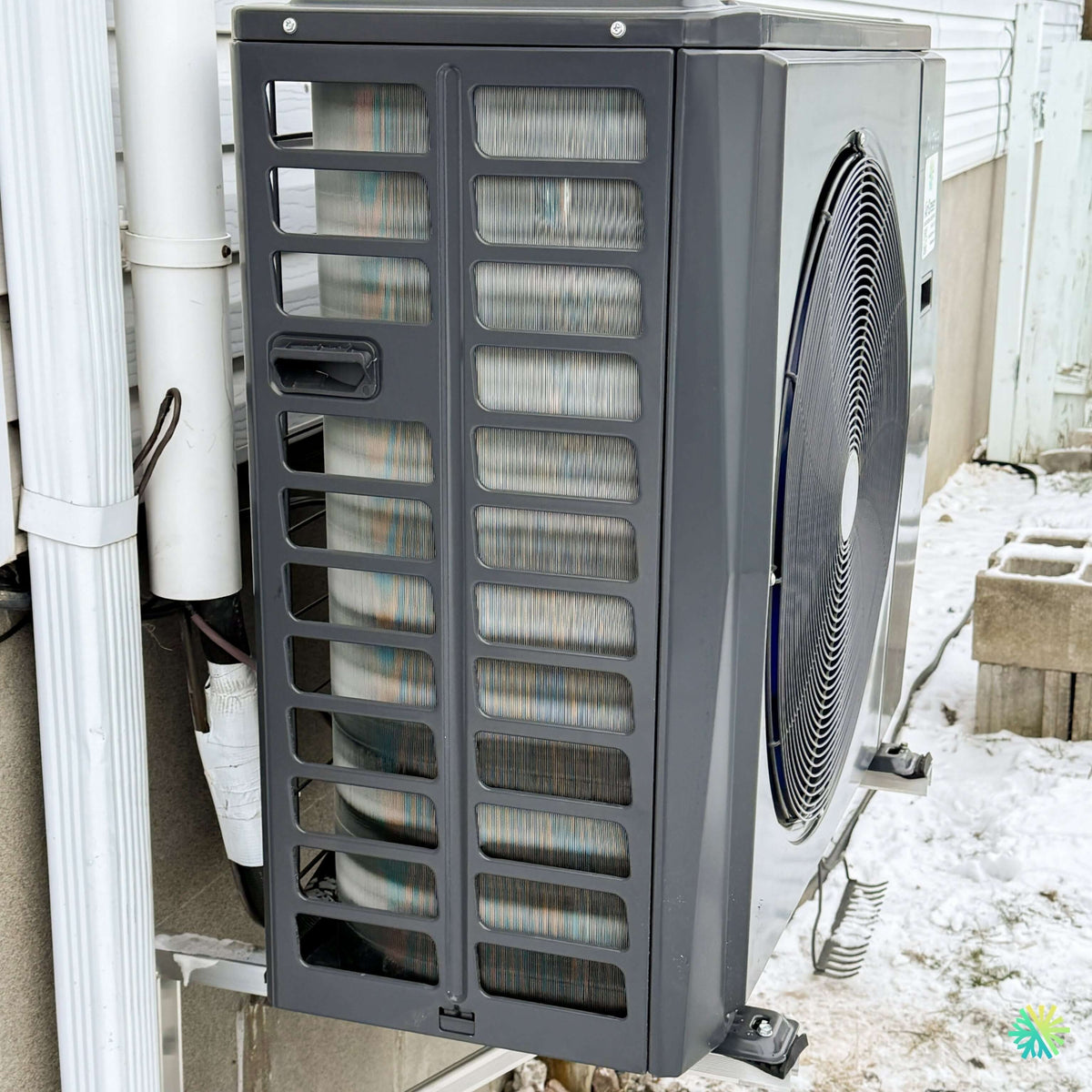
As seen in the project photo, the outdoor unit had to be installed in a relatively confined space, close to the foundation wall and a vertical drain. This type of configuration requires:
- Optimal airflow management
- A minimum distance respected to avoid air recirculation
- Solid mounting with anti-vibration supports
We opted for installation on elevated supports to protect the unit from snow accumulation, a critical element on the South Shore.
2. Integration into the Existing Central System
The indoor system (air handler MAUSE-H18B-2A) had to be integrated into the existing duct network. This implies:
- Complete static pressure verification
- Airflow adjustment to avoid cold or overheated zones
- Optimization of distribution to distant rooms
We also recalibrated the registers to ensure uniform distribution throughout the house.
3. Refrigerant Piping Management
The 3/8 – 3/4 piping was installed with particular attention:
- External mechanical protection
- Reinforced insulation to prevent thermal loss
- Discreet routing to preserve the building's aesthetics
A complete vacuum pull with micron test was performed to guarantee system airtightness.
Key Stages of HVAC Installation
Preparation and Inspection
Before any installation, our team performed:
- Inspection of the existing system
- Electrical validation (220V required)
- Structural analysis for external support
- Duct verification
Outdoor Unit Installation
- Mounting on robust supports
- Precise leveling
- Respect for necessary clearances
- Secure electrical connection
Indoor Installation
- Strategic positioning of the central module
- Connection to the duct network
- Installation of a compatible smart thermostat
Commissioning
- Full system test
- Pressure verification
- Thermostat calibration
- Explanation of WiFi operation to the client
Final Result: Comfort, Efficiency, and Peace of Mind
After startup, the results were immediate:
- Stable temperature throughout the house
- Noticeable noise reduction compared to the old system
- Homogeneous air distribution
- Rapid heating response even in cold conditions
The client particularly appreciated the control via the mobile app, allowing remote temperature adjustment.
Practical Tips for Homeowners in Montreal and on the South Shore
Properly Sizing Your System
A 1.5-ton (18,000 BTU) system is perfect for:
- Well-insulated homes
- Average surface area
- Existing central configuration
Improper sizing can lead to:
- Overconsumption
- Thermal discomfort
- Premature wear
Do Not Neglect Installation
Even the best central heat pump will not perform correctly without rigorous installation. Common mistakes include:
- Poor duct management
- Inadequate outdoor installation
- Incomplete vacuum pull
At AirGreen, every installation is carried out according to strict standards.
Why Choose AirGreen for Your HVAC Installation in Candiac?
Our approach is based on three essential pillars:
Technical Expertise
Our refrigeration technicians are perfectly proficient in modern systems like the MIDEA EVOX G3, including new technologies and eco-friendly refrigerants.
Total Transparency
- Free estimate
- No deposit required
- Payment only at the end, when the client is satisfied
Recognized After-Sales Service
We support our clients long after installation, with HVAC maintenance and fast technical support services throughout Greater Montreal.
A Sustainable Solution for South Shore Homes
This installation in Candiac perfectly illustrates what we aim for at AirGreen: to offer a reliable, high-performing, and locally adapted solution.
The MIDEA EVOX G3 central heat pump now represents an excellent balance between energy efficiency, winter performance, and overall cost, especially with available subsidies.
For homeowners in Montreal, Laval, Longueuil, North Shore, and South Shore, this type of system is a smart long-term investment.
The job tools
Two quick checks with real numbers: what heat costs, and what your current heaters add up to in BTU/h.
Baseboards and electric furnaces turn 1 kWh of electricity into 1 kWh of heat. A heat pump delivers more: that is its COP. At Hydro-Québec’s rate D (11.142¢/kWh above 40 kWh a day, since 1 April 2026):
Hydro-Québec: a heat pump can be up to three times more efficient than baseboards for heating in the colder months.
Estimate per kWh of heat, at the chosen temperature, using the certified COP from the product page. Taxes, access charge and backup heat not included.
Conversion: 1 W = 3.412 BTU/h. An indication, not a load calculation: baseboards and furnaces are often stronger than the real need, and they can stay as backup. AirGreen confirms the capacity on site.
How the job unfolds
The main steps of this kind of job at AirGreen. Every house has its quirks: the estimate brings them out.
We look at the ducts, the current indoor module, the electrical panel and the planned spot for the outdoor unit.
The equipment combination, capacity and price, in writing. We check whether the combination qualifies for assistance programs.
Access protected, old unit disconnected and removed when it is being replaced.
Electric furnace or air handler, with its coil, connected to the supply and return ducts.
On a level base, raised above the snow, with free space all around.
Insulated, they enter through a sealed opening and run to the indoor coil.
Dedicated circuits, accessible disconnect, a thermostat that works with the heat pump and the backup heat.
Leak test, vacuum, start-up, airflow check and a test of both modes.
Filter, thermostat, backup heat in extreme cold: what to know before winter.
- The on-site estimateWe look at the ducts, the current indoor module, the electrical panel and the planned spot for the outdoor unit.
- The quoteThe equipment combination, capacity and price, in writing. We check whether the combination qualifies for assistance programs.
- Getting readyAccess protected, old unit disconnected and removed when it is being replaced.
- The indoor moduleElectric furnace or air handler, with its coil, connected to the supply and return ducts.
- The outdoor unitOn a level base, raised above the snow, with free space all around.
- The refrigerant linesInsulated, they enter through a sealed opening and run to the indoor coil.
- Electrical and thermostatDedicated circuits, accessible disconnect, a thermostat that works with the heat pump and the backup heat.
- Tests and start-upLeak test, vacuum, start-up, airflow check and a test of both modes.
- The walkthroughFilter, thermostat, backup heat in extreme cold: what to know before winter.
What we check on a job like this one
Each number is a point we check on site. Switch between summer and winter to watch air and heat move.
In summer, the outdoor unit rejects the house's heat outside.
Generic illustration of this type of installation, not a survey of this job site. Tap a number.
It captures or rejects heat outside. It sits on a level base, above the snow, with free space all around.
The insulated refrigerant lines enter the house through a sealed opening and run to the indoor coil.
A shut-off switch near the outdoor unit isolates it safely for service.
Sitting on the indoor module, it moves heat between the house air and the refrigerant.
Electric furnace or air handler: its fan pushes air through the ducts. The electric backup takes over in extreme cold.
Supply ducts bring air to the rooms; returns bring it back to the unit. Their condition matters as much as the unit's.
It protects the coil and the fan. A dirty filter cuts airflow, so it gets checked regularly.
It runs the heat pump and the backup heat. It must be compatible with the installed system.
Is your home ready?
Check what applies at your place. A "no" is not a refusal: it is what we sort out during the estimate.
Good habits, once the unit is in place
Six simple habits that keep the unit going. Your list stays on this device.
What to do, season by season
Three habits per season for this unit. They take a few minutes and prevent many calls.
- Check the indoor module's filter.
- Clear winter debris from the outdoor unit.
- Test cooling before the heat arrives.
- Check the filter more often in peak season.
- Keep registers and returns clear.
- Watch condensate drainage near the coil.
- Change or clean the filter.
- Test heating and backup heat before the cold.
- Book periodic maintenance.
- Clear snow around the outdoor unit.
- Store nothing in front of the indoor module.
- Note any unusual noise or smell and call us.
The right pages, at the right time
Four statements: true or false?
It all comes down to details you have just seen.
1. A central heat pump uses the house's ducts.
It connects to the existing ducts to heat and cool everywhere.
2. In extreme cold, electric backup heat can take over.
The indoor module (furnace or air handler) works with the heat pump and takes over in extreme cold.
3. The filter only gets changed when the unit breaks down.
A dirty filter cuts airflow. It gets checked regularly.
4. You can reuse the old unit's size without checking.
The house may have changed: insulation, windows, added rooms. Capacity is confirmed on site.
0 / 4 right answers
What people ask us about this kind of work
Can I keep my current ducts?
What happens in extreme cold?
Furnace, air handler, ducted: what is the difference?
Are there grants?
Do I need a permit?
How much can I save?
How is the LogisVert assistance calculated?
Will my current thermostat work?
Central or wall units: which one?
Does AirGreen hold the required licences?
Is the estimate free?
No question matches. Write to us: we answer.
More jobs to see, near you
By town, by equipment or by region: browse more than 4,700 published projects.
Each dot: a town where AirGreen has published projects. The glowing dot: this job.
An on-site estimate, the right capacity, the right equipment.
The on-site estimate is free and the quote follows within 24 hours.
Text and photo: a real AirGreen Climatisation & Chauffage job. The diagrams are generic illustrations of the type of installation, not a survey of this job site. Sources of the added figures: airgreen.ca product pages (NEEP / AHRI performance), Hydro-Québec (Heat pumps page, LogisVert, read on 13 October 2026), Régie de l’énergie (rate D as of 1 April 2026).