
Installation of a MIDEA EVOX G3 2.5 ton central heat pump in Chomedey, Laval
AirGreen installs a MIDEA EVOX G3 2.5 ton central heat pump in Chomedey: central comfort, neat wall installation, HVAC performance, and professional finish in Laval.
Take a tour of the installation
Each number is a point we check on site. Switch between summer and winter to watch air and heat move.
In summer, the outdoor unit rejects the house's heat outside.
Generic illustration of this type of installation, not a survey of this job site. Tap a number.
It captures or rejects heat outside. It sits on a level base, above the snow, with free space all around.
The insulated refrigerant lines enter the house through a sealed opening and run to the indoor coil.
A shut-off switch near the outdoor unit isolates it safely for service.
Sitting on the indoor module, it moves heat between the house air and the refrigerant.
Electric furnace or air handler: its fan pushes air through the ducts. The electric backup takes over in extreme cold.
Supply ducts bring air to the rooms; returns bring it back to the unit. Their condition matters as much as the unit's.
It protects the coil and the fan. A dirty filter cuts airflow, so it gets checked regularly.
It runs the heat pump and the backup heat. It must be compatible with the installed system.
A well-thought-out central installation for a Chomedey home where outdoor space was as important as indoor comfort
In Chomedey, in a dense residential area of Laval, our AirGreen team installed a MIDEA EVOX G3 2.5-ton central heat pump, a system designed to provide stable, efficient, and discreet comfort throughout the entire home. This project perfectly illustrates what we often encounter in established neighborhoods of Laval: homes with limited side space, exterior siding to preserve, a foundation to respect, and a real need to improve energy efficiency without complicating the existing layout.
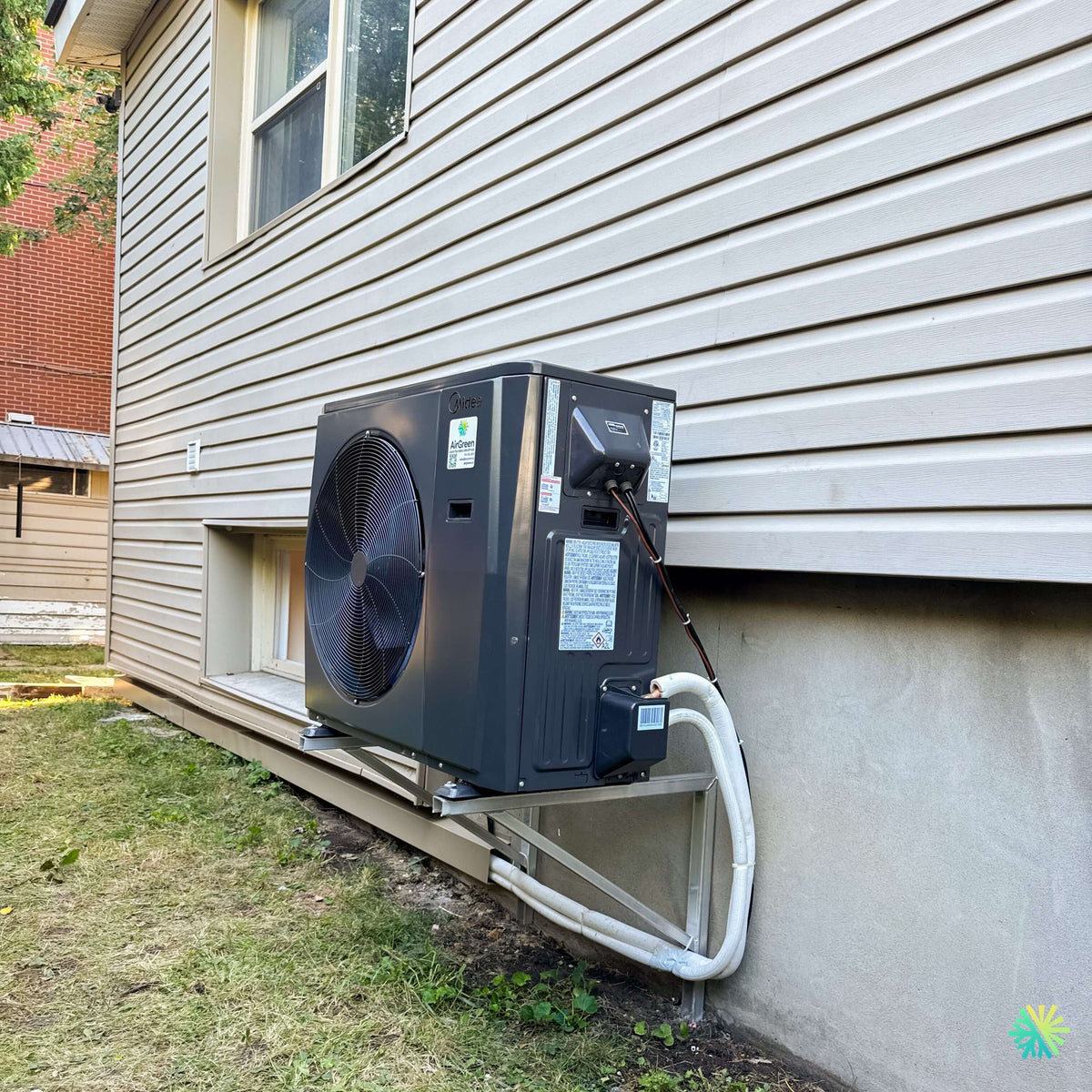
In the installation photo, the MIDEA outdoor unit is immediately noticeable, installed on a robust metal wall bracket, above ground level. This choice is not merely aesthetic: it addresses very practical considerations related to the Quebec climate, snow accumulation, drainage, future maintenance, and equipment protection. For a central heat pump, especially in a region like Montreal, Laval, Longueuil, the North Shore or the South Shore, the quality of outdoor positioning directly influences the system's durability.
Why a MIDEA EVOX G3 2.5 tons for this property in Chomedey
The MIDEA EVOX G3 is a particularly attractive central heat pump solution for homeowners looking to replace or modernize their heating and air conditioning system while maintaining ducted air distribution. In this specific case, the house already had a configuration allowing for efficient central integration, which made the choice of a 2.5-ton system relevant to meet the building's comfort needs.
A 2.5-ton capacity is often suitable for average-sized single-family homes, but sizing should never be chosen randomly. At AirGreen, we evaluate several elements before recommending a capacity:
- the actual living area;
- the building envelope's insulation;
- sun exposure;
- the number of floors;
- the configuration of existing ducts;
- approximate heat losses;
- occupants' heating and cooling habits;
- the possible location of the outdoor unit.
In this installation in Chomedey, the MIDEA EVOX G3 2.5-ton central heat pump offered an excellent balance of performance, comfort, and physical integration. The goal was not merely to install a machine, but to create a reliable system capable of responding to the typical temperature variations of Laval: summer humidity, dry cold, frequent thaws, freezing periods, and defrost cycles in winter.
An outdoor wall-mounted installation: a detail that makes a big difference
The outdoor unit was installed on a wall bracket fixed to the foundation, which keeps the appliance well clear of the ground. This type of installation is very useful in several situations, especially when the terrain is slightly uneven, when space is restricted, or when one wants to limit the risks associated with snow accumulation around the heat exchanger.
In this project, our team paid particular attention to several visible and invisible details:
- clearance around the fan to ensure good airflow;
- the unit's height relative to the ground;
- the robustness of the metal support;
- protection of refrigerant lines;
- clean passage of lines indoors;
- reduction of vibrations transmitted to the structure;
- ease of access for future HVAC maintenance.
The unit is placed along the side wall, in a location that minimizes clutter in the yard while maintaining adequate distance from openings and obstacles. The house's exterior siding was respected, and the insulated lines were neatly routed to the entry point. For a homeowner, this type of finish is important: an HVAC installation must be efficient, but it must also integrate cleanly with the building.
Challenges encountered on site in Chomedey
Every installation has its peculiarities. In Chomedey, houses are often close together, side access can be narrow, and working spaces around foundations require precise planning. Here, the unit's location had to take into account the basement window, vinyl siding, required clearance, and the path of the conduits.
Our team had to work with precision to install the wall bracket at the correct height, while ensuring stable fastening to the foundation. An incorrect height could have made the appliance more vulnerable to snow or complicated access to connections. An incorrect lateral position could have hindered airflow or created undesirable noise near windows.
We therefore opted for a compact, structured, and easy-to-maintain installation. Refrigerant lines were insulated and protected, wiring was carefully routed, and the unit was leveled to ensure proper operation. For a central heat pump, these details influence long-term efficiency, compressor stability, and the quality of heating and cooling cycles.
What this installation concretely brings to home comfort
The difference between an old central system and a well-installed MIDEA EVOX G3 central heat pump is particularly noticeable in the consistency of comfort. The goal is to reduce abrupt temperature variations, improve air conditioning in summer, and optimize heating for a large part of the cold season.
Comfort distributed throughout the house
Unlike a wall-mounted air conditioner or a wall-mounted heat pump, a central heat pump uses the duct network to distribute treated air to multiple rooms. For homeowners who want uniform comfort without visible wall-mounted units in main rooms, this is a much-appreciated solution.
In this Chomedey home, the system allows for more homogeneous air distribution, which improves comfort in distant rooms and limits differences between floors. The central system becomes particularly useful during hot and humid days in Laval, when stable air conditioning helps control both indoor temperature and humidity.
A solution adapted to the climate of Laval and Greater Montreal
The Laval region experiences significant temperature fluctuations. An HVAC system must therefore be selected not only for its cooling capacity but also for its ability to effectively manage heating periods. The MIDEA EVOX G3 is designed to offer efficient operation in varied conditions, making it a serious option for residences in Greater Montreal.
For homeowners in Montreal, Laval, Longueuil, the North Shore, and the South Shore, the question is not only whether a heat pump can heat or cool. One must also ask:
- Is the system correctly sized?
- Are the ducts compatible?
- Is the outdoor unit well located?
- Does the installation respect the required clearances?
- Will the equipment be easy to maintain?
- Will the actual performance be consistent with the home's needs?
It is precisely on these points that our AirGreen approach makes a difference.
The importance of sizing: avoiding a costly mistake
A common mistake is to believe that a larger appliance will automatically be better. In reality, an oversized heat pump can lead to short cycling, less effective dehumidification, premature wear, and less stable comfort. Conversely, an undersized unit risks running too long without reaching desired temperatures.
For this installation, the choice of a 2.5-ton central heat pump was made based on the building and its actual use. This step is essential to maximize the efficiency of the MIDEA EVOX G3 and ensure consistent performance in both heating and cooling.
A clean finish that facilitates future maintenance
Maintenance is often overlooked at the time of purchase, but it becomes very important after a few seasons. A well-positioned outdoor unit facilitates access to service panels, connections, and the heat exchanger. In this Chomedey installation, the appliance is sufficiently clear to allow for adequate cleaning and future inspection.
Good HVAC maintenance includes, among other things:
- cleaning the outdoor unit;
- checking the central system's filters;
- inspecting conduits and insulation;
- checking operating pressures;
- drainage control;
- overall performance evaluation;
- checking electrical components.
A well-thought-out installation reduces complications during maintenance and helps extend the system's lifespan.
Subsidies and energy efficiency: a point to check before installation
Many homeowners in Laval and Greater Montreal are interested in available subsidy programs for central heat pumps. Depending on the exact model, its certification, performance, and current criteria at the time of installation, some systems may be eligible for financial aid programs, notably via Hydro-Québec or other energy initiatives.
At AirGreen, we guide our clients in checking the applicable criteria. The important thing is to confirm the specific model's eligibility before making a final decision, as programs may vary according to updates, model numbers, and technical requirements.
For homeowners, this step can influence the project's overall budget. A well-planned HVAC installation therefore takes into account equipment cost, necessary work, installation quality, potential energy savings, and possible subsidies.
What we recommend to homeowners before installing a central heat pump
From this project in Chomedey, several practical tips can help homeowners considering a similar installation.
Check the condition of existing ducts
A central heat pump heavily relies on the duct network. If the ducts are improperly sized, poorly insulated, or leaky, even a very good appliance will not perform at its best. Before installation, the air distribution must be evaluated, and problematic areas identified.
Carefully choose the outdoor location
The outdoor unit needs to breathe. Avoid overly confined areas, zones exposed to excessive snow accumulation, or locations that complicate maintenance. In the case of this Chomedey installation, the wall bracket allowed for a stable, clean, and durable solution.
Consider noise and vibrations
Even though modern heat pumps are much quieter than before, location remains important. Fastening, the appliance's level, and the quality of the support play a direct role in reducing vibrations.
Don't choose solely based on price
A low price can hide a quicker, less careful, or less suitable installation for the building. A heat pump is a long-term investment. Installation quality is as important as the appliance's brand.
The AirGreen approach on this project
For this installation of a MIDEA EVOX G3 2.5 tons in Chomedey, our work was not limited to dropping off an outdoor unit and connecting conduits. We planned the positioning, checked physical constraints, ensured solid fastening, protected lines, and validated system operation.
Our approach is based on a simple idea: a successful installation must be clean, durable, safe, and adapted to the building's reality. This is true in Laval, but also in our projects in Montreal, Longueuil, on the North Shore, and on the South Shore.
We regularly work on homes where available space is limited, where owners want to preserve the exterior appearance, or where the existing system needs to be modernized without unnecessary house transformations. This field experience allows us to offer realistic and effective solutions.
A discrete, solid, and efficient final result
The final result in Chomedey is a neat, well-structured outdoor installation ready to face local climatic conditions. The MIDEA unit rests on a solid wall bracket, conduits are neatly routed, and the space around the appliance allows for good airflow.
For the homeowner, this means a central system capable of improving indoor comfort while maintaining a clean exterior appearance. For us, this is exactly what an AirGreen installation should represent: rigorous technical work, a clean finish, and a solution adapted to the client's daily life.
Why choose AirGreen for a central heat pump in Laval
Installing a central heat pump requires a complete understanding of the building, duct system, thermal loads, and outdoor constraints. At AirGreen, we support homeowners from initial assessment to final commissioning.
Our clients often contact us because they want a clear solution, transparent pricing, professional installation, and reliable support. We operate throughout the Greater Montreal area, including Montreal, Laval, Longueuil, on the North Shore and the South Shore, with concrete expertise in HVAC installation, central system replacement, heat pumps, central air conditioning, and residential comfort optimization.
This installation in Chomedey clearly demonstrates our working method: taking the time to choose the right appliance, installing it in the right place, paying attention to visible details, respecting building constraints, and delivering a reliable result.
The unit on this job, in figures
The range as published on airgreen.ca: pick a size to see its capacity in deep cold.
| Size | Heating at −8 °C | Heating at −15 °C | Coldest certified point | COP at −15 °C | SEER | HSPF | Indicative LogisVert aid |
|---|---|---|---|---|---|---|---|
| Midea EVOX G3 · 1.5 tons | 14,700 | 18,600 | −30 °C: 11,800 | 2.12 | 19.0 | 10.1 | $1,764 |
| Midea EVOX G3 · 2 tons | 20,800 | 20,600 | −30 °C: 12,100 | 2.14 | 18.6 | 10.0 | $2,496 |
| Midea EVOX G3 · 2.5 tons | 24,000 | 33,200 | −30 °C: 17,900 | 1.97 | 17.2 | 10.8 | $2,880 |
| Midea EVOX G3 · 3 tons | 33,000 | 37,400 | −30 °C: 27,600 | 1.9 | 18.0 | 10.0 | $3,960 |
| Midea EVOX G3 · 4 tons | 39,500 | 48,000 | −30 °C: 27,200 | 2.0 | 17.5 | 9.5 | $4,740 |
| Midea EVOX G3 · 5 tons | 45,000 | 54,000 | −30 °C: 37,300 | 1.9 | 17.5 | 9.5 | $5,400 |
Data read live from the airgreen.ca page of each size (NEEP / AHRI certified performance). When the title names the installed size, it is highlighted; otherwise the whole range is shown. The aid shown is today’s, using Hydro-Québec’s rule ($120 per 1,000 BTU/h at −8 °C); amounts quoted in the article date from its publication. Only Hydro-Québec confirms the assistance granted.
The big day, step by step
The main steps of this kind of job at AirGreen. Every house has its quirks: the estimate brings them out.
We look at the ducts, the current indoor module, the electrical panel and the planned spot for the outdoor unit.
The equipment combination, capacity and price, in writing. We check whether the combination qualifies for assistance programs.
Access protected, old unit disconnected and removed when it is being replaced.
Electric furnace or air handler, with its coil, connected to the supply and return ducts.
On a level base, raised above the snow, with free space all around.
Insulated, they enter through a sealed opening and run to the indoor coil.
Dedicated circuits, accessible disconnect, a thermostat that works with the heat pump and the backup heat.
Leak test, vacuum, start-up, airflow check and a test of both modes.
Filter, thermostat, backup heat in extreme cold: what to know before winter.
- The on-site estimateWe look at the ducts, the current indoor module, the electrical panel and the planned spot for the outdoor unit.
- The quoteThe equipment combination, capacity and price, in writing. We check whether the combination qualifies for assistance programs.
- Getting readyAccess protected, old unit disconnected and removed when it is being replaced.
- The indoor moduleElectric furnace or air handler, with its coil, connected to the supply and return ducts.
- The outdoor unitOn a level base, raised above the snow, with free space all around.
- The refrigerant linesInsulated, they enter through a sealed opening and run to the indoor coil.
- Electrical and thermostatDedicated circuits, accessible disconnect, a thermostat that works with the heat pump and the backup heat.
- Tests and start-upLeak test, vacuum, start-up, airflow check and a test of both modes.
- The walkthroughFilter, thermostat, backup heat in extreme cold: what to know before winter.
What would it look like at your place?
Two quick checks with real numbers: what heat costs, and what your current heaters add up to in BTU/h.
Baseboards and electric furnaces turn 1 kWh of electricity into 1 kWh of heat. A heat pump delivers more: that is its COP. At Hydro-Québec’s rate D (11.142¢/kWh above 40 kWh a day, since 1 April 2026):
Hydro-Québec: a heat pump can be up to three times more efficient than baseboards for heating in the colder months.
Estimate per kWh of heat, at the chosen temperature, using the certified COP from the product page. Taxes, access charge and backup heat not included.
Conversion: 1 W = 3.412 BTU/h. An indication, not a load calculation: baseboards and furnaces are often stronger than the real need, and they can stay as backup. AirGreen confirms the capacity on site.
Four mistakes we do not make
Flip each card to see what we do instead.
Your own project, step by step
What to do, season by season
Three habits per season for this unit. They take a few minutes and prevent many calls.
- Check the indoor module's filter.
- Clear winter debris from the outdoor unit.
- Test cooling before the heat arrives.
- Check the filter more often in peak season.
- Keep registers and returns clear.
- Watch condensate drainage near the coil.
- Change or clean the filter.
- Test heating and backup heat before the cold.
- Book periodic maintenance.
- Clear snow around the outdoor unit.
- Store nothing in front of the indoor module.
- Note any unusual noise or smell and call us.
Is your home ready?
Check what applies at your place. A "no" is not a refusal: it is what we sort out during the estimate.
Four statements: true or false?
It all comes down to details you have just seen.
1. A central heat pump uses the house's ducts.
It connects to the existing ducts to heat and cool everywhere.
2. In extreme cold, electric backup heat can take over.
The indoor module (furnace or air handler) works with the heat pump and takes over in extreme cold.
3. The filter only gets changed when the unit breaks down.
A dirty filter cuts airflow. It gets checked regularly.
4. You can reuse the old unit's size without checking.
The house may have changed: insulation, windows, added rooms. Capacity is confirmed on site.
0 / 4 right answers
What people ask us about this kind of work
Can I keep my current ducts?
What happens in extreme cold?
Furnace, air handler, ducted: what is the difference?
Are there grants?
Do I need a permit?
How much can I save?
How is the LogisVert assistance calculated?
Will my current thermostat work?
Central or wall units: which one?
Does AirGreen hold the required licences?
Is the estimate free?
No question matches. Write to us: we answer.
More jobs to see, near you
By town, by equipment or by region: browse more than 4,700 published projects.
Each dot: a town where AirGreen has published projects. The glowing dot: this job.
Every house has its constraints. We see them before we install.
The on-site estimate is free and the quote follows within 24 hours.
Text and photo: a real AirGreen Climatisation & Chauffage job. The diagrams are generic illustrations of the type of installation, not a survey of this job site. Sources of the added figures: airgreen.ca product pages (NEEP / AHRI performance), Hydro-Québec (Heat pumps page, LogisVert, read on 13 October 2026), Régie de l’énergie (rate D as of 1 April 2026).