
Installation of a MIDEA EVOX G3 2.5 ton central heat pump in Dollard-des-Ormeaux, in Montreal's West Island
AirGreen installs a 2.5-ton MIDEA EVOX G3 central heat pump in Dollard-des-Ormeaux: clean wall installation, central comfort, HVAC efficiency, and durable finish.
- City
- Region
- Equipment
- Brand
- Challenges
- Published
The job on one screen
The unit’s data sheet
The range as published on airgreen.ca: pick a size to see its capacity in deep cold.
| Size | Heating at −8 °C | Heating at −15 °C | Coldest certified point | COP at −15 °C | SEER | HSPF | Indicative LogisVert aid |
|---|---|---|---|---|---|---|---|
| Midea EVOX G3 · 1.5 tons | 14,700 | 18,600 | −30 °C: 11,800 | 2.12 | 19.0 | 10.1 | $1,764 |
| Midea EVOX G3 · 2 tons | 20,800 | 20,600 | −30 °C: 12,100 | 2.14 | 18.6 | 10.0 | $2,496 |
| Midea EVOX G3 · 2.5 tons | 24,000 | 33,200 | −30 °C: 17,900 | 1.97 | 17.2 | 10.8 | $2,880 |
| Midea EVOX G3 · 3 tons | 33,000 | 37,400 | −30 °C: 27,600 | 1.9 | 18.0 | 10.0 | $3,960 |
| Midea EVOX G3 · 4 tons | 39,500 | 48,000 | −30 °C: 27,200 | 2.0 | 17.5 | 9.5 | $4,740 |
| Midea EVOX G3 · 5 tons | 45,000 | 54,000 | −30 °C: 37,300 | 1.9 | 17.5 | 9.5 | $5,400 |
Data read live from the airgreen.ca page of each size (NEEP / AHRI certified performance). When the title names the installed size, it is highlighted; otherwise the whole range is shown. The aid shown is today’s, using Hydro-Québec’s rule ($120 per 1,000 BTU/h at −8 °C); amounts quoted in the article date from its publication. Only Hydro-Québec confirms the assistance granted.
The article, chapter by chapter
A compact, clean, and well-thought-out central installation for a Dollard-des-Ormeaux home
In Dollard-des-Ormeaux, in the West Island of Montreal, our AirGreen team installed a MIDEA EVOX G3 2.5 ton central heat pump in a residential setting where every detail mattered: limited side space, horizontal siding exterior wall, accessible foundation, slightly uneven terrain, and the need to maintain adequate airflow around the outdoor unit.
This type of project is a very common request in West Island residential areas: modernizing home comfort with a central heat pump capable of heating and cooling all rooms served by the ductwork, without adding multiple wall-mounted units indoors. For homeowners who already have a furnace, a central system, or existing ducts, a solution like the MIDEA EVOX G3 2.5 ton can be a very relevant choice.
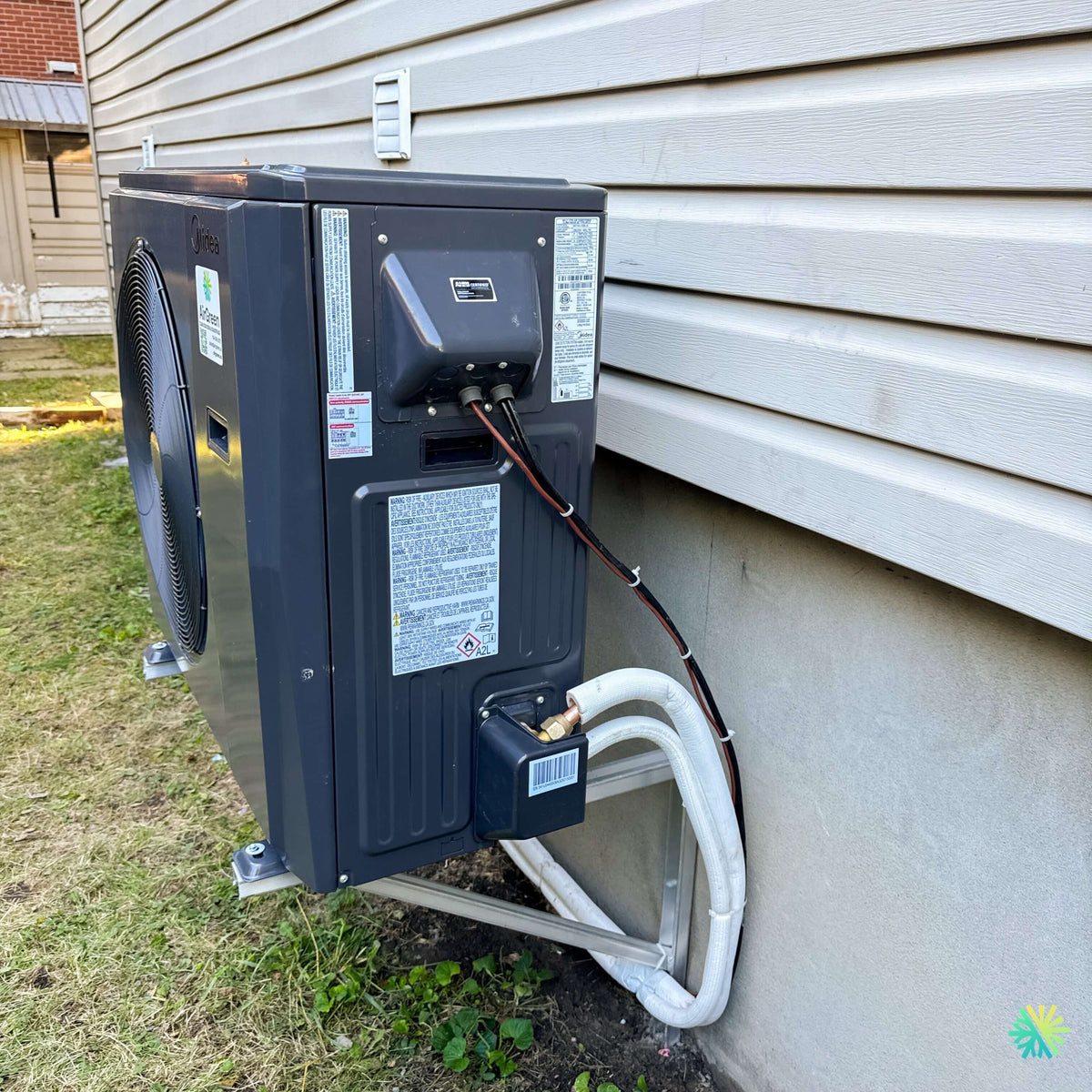
In the photo of this installation, we see a MIDEA outdoor unit installed on wall brackets attached to the foundation. The insulated refrigerant lines are cleanly routed to the building, with particular attention paid to clearance, stability, and finish. The unit is not simply placed on the ground: it is elevated to better withstand the realities of the Quebec climate, including snow, ice, meltwater, and freeze-thaw cycles.
In an area like Dollard-des-Ormeaux, where many homes have narrow side yards and established outdoor landscaping, the choice of location becomes a crucial step. A successful HVAC installation must consider performance, aesthetics, HVAC maintenance access, noise levels, outdoor unit ventilation, and overall durability.
Why a MIDEA EVOX G3 2.5 ton central heat pump was suitable for this residence
The 2.5 ton capacity was selected to meet the home's comfort needs while maintaining a balanced approach. A central heat pump must be carefully sized. A unit that is too small will struggle to maintain temperature during periods of high demand. A unit that is too large risks cycling too frequently, which can negatively affect comfort, humidity management, and overall efficiency.
The MIDEA EVOX G3 is a modern central solution known for its ability to modulate its operation according to the building's actual needs. This modulation allows for more stable temperatures, better adaptation to outdoor variations, and more consistent comfort in the various rooms served by the ducts.
In this Dollard-des-Ormeaux home, the objective was clear:
- obtain efficient central air conditioning in summer;
- improve heating during cold periods;
- reduce temperature differences between rooms;
- maintain a discreet and tidy outdoor installation;
- protect the unit from winter conditions;
- ensure clean integration with the existing central system.
A central heat pump offers a significant advantage over certain localized solutions: it treats the home as a whole. When a duct system is in good condition and well-suited, air can be distributed more uniformly, which improves daily comfort. This is particularly appreciated in family homes in Montreal, Laval, Longueuil, the North Shore, and the South Shore, where occupants want a high-performance system without multiple visible appliances in the rooms.
An outdoor unit installed on a wall bracket: an essential technical choice
The outdoor unit visible in the photo was installed on robust metal brackets attached to the foundation. This choice is not just aesthetic. In the context of a heat pump installation in Quebec, wall mounting offers several concrete advantages.
It notably allows for:
- keeping the unit above the usual snow accumulation level;
- reducing risks associated with standing water and mud;
- preserving ground access around the house;
- ensuring a stable base even on uneven terrain;
- facilitating certain HVAC maintenance tasks;
- protecting the appliance from ground debris.
In Dollard-des-Ormeaux, the terrain around the unit had a mixed surface with lawn, soil, and an area near the foundation. A ground-level base might have been considered in some conditions, but the wall mount offered a cleaner, more durable, and better-suited solution for the available space.
The unit's positioning was also studied to maintain good clearance in front of the fan. A heat pump needs sufficient airflow to function correctly. If the outdoor unit is too close to an obstacle, poorly oriented, or too enclosed, its performance can decrease. Our technicians therefore took care to choose a location that allows air to circulate freely, while maintaining an acceptable visual integration along the wall.
Protected and well-aligned refrigerant connections
The photo highlights the insulated refrigerant lines that connect the outdoor unit to the indoor system. These lines play an essential role in the operation of the central heat pump. Their path must be clean, without excessive tension, with intact insulation, and adequate protection against the elements.
In this installation, the lines were routed with controlled curves, avoiding unnecessary twists. The connections were positioned to facilitate access for inspection or maintenance, while protecting sensitive areas.
This attention to detail is fundamental. A poorly installed refrigerant line can lead to efficiency losses, condensation, vibrations, or difficulties during future interventions. A clean installation from the start reduces the risk of problems and contributes to the long-term performance of the unit.
Integration with the indoor central system
A MIDEA EVOX G3 2.5 ton central heat pump does not operate alone. It integrates into a complete system: ductwork, indoor coil, furnace or air handler, thermostat, electrical power, drainage, and controls. This is why our work is never limited to the outdoor unit.
For this project in Dollard-des-Ormeaux, we paid particular attention to the compatibility between the outdoor equipment and the existing central system. The final comfort depends as much on the MIDEA unit as on the quality of air distribution inside the home.
A good central system must meet several criteria:
- sufficient airflow;
- clean and functional ducts;
- properly configured thermostat;
- compliant electrical connections;
- reliable drainage;
- correct communication between components;
- complete commissioning.
A careful outdoor installation is not enough if the interior is not well adjusted. At AirGreen, we always consider the entire system, because this approach leads to stable, efficient, and durable results.
An AirGreen achievement adapted to West Island homes
Dollard-des-Ormeaux has a varied housing stock: single-family homes, bungalows, cottages, residences with extensions, existing central systems, and sometimes complex outdoor layouts. Central heat pump projects often require a good understanding of the building.
In this specific case, the available space around the unit had to be used intelligently. The exterior wall offered an adequate mounting area, but it was important to avoid creating a cumbersome or difficult-to-maintain installation. The result is a well-positioned outdoor unit, sufficiently clear, and installed with a clean finish.
The particular challenges of this installation
Each AirGreen project has its own constraints. For this installation in Dollard-des-Ormeaux, the main challenges concerned the outdoor location, the routing of the lines, and adapting to the terrain configuration.
A side space to respect
The unit had to be placed along the wall without impeding circulation around the house. In residential areas of the West Island, side yards can be used for yard maintenance, access to the backyard, or the passage of seasonal equipment. An installation that was too low or too far forward would have reduced the available space.
An installation height adapted to the climate
The wall mount allows the unit to be raised, which is particularly useful in winter. A central heat pump also operates during cold periods, and its defrost cycles produce water. If this water accumulates and then refreezes under the unit, it can create unfavorable conditions. Keeping the appliance above the ground reduces this risk.
A clean exterior finish
Insulated lines and connections must be installed professionally. A neglected finish can detract from the building's appearance and complicate future maintenance. In this project, we opted for a simple, visible yet organized path, with accessible connections.
Rigorous commissioning
Commissioning is an essential step. Our technicians validate heating and cooling operation, check parameters, observe system behavior, and ensure that the installation meets client expectations. For a central HVAC installation, this step directly influences comfort in the home.
Concrete benefits for homeowners
After installation, homeowners benefit from a central system capable of improving comfort in different areas of the residence. In summer, the heat pump contributes to more uniform air conditioning than a localized unit. In cold periods, it can provide effective heating, depending on outdoor conditions and system configuration.
The main benefits typically experienced are:
- more stable temperature in rooms;
- better air distribution;
- reduction of temperature differences between zones;
- smoother operation thanks to modulation;
- less intrusive system than multiple wall-mounted units;
- improvement of overall home comfort.
For many homeowners in Montreal, Laval, Longueuil, the North Shore, and the South Shore, this type of project represents a significant modernization. It allows them to maintain the logic of a central system while enjoying the benefits of a modern heat pump.
Central heat pump vs. wall-mounted heat pump: understanding the difference
Many clients contact us comparing a wall-mounted heat pump, a wall-mounted air conditioner, and a central heat pump. The right choice depends on the home.
A wall-mounted heat pump can be ideal for an open concept, a condo, an extension, or a specific area. It is often simpler to install when there are no ducts. A wall-mounted air conditioner can meet a localized cooling need, but it doesn't always replace a complete heating and cooling solution.
A central heat pump, like the MIDEA EVOX G3 2.5 ton, becomes particularly interesting when the home already has a functional duct system. It allows for treating several rooms at once, with a more discreet interior aesthetic.
In the case of this residence in Dollard-des-Ormeaux, the central solution was consistent with the home's configuration and comfort expectations.
Mistakes to avoid in a similar installation
A central heat pump installation represents a significant investment. To protect this investment, certain mistakes must be avoided.
Installing the unit too close to the ground
In Quebec, an outdoor unit installed too low can be quickly affected by snow. The wall mount used here helps reduce this risk.
Neglecting clearance around the appliance
A heat pump needs air. Too many obstacles around the unit can reduce its efficiency. Positioning must always be carefully considered.
Underestimating the importance of refrigerant lines
Lines must be well insulated, well secured, and installed without excessive strain. A quick but careless installation can lead to future problems.
Choosing a capacity without analysis
The 2.5 ton capacity must match the actual needs of the building. Proper sizing is essential for comfort and efficiency.
Postponing maintenance
Regular HVAC maintenance helps maintain performance. Filters, coils, drains, connections, and parameters must be checked according to system usage.
Subsidies and eligibility: a point to validate before work begins
Certain central heat pumps may be eligible for financial aid programs, depending on current criteria, exact model numbers, and the installed configuration. For homeowners in Montreal, Laval, Longueuil, the North Shore, and the South Shore, it is important to check eligibility before basing a decision on a potential subsidy.
At AirGreen, we help our clients gather the necessary information:
- detailed invoice;
- indoor and outdoor model numbers;
- technical documentation;
- proof of installation;
- information related to the applicable program.
This step must be handled with precision, as programs may have specific requirements. A compliant and well-documented installation facilitates the owner's procedures.
Why AirGreen places such importance on finishing
In an installation photo, several details may seem minor: unit height, bracket alignment, line curvature, fitting position, ground clearance. Yet, these details influence the equipment's lifespan, future maintenance, and customer satisfaction.
At AirGreen, we know that a successful HVAC installation must be robust, clean, and logical. Our technicians work with the goal of delivering a reliable system, but also an installation that the owner can look at with confidence. A misaligned outdoor unit, poorly protected lines, or a poorly chosen location can give an impression of incomplete work, even if the machine is functioning.
In this Dollard-des-Ormeaux project, the wall-mounted installation, visible connections, and chosen location demonstrate a structured approach. The goal was to deliver a modern central system without compromising the use of outdoor space.
A durable installation for residential comfort in Dollard-des-Ormeaux
This installation of a MIDEA EVOX G3 2.5 ton central heat pump in Dollard-des-Ormeaux perfectly illustrates the type of work we carry out in the West Island and throughout Greater Montreal. The project combined a request for central comfort, optimizing outdoor space, integrating a modern unit, and mastering technical details.
The MIDEA EVOX G3 provides an effective solution for homeowners who want to improve their heating and air conditioning with a central system. Thanks to a careful wall-mounted installation, well-routed lines, and rigorous commissioning, the house now benefits from a system designed to operate reliably throughout the seasons.
AirGreen regularly serves Dollard-des-Ormeaux, Montreal, Laval, Longueuil, the North Shore, and the South Shore for heat pump, wall-mounted air conditioner, central systems, and multi-zone solutions projects. Each installation is analyzed according to the building, desired comfort, outdoor constraints, and the client's energy objectives.
In this project, the final result is clear: a well-positioned outdoor unit, a clean installation, a high-performance central solution, and improved residential comfort for a home in Dollard-des-Ormeaux.
The job tools
Two quick checks with real numbers: what heat costs, and what your current heaters add up to in BTU/h.
Baseboards and electric furnaces turn 1 kWh of electricity into 1 kWh of heat. A heat pump delivers more: that is its COP. At Hydro-Québec’s rate D (11.142¢/kWh above 40 kWh a day, since 1 April 2026):
Hydro-Québec: a heat pump can be up to three times more efficient than baseboards for heating in the colder months.
Estimate per kWh of heat, at the chosen temperature, using the certified COP from the product page. Taxes, access charge and backup heat not included.
Conversion: 1 W = 3.412 BTU/h. An indication, not a load calculation: baseboards and furnaces are often stronger than the real need, and they can stay as backup. AirGreen confirms the capacity on site.
How the job unfolds
The main steps of this kind of job at AirGreen. Every house has its quirks: the estimate brings them out.
We look at the ducts, the current indoor module, the electrical panel and the planned spot for the outdoor unit.
The equipment combination, capacity and price, in writing. We check whether the combination qualifies for assistance programs.
Access protected, old unit disconnected and removed when it is being replaced.
Electric furnace or air handler, with its coil, connected to the supply and return ducts.
On a level base, raised above the snow, with free space all around.
Insulated, they enter through a sealed opening and run to the indoor coil.
Dedicated circuits, accessible disconnect, a thermostat that works with the heat pump and the backup heat.
Leak test, vacuum, start-up, airflow check and a test of both modes.
Filter, thermostat, backup heat in extreme cold: what to know before winter.
- The on-site estimateWe look at the ducts, the current indoor module, the electrical panel and the planned spot for the outdoor unit.
- The quoteThe equipment combination, capacity and price, in writing. We check whether the combination qualifies for assistance programs.
- Getting readyAccess protected, old unit disconnected and removed when it is being replaced.
- The indoor moduleElectric furnace or air handler, with its coil, connected to the supply and return ducts.
- The outdoor unitOn a level base, raised above the snow, with free space all around.
- The refrigerant linesInsulated, they enter through a sealed opening and run to the indoor coil.
- Electrical and thermostatDedicated circuits, accessible disconnect, a thermostat that works with the heat pump and the backup heat.
- Tests and start-upLeak test, vacuum, start-up, airflow check and a test of both modes.
- The walkthroughFilter, thermostat, backup heat in extreme cold: what to know before winter.
What we check on a job like this one
Each number is a point we check on site. Switch between summer and winter to watch air and heat move.
In summer, the outdoor unit rejects the house's heat outside.
Generic illustration of this type of installation, not a survey of this job site. Tap a number.
It captures or rejects heat outside. It sits on a level base, above the snow, with free space all around.
The insulated refrigerant lines enter the house through a sealed opening and run to the indoor coil.
A shut-off switch near the outdoor unit isolates it safely for service.
Sitting on the indoor module, it moves heat between the house air and the refrigerant.
Electric furnace or air handler: its fan pushes air through the ducts. The electric backup takes over in extreme cold.
Supply ducts bring air to the rooms; returns bring it back to the unit. Their condition matters as much as the unit's.
It protects the coil and the fan. A dirty filter cuts airflow, so it gets checked regularly.
It runs the heat pump and the backup heat. It must be compatible with the installed system.
Is your home ready?
Check what applies at your place. A "no" is not a refusal: it is what we sort out during the estimate.
Good habits, once the unit is in place
Six simple habits that keep the unit going. Your list stays on this device.
What to do, season by season
Three habits per season for this unit. They take a few minutes and prevent many calls.
- Check the indoor module's filter.
- Clear winter debris from the outdoor unit.
- Test cooling before the heat arrives.
- Check the filter more often in peak season.
- Keep registers and returns clear.
- Watch condensate drainage near the coil.
- Change or clean the filter.
- Test heating and backup heat before the cold.
- Book periodic maintenance.
- Clear snow around the outdoor unit.
- Store nothing in front of the indoor module.
- Note any unusual noise or smell and call us.
The right pages, at the right time
Four statements: true or false?
It all comes down to details you have just seen.
1. A central heat pump uses the house's ducts.
It connects to the existing ducts to heat and cool everywhere.
2. In extreme cold, electric backup heat can take over.
The indoor module (furnace or air handler) works with the heat pump and takes over in extreme cold.
3. The filter only gets changed when the unit breaks down.
A dirty filter cuts airflow. It gets checked regularly.
4. You can reuse the old unit's size without checking.
The house may have changed: insulation, windows, added rooms. Capacity is confirmed on site.
0 / 4 right answers
What people ask us about this kind of work
Can I keep my current ducts?
What happens in extreme cold?
Furnace, air handler, ducted: what is the difference?
Are there grants?
Do I need a permit?
How much can I save?
How is the LogisVert assistance calculated?
Will my current thermostat work?
Central or wall units: which one?
Does AirGreen hold the required licences?
Is the estimate free?
No question matches. Write to us: we answer.
More jobs to see, near you
By town, by equipment or by region: browse more than 4,700 published projects.
Each dot: a town where AirGreen has published projects. The glowing dot: this job.
An on-site estimate, the right capacity, the right equipment.
The on-site estimate is free and the quote follows within 24 hours.
Text and photo: a real AirGreen Climatisation & Chauffage job. The diagrams are generic illustrations of the type of installation, not a survey of this job site. Sources of the added figures: airgreen.ca product pages (NEEP / AHRI performance), Hydro-Québec (Heat pumps page, LogisVert, read on 13 October 2026), Régie de l’énergie (rate D as of 1 April 2026).