
Installation of a MIDEA EVOX G3 2-ton central heat pump in Rivière-des-Prairies–Pointe-aux-Trembles, Montreal
AirGreen installs a MIDEA EVOX G3 2-ton central heat pump in Rivière-des-Prairies–Pointe-aux-Trembles: efficiency, clean finish, and lasting HVAC comfort in Montreal.
- City
- Region
- Equipment
- Brand
- Challenges
- Published
The job on one screen
The unit’s data sheet
The range as published on airgreen.ca: pick a size to see its capacity in deep cold.
| Size | Heating at −8 °C | Heating at −15 °C | Coldest certified point | COP at −15 °C | SEER | HSPF | Indicative LogisVert aid |
|---|---|---|---|---|---|---|---|
| Midea EVOX G3 · 1.5 tons | 14,700 | 18,600 | −30 °C: 11,800 | 2.12 | 19.0 | 10.1 | $1,764 |
| Midea EVOX G3 · 2 tons | 20,800 | 20,600 | −30 °C: 12,100 | 2.14 | 18.6 | 10.0 | $2,496 |
| Midea EVOX G3 · 2.5 tons | 24,000 | 33,200 | −30 °C: 17,900 | 1.97 | 17.2 | 10.8 | $2,880 |
| Midea EVOX G3 · 3 tons | 33,000 | 37,400 | −30 °C: 27,600 | 1.9 | 18.0 | 10.0 | $3,960 |
| Midea EVOX G3 · 4 tons | 39,500 | 48,000 | −30 °C: 27,200 | 2.0 | 17.5 | 9.5 | $4,740 |
| Midea EVOX G3 · 5 tons | 45,000 | 54,000 | −30 °C: 37,300 | 1.9 | 17.5 | 9.5 | $5,400 |
Data read live from the airgreen.ca page of each size (NEEP / AHRI certified performance). When the title names the installed size, it is highlighted; otherwise the whole range is shown. The aid shown is today’s, using Hydro-Québec’s rule ($120 per 1,000 BTU/h at −8 °C); amounts quoted in the article date from its publication. Only Hydro-Québec confirms the assistance granted.
The article, chapter by chapter
A compact, clean, and well-thought-out central installation for an already well-appointed Montreal home
In Rivière-des-Prairies–Pointe-aux-Trembles, in eastern Montreal, our AirGreen team recently completed the installation of a 2-ton MIDEA EVOX G3 central heat pump, a system designed to offer an excellent balance between comfort, energy efficiency, and heating performance during Quebec's typical cold periods.
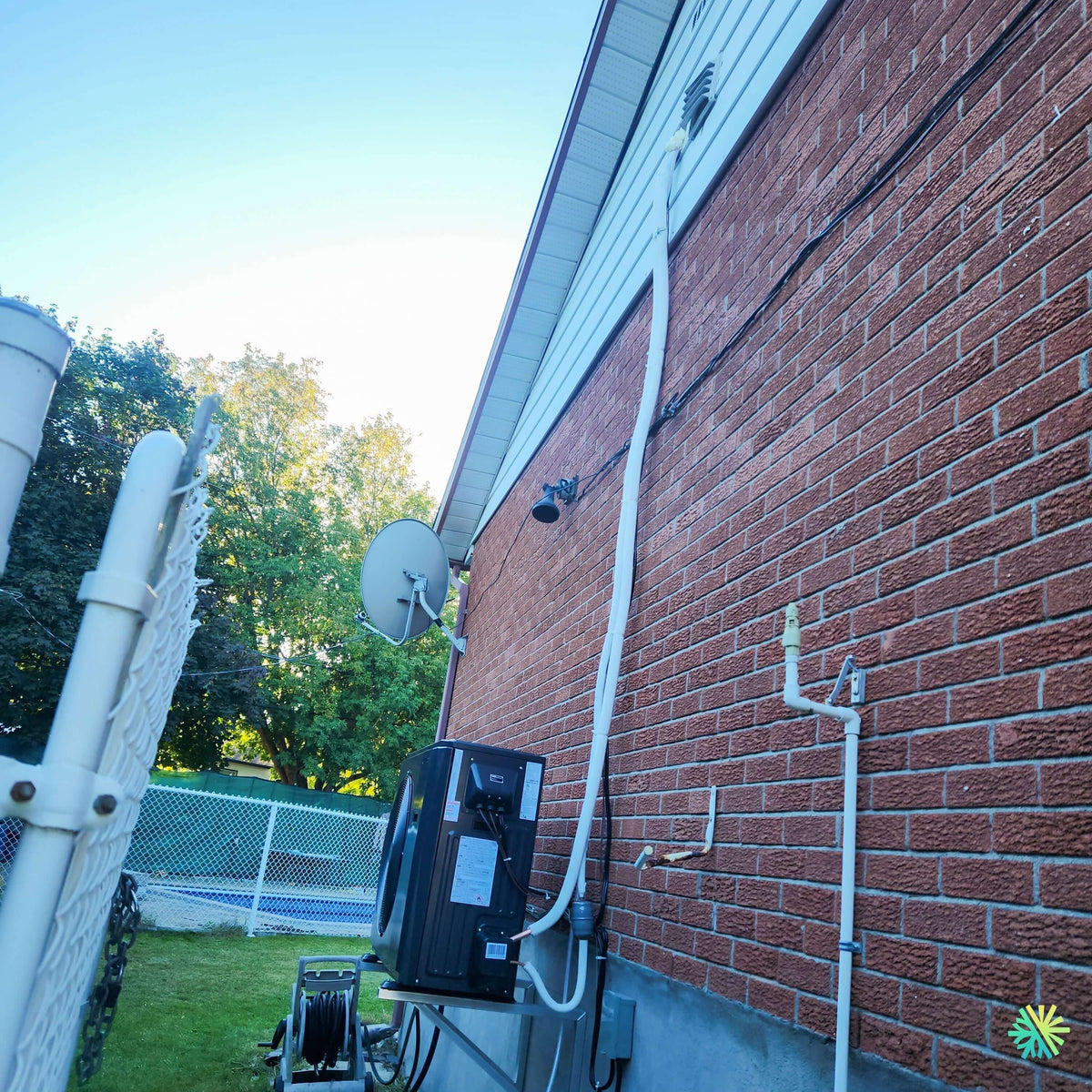
Upon arrival, one element was clear: the outdoor space had to be used intelligently. The backyard was already landscaped, with a fence, a relatively narrow side passage, existing conduits on the side facade, a wall outlet, wiring, and several elements attached to the brick wall. This type of configuration requires a careful HVAC installation, as it's not just about placing an outdoor unit: the system must be integrated into the existing architecture without hindering access, future maintenance, or the overall appearance of the house.
The MIDEA EVOX G3 central heat pump was installed on a solid metal support, slightly elevated from the ground. This choice is particularly important in residential areas of Montreal, where snow accumulation, ground ice, and freeze-thaw cycles can interfere with the proper functioning of a poorly positioned appliance. By keeping the unit clear, stable, and accessible, we also facilitate inspections, cleaning, and future HVAC maintenance services.
Why a 2-ton central heat pump was suitable for this project
In this type of residence, a 2-ton central heat pump is often recommended when the area, existing air distribution, and heating/cooling needs match this capacity. The goal is never to oversize the appliance. A machine that is too large can lead to short cycles, uneven comfort, and less efficient dehumidification in summer. Conversely, a machine that is too small risks running too long without reaching the desired comfort level.
The MIDEA EVOX G3 model stands out with a modern approach to central heating: variable speed compressor, more stable operation, better modulation, and increased performance in cold climates. In a house located in Rivière-des-Prairies–Pointe-aux-Trembles, where winters can be windy and humid near the river, this ability to maintain constant heat becomes a real advantage for the owner.
This installation also makes it possible to replace or complement an existing central system while improving the overall efficiency of the house. For many customers in Montreal, Laval, Longueuil, on the North Shore and the South Shore, the question is no longer simply: "Does it heat?" The real question is rather: "Does the system heat efficiently, quietly, and without creating unpleasant temperature variations?"
An exterior integration that required precision and method
The project photo clearly shows the reality of the site: the outdoor unit was positioned near the brick wall, in a lateral space where several constraints were already present. We had to contend with:
- the proximity of the fence;
- the necessary clearance for unit ventilation;
- refrigerant lines to be run neatly up the wall;
- the presence of existing conduits and cables;
- future access for a technician;
- the overall aesthetics of the installation.
The routing of the lines to the top of the building was carried out with particular care. The white sheath visible on the wall protects the lines and helps maintain a clean finish. In a dense residential neighborhood like Rivière-des-Prairies–Pointe-aux-Trembles, this kind of detail makes a big difference. A central installation can be technically functional, but if the conduits are misaligned, poorly secured, or too visible, the final result gives an impression of improvised work. At AirGreen, we aim for exactly the opposite: a neat, durable, and consistent finish with the house.
The essential role of wall mounting and clearance
Installing a central heat pump directly on the ground may seem simpler, but it's not always the best solution. Here, the metal support allows the unit to be elevated and protected against several frequent problems:
- snow accumulation around the base;
- stagnant water after melting;
- partial obstruction of the heat exchanger;
- vibrations transmitted to the ground;
- difficulty of access for inspections.
Clearance around the outdoor unit is also crucial. A heat pump needs good airflow to function correctly. If it is too confined against a fence, wall, or obstacle, it can lose efficiency, consume more, and wear out faster. On this project, our team verified the location to meet technical constraints while keeping the unit in a practical position for the client.
MIDEA EVOX G3: a powerful central solution for Montreal's climate
The MIDEA EVOX G3 is a central heat pump appreciated for its performance in cold climates, its energy efficiency, and its ability to provide stable comfort throughout the house. In its 2-ton configuration, it is suitable for many residential properties where the ductwork is already in place or adapted to the project.
Important technical details of the MIDEA EVOX G3
For this project, the installed machine was a 2-ton MIDEA EVOX G3 central heat pump, designed to meet the heating and cooling needs of a well-assessed single-family or semi-detached house. Depending on the exact configuration of the indoor system, this type of equipment can offer excellent seasonal efficiency and reliable performance on cold days.
Among the generally sought-after characteristics in this range:
- heating and cooling capacity adapted to Quebec homes;
- variable speed technology for smoother operation;
- improved indoor temperature stability;
- reduction of abrupt on/off cycles;
- compatibility with certain existing central configurations;
- attractive efficiency for homeowners who wish to reduce their reliance on more energy-intensive heating systems.
One of the great advantages of a central heat pump is its ability to distribute air throughout the house via the ductwork. Unlike a simple single-zone wall-mounted system, comfort is distributed more uniformly, which is particularly useful in multi-room homes, with closed bedrooms, corridors, or finished basements.
Subsidies and eligibility: a decisive factor for many homeowners
For homeowners in Montreal, Laval, Longueuil, on the North Shore, and on the South Shore, available subsidies can significantly change the purchasing decision. A MIDEA EVOX G3 central heat pump may be eligible for certain financial aid programs, depending on the exact combination of units, current standards, certified performance, and program conditions at the time of application.
At AirGreen, we pay particular attention to these details. Before presenting an option to a client, we validate the important elements: model, capacity, certification, indoor/outdoor combination, and applicable requirements. An error in equipment selection can result in the loss of a significant subsidy. This is why we avoid generic recommendations and prefer to offer systems that truly match the building, budget, and available programs.
An installation designed for durability, not just for startup
A good HVAC installation is not limited to plugging in a machine and ensuring it starts. For a central system like this one, several steps have a direct impact on long-term performance:
- assessment of outdoor positioning;
- protection and alignment of refrigerant lines;
- clearance verification;
- compliant electrical connection;
- pressure and vacuum testing;
- complete commissioning;
- verification of heating and cooling operation;
- explanation of best usage practices to the client.
On this project in Rivière-des-Prairies–Pointe-aux-Trembles, the outdoor environment required a clean and vertical installation of the conduits. The brick wall offered a solid surface, but an overly intrusive arrangement had to be avoided. We therefore favored a clear, protected, and well-secured path, while keeping the unit accessible.
Mistakes to avoid when installing a central heat pump
Many problems we encounter during replacements or service calls stem from poorly planned initial installations. The most frequent errors include:
Choosing a capacity without serious calculation
A 2-ton heat pump may be perfect in one house and insufficient in another. Area alone is not enough. Insulation, orientation, windows, thermal losses, ductwork, and client habits must be considered.
Neglecting outdoor clearance
A unit too close to an obstacle can lose efficiency. In winter, this can also promote the accumulation of ice or snow around the appliance.
Poorly protecting refrigerant lines
Exposed, poorly secured, or poorly insulated conduits can reduce efficiency and harm the system's durability. On this project, the white vertical protection visible on the wall precisely helps keep the lines organized and better protected.
Forgetting access for maintenance
An appliance can be very well installed on the day of installation but become difficult to maintain if no one has thought about future access. At AirGreen, we always think about the intervention that will take place in two, five, or ten years.
Customer experience: central comfort without transforming the backyard
The client wanted an effective solution, but also an installation that respected the existing space. In this type of property, every outdoor square foot counts. The backyard, fence, wall-mounted equipment, and side passage left little room for improvisation.
Our approach was simple: install the MIDEA EVOX G3 in a stable, clean, accessible, and visually orderly manner. The final result allows the client to benefit from a modern central system without compromising the use of outdoor space.
The positioning near the wall, the elevated support, and the careful routing of the conduits demonstrate the importance of thoughtful work. A central heat pump becomes a permanent piece of equipment in the house; it must therefore be installed as a lasting investment, not just as a quickly added appliance.
AirGreen: local HVAC expertise adapted to the realities of eastern Montreal
In Rivière-des-Prairies–Pointe-aux-Trembles, as in several areas of Montreal, homes often present very varied realities: extensions, existing installations, brick walls, narrow yards, limited side access, older ductwork, or electrical configurations to be validated. It is precisely in these contexts that AirGreen's field experience becomes essential.
We install central, wall-mounted, and multi-zone systems throughout Greater Montreal, including Laval, Longueuil, the North Shore, and the South Shore. Each project reminds us that a good HVAC recommendation must consider the actual house, not just the appliance's technical specifications.
For this installation, the 2-ton MIDEA EVOX G3 central heat pump represented a logical solution: powerful, well-suited to a Montreal residence, compatible with a central comfort approach, and attractive for homeowners who want to improve their energy efficiency.
Practical advice for homeowners considering a central heat pump
Before choosing a central heat pump, we recommend checking several elements:
-
The condition of the ductwork
A central system heavily depends on the quality of air distribution. Poorly sized, obstructed, or unbalanced ducts can reduce comfort. -
The actual capacity needed
The correct tonnage must be chosen according to the house's needs, not just based on the old appliance. -
The outdoor location
Clearances, snow, noise, service access, and visual integration must be considered. -
Eligibility for subsidies
Programs can represent significant savings, but criteria must be precisely met.
Even the best equipment can disappoint if the installation is neglected. Commissioning, vacuuming, connections, and testing are essential.
A representative project of what we do at AirGreen
This installation in Rivière-des-Prairies–Pointe-aux-Trembles perfectly illustrates our way of working: understanding the building, choosing suitable equipment, respecting site constraints, and delivering a clean finish. The MIDEA EVOX G3 2 tons was installed with the objective of providing efficient, durable, and well-integrated central comfort to the home.
In a market where homeowners increasingly compare brands, subsidies, warranties, and operating costs, our role is to provide clear and honest recommendations. A central heat pump is not just a technical purchase; it is a decision that influences daily comfort, energy consumption, and the practical value of a property.
For residents of Montreal, Laval, Longueuil, the North Shore, and the South Shore, AirGreen continues to offer precise, well-installed, and locally adapted HVAC solutions.
The job tools
Two quick checks with real numbers: what heat costs, and what your current heaters add up to in BTU/h.
Baseboards and electric furnaces turn 1 kWh of electricity into 1 kWh of heat. A heat pump delivers more: that is its COP. At Hydro-Québec’s rate D (11.142¢/kWh above 40 kWh a day, since 1 April 2026):
Hydro-Québec: a heat pump can be up to three times more efficient than baseboards for heating in the colder months.
Estimate per kWh of heat, at the chosen temperature, using the certified COP from the product page. Taxes, access charge and backup heat not included.
Conversion: 1 W = 3.412 BTU/h. An indication, not a load calculation: baseboards and furnaces are often stronger than the real need, and they can stay as backup. AirGreen confirms the capacity on site.
How the job unfolds
The main steps of this kind of job at AirGreen. Every house has its quirks: the estimate brings them out.
We look at the ducts, the current indoor module, the electrical panel and the planned spot for the outdoor unit.
The equipment combination, capacity and price, in writing. We check whether the combination qualifies for assistance programs.
Access protected, old unit disconnected and removed when it is being replaced.
Electric furnace or air handler, with its coil, connected to the supply and return ducts.
On a level base, raised above the snow, with free space all around.
Insulated, they enter through a sealed opening and run to the indoor coil.
Dedicated circuits, accessible disconnect, a thermostat that works with the heat pump and the backup heat.
Leak test, vacuum, start-up, airflow check and a test of both modes.
Filter, thermostat, backup heat in extreme cold: what to know before winter.
- The on-site estimateWe look at the ducts, the current indoor module, the electrical panel and the planned spot for the outdoor unit.
- The quoteThe equipment combination, capacity and price, in writing. We check whether the combination qualifies for assistance programs.
- Getting readyAccess protected, old unit disconnected and removed when it is being replaced.
- The indoor moduleElectric furnace or air handler, with its coil, connected to the supply and return ducts.
- The outdoor unitOn a level base, raised above the snow, with free space all around.
- The refrigerant linesInsulated, they enter through a sealed opening and run to the indoor coil.
- Electrical and thermostatDedicated circuits, accessible disconnect, a thermostat that works with the heat pump and the backup heat.
- Tests and start-upLeak test, vacuum, start-up, airflow check and a test of both modes.
- The walkthroughFilter, thermostat, backup heat in extreme cold: what to know before winter.
What we check on a job like this one
Each number is a point we check on site. Switch between summer and winter to watch air and heat move.
In summer, the outdoor unit rejects the house's heat outside.
Generic illustration of this type of installation, not a survey of this job site. Tap a number.
It captures or rejects heat outside. It sits on a level base, above the snow, with free space all around.
The insulated refrigerant lines enter the house through a sealed opening and run to the indoor coil.
A shut-off switch near the outdoor unit isolates it safely for service.
Sitting on the indoor module, it moves heat between the house air and the refrigerant.
Electric furnace or air handler: its fan pushes air through the ducts. The electric backup takes over in extreme cold.
Supply ducts bring air to the rooms; returns bring it back to the unit. Their condition matters as much as the unit's.
It protects the coil and the fan. A dirty filter cuts airflow, so it gets checked regularly.
It runs the heat pump and the backup heat. It must be compatible with the installed system.
Is your home ready?
Check what applies at your place. A "no" is not a refusal: it is what we sort out during the estimate.
Good habits, once the unit is in place
Six simple habits that keep the unit going. Your list stays on this device.
What to do, season by season
Three habits per season for this unit. They take a few minutes and prevent many calls.
- Check the indoor module's filter.
- Clear winter debris from the outdoor unit.
- Test cooling before the heat arrives.
- Check the filter more often in peak season.
- Keep registers and returns clear.
- Watch condensate drainage near the coil.
- Change or clean the filter.
- Test heating and backup heat before the cold.
- Book periodic maintenance.
- Clear snow around the outdoor unit.
- Store nothing in front of the indoor module.
- Note any unusual noise or smell and call us.
The right pages, at the right time
Four statements: true or false?
It all comes down to details you have just seen.
1. A central heat pump uses the house's ducts.
It connects to the existing ducts to heat and cool everywhere.
2. In extreme cold, electric backup heat can take over.
The indoor module (furnace or air handler) works with the heat pump and takes over in extreme cold.
3. The filter only gets changed when the unit breaks down.
A dirty filter cuts airflow. It gets checked regularly.
4. You can reuse the old unit's size without checking.
The house may have changed: insulation, windows, added rooms. Capacity is confirmed on site.
0 / 4 right answers
What people ask us about this kind of work
Can I keep my current ducts?
What happens in extreme cold?
Furnace, air handler, ducted: what is the difference?
Are there grants?
Do I need a permit?
How much can I save?
How is the LogisVert assistance calculated?
Will my current thermostat work?
Central or wall units: which one?
Does AirGreen hold the required licences?
Is the estimate free?
No question matches. Write to us: we answer.
More jobs to see, near you
By town, by equipment or by region: browse more than 4,700 published projects.
Each dot: a town where AirGreen has published projects. The glowing dot: this job.
An on-site estimate, the right capacity, the right equipment.
The on-site estimate is free and the quote follows within 24 hours.
Text and photo: a real AirGreen Climatisation & Chauffage job. The diagrams are generic illustrations of the type of installation, not a survey of this job site. Sources of the added figures: airgreen.ca product pages (NEEP / AHRI performance), Hydro-Québec (Heat pumps page, LogisVert, read on 13 October 2026), Régie de l’énergie (rate D as of 1 April 2026).