
Installation of a 2-ton MIDEA EVOX G3 central heat pump in the West Island
AirGreen installs a 2-ton MIDEA EVOX G3 central heat pump in the West Island: wall-mounted support, clean finish, energy efficiency, and lasting HVAC comfort.
- City
- Region
- Equipment
- Brand
- Challenges
- Published
The job on one screen
The unit’s data sheet
The range as published on airgreen.ca: pick a size to see its capacity in deep cold.
| Size | Heating at −8 °C | Heating at −15 °C | Coldest certified point | COP at −15 °C | SEER | HSPF | Indicative LogisVert aid |
|---|---|---|---|---|---|---|---|
| Midea EVOX G3 · 1.5 tons | 14,700 | 18,600 | −30 °C: 11,800 | 2.12 | 19.0 | 10.1 | $1,764 |
| Midea EVOX G3 · 2 tons | 20,800 | 20,600 | −30 °C: 12,100 | 2.14 | 18.6 | 10.0 | $2,496 |
| Midea EVOX G3 · 2.5 tons | 24,000 | 33,200 | −30 °C: 17,900 | 1.97 | 17.2 | 10.8 | $2,880 |
| Midea EVOX G3 · 3 tons | 33,000 | 37,400 | −30 °C: 27,600 | 1.9 | 18.0 | 10.0 | $3,960 |
| Midea EVOX G3 · 4 tons | 39,500 | 48,000 | −30 °C: 27,200 | 2.0 | 17.5 | 9.5 | $4,740 |
| Midea EVOX G3 · 5 tons | 45,000 | 54,000 | −30 °C: 37,300 | 1.9 | 17.5 | 9.5 | $5,400 |
Data read live from the airgreen.ca page of each size (NEEP / AHRI certified performance). When the title names the installed size, it is highlighted; otherwise the whole range is shown. The aid shown is today’s, using Hydro-Québec’s rule ($120 per 1,000 BTU/h at −8 °C); amounts quoted in the article date from its publication. Only Hydro-Québec confirms the assistance granted.
The article, chapter by chapter
A Compact, Clean, and Sustainable Installation for a West Island Home
In the West Island, our AirGreen team recently completed the installation of a MIDEA EVOX G3 2-ton central heat pump, an HVAC solution designed to provide reliable heating, efficient air conditioning, and discreet exterior integration. The project presented a common challenge in many residential neighborhoods of the West Island: installing a high-performance outdoor unit while respecting available space, the existing foundation, necessary clearances, and the property's aesthetics.
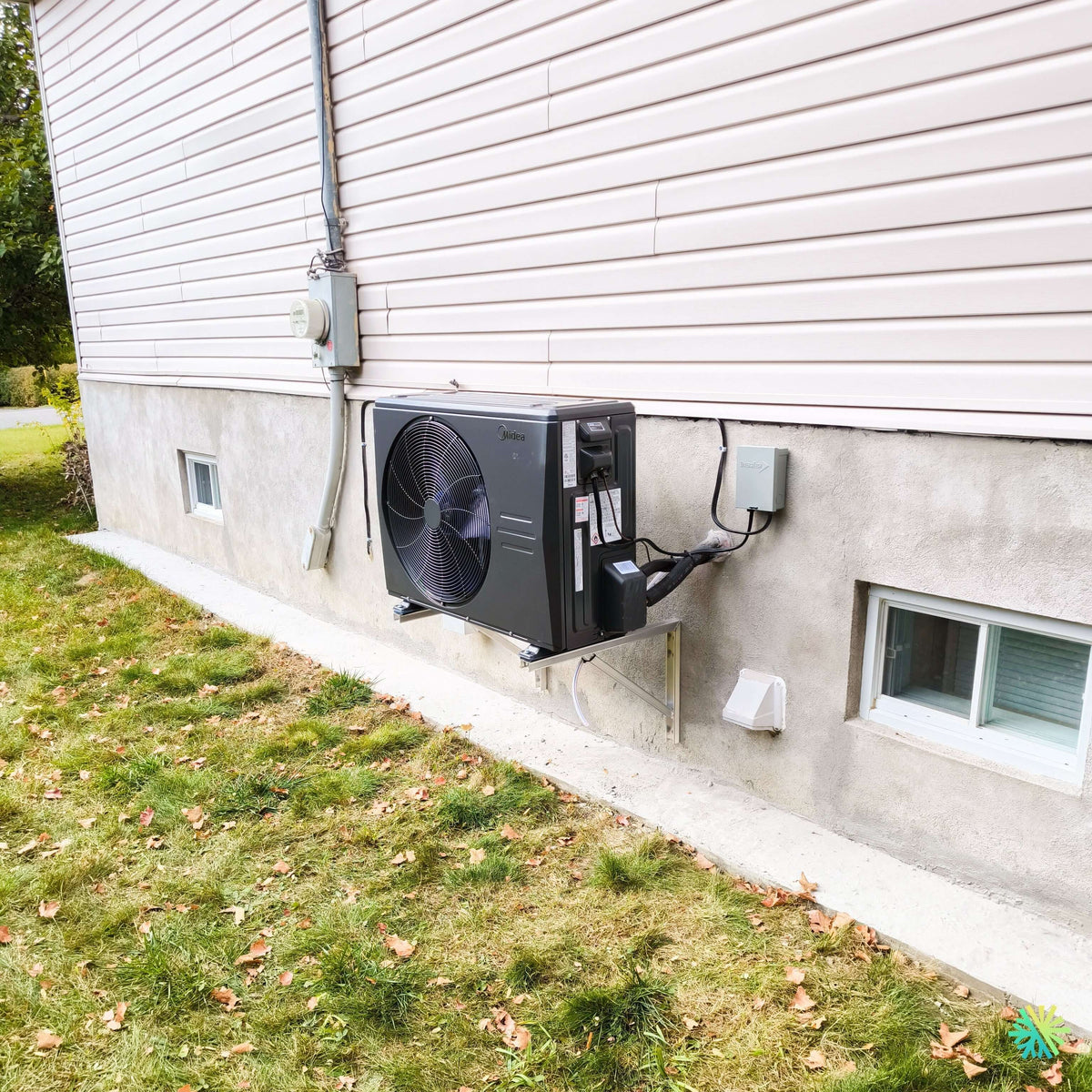
The photo shows an outdoor wall-mounted installation securely attached to a metal bracket, above ground level. This choice is not insignificant. In the Montreal region, where snow accumulation, spring humidity, and temperature variations can affect HVAC equipment, elevating an outdoor unit better protects the machine, improves drainage around the unit, and facilitates access for HVAC maintenance.
The MIDEA EVOX G3 central heat pump installed here is a 2-ton unit, suitable for a home requiring approximately 24,000 BTU capacity, based on thermal load calculations and building characteristics. In this type of project, selecting the correct capacity is essential: a unit that is too small will run constantly without achieving desired comfort, while an oversized unit can lead to short cycling, less effective dehumidification, and premature wear.
Why the MIDEA EVOX G3 was an excellent choice for this property
The MIDEA EVOX G3 range is often chosen by our clients for its balance of performance, energy efficiency, and value for money. For a West Island residence, where winters are harsh and summers are humid, a central heat pump must be able to meet two very different needs: maintaining stable heating during cold periods and providing comfortable air conditioning when humidity becomes heavy in summer.
This model is particularly attractive to homeowners who wish to modernize their central system without necessarily altering the entire house infrastructure. In several projects carried out by AirGreen in Montreal, Laval, Longueuil, on the North Shore and South Shore, we encounter homes where existing ducts are still usable, but the old equipment no longer provides the expected performance. In this context, a well-planned HVAC installation improves comfort without turning the site into a major renovation.
The MIDEA EVOX G3 is also appreciated for its variable-speed technology, which allows the unit to adjust its operation according to the actual demand of the house. This means fewer abrupt starts, more stable temperature, better humidity management, and generally quieter operation than a traditional single-speed system.
Special attention to the outdoor location
One of the most important elements of this installation was the positioning of the outdoor unit. The house had a side wall with clear space, an accessible foundation, and reasonable proximity to necessary connections. Our team chose a wall-mounted installation to ensure:
- better protection against snow;
- easier access to service components;
- adequate airflow around the unit;
- reduced risks associated with stagnant water on the ground;
- a cleaner finish along the foundation.
The metal bracket visible under the unit was securely fastened to the foundation, with precise alignment to ensure the machine's stability. An outdoor central heat pump must remain perfectly stable despite normal operating vibrations, defrost cycles, and changing weather conditions.
A neat and professional exterior finish
In this West Island project, the exterior finish was particularly important. Refrigerant lines, cables, and electrical connections were installed with care, limiting unnecessary lengths and protecting critical passages. It is also visible that the connection elements were concentrated near the unit, facilitating future inspections and maintenance interventions.
At AirGreen, we place great importance on these details, because a successful installation is not limited to getting the machine running on the same day. It must be designed to last. Poorly protected piping, inadequate clearance, improper support, or poorly planned drainage can create problems several months after installation.
This is precisely what we want to avoid for our clients in Montreal, Laval, Longueuil, on the North Shore, and the South Shore: an apparently quick installation that turns out to be costly to correct later.
What this installation reveals about good HVAC planning
The 2-ton capacity: a choice that must be seriously validated
A 2-ton central heat pump is not chosen simply because it seems suitable for a house's square footage. Several factors are considered: insulation, property orientation, window quality, duct distribution, ceiling heights, sun exposure, and occupant comfort habits.
In the case of this West Island home, the choice of the MIDEA EVOX G3 2-ton allowed for a capacity consistent with the building's needs. A good initial analysis avoids two common errors:
Installing too large
An oversized appliance can reach the desired temperature too quickly, without running long enough to properly control humidity. In air conditioning, this can create a sensation of cold but humid air, particularly unpleasant during heavy July and August days in Montreal.
Installing too small
Conversely, an undersized machine can run continuously, consume more energy, and never achieve the desired comfort during periods of intense cold or prolonged heat.
The importance of wall mounting in our climate
In several West Island neighborhoods, homes have slightly sloped lots, exposed foundations, and narrow side access. Installing an outdoor unit directly on the ground is not always ideal. A properly installed wall mount keeps the unit at a safe height, especially when snow accumulates near exterior walls.
This detail is particularly important for a heat pump, as the outdoor unit must be able to breathe freely, even in winter. If snow blocks the base of the unit or obstructs airflow, performance may decrease, and defrost cycles may become less efficient.
Connections: where quality is less visible, but matters immensely
Much of the quality of an HVAC installation lies in what the customer doesn't immediately see: connection sealing, vacuum pulling, refrigerant line protection, clearance adherence, cable fastening, drainage management, and commissioning.
On this installation, our team paid particular attention to the line routing and proximity to existing electrical components. The goal was to create a clear, accessible, and safe installation, while respecting the home's exterior architecture.
Subsidies and energy efficiency
Homeowners who install a high-performance central heat pump may often be eligible for financial aid programs, depending on the exact model, the installed configuration, and the criteria in effect at the time of application. The MIDEA EVOX G3 is among the equipment often considered for its energy efficiency, but each case must be validated according to applicable requirements.
At AirGreen, we help our clients understand the important elements related to subsidies: installed model, AHRI number, capacity, system type, detailed invoice, and installation compliance. For homeowners in Montreal, Laval, Longueuil, on the North Shore and South Shore, this step can make a significant difference in the net cost of the project.
What homeowners should avoid before installing a central heat pump
Before choosing a central heat pump, several errors can be avoided.
Basing solely on price
Price is important, but it shouldn't be the only criterion. A cheaper installation can become more costly if the sizing is poor, if connections are neglected, or if the unit is improperly positioned.
Ignoring the condition of the ducts
A central heat pump depends on air distribution in the house. If the ducts are unbalanced, leaky, or inadequate, even an excellent machine will not perform at its best.
Neglecting access for maintenance
The outdoor unit must remain accessible. An installation too close to an obstacle, a fence, or landscaping can complicate future interventions.
Choosing a model without checking for subsidies
Some models are more advantageous than others once subsidies are considered. A complete analysis often leads to better value for money.
The AirGreen approach to this project
For this installation in the West Island, our approach was simple: choose a suitable machine, install the outdoor unit in a logical location, ensure a clean finish, and prepare the system for reliable long-term performance.
Our team validated the location, installed the wall mount, positioned the MIDEA EVOX G3 heat pump, made the necessary connections, checked operating parameters, and confirmed that the system correctly met the home's needs.
This type of project clearly illustrates our way of working: we don't just aim to install an appliance, but to deliver a complete, durable, and well-integrated HVAC solution tailored to the building's reality.
A relevant solution for many Greater Montreal homes
The MIDEA EVOX G3 2-ton central heat pump can be suitable for several types of properties in the Greater Montreal area, particularly when homeowners want to replace an old central system or improve their energy efficiency without completely changing their air distribution method.
We regularly see similar needs in Laval, Longueuil, on the North Shore, and the South Shore: homes with aging central systems, homeowners looking to reduce their reliance on traditional heating, and families seeking better comfort in both summer and winter.
In these situations, the quality of the installation makes all the difference. A good machine poorly installed will rarely yield good results. A well-chosen machine, installed meticulously, can transform a home's daily comfort.
Final result: a discreet, stable installation ready for Quebec seasons
The final result is a clean, solid, and well-positioned outdoor installation. The MIDEA EVOX G3 unit is elevated, accessible, well-connected, and ready to face the climatic conditions of the West Island. For the customer, this means a more modern central system, better seasonal comfort, and a solution designed to last.
At AirGreen, this type of installation perfectly represents what we aim to offer: serious technical expertise, meticulous finishing, and recommendations tailored to each home. Whether the project is in Montreal, Laval, Longueuil, on the North Shore, or the South Shore, our priority remains the same: install the right system, in the right place, with the right method.
The job tools
Two quick checks with real numbers: what heat costs, and what your current heaters add up to in BTU/h.
Baseboards and electric furnaces turn 1 kWh of electricity into 1 kWh of heat. A heat pump delivers more: that is its COP. At Hydro-Québec’s rate D (11.142¢/kWh above 40 kWh a day, since 1 April 2026):
Hydro-Québec: a heat pump can be up to three times more efficient than baseboards for heating in the colder months.
Estimate per kWh of heat, at the chosen temperature, using the certified COP from the product page. Taxes, access charge and backup heat not included.
Conversion: 1 W = 3.412 BTU/h. An indication, not a load calculation: baseboards and furnaces are often stronger than the real need, and they can stay as backup. AirGreen confirms the capacity on site.
How the job unfolds
The main steps of this kind of job at AirGreen. Every house has its quirks: the estimate brings them out.
We look at the ducts, the current indoor module, the electrical panel and the planned spot for the outdoor unit.
The equipment combination, capacity and price, in writing. We check whether the combination qualifies for assistance programs.
Access protected, old unit disconnected and removed when it is being replaced.
Electric furnace or air handler, with its coil, connected to the supply and return ducts.
On a level base, raised above the snow, with free space all around.
Insulated, they enter through a sealed opening and run to the indoor coil.
Dedicated circuits, accessible disconnect, a thermostat that works with the heat pump and the backup heat.
Leak test, vacuum, start-up, airflow check and a test of both modes.
Filter, thermostat, backup heat in extreme cold: what to know before winter.
- The on-site estimateWe look at the ducts, the current indoor module, the electrical panel and the planned spot for the outdoor unit.
- The quoteThe equipment combination, capacity and price, in writing. We check whether the combination qualifies for assistance programs.
- Getting readyAccess protected, old unit disconnected and removed when it is being replaced.
- The indoor moduleElectric furnace or air handler, with its coil, connected to the supply and return ducts.
- The outdoor unitOn a level base, raised above the snow, with free space all around.
- The refrigerant linesInsulated, they enter through a sealed opening and run to the indoor coil.
- Electrical and thermostatDedicated circuits, accessible disconnect, a thermostat that works with the heat pump and the backup heat.
- Tests and start-upLeak test, vacuum, start-up, airflow check and a test of both modes.
- The walkthroughFilter, thermostat, backup heat in extreme cold: what to know before winter.
What we check on a job like this one
Each number is a point we check on site. Switch between summer and winter to watch air and heat move.
In summer, the outdoor unit rejects the house's heat outside.
Generic illustration of this type of installation, not a survey of this job site. Tap a number.
It captures or rejects heat outside. It sits on a level base, above the snow, with free space all around.
The insulated refrigerant lines enter the house through a sealed opening and run to the indoor coil.
A shut-off switch near the outdoor unit isolates it safely for service.
Sitting on the indoor module, it moves heat between the house air and the refrigerant.
Electric furnace or air handler: its fan pushes air through the ducts. The electric backup takes over in extreme cold.
Supply ducts bring air to the rooms; returns bring it back to the unit. Their condition matters as much as the unit's.
It protects the coil and the fan. A dirty filter cuts airflow, so it gets checked regularly.
It runs the heat pump and the backup heat. It must be compatible with the installed system.
Is your home ready?
Check what applies at your place. A "no" is not a refusal: it is what we sort out during the estimate.
Good habits, once the unit is in place
Six simple habits that keep the unit going. Your list stays on this device.
What to do, season by season
Three habits per season for this unit. They take a few minutes and prevent many calls.
- Check the indoor module's filter.
- Clear winter debris from the outdoor unit.
- Test cooling before the heat arrives.
- Check the filter more often in peak season.
- Keep registers and returns clear.
- Watch condensate drainage near the coil.
- Change or clean the filter.
- Test heating and backup heat before the cold.
- Book periodic maintenance.
- Clear snow around the outdoor unit.
- Store nothing in front of the indoor module.
- Note any unusual noise or smell and call us.
The right pages, at the right time
Four statements: true or false?
It all comes down to details you have just seen.
1. A central heat pump uses the house's ducts.
It connects to the existing ducts to heat and cool everywhere.
2. In extreme cold, electric backup heat can take over.
The indoor module (furnace or air handler) works with the heat pump and takes over in extreme cold.
3. The filter only gets changed when the unit breaks down.
A dirty filter cuts airflow. It gets checked regularly.
4. You can reuse the old unit's size without checking.
The house may have changed: insulation, windows, added rooms. Capacity is confirmed on site.
0 / 4 right answers
What people ask us about this kind of work
Can I keep my current ducts?
What happens in extreme cold?
Furnace, air handler, ducted: what is the difference?
Are there grants?
Do I need a permit?
How much can I save?
How is the LogisVert assistance calculated?
Will my current thermostat work?
Central or wall units: which one?
Does AirGreen hold the required licences?
Is the estimate free?
No question matches. Write to us: we answer.
More jobs to see, near you
By town, by equipment or by region: browse more than 4,700 published projects.
Each dot: a town where AirGreen has published projects. The glowing dot: this job.
An on-site estimate, the right capacity, the right equipment.
The on-site estimate is free and the quote follows within 24 hours.
Text and photo: a real AirGreen Climatisation & Chauffage job. The diagrams are generic illustrations of the type of installation, not a survey of this job site. Sources of the added figures: airgreen.ca product pages (NEEP / AHRI performance), Hydro-Québec (Heat pumps page, LogisVert, read on 13 October 2026), Régie de l’énergie (rate D as of 1 April 2026).