
Installation of a MIDEA MIDEA28 dual-zone heat pump in Île-Bizard–Sainte-Geneviève
AirGreen installs a MIDEA MIDEA28 dual-zone heat pump in Île-Bizard–Sainte-Geneviève: two heads, one outdoor unit, precise comfort, and a neat HVAC finish.
In summer, the outdoor unit rejects the house's heat outside.
Generic illustration of this type of installation, not a survey of this job site. Tap a number.
Mounted level on a wall plate, high enough for the air to reach the whole room, with enough space around it to slide the filters out easily.
The refrigerant lines, the communication cable and the drain go through the wall in a single opening, sealed against water, cold air and insects.
Two insulated copper pipes connect the two units. Outside, a line cover can protect them from sun, knocks and weather.
A shut-off switch near the outdoor unit isolates it safely for service. It must stay accessible at all times.
The compressor and the fan. In heating mode it captures heat from the outdoor air, even in winter, and moves it inside.
On the ground or on the wall, it keeps the unit above accumulated snow. The unit stays clear and defrost water can drain away.
The fan needs to blow freely. Storage, a fence or a wall too close, and efficiency drops while noise goes up.
A discreet, sturdy installation designed for two distinct comfort zones
In Île-Bizard–Sainte-Geneviève, this AirGreen installation showcased a highly sought-after solution in West Island residential homes: a MIDEA MIDEA28 dual-zone heat pump, consisting of one outdoor unit and two indoor heads, allowing for independent air conditioning and heating of two spaces.
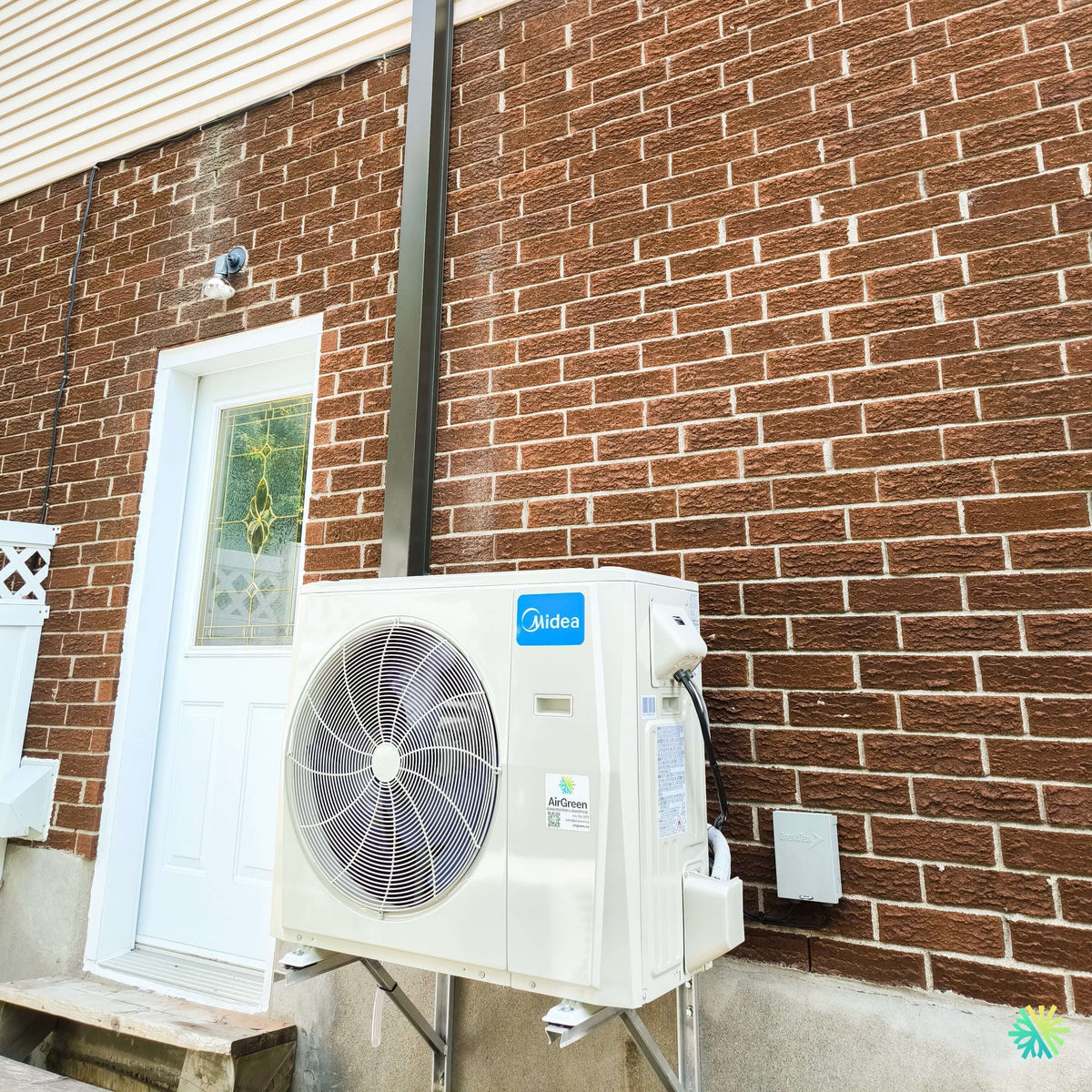
In the photo, one immediately notices the care taken with the outdoor installation: the MIDEA unit is installed on a robust wall bracket, well clear of the ground, with piping protected by a vertical cover neatly aligned with the brick. This type of finish is essential for a durable HVAC installation, especially in an area like Île-Bizard–Sainte-Geneviève, where temperature variations, humidity, snow, and freeze-thaw cycles demand a stable, clean, and well-protected setup.
The specificity of this project was to provide efficient comfort in two zones of the house, without multiplying the outdoor units. The Midea multi-zone system allows for connecting several indoor units to a single outdoor unit, with each zone being controlled separately according to the family's needs. The Midea brochure specifies that a multi-zone system allows heating or cooling multiple rooms with a single outdoor unit, while offering individual control per indoor unit.
Why a MIDEA28 dual-zone heat pump was suitable for this house
In many homes in Montreal, Laval, Longueuil, the North Shore, and the South Shore, comfort needs are not uniform. A ground-floor room can overheat in summer, while an upstairs bedroom might remain cooler or more humid. A single wall-mounted unit can sometimes be insufficient, whereas a complete central system is not always necessary.
The MIDEA MIDEA28 dual-zone heat pump represents a smart compromise here:
- a single outdoor unit to limit bulk;
- two indoor heads to manage two separate spaces;
- better distribution of heating and air conditioning;
- better controlled consumption, as each zone can be used according to actual occupancy;
- a cleaner exterior finish compared to multiple independent appliances.
In this project, the location of the outdoor unit was chosen with care. The door, brick wall, exterior passage, and available height necessitated a compact, stable, and secure installation. The goal was not just to install a machine, but to integrate it properly into the existing architecture.
A wall mount that protects equipment and facilitates maintenance
The outdoor unit was installed on metallic wall brackets, above ground level. This decision offers several practical advantages for a heat pump in Montreal:
- reduces direct exposure to snow accumulation;
- facilitates drainage around the unit;
- protects the base of the appliance from splashes, ice, and debris;
- improves access for HVAC maintenance;
- maintains adequate distance between the appliance and surrounding surfaces.
On a brick wall, the quality of the anchoring is crucial. An outdoor unit must remain perfectly stable despite normal compressor vibrations, winds, defrost cycles, and seasonal variations. At AirGreen, we pay particular attention to the choice of anchors, the level of the appliance, and the overall solidity.
The photo also shows a dark vertical cover that protects the refrigerant lines and wiring. This finish is more than just aesthetic: it limits exposure to UV rays, protects insulation, and reduces the risk of accidental damage. In a dual-zone installation, line management is even more important, as several connections must remain clean, accessible, and well-organized.
The challenge: integrating a dual-zone system without cluttering the facade
One of the common challenges with a dual-zone heat pump is managing outdoor space. Two indoor units must be connected to a single outdoor unit, while maintaining a clean and functional facade. In this specific case, the space near the door required a well-calculated installation: too low, the unit would have been more exposed to snow; too close to the passage, it could have obstructed movement; misaligned, the finish would have detracted from the wall's appearance.
Our team therefore worked according to three priorities:
Maintain adequate clearance around the unit
An outdoor unit must breathe properly. The front fan, sides, and back of the unit must maintain the necessary clearances to promote good heat exchange. Poor air circulation can reduce efficiency, increase noise, and force the machine to work longer.
Protect pipes and fittings
Refrigerant lines, drain, and wiring must be protected along their entire path. The vertical cover installed on the brick maintains a clean appearance while protecting the technical components.
Preserve the aesthetics of the house
In a residential area like Île-Bizard–Sainte-Geneviève, homeowners want a high-performance, yet discreet solution. Choosing a single MIDEA outdoor unit for two zones helps reduce visual impact compared to two separate systems.
The concrete advantages of the MIDEA28 in a dual-zone configuration
The MIDEA28 model is appreciated for residential projects where the customer seeks a good balance between performance, flexibility, and cost. In a 2-head – 1-outdoor configuration, it allows treating two zones without completely transforming the house.
Midea highlights several advantages for its multi-zone systems: choice of indoor units, individual control, outdoor space savings, and reduced noise level thanks to a single outdoor unit for multiple zones.
For homeowners, this translates into very practical daily use. For example, one head can be installed in the main living area, while the other serves a bedroom, an office, a basement, or an extension. Each zone can have its own temperature, which avoids overheating or over-cooling the entire house.
A relevant solution for West Island homes
Homes in Île-Bizard–Sainte-Geneviève often have varied configurations: extensions, more glazed rooms, partially open floors, finished basements, bedrooms far from the main living area. In these contexts, a simple single-zone wall-mounted system may lack reach, while a central solution might be too substantial for the actual need.
A MIDEA dual-zone heat pump allows precisely targeting problematic areas. This is particularly useful when:
- a bedroom gets too hot in summer;
- the living room is exposed to the sun for most of the day;
- a home office requires a stable temperature;
- the basement is cooler or more humid;
- an extension is not well served by the existing system;
- the homeowner wants to reduce the use of electric baseboards.
This type of solution is also highly sought after in Montreal, Laval, Longueuil, on the North Shore, and the South Shore, especially in homes where a quick improvement in comfort is desired without major renovations.
Mistakes to avoid during a dual-zone installation
A multi-zone installation requires more planning than a simple installation. Here are the most common mistakes that we systematically avoid at AirGreen.
Choosing indoor locations based solely on appearance
An indoor head must be placed according to air circulation, room shape, ceiling height, obstacles, and the actual use of the zone. A too discreet location can sometimes hinder performance.
Neglecting the path of refrigerant lines
In a dual-zone system, the lines must be well thought out from the start. A path that is too long, poorly protected, or unnecessarily complex can complicate maintenance and negatively impact the exterior finish.
Installing the outdoor unit too close to the ground
In Montreal and the surrounding areas, snow accumulation is an important factor. A unit that is too low can be partially blocked in winter, reducing its efficiency and increasing the risk of problems.
Underestimating the importance of drainage
In cooling mode, indoor heads produce condensation. Drains must be properly sloped, protected, and tested. Poor drainage can cause leaks, odors, or damage.
Forgetting access for maintenance
An installation must remain accessible for inspections, cleanings, pressure checks, electrical tests, and seasonal maintenance. A beautiful installation that becomes difficult to maintain is not a good installation.
AirGreen's work: precision, cleanliness, and long-term vision
For this project in Île-Bizard–Sainte-Geneviève, our team applied a rigorous method:
- validation of zones to be served;
- selection of indoor head locations;
- planning of pipe routing;
- installation of the outdoor wall bracket;
- installation of the MIDEA outdoor unit;
- refrigerant and electrical connection;
- protection of lines in a clean cover;
- functional tests in heating and cooling;
- drainage verification;
- explanation of use to the client.
This approach allows us to deliver a reliable HVAC installation, which is also easy for the homeowner to understand. A good system is not limited to its technical specifications: it must be properly sized, well installed, and clearly explained.
Subsidies and eligibility: a point to check before each project
Subsidy programs, such as LogisVert or other aids available in Quebec, can influence the choice of a heat pump. However, eligibility depends on the exact model, configuration, building type, installed power, and criteria in force at the time of the project.
For a MIDEA MIDEA28 in a dual-zone configuration, we always recommend validating eligibility before installation, especially when the client wishes to integrate the subsidy into their final budget. At AirGreen, we support our clients in this step by verifying models, AHRI numbers when required, and applicable conditions.
Why this installation is a good example of well-integrated residential performance
This project perfectly illustrates what many homeowners are looking for: improving comfort in two zones without imposing a major transformation on the house. The unit is well positioned, the lines are protected, the exterior finish is clean, and the outdoor unit remains accessible.
The MIDEA MIDEA28 dual-zone heat pump installed in Île-Bizard–Sainte-Geneviève offers an efficient solution for heating and air conditioning, while maintaining a neat appearance. This is exactly the type of installation we prioritize at AirGreen: a serious technical solution, adapted to the building, and designed to last.
A flexible HVAC solution for Montreal, Laval, Longueuil, the North Shore, and the South Shore
Multi-zone systems like the MIDEA28 address a very common reality in the greater Montreal area: homes do not all heat and cool uniformly. A dual-zone solution allows adapting comfort to the actual habits of occupants, without wasting energy in little-used rooms.
At AirGreen, we install heat pumps, wall-mounted air conditioners, central systems, and multi-zone solutions throughout the region: Montreal, Laval, Longueuil, North Shore, and South Shore. Each project is evaluated based on the house, client needs, outdoor configuration, access constraints, and comfort objectives.
This MIDEA installation in Île-Bizard–Sainte-Geneviève demonstrates that a good installation is not only reflected in the installed machine but in all the surrounding details: height, clearances, line protection, support strength, cover alignment, connection cleanliness, and ease of maintenance.
How it goes, from the first call to the end
The main steps of this kind of job at AirGreen. Every house has its quirks: the estimate brings them out.
We look at the room, the outside wall, the line route and where the outdoor unit will go. That is where the capacity gets chosen.
Model, capacity and price, in writing. We also check whether the model qualifies for assistance programs.
Floors and furniture protected, wall plate position marked level, wall opening located.
A single opening, with the slope the drain needs to flow outside.
Set on a stand raised above the snow, with the clearances the manufacturer requires.
Connected, insulated and protected. The opening is then sealed against water, cold air and insects.
A dedicated circuit and an accessible disconnect near the outdoor unit.
Leak test, vacuum, then start-up and a check of heating and cooling.
Remote, modes, filters: we show you the essentials before we leave.
- The on-site estimateWe look at the room, the outside wall, the line route and where the outdoor unit will go. That is where the capacity gets chosen.
- The quoteModel, capacity and price, in writing. We also check whether the model qualifies for assistance programs.
- Getting readyFloors and furniture protected, wall plate position marked level, wall opening located.
- The wall openingA single opening, with the slope the drain needs to flow outside.
- The outdoor unitSet on a stand raised above the snow, with the clearances the manufacturer requires.
- Lines, cable and drainConnected, insulated and protected. The opening is then sealed against water, cold air and insects.
- The electrical workA dedicated circuit and an accessible disconnect near the outdoor unit.
- Tests and start-upLeak test, vacuum, then start-up and a check of heating and cooling.
- The walkthroughRemote, modes, filters: we show you the essentials before we leave.
And at your place?
Two quick checks with real numbers: what heat costs, and what your current heaters add up to in BTU/h.
Conversion: 1 W = 3.412 BTU/h. An indication, not a load calculation: baseboards and furnaces are often stronger than the real need, and they can stay as backup. AirGreen confirms the capacity on site.
What to do, season by season
Three habits per season for this unit. They take a few minutes and prevent many calls.
- Clean the indoor unit's filters.
- Clear leaves and debris left on the outdoor unit by winter.
- Test cooling before the first hot days.
- Clean the filters more often when the unit runs a lot.
- Keep plants away from the outdoor unit.
- Check that no water drips from the indoor unit.
- Rake the leaves around the outdoor unit.
- Test heating before the first cold days.
- Book periodic maintenance before winter.
- Keep snow away from the stand and the front of the unit.
- Let the unit defrost: it is normal.
- Never hit the ice on the fins; call us if the unit stays iced up.
Which type of equipment for your project?
Pick what looks like your need.
Four mistakes we do not make
Flip each card to see what we do instead.
What people ask us about this kind of work
Does a wall-mounted heat pump heat in winter?
Wall-mounted or multi-zone: how do I choose?
Where does the outdoor unit go?
Are there grants?
Do I need a permit?
How cold can it heat?
How much can I save?
How is the LogisVert assistance calculated?
Is it noisy?
The outdoor unit is covered in ice: is that normal?
Does AirGreen hold the required licences?
Is the estimate free?
No question matches. Write to us: we answer.
Useful pages for what comes next
More jobs to see, near you
By town, by equipment or by region: browse more than 4,700 published projects.
Each dot: a town where AirGreen has published projects. The glowing dot: this job.
Tell us about your house. We come and see it for free.
The on-site estimate is free and the quote follows within 24 hours.
Text and photo: a real AirGreen Climatisation & Chauffage job. The diagrams are generic illustrations of the type of installation, not a survey of this job site. Sources of the added figures: airgreen.ca product pages (NEEP / AHRI performance), Hydro-Québec (Heat pumps page, LogisVert, read on 13 October 2026), Régie de l’énergie (rate D as of 1 April 2026).