
Installation of a MIDEA MIDEA28 dual-zone heat pump on a balcony in Plateau-Mont-Royal
AirGreen installs a MIDEA MIDEA28 dual-zone heat pump in Plateau-Mont-Royal: two-zone comfort, compact outdoor unit on balcony, and meticulous HVAC finishing.
In summer, the outdoor unit rejects the house's heat outside.
Generic illustration of this type of installation, not a survey of this job site. Tap a number.
Mounted level on a wall plate, high enough for the air to reach the whole room, with enough space around it to slide the filters out easily.
The refrigerant lines, the communication cable and the drain go through the wall in a single opening, sealed against water, cold air and insects.
Two insulated copper pipes connect the two units. Outside, a line cover can protect them from sun, knocks and weather.
A shut-off switch near the outdoor unit isolates it safely for service. It must stay accessible at all times.
The compressor and the fan. In heating mode it captures heat from the outdoor air, even in winter, and moves it inside.
On the ground or on the wall, it keeps the unit above accumulated snow. The unit stays clear and defrost water can drain away.
The fan needs to blow freely. Storage, a fence or a wall too close, and efficiency drops while noise goes up.
A compact installation designed for the comfort of two zones in a confined urban space
In a dense neighborhood like the Plateau-Mont-Royal, every detail matters when it comes to an HVAC installation. Buildings are close together, balconies are often narrow, technical access requires precision, and the exterior appearance must remain neat. This is exactly the type of context where a MIDEA MIDEA28 dual-zone heat pump becomes a particularly relevant solution: a single outdoor unit, two indoor heads, and independent comfort management in two distinct spaces.
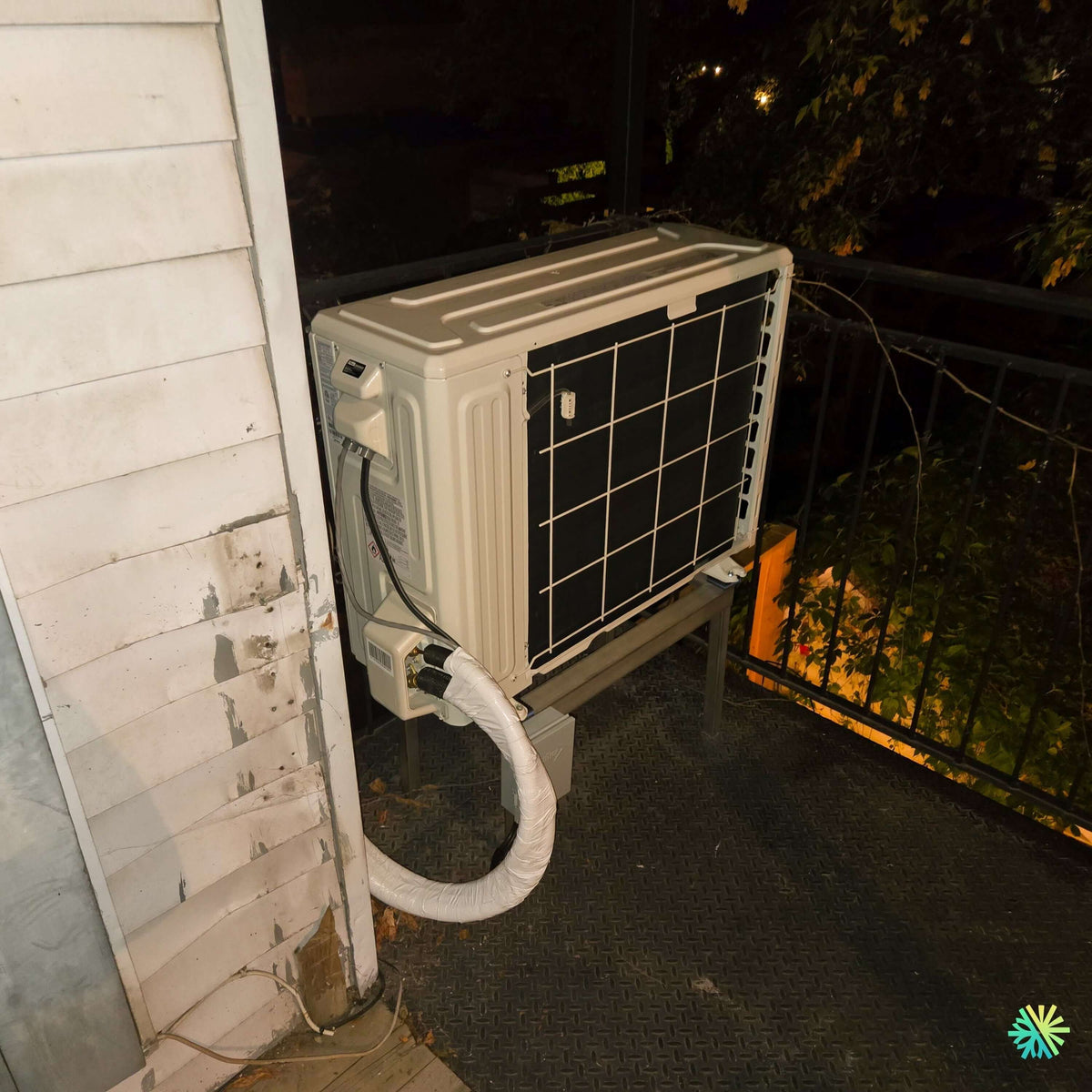
For this project, our AirGreen team installed a MIDEA28 dual-zone heat pump on a metallic outdoor balcony platform. The outdoor unit was positioned to respect the available space, while ensuring good air circulation around the unit. The configuration visible in the photo shows typical work for urban installations: grouped refrigerant lines, careful insulating protection, controlled side clearance, and discreet integration near the exterior wall.
Why a dual-zone heat pump is ideal for this type of dwelling
A dual-zone heat pump allows two indoor units to be connected to a single outdoor unit. In a dwelling in the Plateau-Mont-Royal, this can be used to cool and heat, for example, a living room and a bedroom, or an open-plan area and a closed office. The advantage is significant: each zone can be controlled separately, which improves comfort while avoiding unnecessary heating or cooling of rarely used rooms.
The Midea multi-zone range is designed to connect several indoor units to a single outdoor condenser, with individual control of each room and the possibility of choosing different indoor unit formats according to needs.
Specific balcony constraints
In the photo, the outdoor unit is installed on a metal structure, in a limited space between the building wall and the railing. This type of installation requires rigorous planning, especially to:
- preserve balcony access;
- limit vibrations transmitted to the structure;
- ensure sufficient clearance for unit ventilation;
- protect refrigerant lines against wear, weathering, and friction;
- maintain a neat appearance despite visible technical piping.
We paid particular attention to the curvature of the lines and their protection. Incorrect curvature can create unnecessary tension in the refrigerant lines, while insufficient protection can accelerate the deterioration of the insulation. In an exposed outdoor installation like this, the finish is not only aesthetic: it directly contributes to the system's durability.
The MIDEA MIDEA28: a flexible multi-zone solution for Montreal, Laval, Longueuil, the North Shore, and the South Shore
The MIDEA MIDEA28 stands out for its ability to offer an efficient multi-zone solution in buildings where outdoor space is limited. For many owners in Montreal, Laval, Longueuil, on the North Shore or the South Shore, the question is not just about choosing a good heat pump: it's also about choosing a system that can actually be installed under the building's conditions.
One outdoor unit, two better-controlled spaces
In this project, the goal was clear: to improve comfort in two zones without multiplying outdoor units. This approach reduces clutter on the balcony and limits visual impact. For a building in the Plateau, where back balconies often serve as access, storage, and outdoor space, this is a tangible advantage.
Multi-zone technology also allows for adapting usage to lifestyle habits. A bedroom can be kept cooler at night, while a living room can be heated preferentially in the morning or evening. This flexibility is one of the reasons why 2-head / 1-outdoor systems are increasingly in demand for wall-mounted heat pump projects in Montreal.
An installation that requires more than just a simple connection
Installing a dual-zone heat pump is not limited to attaching a machine to the wall and connecting two pipes. It is necessary to check the line path, condensate drainage, electrical access, support stability, outdoor unit clearance, and compatibility between indoor units and the condenser.
In this specific case, the proximity of the wall and the railing forced us to work with great precision. The unit had to be sufficiently accessible for future maintenance, while remaining well positioned to function correctly. We also ensured that the lines were neatly grouped to reduce visual clutter on the balcony.
Mistakes to avoid in a similar installation
For homeowners considering a heat pump installation in a dwelling in Plateau-Mont-Royal or a similar area, certain mistakes often recur:
Choosing an outdoor unit without considering clearance
A unit too close to a wall, railing, or dense vegetation can lose efficiency. Air circulation around the condenser is essential.
Neglecting the protection of refrigerant lines
Lines exposed to sun, cold, friction, or impacts must be properly protected. Damaged insulation can compromise the system's performance and durability.
Installing without thinking about maintenance
Even a compact installation must allow reasonable access for inspection, cleaning, and future interventions.
Underestimating the complexity of a dual-zone system
A dual-zone heat pump requires precise coordination between the two heads, line lengths, electrical connections, and startup parameters.
The result: two comfort zones with a minimal outdoor footprint
The client now benefits from a system capable of providing heating and cooling in two distinct spaces, while maintaining a single outdoor unit. This is a particularly suitable solution for urban dwellings where space is at a premium.
At AirGreen, we favor this type of configuration when the building allows it, as it offers an excellent balance between comfort, efficiency, and discretion. Whether in Plateau-Mont-Royal, Outremont, Rosemont, Verdun, Laval, Longueuil, on the North Shore or the South Shore, our approach remains the same: adapt the HVAC solution to the actual building, and not the other way around.
Our AirGreen approach to this project
For this installation, our team followed a structured method:
- Assessment of available outdoor location.
- Validation of condenser positioning on the balcony.
- Planning the line routing to the two indoor units.
- Installation of the support and stabilization of the outdoor unit.
- Refrigerant and electrical connection.
- Protection of exposed lines.
- Startup, functional tests, and verification of both zones.
This rigor helps reduce the risks of noise, vibration, performance loss, or access problems during future HVAC maintenance.
A relevant choice for homeowners looking to modernize their comfort
The MIDEA MIDEA28 represents an interesting option for homeowners who want to modernize a dwelling without undertaking major work. In many Montreal buildings, it is not realistic to add ducts or deeply modify the interior structure. A wall-mounted multi-zone solution then allows for effective comfort with a more targeted intervention.
For readers comparing different heat pump options in Montreal, remember this: the quality of the machine is important, but the quality of the installation is just as important. A high-performance heat pump that is poorly positioned, poorly connected, or poorly protected can quickly lose its advantages. Conversely, a well-designed installation extends the system's lifespan and improves daily comfort.
AirGreen, specialist in HVAC installations in urban environments
Projects like this demonstrate the importance of a contractor accustomed to local constraints. Installing a dual-zone heat pump on a balcony in the Plateau-Mont-Royal is nothing like an installation on an open wall in the suburbs. Access is different, clearances are tighter, neighbors are closer, and visual integration matters more.
Our AirGreen team regularly works in similar contexts in Montreal, Laval, Longueuil, on the North Shore and the South Shore. This experience allows us to anticipate challenges before they become problems: choice of location, line routing, noise, vibration, condensate drainage, aesthetics, and future maintenance.
A discreet, technical, and durable project
This MIDEA MIDEA28 dual-zone heat pump installation in the Plateau-Mont-Royal perfectly illustrates what we seek in every project: a solution adapted to the building, a clean finish, reliable performance, and truly useful comfort for the occupants.
In a confined outdoor space, every centimeter counts. In a multi-zone installation, every connection counts. And in a dense neighborhood like the Plateau, every visible detail also counts. This is precisely where AirGreen's expertise makes a difference.
How it goes, from the first call to the end
The main steps of this kind of job at AirGreen. Every house has its quirks: the estimate brings them out.
We look at the room, the outside wall, the line route and where the outdoor unit will go. That is where the capacity gets chosen.
Model, capacity and price, in writing. We also check whether the model qualifies for assistance programs.
Floors and furniture protected, wall plate position marked level, wall opening located.
A single opening, with the slope the drain needs to flow outside.
Set on a stand raised above the snow, with the clearances the manufacturer requires.
Connected, insulated and protected. The opening is then sealed against water, cold air and insects.
A dedicated circuit and an accessible disconnect near the outdoor unit.
Leak test, vacuum, then start-up and a check of heating and cooling.
Remote, modes, filters: we show you the essentials before we leave.
- The on-site estimateWe look at the room, the outside wall, the line route and where the outdoor unit will go. That is where the capacity gets chosen.
- The quoteModel, capacity and price, in writing. We also check whether the model qualifies for assistance programs.
- Getting readyFloors and furniture protected, wall plate position marked level, wall opening located.
- The wall openingA single opening, with the slope the drain needs to flow outside.
- The outdoor unitSet on a stand raised above the snow, with the clearances the manufacturer requires.
- Lines, cable and drainConnected, insulated and protected. The opening is then sealed against water, cold air and insects.
- The electrical workA dedicated circuit and an accessible disconnect near the outdoor unit.
- Tests and start-upLeak test, vacuum, then start-up and a check of heating and cooling.
- The walkthroughRemote, modes, filters: we show you the essentials before we leave.
And at your place?
Two quick checks with real numbers: what heat costs, and what your current heaters add up to in BTU/h.
Conversion: 1 W = 3.412 BTU/h. An indication, not a load calculation: baseboards and furnaces are often stronger than the real need, and they can stay as backup. AirGreen confirms the capacity on site.
What to do, season by season
Three habits per season for this unit. They take a few minutes and prevent many calls.
- Clean the indoor unit's filters.
- Clear leaves and debris left on the outdoor unit by winter.
- Test cooling before the first hot days.
- Clean the filters more often when the unit runs a lot.
- Keep plants away from the outdoor unit.
- Check that no water drips from the indoor unit.
- Rake the leaves around the outdoor unit.
- Test heating before the first cold days.
- Book periodic maintenance before winter.
- Keep snow away from the stand and the front of the unit.
- Let the unit defrost: it is normal.
- Never hit the ice on the fins; call us if the unit stays iced up.
Which type of equipment for your project?
Pick what looks like your need.
Four mistakes we do not make
Flip each card to see what we do instead.
What people ask us about this kind of work
Does a wall-mounted heat pump heat in winter?
Wall-mounted or multi-zone: how do I choose?
Where does the outdoor unit go?
Are there grants?
Do I need a permit?
How cold can it heat?
How much can I save?
How is the LogisVert assistance calculated?
Is it noisy?
The outdoor unit is covered in ice: is that normal?
Does AirGreen hold the required licences?
Is the estimate free?
No question matches. Write to us: we answer.
Useful pages for what comes next
More jobs to see, near you
By town, by equipment or by region: browse more than 4,700 published projects.
Each dot: a town where AirGreen has published projects. The glowing dot: this job.
Tell us about your house. We come and see it for free.
The on-site estimate is free and the quote follows within 24 hours.
Text and photo: a real AirGreen Climatisation & Chauffage job. The diagrams are generic illustrations of the type of installation, not a survey of this job site. Sources of the added figures: airgreen.ca product pages (NEEP / AHRI performance), Hydro-Québec (Heat pumps page, LogisVert, read on 13 October 2026), Régie de l’énergie (rate D as of 1 April 2026).