
Installation of a GREE FREE MATCH R32 Dual-Zone Heat Pump in Sainte-Thérèse: a 2-zone solution designed for lasting comfort
AirGreen installs a GREE FREE MATCH R32 Dual-Zone Heat Pump in Sainte-Thérèse: 2 zones, 2 heads, rooftop HVAC installation, and optimized comfort.
- City
- Region
- Equipment
- Brand
- Challenges
- Published
The job on one screen
The article, chapter by chapter
A Rooftop HVAC Installation Demanding Precision, Method, and True Field Expertise
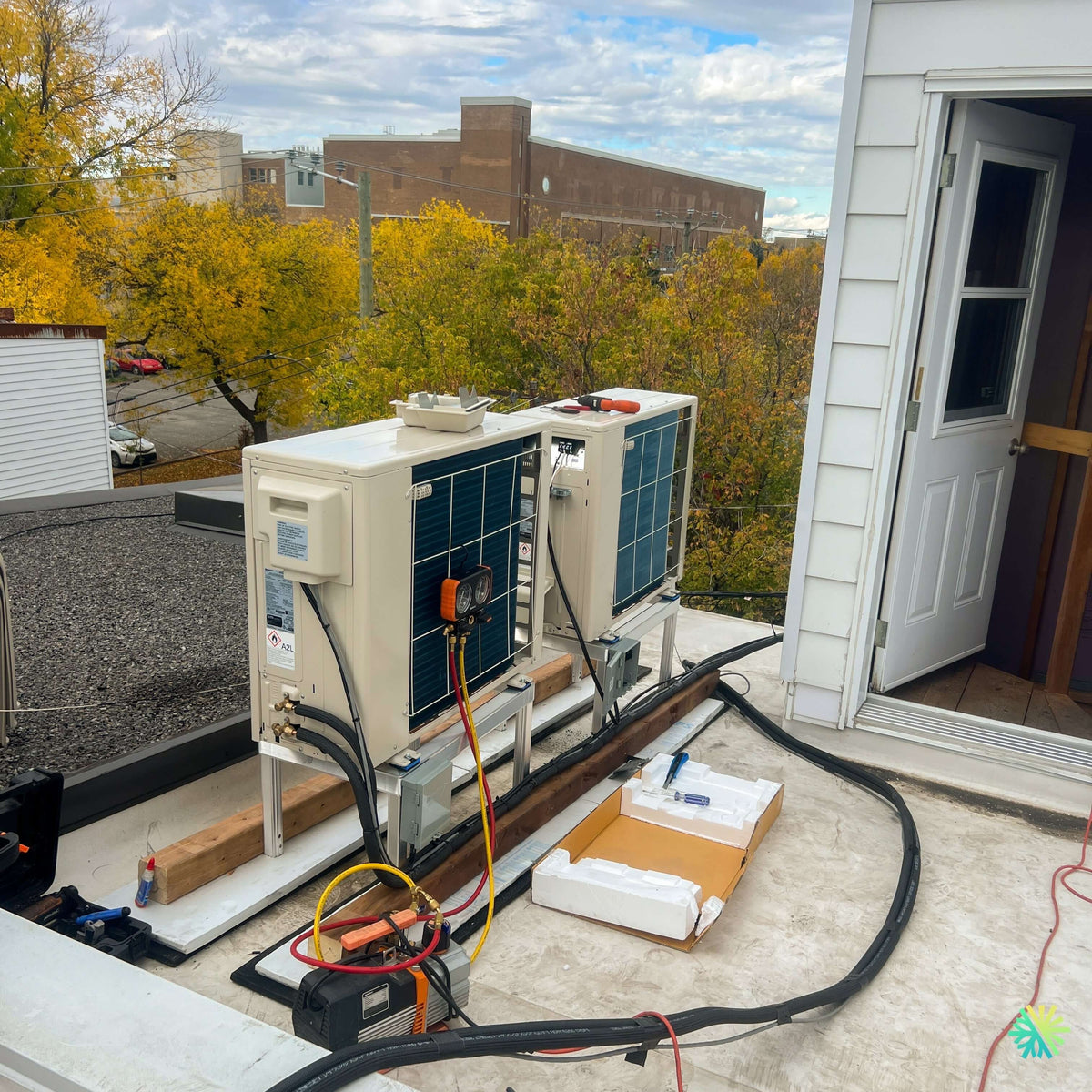
In Sainte-Thérèse, AirGreen recently completed a GREE FREE MATCH R32 DoubleZone heat pump installation, consisting of 2 zones and 2 indoor units, for a residential building where the configuration required a meticulous approach, both technically and practically. The job site photo clearly illustrates the reality of this intervention: two outdoor units installed side-by-side on an elevated metal structure, on a roof accessible from an exterior door, with refrigerant lines, wiring, and commissioning equipment still visible during installation.
This type of project perfectly illustrates what many homeowners are looking for when comparing different wall-mounted heat pump, wall-mounted air conditioner, or multi-zone system options in the greater Montreal, Laval, Longueuil, North Shore, and South Shore regions: a high-performance, flexible system, eligible for subsidies when criteria are met, but above all, a clean, durable installation adapted to the building's reality.
At first glance, a DoubleZone installation may seem simple: two indoor units, one multi-zone outdoor unit, a few ducts, then startup. In practice, every detail matters. The outdoor location, line distance, clearance around the units, mechanical protection of the ducts, condensate drainage, access for maintenance, and the quality of the vacuum influence the system's performance, comfort, and longevity directly.
In this project in Sainte-Thérèse, the objective was clear: to install a GREE FREE MATCH R32 system capable of efficiently serving two distinct zones, while respecting the physical constraints of a roof and the requirements of a professional HVAC installation.
Why choose a GREE FREE MATCH R32 for a DoubleZone installation in Sainte-Thérèse
The GREE FREE MATCH R32 system is particularly interesting for residential projects where one wishes to air condition and heat more than one space without unnecessarily multiplying equipment. In a DoubleZone – 2 zones – 2 heads configuration, a single outdoor unit can power two indoor units, each controlled independently according to the occupants' needs.
This flexibility represents a concrete advantage in several types of buildings in Sainte-Thérèse and the neighboring areas of the North Shore. For example, one head can serve a main living area, while the other can be installed in a bedroom, an office, an upper floor, or a room that is more difficult to temperature-regulate. The customer thus obtains better room-by-room control, without having to over-cool or over-heat the entire dwelling.
The choice of R32 refrigerant is also important. This refrigerant is used in many modern appliances due to its energy efficiency and lower global warming potential than some older refrigerants. For an owner investing in a new heat pump, this allows for choosing more current technology, better aligned with market expectations in terms of performance, comfort, and environmental responsibility.
A solution adapted to Quebec's climate realities
In Sainte-Thérèse, temperature variations put a lot of strain on HVAC equipment. A system must be able to maintain stable comfort during hot and humid summer periods, but also support heating when temperatures drop during winter. A well-sized and well-installed DoubleZone heat pump can reduce reliance on auxiliary heating systems in many situations, while improving comfort distribution.
In the context of an installation like this, the choice of model is never made solely based on the number of BTUs. We also analyze:
- the actual area to be covered;
- the building's insulation;
- sun exposure;
- ceiling height;
- room position;
- the possible path of refrigerant lines;
- the safe and accessible location of the outdoor unit;
- the client's needs for heating, cooling, and independent control.
A successful HVAC installation always begins before the team arrives on site. A large part of the final quality is determined during this preparation.
Two zones, two needs, one coherent system
One of the major advantages of the GREE FREE MATCH R32 system is the ability to adapt comfort to the actual use of each zone. A room occupied all day does not require the same temperature as a bedroom used mainly in the evening. A south-facing space may need more air conditioning in the afternoon, while a closed office may require more precise adjustment due to electronic equipment or prolonged occupancy.
With two indoor units, the customer can manage each zone separately. This helps reduce temperature differences, limit unnecessary consumption, and improve daily comfort. For homeowners considering a multi-zone wall-mounted heat pump in Montreal, Laval, Longueuil, on the North Shore or South Shore, this zoning logic is often one of the most important criteria.
Technical specificities of this rooftop installation
The job site photo highlights an outdoor rooftop installation, with two GREE units installed on an elevated base. This type of location offers several advantages, but also requires rigorous execution.
A stable and elevated base to protect the units
The outdoor units are installed on a metal structure supported by adapted bases. This approach keeps the units above the roof surface, which helps limit direct exposure to standing water, accumulated snow, and debris. In Quebec, this detail is essential. A poorly positioned outdoor unit can be affected by ice, snow accumulation, or freeze-thaw cycles.
In this project, our team ensured that the units were well-aligned, well-supported, and installed with sufficient clearance to ensure good airflow. Clearance around outdoor units is an often underestimated element. However, a heat pump needs to breathe. If air is blocked, recirculated, or poorly exhausted, efficiency decreases, and the unit can be subjected to unnecessary stress.
Management of refrigerant lines and wiring
Several black lines are visible in the photo, corresponding to the insulated ducts and wiring connected to the units. In a multi-zone installation, the routing of lines must be planned with precision. Maximum permissible lengths must be respected, excessive bends avoided, ducts protected against friction, and a clean finish ensured once the work is completed.
Refrigerant lines are at the heart of the system's operation. Poor insulation, a kink in the copper, a minimal leak, or an inadequate vacuum can impair performance. At AirGreen, we place particular importance on connection preparation, brazing when required, leak testing, vacuuming, and final verification of operating pressures and temperatures.
In this installation in Sainte-Thérèse, rooftop access facilitated certain aspects of the work, particularly the space available around the units, but it also demanded rigorous organization of tools, materials, and safety. A roof is not an ordinary workspace. The membrane must be protected, impacts avoided, repeated passages managed, and a clean area maintained throughout the intervention.
Commissioning that goes beyond "turning on the system"
The commissioning of a GREE FREE MATCH R32 DoubleZone heat pump is not simply a matter of plugging in the unit and checking that air comes out of the indoor units. We must confirm that each zone communicates correctly with the outdoor unit, that heating and cooling modes respond well, that drains are functioning, that discharge temperatures are consistent, and that the electrical installation complies with applicable standards.
Proper commissioning includes:
- checking the electrical supply;
- verifying communication connections;
- leak testing;
- adequate vacuuming;
- checking condensate drains;
- testing each indoor unit;
- validating heating, cooling, ventilation, and dehumidification modes;
- explaining optimal system usage to the client.
These steps make the difference between a merely functional installation and a truly reliable one.
The challenge of access and aesthetics
In projects in Sainte-Thérèse, as elsewhere in the greater Montreal area, aesthetics often play an important role. Clients want a high-performance system, but they also want the installation to remain clean, discreet, and well-integrated into the building. On a roof, the advantage is that outdoor units are often less visible from the street or living areas. However, this does not mean that the finish can be neglected.
Lines must be grouped, properly secured, and protected. Openings in the building envelope must be well sealed. Ducts must be installed in a way that prevents water accumulation, mechanical stress, and risks of premature wear. It is precisely in these details that the experience of an HVAC team is seen.
What this installation concretely brings to the client
Once the installation is complete, the client benefits from a system capable of managing two distinct spaces with a single centralized solution. This type of installation improves daily comfort, particularly in buildings where certain rooms are hotter, colder, or more difficult to balance.
Better distributed comfort in the dwelling
With a single indoor unit, some areas may remain less well-served, especially when the configuration includes several closed rooms, corridors, or different levels. A 2-zone – 2-head installation allows for better targeting of actual needs. Comfort becomes more homogeneous, but also more flexible.
For example, the client can maintain a cooler temperature in a bedroom at night, while reducing demand in the common area. Conversely, during the day, the main zone can be prioritized. This independent management is one of the reasons why multi-zone systems are gaining popularity in Montreal, Laval, Longueuil, on the North Shore, and South Shore.
Improved efficiency through proper sizing
A system that is too small constantly strains. A system that is too large can create short cycles, reduce comfort, and affect dehumidification. Proper sizing is therefore essential. In this installation, the choice of a GREE FREE MATCH R32 DoubleZone met a specific need: to provide adequate capacity for two zones, without multiplying outdoor units or compromising performance.
Sizing takes into account the actual thermal load. This analysis includes windows, orientation, insulation level, heat losses, solar gains, and room usage. This is an important step for any owner comparing the prices of a wall-mounted heat pump or a wall-mounted air conditioner. Price alone is not enough: the real value depends on the quality of the analysis and installation.
A solution compatible with modern energy efficiency demands
Homeowners are increasingly looking to reduce their energy costs while improving their comfort. A modern heat pump like the GREE FREE MATCH R32 can be a very relevant solution when the project is well designed. In heating mode, it can transfer heat rather than just producing it through electric resistance, which improves efficiency under various conditions.
Eligibility for subsidy programs, such as provincial programs applicable to eligible heat pumps, always depends on the exact model, capacity, certification, installation, and criteria in force at the time of the project. At AirGreen, we help our clients better understand these criteria and gather the necessary documents when their installation is eligible.
Mistakes to avoid during a DoubleZone installation
A multi-zone installation requires more coordination than a single-zone system. Several errors can compromise performance or durability.
Choosing the outdoor location without considering maintenance
An outdoor unit must remain accessible for maintenance, cleaning, and any necessary repairs. On a roof, access may seem convenient during installation, but future interventions must also be considered. In this project, the location allowed for adequate access while respecting the necessary clearances around the units.
Neglecting line protection
Refrigerant and electrical lines must be protected against weathering, friction, and movement. A poorly secured line can vibrate, wear out, or degrade over time. Exterior finishes, supports, and mechanical protections are not just aesthetic details: they directly contribute to the system's reliability.
Installing heads without analyzing airflow
A poorly positioned indoor unit can create uncomfortable zones, blow directly on occupants, or poorly distribute air in the room. The indoor location must be chosen based on the actual arrangement of furniture, openings, doors, and the room's use. In a DoubleZone installation, this consideration must be made for each head.
Underestimating the importance of drainage
In cooling mode, indoor units produce condensation. Water must be properly drained. Poor drainage can cause leaks, odors, or damage. Every slope, every connection, and every outlet must be checked.
Relying solely on the advertised price
Two quotes may seem similar on paper but be very different in the details: line length included, material quality, conduit protection, warranties, commissioning, insurance, electrical compliance, team experience, and after-sales service. At AirGreen, we prioritize clear, complete, and realistic quotes to avoid surprises.
The AirGreen Approach: A Clean, Sustainable, and Compliant Installation
This project in Sainte-Thérèse perfectly represents our way of working. We do not view an HVAC installation as a simple equipment placement. We consider the entire system: building, occupants, performance, aesthetics, access, maintenance, and durability.
Planning Before Installation
Before starting, we analyze site constraints. In this case, the roof, access door, position of outdoor units, and conduit path were evaluated to ensure an efficient installation. This preparation helps avoid costly improvisations and unnecessary compromises.
Execution by a Team Experienced in Complex Installations
Rooftop installations require an organized team. Tools, supports, conduits, units, and accessories must be brought and handled with care. The photo shows a work in progress, with units in place, pressure gauges installed, and commissioning equipment ready to validate the system. This is an important step that demonstrates the seriousness of the work: final performance depends as much on the machine as on the quality of the installation.
Support After Commissioning
Once the installation is complete, we explain to the client how to use their system, how to set modes, how to optimize temperatures, when to clean filters, and when to schedule HVAC maintenance. A well-maintained heat pump better preserves its efficiency, comfort, and lifespan.
We generally recommend regularly cleaning indoor filters, keeping outdoor units clear, checking for obstructions around conduits, and scheduling periodic professional maintenance. These simple actions help prevent performance losses and unnecessary service calls.
A Concrete Example for Homeowners in Sainte-Thérèse, Montreal, Laval, Longueuil, North Shore, and South Shore
This installation of a GREE FREE MATCH R32 DualZone heat pump in Sainte-Thérèse is an excellent example for homeowners wondering if a multi-zone system is suitable for their building. When two spaces need to be controlled separately, only one outdoor unit is preferred, and year-round comfort is a priority, a 2-zone – 2-head solution can be particularly effective.
At AirGreen, we carry out this type of project in several areas: Montreal, Laval, Longueuil, the North Shore, the South Shore, as well as in many surrounding municipalities. Each building has its own constraints, but our method remains the same: analyze, recommend, install cleanly, rigorously test, and support the client after commissioning.
The choice of a heat pump should never be based solely on a technical sheet or a quick price. True performance depends on the match between the chosen model, the building configuration, and the quality of the installation. A well-installed GREE FREE MATCH R32 can offer an excellent balance between comfort, independent control, energy efficiency, and discreet integration into the building.
In this project in Sainte-Thérèse, the result is a solid, well-organized installation designed to last. The elevated outdoor units, line management, technical commissioning, and multi-zone approach demonstrate the importance of precisely executed work. For a homeowner, it is this rigor that transforms an equipment purchase into a real improvement in residential comfort.
The job tools
Two quick checks with real numbers: what heat costs, and what your current heaters add up to in BTU/h.
Conversion: 1 W = 3.412 BTU/h. An indication, not a load calculation: baseboards and furnaces are often stronger than the real need, and they can stay as backup. AirGreen confirms the capacity on site.
How the job unfolds
The main steps of this kind of job at AirGreen. Every house has its quirks: the estimate brings them out.
We look at the room, the outside wall, the line route and where the outdoor unit will go. That is where the capacity gets chosen.
Model, capacity and price, in writing. We also check whether the model qualifies for assistance programs.
Floors and furniture protected, wall plate position marked level, wall opening located.
A single opening, with the slope the drain needs to flow outside.
Set on a stand raised above the snow, with the clearances the manufacturer requires.
Connected, insulated and protected. The opening is then sealed against water, cold air and insects.
A dedicated circuit and an accessible disconnect near the outdoor unit.
Leak test, vacuum, then start-up and a check of heating and cooling.
Remote, modes, filters: we show you the essentials before we leave.
- The on-site estimateWe look at the room, the outside wall, the line route and where the outdoor unit will go. That is where the capacity gets chosen.
- The quoteModel, capacity and price, in writing. We also check whether the model qualifies for assistance programs.
- Getting readyFloors and furniture protected, wall plate position marked level, wall opening located.
- The wall openingA single opening, with the slope the drain needs to flow outside.
- The outdoor unitSet on a stand raised above the snow, with the clearances the manufacturer requires.
- Lines, cable and drainConnected, insulated and protected. The opening is then sealed against water, cold air and insects.
- The electrical workA dedicated circuit and an accessible disconnect near the outdoor unit.
- Tests and start-upLeak test, vacuum, then start-up and a check of heating and cooling.
- The walkthroughRemote, modes, filters: we show you the essentials before we leave.
What we check on a job like this one
Each number is a point we check on site. Switch between summer and winter to watch air and heat move.
In summer, the outdoor unit rejects the house's heat outside.
Generic illustration of this type of installation, not a survey of this job site. Tap a number.
Mounted level on a wall plate, high enough for the air to reach the whole room, with enough space around it to slide the filters out easily.
The refrigerant lines, the communication cable and the drain go through the wall in a single opening, sealed against water, cold air and insects.
Two insulated copper pipes connect the two units. Outside, a line cover can protect them from sun, knocks and weather.
A shut-off switch near the outdoor unit isolates it safely for service. It must stay accessible at all times.
The compressor and the fan. In heating mode it captures heat from the outdoor air, even in winter, and moves it inside.
On the ground or on the wall, it keeps the unit above accumulated snow. The unit stays clear and defrost water can drain away.
The fan needs to blow freely. Storage, a fence or a wall too close, and efficiency drops while noise goes up.
Is your home ready?
Check what applies at your place. A "no" is not a refusal: it is what we sort out during the estimate.
Good habits, once the unit is in place
Six simple habits that keep the unit going. Your list stays on this device.
What to do, season by season
Three habits per season for this unit. They take a few minutes and prevent many calls.
- Clean the indoor unit's filters.
- Clear leaves and debris left on the outdoor unit by winter.
- Test cooling before the first hot days.
- Clean the filters more often when the unit runs a lot.
- Keep plants away from the outdoor unit.
- Check that no water drips from the indoor unit.
- Rake the leaves around the outdoor unit.
- Test heating before the first cold days.
- Book periodic maintenance before winter.
- Keep snow away from the stand and the front of the unit.
- Let the unit defrost: it is normal.
- Never hit the ice on the fins; call us if the unit stays iced up.
The right pages, at the right time
Four statements: true or false?
It all comes down to details you have just seen.
1. In heating mode, the outdoor unit can produce water.
During defrost cycles. That water must drain away without forming ice.
2. You pick the capacity with a simple square-footage rule.
Windows, insulation, orientation and how the room is used all count. Capacity is chosen on site.
3. A multi-zone connects several indoor heads to a single condenser.
One head per room, all on the same condenser. Each room keeps its own temperature.
4. The disconnect can sit behind the patio furniture.
It must stay accessible: it is what shuts the unit off for service.
0 / 4 right answers
What people ask us about this kind of work
Does a wall-mounted heat pump heat in winter?
Wall-mounted or multi-zone: how do I choose?
Where does the outdoor unit go?
Are there grants?
Do I need a permit?
How cold can it heat?
How much can I save?
How is the LogisVert assistance calculated?
Is it noisy?
The outdoor unit is covered in ice: is that normal?
Does AirGreen hold the required licences?
Is the estimate free?
No question matches. Write to us: we answer.
More jobs to see, near you
By town, by equipment or by region: browse more than 4,700 published projects.
Each dot: a town where AirGreen has published projects. The glowing dot: this job.
An on-site estimate, the right capacity, the right equipment.
The on-site estimate is free and the quote follows within 24 hours.
Text and photo: a real AirGreen Climatisation & Chauffage job. The diagrams are generic illustrations of the type of installation, not a survey of this job site. Sources of the added figures: airgreen.ca product pages (NEEP / AHRI performance), Hydro-Québec (Heat pumps page, LogisVert, read on 13 October 2026), Régie de l’énergie (rate D as of 1 April 2026).