
Installation of a GREE All Match Slim Duct R32 Ducted Heat Pump in Côte Saint-Luc, Montreal
AirGreen installs a GREE All Match Slim Duct R32 ducted heat pump in Côte Saint-Luc: custom plenum, discreet ducts, uniform comfort, and local HVAC expertise.
In summer, the outdoor unit rejects the house's heat outside.
Generic illustration of this type of installation, not a survey of this job site. Tap a number.
It captures or rejects heat outside. It sits on a level base, above the snow, with free space all around.
The insulated refrigerant lines enter the house through a sealed opening and run to the indoor coil.
A shut-off switch near the outdoor unit isolates it safely for service.
Sitting on the indoor module, it moves heat between the house air and the refrigerant.
Electric furnace or air handler: its fan pushes air through the ducts. The electric backup takes over in extreme cold.
Supply ducts bring air to the rooms; returns bring it back to the unit. Their condition matters as much as the unit's.
It protects the coil and the fan. A dirty filter cuts airflow, so it gets checked regularly.
It runs the heat pump and the backup heat. It must be compatible with the installed system.
A GREE ducted system integrated with a custom plenum for discreet and better-distributed comfort
In Côte Saint-Luc, our AirGreen team carried out a HVAC installation of the ducted type, also called ducted ducts, Slim Duct or ductable, with a GREE system designed to offer uniform comfort without a visible wall unit in the main rooms. This type of project requires much more precision than a classic wall installation, as performance depends as much on the machine as on the quality of the air network, the plenum, the ducts, the air return, and the final balancing.
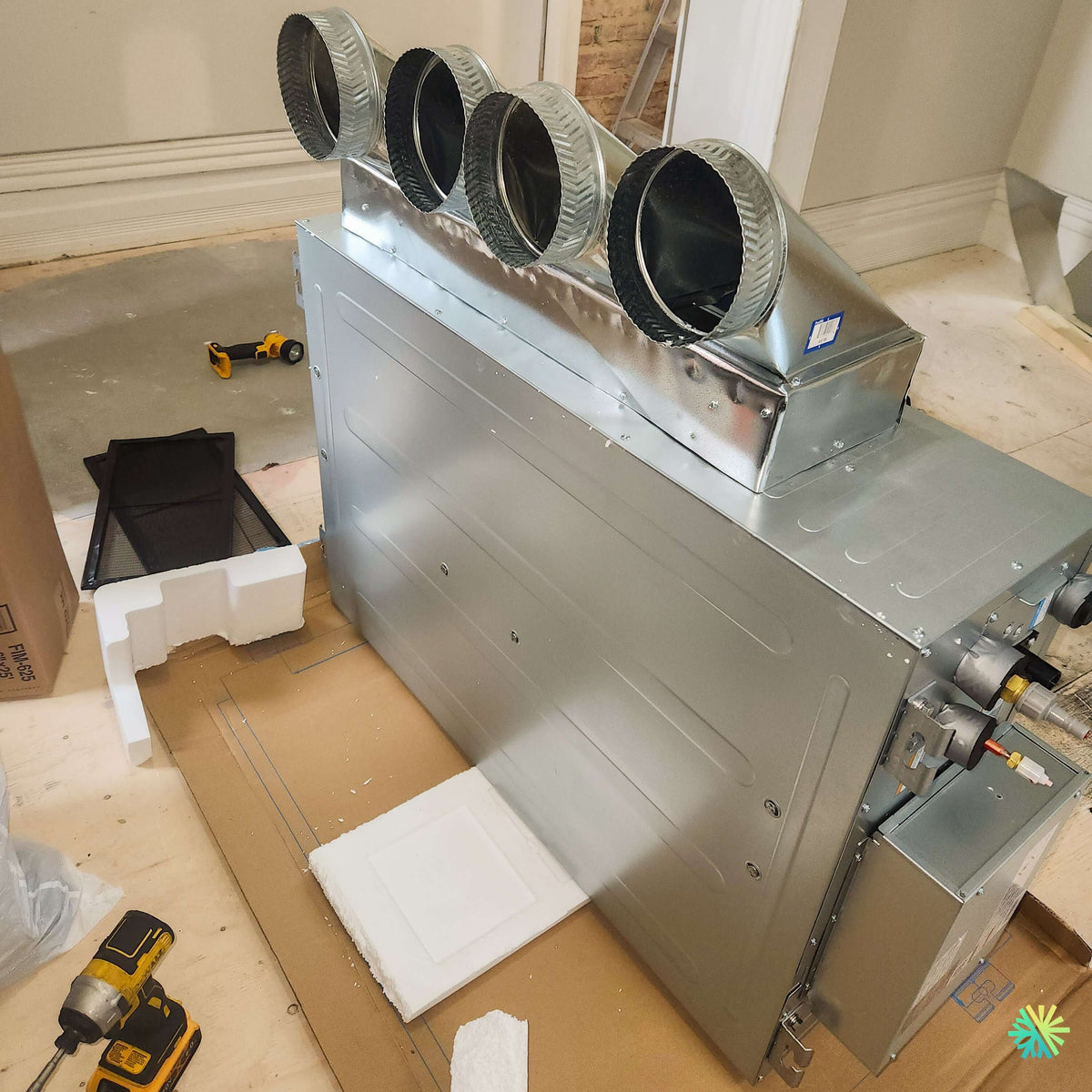
In the construction photo, you can see the GREE ducted indoor unit being prepared, with a metal plenum installed on top and four circular outlets intended to supply different zones. This step is at the heart of the installation: each outlet must be designed according to the required airflow, duct length, grille position, and network resistance. A well-chosen ducted heat pump, but poorly connected, can result in noise, unevenness, or inefficiency. That is why we give as much importance to the design work as to the installation of the equipment itself.
In this residence in Côte Saint-Luc, the goal was clear: to provide an efficient, discreet heating and cooling solution adapted to the interior architecture. The client did not want to multiply visible units in the rooms. Instead, they were looking for an integrated solution capable of distributing air through short, well-organized ducts, with discreet grilles and minimal mechanical presence in the living space.
Why a GREE ducted heat pump in this project?
The GREE ducted systems are particularly well suited for houses, condos, and renovations where interior aesthetics are important. In Côte Saint-Luc, several properties present typical constraints: finished ceilings, limited technical areas, load-bearing walls, partial renovations, open spaces, and high expectations regarding acoustic comfort. In this context, a GREE Slim Duct solution allows for a balance of performance, discretion, and flexibility.
The range offered by AirGreen includes notably the GREE FM Ducted systems in low and high static pressure, as well as the GREE All Match Slim Duct R32 series, available in several capacities: 9,000 BTU, 12,000 BTU, 18,000 BTU, 24,000 BTU, 30,000 BTU, and 36,000 BTU, depending on the building's needs. The final choice always depends on a serious sizing, based on the volumes to be treated, insulation, orientation, glazed openings, room usage, and the feasibility of the duct network.
In this project, the priority was to achieve stable air distribution. The four-outlet plenum allowed the network to be structured in an orderly manner, preparing each outlet for a specific zone. This kind of configuration is particularly useful when you want to avoid one room receiving too much air while another remains less comfortable.
The plenum: a technical component that changes everything
The metal plenum visible on the unit is not just a simple accessory. It acts as a distribution chamber that receives the air treated by the heat pump and distributes it to several ducts. Its design directly influences:
- the airflow available at each grille;
- the system's static pressure;
- noise level;
- comfort stability;
- energy efficiency;
- the durability of the equipment.
When a plenum is too small, poorly positioned, or poorly sealed, it can generate turbulence and pressure losses. When well designed, the air flows more naturally, the ducts work better, and the unit operates under more favorable conditions.
On this site in Côte Saint-Luc, our team paid particular attention to the alignment of the outlets, the sealing of the joints, and the mechanical strength of the whole. The four circular fittings installed on the plenum had to allow a clean start of the ducts, without unnecessary angles or excessive restriction right at the unit's outlet.
Low or high static pressure: the right choice according to the ducts
A ducted system is not chosen solely based on its BTU capacity. Static pressure is a crucial criterion. A low static pressure unit can work very well in a short and simple network. A high static pressure unit becomes more relevant when air needs to be pushed through longer ducts, with multiple branches or greater constraints.
At AirGreen, we always analyze the actual configuration before recommending an option. In an installation with multiple outlets, like the one shown here, factors such as duct length, number of bends, outlet diameter, grille type, return air, and available space to properly insulate the ducts must be considered.
It is often at this stage that the expertise of an HVAC contractor makes a major difference. A machine may seem adequate on a technical sheet, but if it is not compatible with the installed network, the client may end up with a system that is less quiet, less comfortable, and less efficient than expected.
An installation that demands coordination and precision
This project in Côte Saint-Luc required meticulous coordination between mechanical preparation, unit positioning, plenum fabrication, refrigerant connection, drainage, electricity, and future architectural closure. Unlike a wall unit, a GREE ducted heat pump becomes largely invisible after the work is done. Therefore, access and connections must be validated before ceilings, partitions, or finishing panels are closed.
Our technicians worked with a clear method:
-
Validation of the indoor unit location
The unit had to be positioned to facilitate connections, limit air loss, and allow future access to the filter, drain, and service components. -
Preparation of the plenum and air outlets
The circular outlets were aligned to supply the designated areas with as little restriction as possible. -
Return air planning
Good air return is essential. Without it, the unit may lack airflow, become noisier, and lose efficiency. -
Drainage management
The drain must be carefully designed to avoid backflows, water accumulation, and moisture problems. -
Vibration and noise control
Fastenings, connections, and transitions must limit vibrations transmitted to the structure. -
Tests and adjustments
Once the system is connected, the flows and operation must be checked to ensure the installation meets expectations.
Invisible comfort: a tangible advantage in Côte Saint-Luc residences
The great advantage of a GREE ducted system is its discreet integration. The customer enjoys heating and air conditioning without having to see a wall unit in every room. The grilles can be placed more subtly, depending on the interior layout. In homes where design, moldings, ceilings, and finishes matter, this approach is often preferable.
In Côte Saint-Luc, this type of solution meets the expectations of homeowners who want to modernize their comfort without changing the appearance of the rooms. A ducted installation can also be interesting in projects where multiple spaces need to be served from a single indoor unit, when the configuration allows.
That said, a ducted system is not automatically the right choice for every building. There must be enough space for the unit, ducts, insulation, and service access. At AirGreen, we always explain the advantages and limitations of each option before proposing a final solution.
Energy efficiency, R32, and subsidy eligibility
The GREE All Match Slim Duct R32 series belongs to a generation of systems designed to offer an efficient heating and air conditioning solution, with a refrigerant R32 depending on the models concerned. Some GREE ducted systems can be associated with ENERGY STAR certifications and potential eligibility for subsidy programs, depending on the exact combination of indoor and outdoor units, the selected capacity, and the criteria in effect at the time of installation.
At AirGreen, we verify these elements at the time of submission to avoid unpleasant surprises. Clients seeking a subsidy must pay attention to several points:
- the certification of the installed combination;
- the exact capacity of the system;
- the requirements of the applicable program;
- the documents required after installation;
- the final invoice and technical information of the model;
- processing times by the relevant organization.
For owners in Montreal, Laval, Longueuil, the North Shore, and the South Shore, this step can have a significant impact on the net cost of the project. We support our clients with clear information to help them make an informed decision.
The details that distinguish a successful ducted installation
A successful ducted installation is never just about connecting a machine. It relies on a series of technical decisions. In this project in Côte Saint-Luc, the quality of the result depended on details sometimes invisible but essential: the correct positioning of the plenum, managing connections, respecting service access, limiting noise, ensuring drainage stability, and balancing the outlets.
The air return: often forgotten, never secondary
In many less rigorous installations, the air return is treated as a formality. This is a mistake. A ducted indoor unit must receive a sufficient volume of air to function properly. A return that is too small or poorly positioned can create a restriction, increase noise, reduce airflow at the grilles, and harm overall performance.
On this site, our team incorporated this consideration from the preparation stage of the installation. The system had to breathe properly, both on the distribution side and the return side. This allows the machine to operate stably without unnecessary strain.
Noise: a criterion as important as temperature
When a customer chooses a ducted system, they generally expect a discreet installation. This discretion must be both visual and acoustic. Noise can come from several sources: air velocity too high, improperly sized ducts, metal vibration, overly rigid connections, or poorly assessed static pressure.
Our technicians take these factors into account during installation. Transitions must be clean, parts must be well secured, and ducts must be adapted to the actual airflow. In a residence, this attention to detail makes a difference every day, especially in bedrooms, home offices, and relaxation areas.
Mistakes to avoid before installing a Slim Duct system
Homeowners considering a ducted heat pump should avoid some common mistakes.
The first is choosing based only on price. Two quotes may mention a similar GREE machine but hide significant differences in network design, duct insulation, plenum quality, service access, and included work.
The second is underestimating the necessary space. A Slim Duct unit is compact, but it still needs enough clearance for installation, the filter, the drain, and HVAC maintenance.
The third is ignoring duct lengths. The longer or more complex a network is, the more important the static pressure becomes. A poor choice at this level can reduce comfort in certain rooms.
The fourth is neglecting balancing. When several outlets are connected to the same plenum, it is necessary to ensure that the air is distributed correctly. Otherwise, one room can become too cold in summer while another remains warmer.
An AirGreen approach adapted to houses, condos, and renovations
Our experience with GREE ducted systems allows us to work in various contexts: single-family homes, condos, major renovations, extensions, finished ceiling apartments, and projects where architectural integration is a priority. In Montreal, we often face structural and space constraints. In Laval, projects frequently involve houses where one floor or an open area needs to be treated. In Longueuil, on the South Shore and on the North Shore, many clients choose ducted systems to combine comfort, aesthetics, and performance.
As an experienced GREE dealer, AirGreen offers full support: selecting the right type of machine, sizing, duct validation, installation, commissioning, and after-sales service. We also consider the warranties available on the selected models, access to original parts, and future maintenance needs.
What the client ultimately gets
Once the installation is complete, the client gets a solution much more discreet than a traditional wall-mounted setup. The indoor unit is hidden, the ducts distribute air to the designated areas, and the grilles ensure diffusion better integrated with the interior design.
The desired outcome is simple: stable comfort, preserved interior appearance, and a reliable mechanical installation. To achieve this, every step counts. The plenum visible in the photo perfectly illustrates this reality: before the system becomes almost invisible, there is precise, concrete, and technical work that determines the quality of comfort for years to come.
Why entrust this type of project to AirGreen?
Ducted systems require specific expertise. It’s not enough to know about wall-mounted heat pumps or wall-mounted air conditioners. You need to understand static pressure, pressure losses, air distribution, drainage, acoustics, and building integration.
At AirGreen, we carry out HVAC installations in Greater Montreal with particular attention to transparency, site cleanliness, and the durability of the result. Our clients appreciate clear estimates, tailored recommendations, and the fact that we explain the available options without oversimplifying the technical aspects.
This installation of a GREE All Match Slim Duct R32 ducted heat pump in Côte Saint-Luc perfectly represents the type of project where our expertise truly matters: a discreet system, careful design, a suitable plenum, multiple well-planned outlets, and a solution designed for the client’s real comfort.
How it goes, from the first call to the end
The main steps of this kind of job at AirGreen. Every house has its quirks: the estimate brings them out.
We look at the ducts, the current indoor module, the electrical panel and the planned spot for the outdoor unit.
The equipment combination, capacity and price, in writing. We check whether the combination qualifies for assistance programs.
Access protected, old unit disconnected and removed when it is being replaced.
Electric furnace or air handler, with its coil, connected to the supply and return ducts.
On a level base, raised above the snow, with free space all around.
Insulated, they enter through a sealed opening and run to the indoor coil.
Dedicated circuits, accessible disconnect, a thermostat that works with the heat pump and the backup heat.
Leak test, vacuum, start-up, airflow check and a test of both modes.
Filter, thermostat, backup heat in extreme cold: what to know before winter.
- The on-site estimateWe look at the ducts, the current indoor module, the electrical panel and the planned spot for the outdoor unit.
- The quoteThe equipment combination, capacity and price, in writing. We check whether the combination qualifies for assistance programs.
- Getting readyAccess protected, old unit disconnected and removed when it is being replaced.
- The indoor moduleElectric furnace or air handler, with its coil, connected to the supply and return ducts.
- The outdoor unitOn a level base, raised above the snow, with free space all around.
- The refrigerant linesInsulated, they enter through a sealed opening and run to the indoor coil.
- Electrical and thermostatDedicated circuits, accessible disconnect, a thermostat that works with the heat pump and the backup heat.
- Tests and start-upLeak test, vacuum, start-up, airflow check and a test of both modes.
- The walkthroughFilter, thermostat, backup heat in extreme cold: what to know before winter.
And at your place?
Two quick checks with real numbers: what heat costs, and what your current heaters add up to in BTU/h.
Conversion: 1 W = 3.412 BTU/h. An indication, not a load calculation: baseboards and furnaces are often stronger than the real need, and they can stay as backup. AirGreen confirms the capacity on site.
What to do, season by season
Three habits per season for this unit. They take a few minutes and prevent many calls.
- Check the indoor module's filter.
- Clear winter debris from the outdoor unit.
- Test cooling before the heat arrives.
- Check the filter more often in peak season.
- Keep registers and returns clear.
- Watch condensate drainage near the coil.
- Change or clean the filter.
- Test heating and backup heat before the cold.
- Book periodic maintenance.
- Clear snow around the outdoor unit.
- Store nothing in front of the indoor module.
- Note any unusual noise or smell and call us.
Which type of equipment for your project?
Pick what looks like your need.
Four mistakes we do not make
Flip each card to see what we do instead.
What people ask us about this kind of work
Can I keep my current ducts?
What happens in extreme cold?
Furnace, air handler, ducted: what is the difference?
Are there grants?
Do I need a permit?
How much can I save?
How is the LogisVert assistance calculated?
Will my current thermostat work?
Central or wall units: which one?
Does AirGreen hold the required licences?
Is the estimate free?
No question matches. Write to us: we answer.
Useful pages for what comes next
More jobs to see, near you
By town, by equipment or by region: browse more than 4,700 published projects.
Each dot: a town where AirGreen has published projects. The glowing dot: this job.
Tell us about your house. We come and see it for free.
The on-site estimate is free and the quote follows within 24 hours.
Text and photo: a real AirGreen Climatisation & Chauffage job. The diagrams are generic illustrations of the type of installation, not a survey of this job site. Sources of the added figures: airgreen.ca product pages (NEEP / AHRI performance), Hydro-Québec (Heat pumps page, LogisVert, read on 13 October 2026), Régie de l’énergie (rate D as of 1 April 2026).