
Installation of a GREE FREE MATCH R32 5-zone heat pump with 5 wall-mounted units in Oka
AirGreen installs a 5-zone GREE FREE MATCH R32 heat pump in Oka with 5 wall-mounted heads, a clean, efficient, and multi-zone HVAC solution suitable for homes on the North Shore.
Take a tour of the installation
Each number is a point we check on site. Switch between summer and winter to watch air and heat move.
In summer, the outdoor unit rejects the house's heat outside.
Generic illustration of this type of installation, not a survey of this job site. Tap a number.
Mounted level on a wall plate, high enough for the air to reach the whole room, with enough space around it to slide the filters out easily.
The refrigerant lines, the communication cable and the drain go through the wall in a single opening, sealed against water, cold air and insects.
Two insulated copper pipes connect the two units. Outside, a line cover can protect them from sun, knocks and weather.
A shut-off switch near the outdoor unit isolates it safely for service. It must stay accessible at all times.
The compressor and the fan. In heating mode it captures heat from the outdoor air, even in winter, and moves it inside.
On the ground or on the wall, it keeps the unit above accumulated snow. The unit stays clear and defrost water can drain away.
The fan needs to blow freely. Storage, a fence or a wall too close, and efficiency drops while noise goes up.
A Discreet Multi-Zone Installation in an Oka Home Where Every Detail Mattered
In Oka, this installation of a GREE FREE MATCH R32 5-zone heat pump represented a typical project for Quebec homes where comfort depends not on a single room, but on a set of living spaces used differently throughout the day. The client sought a solution capable of effectively air conditioning multiple zones during the summer, while also providing efficient auxiliary heating during cooler periods, without multiplying outdoor units or complicating maintenance.
At AirGreen, we therefore proposed a GREE FREE MATCH R32 solution with 5 wall-mounted units, a configuration particularly attractive for residences where separate temperature control is desired for bedrooms, living room, open spaces, and more isolated areas. This type of system allows for much more precise comfort than a single wall-mounted unit, especially in a house where not all rooms receive the same sun exposure and where air circulation can vary depending on the interior layout.
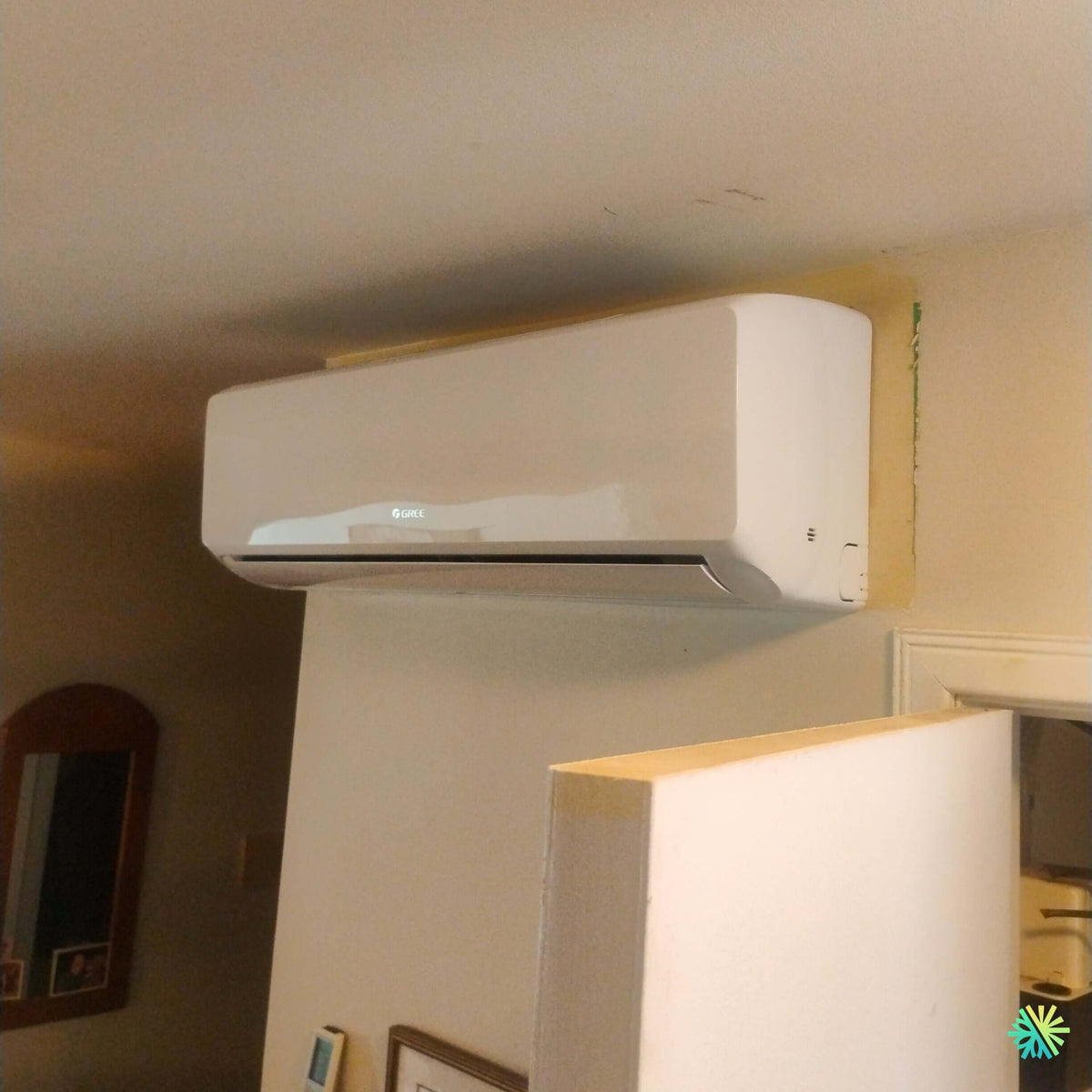
The photo of this installation clearly illustrates one of the challenges encountered on site: one of the wall-mounted units was installed in a confined space, close to the ceiling, a side wall, and an interior opening. This type of location requires careful analysis, as it is necessary to respect the clearances required for the unit's proper functioning, ensure effective air distribution, and provide sufficient access for future HVAC maintenance. The goal was not merely to install a device on the wall, but to integrate a complete system into an existing home without compromising aesthetics or performance.
Why the GREE FREE MATCH R32 Was a Relevant Choice for This Oka Installation
The GREE FREE MATCH R32 system is designed for multi-zone installations where several indoor units are connected to a single outdoor unit. In this project in Oka, this approach provided a complete solution with 5 wall-mounted units, while reducing outdoor clutter. For a homeowner, this means fewer visible outdoor units, better zone management, and more flexible daily use.
The choice of R32 refrigerant is also an important point. This refrigerant is increasingly used in modern heat pump and wall-mounted air conditioner systems, especially because it achieves good energy performance with an optimized refrigerant charge. For a residential installation in Oka, where winters can be harsh and summers humid, it was essential to recommend a system capable of providing a stable, quiet response tailored to the building's actual needs.
A 5-Zone Configuration Designed for Room-by-Room Comfort
In a house, not all rooms behave the same way. An upstairs bedroom can become too hot in summer, while a ground-floor space can remain cooler. A room facing full sun may require more air conditioning in the afternoon, while an office or guest room may only be used at certain times.
With a 5-zone heat pump, each wall-mounted unit can be controlled separately. This allows the client not to over-cool or overheat the entire house to correct discomfort in a single room. This flexibility is one of the greatest advantages of multi-zone systems, particularly in homes on the North Shore, in the Montreal region, in Laval, in Longueuil, and on the South Shore, where properties can have highly varied configurations.
In this project, the 5 wall-mounted units were positioned to cover the main areas of the house while respecting existing architectural constraints. The work required precise planning of piping routes, drains, penetrations, and passages to the outdoor unit.
A Wall Unit Installed in a Complex Space
One of the most interesting aspects of this installation is visible in the photo: a GREE wall unit installed very close to the ceiling and a return wall. This type of location is never chosen at random. Before installation, our technicians evaluate several elements:
- the available top clearance for air intake;
- the air diffusion angle towards the room;
- accessibility for filter cleaning;
- proximity to moldings, door frames, and structural elements;
- the possibility of concealing or neatly aligning the ducts;
- the perceived noise level in the occupied zone;
- the visual impact of the appliance in the space.
In this specific case, the available space required great rigor. It was necessary to avoid an installation that was too low, which could have hindered opening or circulation in the room, while not placing the unit too close to an obstacle that would have reduced air intake. The unit was installed in a way that maintained a clean look on the wall, with discreet integration into an area already structured by partitions and interior openings.
Technical Challenges of a Multi-Zone System in an Existing Home
A multi-zone HVAC installation always requires more planning than a simple wall-mounted installation. In a 5-head configuration, each indoor unit must be correctly connected to the outdoor unit by refrigerant lines, communication wiring, an appropriate power supply, and a functional drainage system.
In Oka, the main challenges involved coordinating routes without unnecessarily multiplying openings, preserving interior and exterior aesthetics, and ensuring an adequate drainage slope for each head. In an existing house, walls, ceilings, beams, partitions, and finishes often impose constraints not encountered in new construction.
Our technicians therefore worked with a progressive method: validation of locations, identification of possible passages, confirmation of clearances, protection of interior surfaces, installation of supports, routing of conduits, connections, pressure testing, vacuuming, drain verification, system startup, and explanation of operation to the client.
This attention to detail is essential. A poorly planned multi-zone installation can lead to drainage problems, uneven performance between rooms, vibrations, unnecessarily visible conduits, or difficulties accessing for maintenance. At AirGreen, we attach as much importance to these elements as to the choice of the machine itself.
The Importance of Wall Unit Positioning
In a 5-zone heat pump project, the positioning of the wall units directly influences comfort. It's not enough to simply install each unit in the desired room. It's necessary to determine where the air will be projected, how it will circulate, and whether the unit is likely to blow directly towards a bed, a sofa, a workstation, or a passageway.
In this installation in Oka, each head was designed according to the room's use. For bedrooms, sound comfort and the absence of direct drafts were priorities. For common areas, the priority was diffusion range and temperature stability. For more enclosed areas, the goal was to avoid significant differences between neighboring rooms.
This approach allows the GREE FREE MATCH R32 system to operate more efficiently. When indoor units are well-positioned, they reach the requested temperature faster and do not need to operate unnecessarily at high intensity. This helps improve comfort, limit energy consumption, and extend the system's lifespan.
A Solution Adapted to Homes in Oka and the North Shore
Oka presents a particular residential context: single-family homes, properties with extensions, sometimes multi-story rooms, open spaces leading to more partitioned sections, and comfort needs that vary greatly depending on orientation and insulation. In this type of environment, a multi-zone system often becomes more coherent than a single centralized unit or a single wall-mounted air conditioner.
The GREE FREE MATCH R32 is well-suited to this type of project because it offers great installation flexibility. Homeowners can control zones according to their lifestyle. For example, it is possible to cool bedrooms more in the evening, keep the living room comfortable during the day, and reduce usage in unoccupied rooms. This room-by-room management perfectly matches current customer expectations for comfort, efficiency, and control.
Mistakes to Avoid During a Multi-Zone Installation
A project with 5 wall-mounted units requires professional execution. Here are some common mistakes that we systematically avoid at AirGreen:
- choosing locations based solely on aesthetics, without considering air diffusion;
- neglecting drainage slopes;
- installing a unit too close to a ceiling, wall, or obstacle without validating clearances;
- underestimating the total length of refrigerant lines;
- poorly balancing zones according to the actual needs of each room;
- forgetting future access to filters and service panels;
- choosing a multi-zone system without checking the compatibility of indoor units;
- entrusting refrigerant connections to an unqualified person.
These errors can reduce system performance and create costly problems in the medium term. That's why an HVAC installation must be carried out by qualified technicians, with the necessary tools, procedures, and knowledge.
Commissioning and Final Checks
After installing the 5 wall units and the outdoor unit, our team performed comprehensive system checks. This step is essential to confirm that each zone is functioning correctly. We checked connections, communication between units, remote control response, drainage, supply air temperatures, noise level, and operational stability.
The client also received clear explanations on system usage: mode selection, temperature settings, zone management, filter cleaning, and good seasonal practices. A multi-zone system offers great flexibility, but it must be used correctly to deliver its full performance. For example, it is preferable not to set all zones to extremely different temperatures, especially when several rooms communicate with each other. Consistent use improves overall comfort and helps the system operate more stably.
Practical Tips for Getting the Most Out of a 5-Zone Heat Pump
For homeowners considering a 5-zone heat pump in Oka, Montreal, Laval, Longueuil, on the North Shore, or on the South Shore, some tips can make a big difference:
- have the house evaluated before choosing the number of heads;
- do not choose BTUs solely based on total area;
- consider room orientation and sun exposure;
- plan conduit routing before validating locations;
- ask for a clear explanation of filter maintenance;
- check available subsidy options at the time of the project;
- prioritize a clean and durable installation over a quick fix;
- plan periodic maintenance to maintain performance.
At AirGreen, we support clients in these decisions from the first visit. Our role is not only to install equipment, but to recommend a configuration that matches the house, the client's habits, and the building's technical constraints.
Subsidies and Energy Efficiency
Eligible heat pump systems, depending on current programs and the exact characteristics of the installed equipment, may provide access to certain financial aid, particularly under energy efficiency programs. For a system like the GREE FREE MATCH R32, it is important to validate exact eligibility according to the combination of installed units, model numbers, power, certifications, and applicable rules at the time of installation.
At AirGreen, we help our clients better understand the information needed for their applications: invoice, equipment details, proof of installation, and relevant technical data. Programs can change, which is why we always prefer to validate the criteria at the time of the project rather than giving a general answer that would not take into account the actual configuration.
An Installation Reflecting the AirGreen Approach
This project in Oka perfectly illustrates our way of working. A successful installation is not limited to simply installing wall-mounted units. It is based on a complete analysis of the house, a suitable equipment choice, precise execution, a clean finish, and rigorous commissioning.
The wall unit visible in the photo demonstrates the importance of on-site adaptation. Space was limited, clearances had to be respected, and integration had to remain clean. Our technicians were able to work with the room's constraints to provide a functional, discreet installation consistent with the existing layout.
It is this type of detail that distinguishes an ordinary installation from a professional one. In a multi-zone system, every head counts. Poor positioning in a single room can negatively impact the overall experience. Conversely, serious planning allows for balanced comfort throughout the house.
Why Choose AirGreen for a Multi-Zone GREE Installation
AirGreen regularly carries out installations of wall-mounted heat pumps, wall-mounted air conditioners, and multi-zone systems in the greater Montreal area, in Laval, in Longueuil, on the North Shore, and on the South Shore. Our field experience allows us to work in old houses, condos, renovated properties, extensions, and buildings where technical constraints require a customized approach.
For an installation like this in Oka, our value is seen in several aspects:
- a realistic assessment of each zone's needs;
- a suitable equipment recommendation;
- a clean and structured installation;
- a particular attention to visible details;
- rigorous management of refrigeration connections;
- clear usage instructions;
- accessible post-installation service;
- local expertise in residential HVAC.
The end result is a GREE FREE MATCH R32 5-zone system capable of improving home comfort while offering the client much more precise control over each space. For homeowners who want a complete, flexible, and well-integrated solution, this type of project represents an excellent option when the installation is entrusted to an experienced team.
Conclusion: A well-thought-out multi-zone system for lasting comfort in Oka
This installation of a GREE FREE MATCH R32 5-zone heat pump with 5 wall-mounted units in Oka demonstrates the importance of precise work, especially when integrating multiple indoor units into an existing home. Every decision, from the positioning of the units to the routing of the conduits, influences performance, aesthetics, comfort, and ease of maintenance.
At AirGreen, we approach every project with the same rigor. Whether the installation takes place in Oka, Montreal, Laval, Longueuil, on the North Shore or on the South Shore, our goal remains the same: to offer a reliable, clean, efficient, and building-appropriate HVAC solution.
The big day, step by step
The main steps of this kind of job at AirGreen. Every house has its quirks: the estimate brings them out.
We look at the room, the outside wall, the line route and where the outdoor unit will go. That is where the capacity gets chosen.
Model, capacity and price, in writing. We also check whether the model qualifies for assistance programs.
Floors and furniture protected, wall plate position marked level, wall opening located.
A single opening, with the slope the drain needs to flow outside.
Set on a stand raised above the snow, with the clearances the manufacturer requires.
Connected, insulated and protected. The opening is then sealed against water, cold air and insects.
A dedicated circuit and an accessible disconnect near the outdoor unit.
Leak test, vacuum, then start-up and a check of heating and cooling.
Remote, modes, filters: we show you the essentials before we leave.
- The on-site estimateWe look at the room, the outside wall, the line route and where the outdoor unit will go. That is where the capacity gets chosen.
- The quoteModel, capacity and price, in writing. We also check whether the model qualifies for assistance programs.
- Getting readyFloors and furniture protected, wall plate position marked level, wall opening located.
- The wall openingA single opening, with the slope the drain needs to flow outside.
- The outdoor unitSet on a stand raised above the snow, with the clearances the manufacturer requires.
- Lines, cable and drainConnected, insulated and protected. The opening is then sealed against water, cold air and insects.
- The electrical workA dedicated circuit and an accessible disconnect near the outdoor unit.
- Tests and start-upLeak test, vacuum, then start-up and a check of heating and cooling.
- The walkthroughRemote, modes, filters: we show you the essentials before we leave.
What would it look like at your place?
Two quick checks with real numbers: what heat costs, and what your current heaters add up to in BTU/h.
Conversion: 1 W = 3.412 BTU/h. An indication, not a load calculation: baseboards and furnaces are often stronger than the real need, and they can stay as backup. AirGreen confirms the capacity on site.
Four mistakes we do not make
Flip each card to see what we do instead.
Your own project, step by step
What to do, season by season
Three habits per season for this unit. They take a few minutes and prevent many calls.
- Clean the indoor unit's filters.
- Clear leaves and debris left on the outdoor unit by winter.
- Test cooling before the first hot days.
- Clean the filters more often when the unit runs a lot.
- Keep plants away from the outdoor unit.
- Check that no water drips from the indoor unit.
- Rake the leaves around the outdoor unit.
- Test heating before the first cold days.
- Book periodic maintenance before winter.
- Keep snow away from the stand and the front of the unit.
- Let the unit defrost: it is normal.
- Never hit the ice on the fins; call us if the unit stays iced up.
Is your home ready?
Check what applies at your place. A "no" is not a refusal: it is what we sort out during the estimate.
Four statements: true or false?
It all comes down to details you have just seen.
1. In heating mode, the outdoor unit can produce water.
During defrost cycles. That water must drain away without forming ice.
2. You pick the capacity with a simple square-footage rule.
Windows, insulation, orientation and how the room is used all count. Capacity is chosen on site.
3. A multi-zone connects several indoor heads to a single condenser.
One head per room, all on the same condenser. Each room keeps its own temperature.
4. The disconnect can sit behind the patio furniture.
It must stay accessible: it is what shuts the unit off for service.
0 / 4 right answers
What people ask us about this kind of work
Does a wall-mounted heat pump heat in winter?
Wall-mounted or multi-zone: how do I choose?
Where does the outdoor unit go?
Are there grants?
Do I need a permit?
How cold can it heat?
How much can I save?
How is the LogisVert assistance calculated?
Is it noisy?
The outdoor unit is covered in ice: is that normal?
Does AirGreen hold the required licences?
Is the estimate free?
No question matches. Write to us: we answer.
More jobs to see, near you
By town, by equipment or by region: browse more than 4,700 published projects.
Each dot: a town where AirGreen has published projects. The glowing dot: this job.
Every house has its constraints. We see them before we install.
The on-site estimate is free and the quote follows within 24 hours.
Text and photo: a real AirGreen Climatisation & Chauffage job. The diagrams are generic illustrations of the type of installation, not a survey of this job site. Sources of the added figures: airgreen.ca product pages (NEEP / AHRI performance), Hydro-Québec (Heat pumps page, LogisVert, read on 13 October 2026), Régie de l’énergie (rate D as of 1 April 2026).