
Installation of a Gree FreeMatch heat pump in Fabreville (Laval)
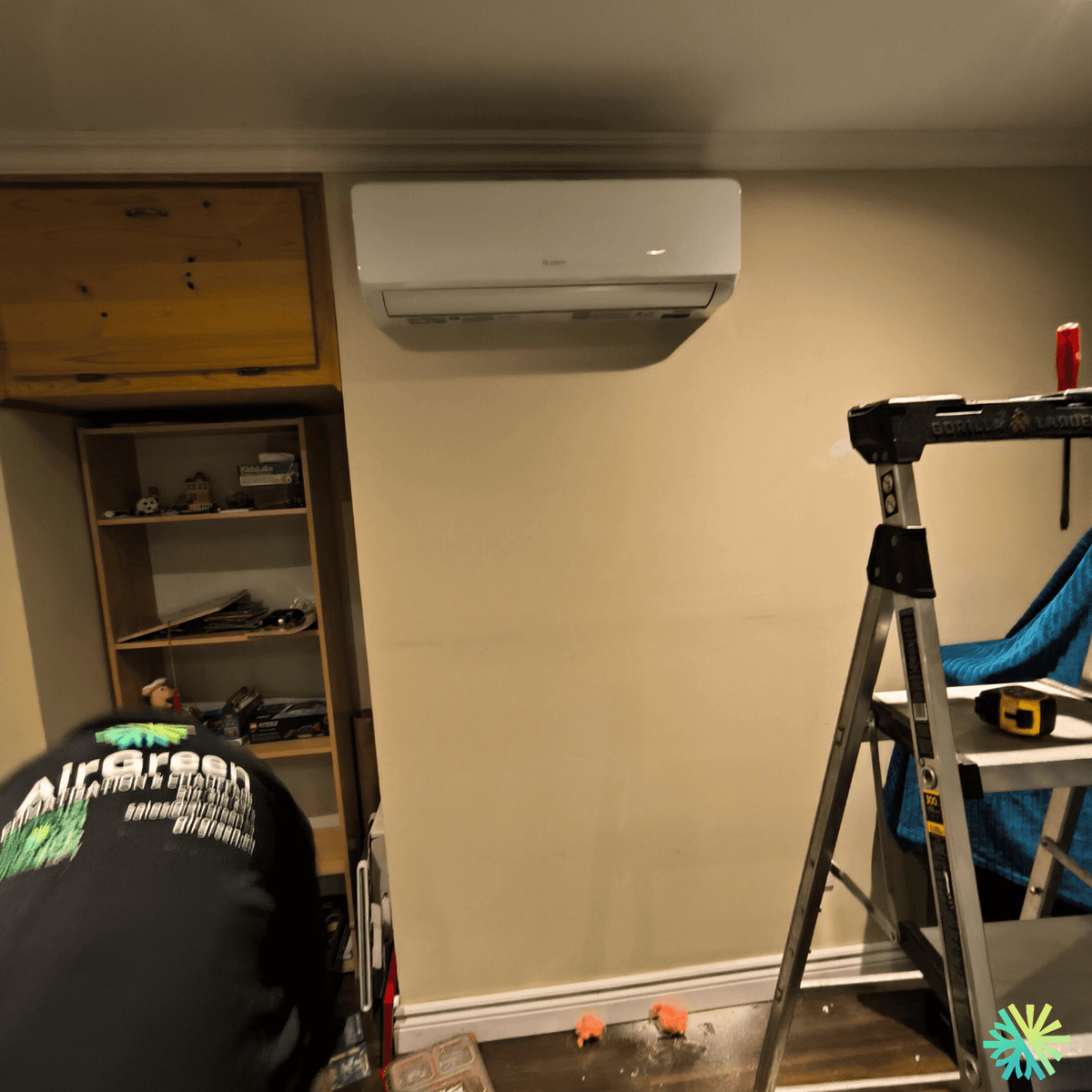
In Fabreville (Laval), AirGreen installed a Gree FreeMatch multi-zone heat pump to stabilize the temperature of a finished basement. Optimal positioning, clean finish, well-designed drainage, and complete commissioning: a comfortable solution, summer and winter.
- City
- Region
- Equipment
- Brand
- Challenges
- Published
The job on one screen
The article, chapter by chapter
When we think of residential comfort, we often picture the living room or bedrooms… but in reality, it's often the "secondary" rooms that present the most challenges: a finished basement, a playroom, a home office, a workshop, or a storage room that also serves as living space. In Fabreville (Laval), our AirGreen team installed a Gree FreeMatch multi-zone wall-mounted heat pump specifically to stabilize the temperature of a lower-level space and improve daily comfort—summer and winter.
The photo clearly shows the wall-mounted indoor unit installed high up, near the ceiling, with a typical approach to careful installation: adequate clearance, logical positioning for air distribution, and work in progress using a stepladder and protective measures. This type of setup is very common in Laval houses and cottages, where basements play a central role in family life.
Why a Gree FreeMatch in a basement in Laval?
A basement, even a well-finished one, does not have the same thermal behavior as a main floor:
-
humidity tends to be more prevalent (especially in summer);
-
the air is more "dense" and natural circulation is less efficient;
-
Temperature variations can be marked between day and night;
-
Some rooms remain too cool in winter, too heavy in summer.
The Gree FreeMatch is particularly interesting in these contexts because it is part of an evolving logic: you can start with one zone (like here, a wall unit) and, depending on the configuration of the building, plan the addition of other zones (e.g. bedroom upstairs, office, conservatory), while remaining in a clean and compact approach.
Type of system installed
In this project in Fabreville, it involves:
Multi-Zone Heat Pump (mini-split multi-zone) – Gree FreeMatch
with indoor wall head (indoor unit) installed in a basement room.
Model (consistent with the range)
The image does not allow for the reading of a precise nameplate. We therefore present the equipment realistically and faithfully to the product range:
-
Gree FreeMatch – residential multi-zone system (new generation)
-
Typical configuration: 1 to 2 zones (expandable depending on the house)
-
A capacity often chosen for this type of space is approximately 12,000 BTU (sized according to area, insulation and use).
At AirGreen, the final capacity is never chosen "at random": it is determined according to the air volumes, the level of insulation, the orientation, the actual use of the room and the way the house is currently heated.
Observable installation details and key technical points
Even if a photo doesn't show everything (outdoor unit, drilling, drainage, wiring), it reveals several important elements about how the installation was designed.
1) Positioning the wall unit
The unit is installed high on the wall , which is ideal for:
-
promote even air distribution;
-
avoid direct airflow at the level of the sofa or seating areas;
-
maintain good clearance under the device;
-
Optimize air mixing, particularly useful in a basement.
2) Indoor environmental management
We see a real living space: furniture, shelves, objects, circulation. In this type of room, our technicians primarily work on:
-
surface protection (floors, furniture, walls);
-
dust reduction during drilling;
-
the cleanliness at the end of the construction site (a detail that makes all the difference for the client).
3) Connection and finishing
On a clean wall-mounted installation, the refrigerant lines , communication cable, and condensate drain must be:
-
routed with a logical slope for drainage;
-
protected and securely fixed;
-
aesthetics (well-aligned gutters, discreet outlets).
In a basement with a lower ceiling, every centimeter counts: the layout must be designed to avoid obstacles, maintain a good appearance, and facilitate future maintenance.
4) Condensate drainage (a common issue in basements)
In air conditioning mode, a wall-mounted heat pump produces condensation. In the basement, the drainage strategy must be impeccable:
-
sufficient slope;
-
path without a counter-slope;
-
output or logic connection (depending on configuration).
This is a point we treat with great rigor, because a poorly designed drain can lead to problems with water, odors or persistent dampness.
5) Commissioning
A quality installation isn't just about "hanging a wall-mounted unit." Commissioning includes, among other things:
-
compliant vacuuming;
-
leak test;
-
verification of operating parameters;
-
validation of modes (heating, air conditioning, dehumidification);
-
simple usage instructions for the customer.
Winter comfort in Quebec: what FreeMatch actually delivers
In Laval, people want a system that doesn't panic as soon as the temperature drops. A well-chosen and properly installed heat pump offers:
-
stable heat for cooler rooms (such as basements);
-
a better overall balance of the home;
-
a reduction of the "cold floor" effect thanks to better controlled air temperature;
-
efficient air conditioning in summer, without excessive noise.
And above all: comfort becomes predictable . We no longer have to "compensate" by opening/closing doors, adding extra heaters, or living with an uncomfortable room half the year.
Why AirGreen for a Gree installation in Laval?
In areas like Fabreville, Sainte-Dorothée, Chomedey, and Duvernay, homes often share similar characteristics: finished basements, multi-purpose rooms, renovations over time, and finishing constraints. Our added value lies in providing a professional installation.
-
correctly sized (avoid oversizing and short cycles);
-
clean and aesthetic (because it's a living space, not a mechanical room);
-
designed for durability (drainage, fixing, access for maintenance);
-
adapted to the climate (consistent operation in heating and cooling).
We also take the time to explain the use: modes, realistic instructions, good practices to maintain high performance (cleaning the filters, clearance, seasonal adjustments).
Some simple tips to maximize performance and longevity
After installation, here's what actually helps:
-
Clean the filters regularly (especially if the space is used as a playroom or workshop).
-
Keep some clearance around the wall unit (avoid furniture too close).
-
In winter, aim for a stable setpoint rather than constantly going up/down.
-
In summer, use the dehumidification mode when the humidity in the basement is high.
Conclusion: a logical, clean, and scalable solution
This installation in Fabreville (Laval) perfectly illustrates a common scenario: a home where basement comfort makes all the difference. With a Gree FreeMatch multi-zone heat pump , you get an efficient, quiet, and adaptable solution—while tangibly improving quality of life, season after season.
At AirGreen, our approach is simple: a clean installation, solid technical logic, and a result that is immediately noticeable.
The job tools
Two quick checks with real numbers: what heat costs, and what your current heaters add up to in BTU/h.
Conversion: 1 W = 3.412 BTU/h. An indication, not a load calculation: baseboards and furnaces are often stronger than the real need, and they can stay as backup. AirGreen confirms the capacity on site.
How the job unfolds
The main steps of this kind of job at AirGreen. Every house has its quirks: the estimate brings them out.
We look at the room, the outside wall, the line route and where the outdoor unit will go. That is where the capacity gets chosen.
Model, capacity and price, in writing. We also check whether the model qualifies for assistance programs.
Floors and furniture protected, wall plate position marked level, wall opening located.
A single opening, with the slope the drain needs to flow outside.
Set on a stand raised above the snow, with the clearances the manufacturer requires.
Connected, insulated and protected. The opening is then sealed against water, cold air and insects.
A dedicated circuit and an accessible disconnect near the outdoor unit.
Leak test, vacuum, then start-up and a check of heating and cooling.
Remote, modes, filters: we show you the essentials before we leave.
- The on-site estimateWe look at the room, the outside wall, the line route and where the outdoor unit will go. That is where the capacity gets chosen.
- The quoteModel, capacity and price, in writing. We also check whether the model qualifies for assistance programs.
- Getting readyFloors and furniture protected, wall plate position marked level, wall opening located.
- The wall openingA single opening, with the slope the drain needs to flow outside.
- The outdoor unitSet on a stand raised above the snow, with the clearances the manufacturer requires.
- Lines, cable and drainConnected, insulated and protected. The opening is then sealed against water, cold air and insects.
- The electrical workA dedicated circuit and an accessible disconnect near the outdoor unit.
- Tests and start-upLeak test, vacuum, then start-up and a check of heating and cooling.
- The walkthroughRemote, modes, filters: we show you the essentials before we leave.
What we check on a job like this one
Each number is a point we check on site. Switch between summer and winter to watch air and heat move.
In summer, the outdoor unit rejects the house's heat outside.
Generic illustration of this type of installation, not a survey of this job site. Tap a number.
Mounted level on a wall plate, high enough for the air to reach the whole room, with enough space around it to slide the filters out easily.
The refrigerant lines, the communication cable and the drain go through the wall in a single opening, sealed against water, cold air and insects.
Two insulated copper pipes connect the two units. Outside, a line cover can protect them from sun, knocks and weather.
A shut-off switch near the outdoor unit isolates it safely for service. It must stay accessible at all times.
The compressor and the fan. In heating mode it captures heat from the outdoor air, even in winter, and moves it inside.
On the ground or on the wall, it keeps the unit above accumulated snow. The unit stays clear and defrost water can drain away.
The fan needs to blow freely. Storage, a fence or a wall too close, and efficiency drops while noise goes up.
Is your home ready?
Check what applies at your place. A "no" is not a refusal: it is what we sort out during the estimate.
Good habits, once the unit is in place
Six simple habits that keep the unit going. Your list stays on this device.
What to do, season by season
Three habits per season for this unit. They take a few minutes and prevent many calls.
- Clean the indoor unit's filters.
- Clear leaves and debris left on the outdoor unit by winter.
- Test cooling before the first hot days.
- Clean the filters more often when the unit runs a lot.
- Keep plants away from the outdoor unit.
- Check that no water drips from the indoor unit.
- Rake the leaves around the outdoor unit.
- Test heating before the first cold days.
- Book periodic maintenance before winter.
- Keep snow away from the stand and the front of the unit.
- Let the unit defrost: it is normal.
- Never hit the ice on the fins; call us if the unit stays iced up.
The right pages, at the right time
Four statements: true or false?
It all comes down to details you have just seen.
1. In heating mode, the outdoor unit can produce water.
During defrost cycles. That water must drain away without forming ice.
2. You pick the capacity with a simple square-footage rule.
Windows, insulation, orientation and how the room is used all count. Capacity is chosen on site.
3. A multi-zone connects several indoor heads to a single condenser.
One head per room, all on the same condenser. Each room keeps its own temperature.
4. The disconnect can sit behind the patio furniture.
It must stay accessible: it is what shuts the unit off for service.
0 / 4 right answers
What people ask us about this kind of work
Does a wall-mounted heat pump heat in winter?
Wall-mounted or multi-zone: how do I choose?
Where does the outdoor unit go?
Are there grants?
Do I need a permit?
How cold can it heat?
How much can I save?
How is the LogisVert assistance calculated?
Is it noisy?
The outdoor unit is covered in ice: is that normal?
Does AirGreen hold the required licences?
Is the estimate free?
No question matches. Write to us: we answer.
More jobs to see, near you
By town, by equipment or by region: browse more than 4,700 published projects.
Each dot: a town where AirGreen has published projects. The glowing dot: this job.
An on-site estimate, the right capacity, the right equipment.
The on-site estimate is free and the quote follows within 24 hours.
Text and photo: a real AirGreen Climatisation & Chauffage job. The diagrams are generic illustrations of the type of installation, not a survey of this job site. Sources of the added figures: airgreen.ca product pages (NEEP / AHRI performance), Hydro-Québec (Heat pumps page, LogisVert, read on 13 October 2026), Régie de l’énergie (rate D as of 1 April 2026).