
Installation of a Fujitsu wall-mounted heat pump in Plateau-Mont-Royal (Montreal)
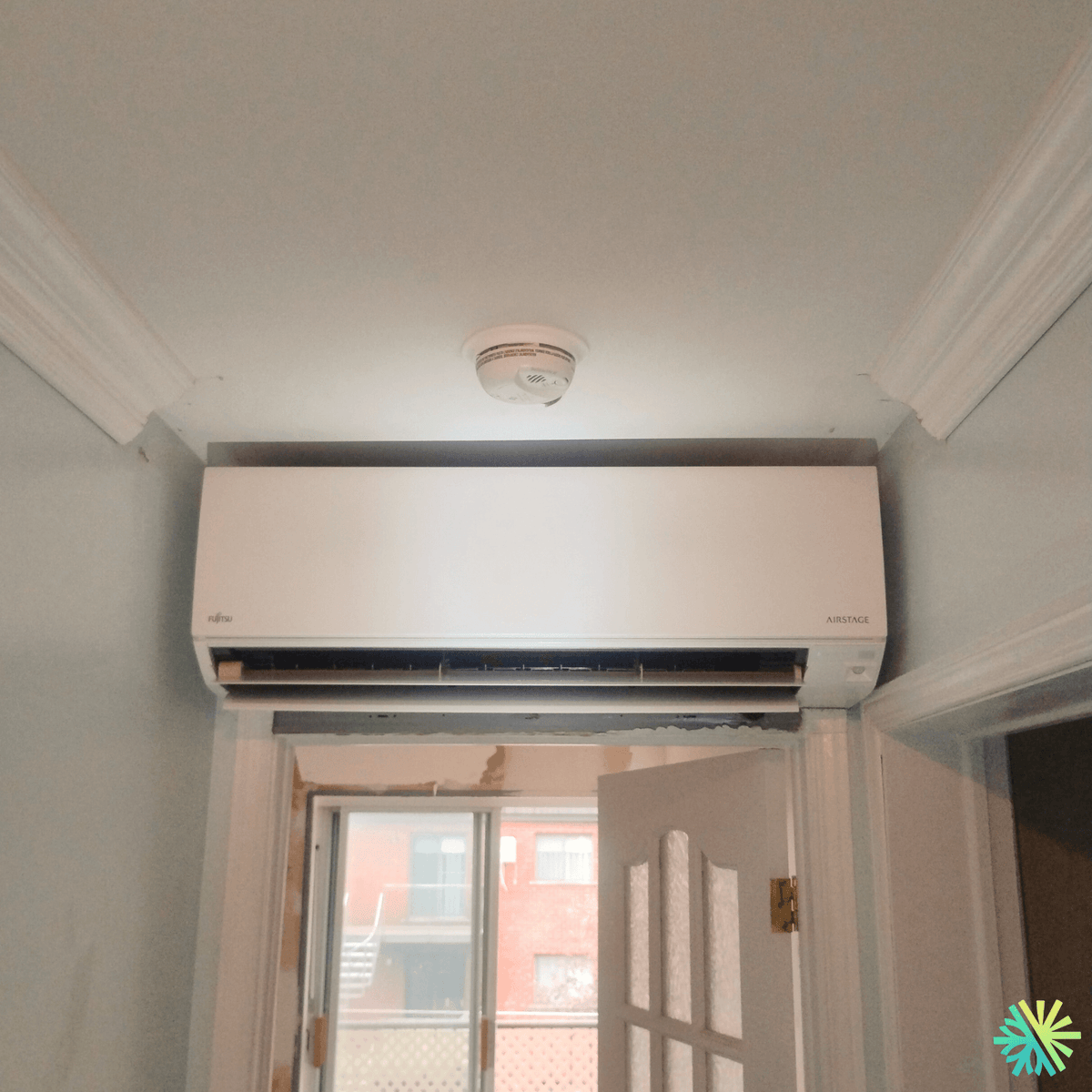
In a multi-unit building in the Plateau-Mont-Royal neighbourhood, AirGreen installed a Fujitsu wall-mounted heat pump (AIRSTAGE) above a patio door. A smart choice to save space, improve air distribution and ensure consistent comfort year-round.
In summer, the outdoor unit rejects the house's heat outside.
Generic illustration of this type of installation, not a survey of this job site. Tap a number.
Mounted level on a wall plate, high enough for the air to reach the whole room, with enough space around it to slide the filters out easily.
The refrigerant lines, the communication cable and the drain go through the wall in a single opening, sealed against water, cold air and insects.
Two insulated copper pipes connect the two units. Outside, a line cover can protect them from sun, knocks and weather.
A shut-off switch near the outdoor unit isolates it safely for service. It must stay accessible at all times.
The compressor and the fan. In heating mode it captures heat from the outdoor air, even in winter, and moves it inside.
On the ground or on the wall, it keeps the unit above accumulated snow. The unit stays clear and defrost water can drain away.
The fan needs to blow freely. Storage, a fence or a wall too close, and efficiency drops while noise goes up.
In many typical Plateau apartments—with their relatively high ceilings, ceiling moldings, sometimes uneven walls, and patio doors opening onto a backyard—the placement of a wall-mounted heat pump must be carefully chosen. The photo clearly shows a wall-mounted indoor unit installed above a patio door , a very common scenario in Montreal duplexes where every square foot counts.
At AirGreen , we love this type of project: it requires a real attention to detail (clearances, direction of airflow, condensate drainage, aesthetics), while offering an immediate result: comfort in summer and winter , without sacrificing living space.
The installed system: a Fujitsu wall-mounted heat pump (AIRSTAGE range)
The brand is specified: Fujitsu . The unit shown is a wall-mounted unit from the Fujitsu AIRSTAGE family, used in residential settings for air conditioning and heating. When the exact model is not visible in a photo, we remain consistent with the product range: in this case, we are referring to a new-generation Fujitsu wall-mounted heat pump , frequently chosen in urban settings like the Plateau district for its reliability, comfort, and stable temperature control.
This type of device is particularly appreciated for:
-
Silence during operation (important in bedrooms, home offices, open living rooms).
-
Modulation (the device adjusts its power as needed instead of aggressively switching on and off).
-
Comfort in mid-season (spring/autumn) where a heat pump is often the most efficient option.
Why installing above the patio door is a good decision (when done correctly)
At first glance, some landlords hesitate to place a unit above a window. Yet, in many apartments in the Plateau-Mont-Royal, it's the most logical location, for three reasons:
-
Optimizing wall space
Between the windows, the bookshelves, the furniture, and sometimes the interior brick walls, there are few "clean" spaces left. Above a patio door, one can reclaim a space that is often unused. -
Efficient air distribution
The blown air spreads well in a main room (living room/dining room) and can reach adjacent areas if the doors and air circulation are favorable. -
Managing pipe passage constraints
The routing of refrigerant lines and condensate drain is often simpler (and more discreet) using a side or top passage, depending on the wall structure and exterior access.
Obviously, this positioning requires rigorous installation: ceiling clearance, access for maintenance, drainage slope, and orientation of the shutter to avoid blowing directly on the occupants.
Visible salient installation details (and what this implies on the construction site)
Several elements in the photo provide information about the actual context of the installation:
-
Unit installed very close to the ceiling , with decorative moldings:
We must respect the recommended clearances for the device to function properly (air intake, filter access, internal circulation). In a Montreal apartment, the height is often adjusted to the millimeter to balance performance and aesthetics. -
Installation above a patio door :
This requires attention to airflow: the orientation of the fins is adjusted to avoid a direct airflow towards the passage area, while maximizing the range. -
Urban “plex” environment (brick visible on the exterior):
In this context, the wall penetration and the finishing (pipe covers, sealing, protection against leaks) are essential. Poor sealing around the penetration is often where problems with cold air, humidity, or minor leak noises begin. -
Finishing work around the opening :
It's clear the wall above the door has been prepared/touched up. That's normal: a clean installation also means seamless integration with the decor. At AirGreen, we insist that the final result be "visually clean," not just functional.
Typical steps we follow for this type of installation (Plateau, Rosemont, Ville-Marie)
Without burdening the reader with a technical lesson, here's what makes the difference between a "correct" installation and an AirGreen installation:
1) Location validation (comfort + maintenance)
We are checking:
-
Clearances (top, sides, front).
-
Accessibility for filter cleaning and seasonal maintenance.
-
Ideal direction of airflow depending on the room.
2) Connection passage and drain management
Two critical points:
-
Refrigerant lines : the shortest possible route, clean, protected, with careful finishing.
-
The condensate drain : continuous slope, secure drainage, prevention of backflow and odors.
3) Serious commissioning
A heat pump performs best when:
-
The vacuuming process is well done.
-
The connections are checked,
-
The operating parameters have been validated.
-
And the user receives simple instructions (heating mode, air conditioning mode, maintenance).
Comfort in summer and winter: why Fujitsu is often a winning choice in Montreal
In Greater Montreal, people don't choose a heat pump just to "have air conditioning." They choose it to get through:
-
The heavy, humid days of July,
-
The cool nights of September,
-
Cold spells where supplementary heating may become necessary depending on the model and insulation.
A properly installed Fujitsu wall-mounted heat pump typically offers:
-
A stable temperature (fewer variations).
-
Gentle operation (fewer cycles).
-
A very pleasant feeling of comfort in the living areas.
Instructions for use (simple, but essential)
To ensure consistent performance in a home like this:
-
Clean the filters regularly (every 4 to 6 weeks during periods of intensive use).
-
When heating, avoid sudden temperature fluctuations (e.g., 18 → 25 → 19). A heat pump prefers stability.
-
When air conditioning, aim for a realistic setpoint (often 23–25 °C ): more comfortable, more economical, and less risk of excessive condensation.
-
Do not obstruct the airflow (thick curtains, tall furniture directly underneath, etc.).
What this installation actually brings to everyday life
In an urban apartment in Plateau-Mont-Royal, this type of installation is life-changing:
-
A comfortable main room , even during heat waves.
-
Less humidity , therefore a lighter feeling and better sleep.
-
An effective supplementary heating source in the mid-season (and often longer), reducing dependence on other heating sources.
And above all: a system that integrates without invading space, thanks to a strategic location above the patio door.
AirGreen: a clean, local approach designed for Montreal plexes
Montreal is not a “standard market”. Between old walls, structural peculiarities, backyard exits and aesthetic requirements, a residential HVAC installation must be done by a team that truly knows the terrain.
At AirGreen , we install Fujitsu wall-mounted heat pumps throughout Montreal — Plateau-Mont-Royal, Rosemont, Villeray, Ahuntsic, Southwest — as well as in Laval and on the South Shore and North Shore. Our goal is always the same: a high-performing, durable, and clean result , both technically and visually.
How it goes, from the first call to the end
The main steps of this kind of job at AirGreen. Every house has its quirks: the estimate brings them out.
We look at the room, the outside wall, the line route and where the outdoor unit will go. That is where the capacity gets chosen.
Model, capacity and price, in writing. We also check whether the model qualifies for assistance programs.
Floors and furniture protected, wall plate position marked level, wall opening located.
A single opening, with the slope the drain needs to flow outside.
Set on a stand raised above the snow, with the clearances the manufacturer requires.
Connected, insulated and protected. The opening is then sealed against water, cold air and insects.
A dedicated circuit and an accessible disconnect near the outdoor unit.
Leak test, vacuum, then start-up and a check of heating and cooling.
Remote, modes, filters: we show you the essentials before we leave.
- The on-site estimateWe look at the room, the outside wall, the line route and where the outdoor unit will go. That is where the capacity gets chosen.
- The quoteModel, capacity and price, in writing. We also check whether the model qualifies for assistance programs.
- Getting readyFloors and furniture protected, wall plate position marked level, wall opening located.
- The wall openingA single opening, with the slope the drain needs to flow outside.
- The outdoor unitSet on a stand raised above the snow, with the clearances the manufacturer requires.
- Lines, cable and drainConnected, insulated and protected. The opening is then sealed against water, cold air and insects.
- The electrical workA dedicated circuit and an accessible disconnect near the outdoor unit.
- Tests and start-upLeak test, vacuum, then start-up and a check of heating and cooling.
- The walkthroughRemote, modes, filters: we show you the essentials before we leave.
And at your place?
Two quick checks with real numbers: what heat costs, and what your current heaters add up to in BTU/h.
Conversion: 1 W = 3.412 BTU/h. An indication, not a load calculation: baseboards and furnaces are often stronger than the real need, and they can stay as backup. AirGreen confirms the capacity on site.
What to do, season by season
Three habits per season for this unit. They take a few minutes and prevent many calls.
- Clean the indoor unit's filters.
- Clear leaves and debris left on the outdoor unit by winter.
- Test cooling before the first hot days.
- Clean the filters more often when the unit runs a lot.
- Keep plants away from the outdoor unit.
- Check that no water drips from the indoor unit.
- Rake the leaves around the outdoor unit.
- Test heating before the first cold days.
- Book periodic maintenance before winter.
- Keep snow away from the stand and the front of the unit.
- Let the unit defrost: it is normal.
- Never hit the ice on the fins; call us if the unit stays iced up.
Which type of equipment for your project?
Pick what looks like your need.
Four mistakes we do not make
Flip each card to see what we do instead.
What people ask us about this kind of work
Does a wall-mounted heat pump heat in winter?
Wall-mounted or multi-zone: how do I choose?
Where does the outdoor unit go?
Are there grants?
Do I need a permit?
How cold can it heat?
How much can I save?
How is the LogisVert assistance calculated?
Is it noisy?
The outdoor unit is covered in ice: is that normal?
Does AirGreen hold the required licences?
Is the estimate free?
No question matches. Write to us: we answer.
Useful pages for what comes next
More jobs to see, near you
By town, by equipment or by region: browse more than 4,700 published projects.
Each dot: a town where AirGreen has published projects. The glowing dot: this job.
Tell us about your house. We come and see it for free.
The on-site estimate is free and the quote follows within 24 hours.
Text and photo: a real AirGreen Climatisation & Chauffage job. The diagrams are generic illustrations of the type of installation, not a survey of this job site. Sources of the added figures: airgreen.ca product pages (NEEP / AHRI performance), Hydro-Québec (Heat pumps page, LogisVert, read on 13 October 2026), Régie de l’énergie (rate D as of 1 April 2026).