
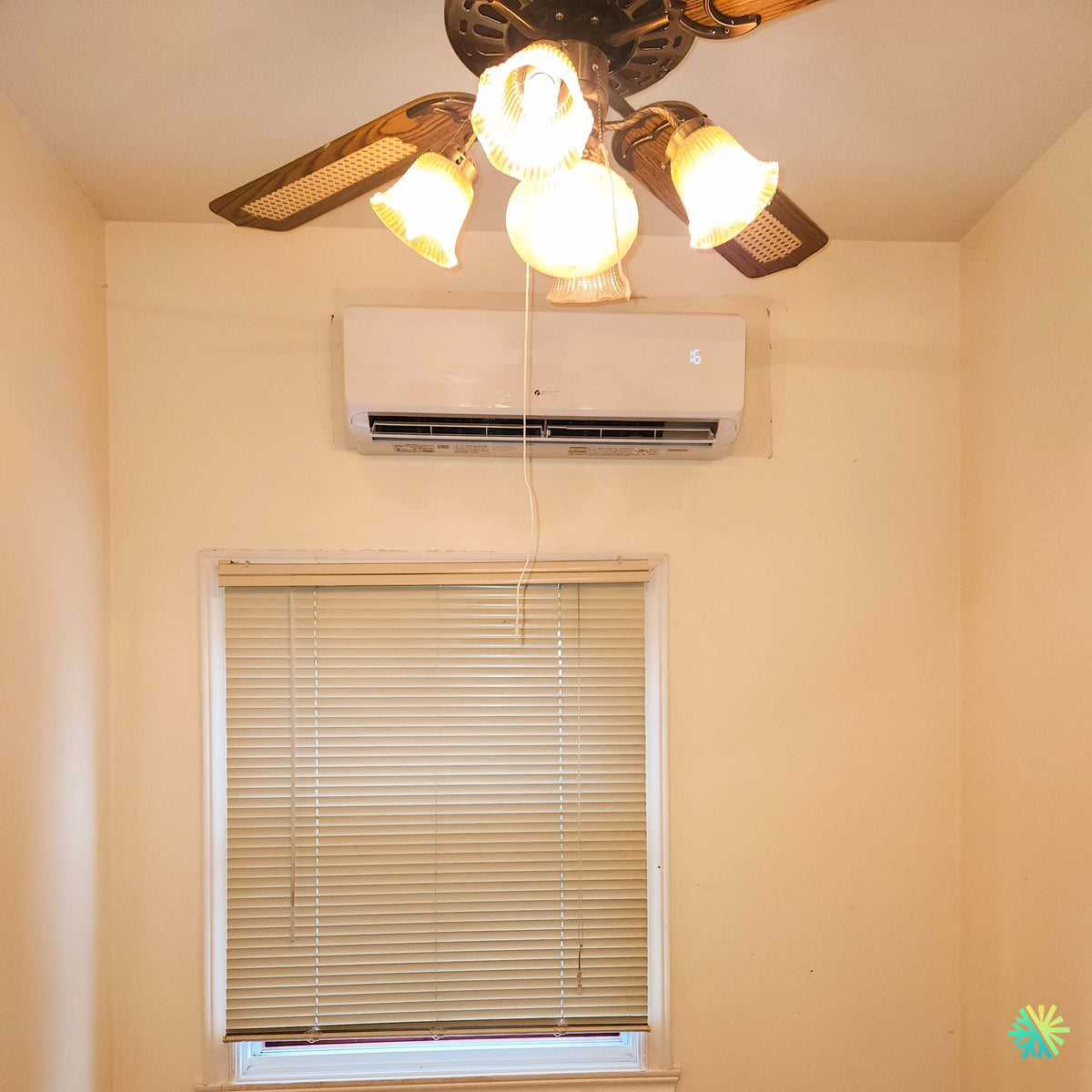
Installation of a GREE LIVO R32 Mini Split Wall-Mounted Heat Pump in Longueuil, above a residential window
AirGreen installs a GREE LIVO R32 wall-mounted heat pump in Longueuil: mini split above a window, ideal for air conditioning, supplementary heating, and sustainable residential comfort.
In summer, the outdoor unit rejects the house's heat outside.
Generic illustration of this type of installation, not a survey of this job site. Tap a number.
Mounted level on a wall plate, high enough for the air to reach the whole room, with enough space around it to slide the filters out easily.
The refrigerant lines, the communication cable and the drain go through the wall in a single opening, sealed against water, cold air and insects.
Two insulated copper pipes connect the two units. Outside, a line cover can protect them from sun, knocks and weather.
A shut-off switch near the outdoor unit isolates it safely for service. It must stay accessible at all times.
The compressor and the fan. In heating mode it captures heat from the outdoor air, even in winter, and moves it inside.
On the ground or on the wall, it keeps the unit above accumulated snow. The unit stays clear and defrost water can drain away.
The fan needs to blow freely. Storage, a fence or a wall too close, and efficiency drops while noise goes up.
A GREE LIVO R32 installation in Longueuil designed for a room with a window, blinds, and ceiling fan
In Longueuil, our AirGreen team installed a wall-mounted heat pump GREE LIVO R32, a mini split system designed to provide efficient cooling, comfortable supplementary heating, and easy daily use. This installation stands out for a particularly interesting location: the indoor unit was installed above a window equipped with blinds, in a room where a ceiling fan already occupies the central space.
This type of setup requires real thought before starting the work. A wall-mounted heat pump installed above a window must meet several criteria: clearance near the ceiling, air distribution into the room, access for filter cleaning, drainage management, passage of refrigerant lines, and visual integration into a wall already framed by an opening. In the photo, the GREE unit is well centered above the window, with the shutters open and the digital display visible on the right side of the front. The device is operating, confirming commissioning after installation.
In this room, the ceiling fan was an important element to consider. Even though this type of device helps circulate the air, it does not replace a heat pump or a wall air conditioner. Its role is different: it moves the existing air, while the mini split system actually controls the room temperature. The challenge was therefore to create a harmonious combination between the two devices, without the heat pump’s airflow being misdirected or disturbed by the fan.
At AirGreen, we approach every HVAC installation as a custom project. The same heat pump can deliver very different results depending on where it is installed, how it is connected, the quality of the commissioning, and the advice given to the client after the work.
Why the GREE LIVO R32 was well suited for this residential project in Longueuil
The GREE LIVO R32 is a relevant choice for homeowners who want to improve the comfort of a room without installing ducts. Its wall-mounted format frees up floor space, while the mini-split technology offers a quick response to air conditioning and heating needs.
In this project in Longueuil, the client wanted a solution capable of better controlling the temperature of a room with a window. Rooms exposed to the sun or located in areas where heat accumulates can become uncomfortable during summer, even with a ceiling fan. Adding a wall-mounted heat pump directly addresses this problem while providing a supplementary heating source during cooler periods.
The LIVO R32 range uses the refrigerant R32, an important feature in recent wall systems. This refrigerant is valued in the HVAC industry for its thermal efficiency and integration into modern equipment. For the customer, the advantage translates into a device designed to maintain a more stable temperature, with inverter technology that adjusts operation according to actual demand.
The BTU capacity must always be validated according to the area, ceiling height, insulation, window exposure, room layout, and usage habits. In a room like this, where the unit is installed above a window, sizing should never be done randomly. Too low a capacity could leave the room uncomfortable during intense heat days, while too high a capacity could cause short cycles and less effective humidity control. For this installation, the device was selected based on the actual needs of the room and confirmed in the project's technical quote.
Installation above the window: a practical but demanding solution
Installing a wall-mounted heat pump above a window can be an excellent solution when other walls are less suitable. This approach allows you to keep the side walls available for furniture, storage, or traffic flow. It can also promote a more natural air distribution toward the center of the room.
However, this option requires a lot of precision. You must take into account:
- the available space between the top of the window and the ceiling;
- the strength of the wall to secure the mounting plate;
- the visual alignment with the existing opening;
- the slope required for drainage;
- access to filters for HVAC maintenance;
- the direction of the airflow to avoid discomfort;
- the presence of the ceiling fan and its effect on air circulation.
In this installation, the indoor unit is positioned in a wall niche that clearly frames the area above the window. The space was limited but usable. Our team had to ensure the device was properly leveled, securely fixed, and sufficiently clear to operate correctly. Alignment was particularly important because a unit placed above a window immediately becomes visible in the room. The slightest misalignment can give an impression of poor finishing.
Coordination with the ceiling fan
The ceiling fan visible in the photo is an element we considered when analyzing the location. A fan can help distribute the air treated by the heat pump, but it can also create a draft sensation if the settings are poorly combined.
To achieve good comfort, it is preferable to use the ceiling fan at a moderate speed when the GREE LIVO R32 heat pump is running. In cooling mode, the fan can help distribute cool air in the room. In heating mode, it can help bring down warm air that tends to accumulate near the ceiling. However, it is important to avoid directing the heat pump's airflow directly at occupants or the blinds.
This coordination between equipment is a concrete example of what distinguishes a well-thought-out installation. Comfort does not depend solely on the chosen model. It also depends on how air circulates in the room, the obstacles present, and the client's usage habits.
Blinds, window, and solar heat: a trio to manage smartly
The window located under the unit affects the comfort of the room. Windows can let in heat during summer, cause heat loss in winter, and change the perceived temperature near the wall. The blinds in this room therefore play a useful role, especially on very sunny days.
With a wall-mounted heat pump installed above the window, it is important to avoid blinds, cords, or moldings interfering with the unit's operation. In this setup, the device is placed high enough not to interfere with opening the window or the normal use of the blinds. The heat pump's louvers can direct air into the room, which helps prevent a concentration of cold or hot air directly on the glass area.
For the client, this positioning offers a practical advantage: the heat pump treats the air from a high point without taking up useful space. This solution is well suited for bedrooms, offices, small family rooms, and multifunctional spaces where available wall space is sometimes limited.
What this installation in Longueuil shows about the importance of precise HVAC work
A successful HVAC installation relies on technical actions invisible once the job is done. The photo mainly shows the indoor unit, but the final performance also depends on drilling, duct routing, refrigerant connections, vacuuming, drainage, and a complete system check.
The technical steps behind a clean installation
Before securing the indoor unit, our team verified the exact location, available height, alignment with the window, and external constraints. Once the mounting plate was positioned, the unit had to be perfectly level. This step is essential for appearance but also for drainage.
The condensation drain must allow water to evacuate properly when the unit is running in cooling mode. A poor slope can cause leaks, odors, or water accumulation inside the unit. In an installation above a window, this management is even more important because any leak would be immediately visible and could damage the finishes around the opening.
The refrigerant lines must also be handled with care. An imprecise cut, poorly flared ends, or incorrect tightening can harm the system's performance. After connections, vacuuming and testing are essential to ensure reliable operation. A high-quality heat pump will never deliver its full performance if these steps are neglected.
Mistakes to avoid for a wall-mounted heat pump above a window
Several owners from Montreal, Laval, Longueuil, the North Shore, and the South Shore contact us after experiencing problems with installations done too quickly. When a unit is installed above a window, certain errors often recur:
- device placed too close to the ceiling, reducing air return;
- unit poorly centered, resulting in an unbalanced visual appearance;
- drain without proper slope;
- airflow directed towards the blinds or too directly towards the occupants;
- difficult access to filters;
- BTU capacity chosen without serious calculation;
- lack of explanation on seasonal settings;
- poorly protected outdoor connections.
In this project in Longueuil, our team avoided these problems by planning the installation precisely. The result is clean, stable, and suited to the room. The unit is visible but well integrated, and its location allows effective air distribution.
Usage tips after installation
To get the best performance from the GREE LIVO R32, the customer must adopt a few simple habits. Filters should be cleaned regularly, especially if the room is frequently used, windows are open, or dust accumulates quickly. Dirty filters reduce airflow, increase consumption, and can make the device less comfortable.
It is also advisable to maintain a stable temperature. Inverter systems are designed to operate in a modulated way. They generally offer better comfort when the user avoids large setting changes. In cooling, a reasonable temperature helps better control humidity and reduce sudden startups. In heating, a constant setting helps maintain more even warmth.
The ceiling fan can be used with the heat pump, but in moderation. Too high a speed can create unnecessary discomfort. A gentle speed can, on the contrary, improve air distribution, especially in a room where the unit is installed high up.
HVAC maintenance and system durability
HVAC maintenance is essential to preserve the performance of a wall-mounted heat pump. For a unit installed above a window, it is important to ensure that access to the front panel remains convenient. Filters must be removable without difficulty, and the unit must remain accessible for periodic inspections.
Complete maintenance may include:
- cleaning the filters;
- inspection of the indoor heat exchanger;
- checking the drain;
- inspection of the outdoor unit;
- checking the operation in cooling and heating modes;
- the assessment of noise, airflow, and blowing temperature.
In Longueuil, as elsewhere in the greater Montreal area, outdoor units are exposed to snow, frost, pollen, leaves, and significant temperature variations. Regular maintenance helps reduce the risk of breakdowns and extend the equipment's lifespan.
Subsidies and eligibility: a check to include in the project
Subsidy programs for heat pumps can vary depending on current criteria, eligible models, and combinations of indoor and outdoor units. For a GREE LIVO R32, eligibility must be confirmed with the exact information of the installed system, including the model number, BTU capacity, and performance data.
At AirGreen, we help clients understand the documents to keep: detailed invoice, proof of payment, technical information, and data needed for a possible claim. This step can have a significant impact on the net cost of the project, especially for owners comparing several options for a wall air conditioner or a wall-mounted heat pump.
An installation that reflects AirGreen’s approach in Longueuil
This project in Longueuil clearly shows our approach: choose a logical location, respect the room’s constraints, install the equipment with rigor, and deliver a system ready to use. The GREE LIVO R32 unit is installed above the window, in an area where it remains accessible, clearly visible, and functional. The ceiling fan, blinds, and wall configuration were taken into account to achieve real comfort, not just a technically compliant installation.
AirGreen regularly installs wall-mounted heat pumps, wall air conditioners, and mini split systems in Longueuil, Montreal, Laval, on the North Shore and the South Shore. Each project brings its challenges: narrow walls, windows, low ceilings, condominiums, existing furniture, aesthetic requirements, or complex outdoor routes. Our job is to turn these constraints into lasting solutions.
This installation of a GREE LIVO R32 wall-mounted heat pump in Longueuil perfectly illustrates the importance of an experienced HVAC contractor. The comfort of a mini split system depends as much on the quality of the device as on the precision of the installation. In this case, the final result offers a compact, efficient, and well-integrated solution to improve the daily comfort of the room.
How it goes, from the first call to the end
The main steps of this kind of job at AirGreen. Every house has its quirks: the estimate brings them out.
We look at the room, the outside wall, the line route and where the outdoor unit will go. That is where the capacity gets chosen.
Model, capacity and price, in writing. We also check whether the model qualifies for assistance programs.
Floors and furniture protected, wall plate position marked level, wall opening located.
A single opening, with the slope the drain needs to flow outside.
Set on a stand raised above the snow, with the clearances the manufacturer requires.
Connected, insulated and protected. The opening is then sealed against water, cold air and insects.
A dedicated circuit and an accessible disconnect near the outdoor unit.
Leak test, vacuum, then start-up and a check of heating and cooling.
Remote, modes, filters: we show you the essentials before we leave.
- The on-site estimateWe look at the room, the outside wall, the line route and where the outdoor unit will go. That is where the capacity gets chosen.
- The quoteModel, capacity and price, in writing. We also check whether the model qualifies for assistance programs.
- Getting readyFloors and furniture protected, wall plate position marked level, wall opening located.
- The wall openingA single opening, with the slope the drain needs to flow outside.
- The outdoor unitSet on a stand raised above the snow, with the clearances the manufacturer requires.
- Lines, cable and drainConnected, insulated and protected. The opening is then sealed against water, cold air and insects.
- The electrical workA dedicated circuit and an accessible disconnect near the outdoor unit.
- Tests and start-upLeak test, vacuum, then start-up and a check of heating and cooling.
- The walkthroughRemote, modes, filters: we show you the essentials before we leave.
What the unit delivers when it is cold
The range as published on airgreen.ca: pick a size to see its capacity in deep cold.
| Size | Heating at −8 °C | Heating at −15 °C | Coldest certified point | COP at −15 °C | SEER | HSPF | Indicative LogisVert aid |
|---|---|---|---|---|---|---|---|
| Gree Livo R32 9 000 (115 V) | 10,000 | 7,600 | −25 °C: 5,700 | 1.86 | 20.5 | 8.8 | – |
| Gree Livo R32 9 000 | 9,600 | 7,600 | −25 °C: 5,500 | 1.94 | 20.5 | 8.8 | – |
| Gree Livo R32 12 000 (115 V) | 9,700 | 8,500 | −25 °C: 6,500 | 1.75 | 19.0 | 8.5 | – |
| Gree Livo R32 12 000 | 9,700 | 9,100 | −25 °C: 6,500 | 1.8 | 19.0 | 8.5 | $1,164 |
| Gree Livo R32 18 000 | 15,300 | 12,100 | −25 °C: 10,200 | 1.85 | 20.0 | 8.5 | $1,836 |
| Gree Livo R32 24 000 | 19,200 | 15,700 | −25 °C: 10,500 | 1.75 | 19.0 | 8.5 | $2,304 |
| Gree Livo R32 30 000 | 24,000 | 23,000 | −25 °C: 16,900 | 1.8 | 22.0 | 9.0 | $2,880 |
| Gree Livo R32 36 000 | 27,400 | 24,600 | −25 °C: 21,000 | 1.8 | 21.0 | 8.5 | $3,288 |
According to NEEP, it delivers 10,000 BTU/h at −8 °C (17 °F), as much as at 8 °C. It heats as hard in moderate cold as in mild weather.
According to NEEP, its certified maximum capacity at −25 °C (−13 °F) is 5,700 BTU/h, 63% of its nominal 9,000 BTU size.
At 8 °C, its certified maximum capacity reaches 13,300 BTU/h, 48% more than its nominal 9,000 BTU size.
According to NEEP, its COP at −15 °C is 1.94: the highest of the Livo R32 line, which ranges from 1.75 to 1.86 at that temperature.
According to NEEP, its certified maximum capacity at −25 °C (−13 °F) is 5,500 BTU/h, 61% of its nominal 9,000 BTU size.
At 8 °C, its certified maximum capacity reaches 13,136 BTU/h, 46% more than its nominal 9,000 BTU size.
According to NEEP, it delivers 8,500 BTU/h at −15 °C, against 9,100 for the Gree Livo R32 12 000.
At −25 °C, its certified minimum capacity is 1,800 BTU/h (3,070 at 8 °C). It slows down instead of cycling on and off.
According to NEEP, its certified heating capacity at −15 °C (5 °F) is 8,500 BTU/h, 71% of its nominal 12,000 BTU size. Its COP there is 1.75.
According to NEEP, it delivers 9,100 BTU/h at −15 °C, against 8,500 for the Gree Livo R32 12 000 (115 V).
At −25 °C, its certified minimum capacity is 1,800 BTU/h (3,070 at 8 °C). It slows down instead of cycling on and off.
According to NEEP, its certified heating capacity at −15 °C (5 °F) is 9,100 BTU/h, 76% of its nominal 12,000 BTU size. Its COP there is 1.80.
At 8 °C, its certified maximum capacity reaches 22,500 BTU/h, 25% more than its nominal 18,000 BTU size.
According to NEEP, its certified minimum capacity is at least 7,000 BTU/h at every temperature. In a small, well-insulated room it will cycle on and off more often: size it carefully.
According to NEEP, its certified heating capacity at −15 °C (5 °F) is 12,100 BTU/h, 67% of its nominal 18,000 BTU size. Its COP there is 1.85.
At −25 °C, its certified minimum capacity is 3,100 BTU/h (5,800 at 8 °C). It slows down instead of cycling on and off.
According to NEEP, its certified heating capacity at −15 °C (5 °F) is 15,700 BTU/h, 65% of its nominal 24,000 BTU size. Its COP there is 1.75.
According to NEEP, its certified heating capacity at −15 °C (5 °F) is 23,000 BTU/h, 77% of its nominal 30,000 BTU size. Its COP there is 1.80.
According to NEEP, its COP at −25 °C is 1.54: the highest of the Livo R32 line, which ranges from 1.30 to 1.52 at that temperature.
At −25 °C, its certified minimum capacity is 7,000 BTU/h (10,000 at 8 °C). It slows down instead of cycling on and off.
According to NEEP, its certified heating capacity at −15 °C (5 °F) is 24,600 BTU/h, 68% of its nominal 36,000 BTU size. Its COP there is 1.80.
Data read live from the airgreen.ca page of each size (NEEP / AHRI certified performance). When the title names the installed size, it is highlighted; otherwise the whole range is shown. The aid shown is today’s, using Hydro-Québec’s rule ($120 per 1,000 BTU/h at −8 °C); amounts quoted in the article date from its publication. Only Hydro-Québec confirms the assistance granted.A dash in the aid column: amount to be confirmed for this model.
And at your place?
Two quick checks with real numbers: what heat costs, and what your current heaters add up to in BTU/h.
Baseboards and electric furnaces turn 1 kWh of electricity into 1 kWh of heat. A heat pump delivers more: that is its COP. At Hydro-Québec’s rate D (11.142¢/kWh above 40 kWh a day, since 1 April 2026):
Hydro-Québec: a heat pump can be up to three times more efficient than baseboards for heating in the colder months.
Estimate per kWh of heat, at the chosen temperature, using the certified COP from the product page. Taxes, access charge and backup heat not included.
Conversion: 1 W = 3.412 BTU/h. An indication, not a load calculation: baseboards and furnaces are often stronger than the real need, and they can stay as backup. AirGreen confirms the capacity on site.
What to do, season by season
Three habits per season for this unit. They take a few minutes and prevent many calls.
- Clean the indoor unit's filters.
- Clear leaves and debris left on the outdoor unit by winter.
- Test cooling before the first hot days.
- Clean the filters more often when the unit runs a lot.
- Keep plants away from the outdoor unit.
- Check that no water drips from the indoor unit.
- Rake the leaves around the outdoor unit.
- Test heating before the first cold days.
- Book periodic maintenance before winter.
- Keep snow away from the stand and the front of the unit.
- Let the unit defrost: it is normal.
- Never hit the ice on the fins; call us if the unit stays iced up.
Which type of equipment for your project?
Pick what looks like your need.
Four mistakes we do not make
Flip each card to see what we do instead.
What people ask us about this kind of work
Does a wall-mounted heat pump heat in winter?
Wall-mounted or multi-zone: how do I choose?
Where does the outdoor unit go?
Are there grants?
Do I need a permit?
How cold can it heat?
How much can I save?
How is the LogisVert assistance calculated?
Is it noisy?
The outdoor unit is covered in ice: is that normal?
Does AirGreen hold the required licences?
Is the estimate free?
No question matches. Write to us: we answer.
Useful pages for what comes next
More jobs to see, near you
By town, by equipment or by region: browse more than 4,700 published projects.
Each dot: a town where AirGreen has published projects. The glowing dot: this job.
Tell us about your house. We come and see it for free.
The on-site estimate is free and the quote follows within 24 hours.
Text and photo: a real AirGreen Climatisation & Chauffage job. The diagrams are generic illustrations of the type of installation, not a survey of this job site. Sources of the added figures: airgreen.ca product pages (NEEP / AHRI performance), Hydro-Québec (Heat pumps page, LogisVert, read on 13 October 2026), Régie de l’énergie (rate D as of 1 April 2026).