
Installation of a GREE LIVO R32 Mini Split Wall-Mounted Heat Pump in Montréal-Est: Efficient Cooling and Heating in a Limited Clearance Indoor Space
AirGreen installs a GREE LIVO R32 wall-mounted heat pump in Montreal East: discreet mini split, efficient air conditioning, supplementary heating, and HVAC installation adapted to limited indoor spaces.
Take a tour of the installation
Each number is a point we check on site. Switch between summer and winter to watch air and heat move.
In summer, the outdoor unit rejects the house's heat outside.
Generic illustration of this type of installation, not a survey of this job site. Tap a number.
Mounted level on a wall plate, high enough for the air to reach the whole room, with enough space around it to slide the filters out easily.
The refrigerant lines, the communication cable and the drain go through the wall in a single opening, sealed against water, cold air and insects.
Two insulated copper pipes connect the two units. Outside, a line cover can protect them from sun, knocks and weather.
A shut-off switch near the outdoor unit isolates it safely for service. It must stay accessible at all times.
The compressor and the fan. In heating mode it captures heat from the outdoor air, even in winter, and moves it inside.
On the ground or on the wall, it keeps the unit above accumulated snow. The unit stays clear and defrost water can drain away.
The fan needs to blow freely. Storage, a fence or a wall too close, and efficiency drops while noise goes up.
A strategic indoor installation above a passageway to maximize comfort without losing living space
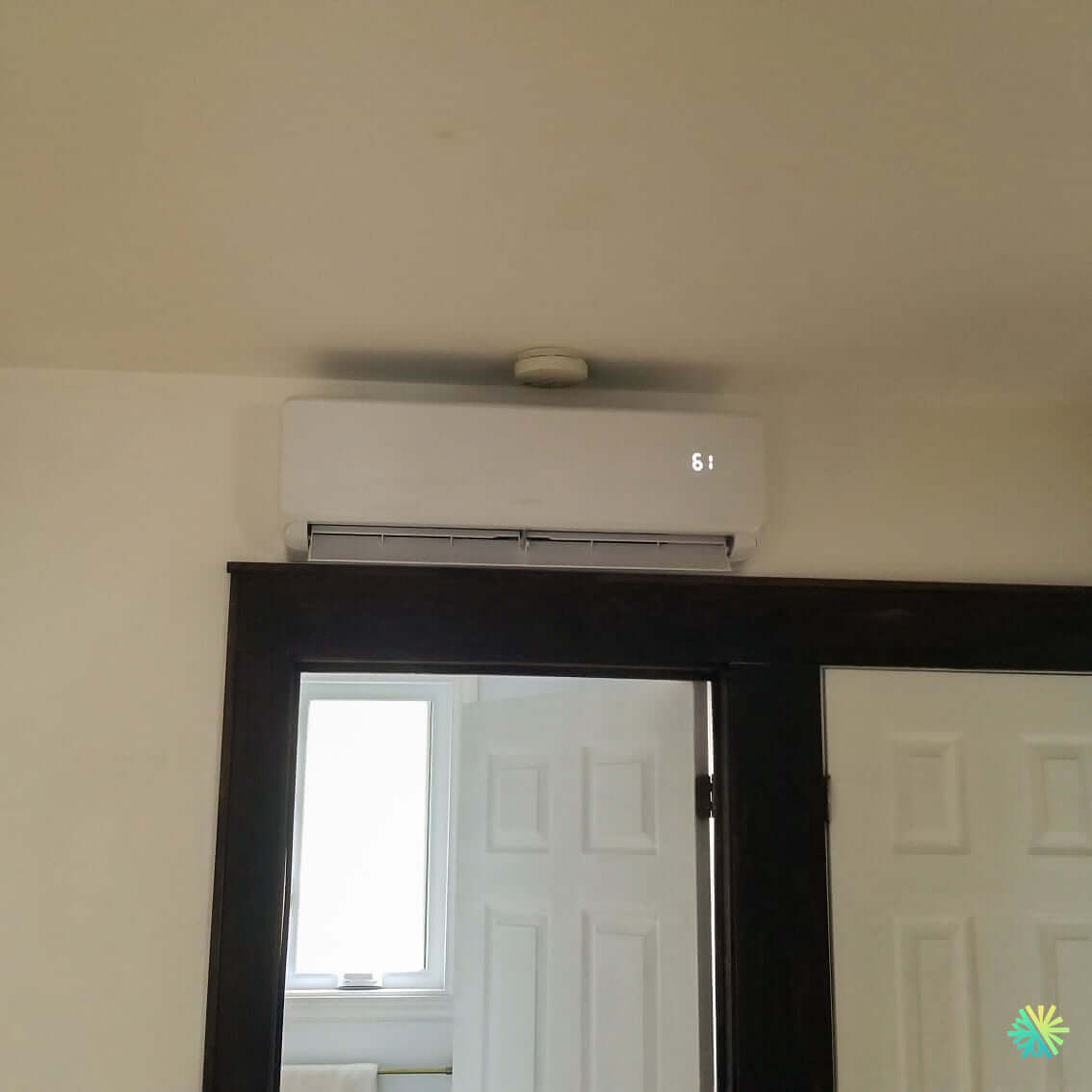
In Montreal East, this installation of a GREE LIVO R32 wall heat pump perfectly demonstrates the importance of thoughtful positioning when an interior space leaves little room for maneuver. In the photo, the wall unit is installed high above an interior opening framed with dark woodwork, in a room where available walls are limited. This type of configuration is common in houses, duplexes, renovated apartments, and small residential spaces in the east of Montreal, where every wall is already occupied by a door, window, piece of furniture, closet, or architectural constraint.
At AirGreen, we know that a successful HVAC installation depends not only on the choice of brand or model. It also relies on the ability to understand the actual air circulation in the room. In this project, our team had to install a mini split wall air conditioner capable of distributing air efficiently, without obstructing the door opening, without interfering with the daily use of the space, and without compromising the interior aesthetics. The choice of a location above the passageway precisely met these objectives.
The GREE LIVO R32 is a well-suited solution for this type of project. It offers an interesting combination of heating and air conditioning in a compact wall-mounted format, with quiet operation and discreet integration. For the client, the goal was clear: to improve the comfort of the room without undertaking major work or installing a ducted system. The result visible in the photo is simple, clean, and functional: the unit is well aligned, placed high enough to free up the wall, while maintaining a favorable diffusion angle towards the room.
A typical project for houses and apartments in Montreal East
Montreal East features a variety of homes where adding a wall-mounted heat pump often requires precise planning. Rooms can be divided, ceilings sometimes lower than in newer constructions, corridors narrow, and many interior openings. In this context, installing a mini split requires a more thorough analysis than simply identifying an available wall.
In this project, several elements visible in the photo guided our work:
- the unit had to be installed near the ceiling without blocking air circulation;
- the passage under the unit had to remain fully functional;
- the open door had to avoid conflicting with the unit or airflow;
- the unit had to direct air toward the main room rather than directly onto an uncomfortable area;
- the installation had to remain visually clean despite limited wall space;
- the available height between the framing and the ceiling had to be used precisely.
This attention to detail is especially important with a wall air conditioner. A poorly positioned unit can create cold spots, unpleasant drafts, or uneven heat distribution. Conversely, a good location allows the heat pump to operate more efficiently, with less effort and better perceived comfort.
Why the GREE LIVO R32 was a good choice for this installation
The GREE LIVO R32 is often chosen by homeowners who want a reliable, modern, and well-balanced solution for heating and cooling a residential area. It fits well in projects where space is limited, notably thanks to its compact wall-mounted design and discreet appearance. In this installation in Montreal East, the white indoor unit naturally blends into the upper part of the wall, despite the presence of the dark framing below the unit.
The refrigerant R32 also constitutes an important factor in choosing this system. It is used in many recent HVAC equipment and allows for good thermal transfer efficiency. For homeowners, this means a device designed according to current standards, with a focus on efficiency, ease of use, and seasonal performance.
The GREE LIVO R32 is especially suitable for customers who are looking for:
- a wall-mounted heat pump to heat and cool a specific area;
- a discreet wall air conditioner for hot periods;
- a mini split solution without ducts;
- a device suitable for renovations or existing homes;
- an installation less invasive than a central system;
- a good balance between comfort, efficiency, and budget;
- an easy-to-use solution for daily life.
The exact capacity of the device must always be validated according to the area, insulation, number of windows, housing orientation, and interior layout. In this project, our team evaluated these parameters before confirming the equipment choice to avoid a device that is too small or too large for the client’s actual needs.
The main constraint: install high, but install correctly
The indoor unit visible in the photo is placed near the ceiling. This type of installation requires special attention because the available upper space affects filter access, air circulation, and ease of maintenance. A wall unit should not be installed flush against the ceiling without sufficient clearance. Space must be preserved for air intake and service interventions.
In this case, our team verified the available clearance before mounting. The goal was to use the top of the wall without compromising the device’s performance. The unit had to remain accessible for filter cleaning and for future HVAC maintenance. This detail is essential because a filter that is hard to reach risks being neglected, which can reduce system performance over time.
Installation above a passageway also requires consideration of the airflow direction. The louvers of the GREE LIVO R32 allow air to be directed toward the room. Poor orientation could blow directly toward a door, an opening, or a transition space, instead of effectively treating the main area. Our team therefore adjusted the commissioning so that the diffusion is comfortable, stable, and suited to the actual use of the room.
The technical steps carried out by AirGreen
An installation of a mini split wall-mounted heat pump must follow a strict sequence. Even when the indoor unit seems simply installed, several technical operations are necessary to ensure long-lasting operation.
For this project in Montreal East, our intervention notably included:
- analyzing the room and available wall;
- validating clearance above the framing;
- marking the passage of refrigerant lines and the drain;
- mounting the wall bracket perfectly level;
- controlled drilling to the outside with the necessary slope;
- installing the GREE LIVO R32 indoor unit;
- connecting the refrigerant lines;
- checking the drainage;
- vacuuming the circuit;
- functionality tests in cooling and heating modes;
- explaining the use to the customer.
These steps are never optional. Insufficient vacuuming, poorly planned drainage, or approximate mounting can cause performance, noise, condensation, or lifespan issues. At AirGreen, we treat each installation as a complete system, not just a simple device setup.
The concrete benefits of a well-installed wall heat pump in East Montreal
A well-installed GREE LIVO R32 wall heat pump can transform the comfort of a residential space, especially in a room that previously suffered from excessive heat in summer or less even heating in mid-season. In Montreal East, where many buildings combine old structures, successive renovations, and sometimes partitioned rooms, a mini split solution often solves a specific problem without changing the entire building's mechanics.
Better daily temperature control
One of the great advantages of a wall-mounted air conditioner with heat pump function is direct temperature control. The customer can adjust the comfort of the used area without necessarily changing the entire house. This flexibility is appreciated in living rooms, bedrooms, home offices, rental units, finished basements, and open spaces.
In the photo, the unit's light display indicates that the device is in operation. This simple detail confirms the ultimate goal of the installation: to provide comfort that is immediately usable, with intuitive control and a clear temperature readout. For an owner or tenant, this simplicity matters a lot. A good HVAC system must be efficient but also easy to live with.
A solution suited for spaces where ducts are not practical
Installing ducts in an existing home can require significant work: ceiling openings, loss of space, wall modifications, high costs, and longer delays. A mini split wall-mounted heat pump avoids most of these constraints. It connects an indoor unit to an outdoor unit with a set of compact conduits, reducing the impact on the building.
In this project in Montréal-Est, this approach was particularly relevant. The chosen location allowed adding a heating and cooling system without occupying an entire wall or moving existing elements. The unit is installed in a high, rarely used area, preserving the wall surface available for furniture, circulation, and interior layout.
Mistakes to avoid during an indoor wall installation
We often encounter installations where the device works but does not provide the expected comfort due to poor positioning. Here are the most common mistakes we avoid in our projects in Montréal, Laval, Longueuil, on the North Shore and the South Shore.
Placing the unit too close to the ceiling
Insufficient clearance above the unit can impair air intake. It can also complicate filter cleaning. In this project, the location was approved to maintain a functional installation despite the tight space.
Installing the unit directly facing a sensitive area
Direct airflow towards a bed, desk, sofa, or door can create discomfort. The orientation of the louvers and the position of the unit must be considered according to the actual use of the room.
Neglecting drainage
Condensation produced in cooling mode must be properly drained. A poor slope can cause leaks or water accumulation. This is a point we systematically check before commissioning.
Choosing an inadequate capacity
Too high a capacity can cause short cycling, while insufficient capacity can force the device to run continuously. The choice should be made based on the thermal load, not just the approximate area.
Forgetting access for maintenance
A well-placed device must also remain accessible. Cleaning the filters and periodic inspections are part of long-term performance.
Grants and eligibility: an essential check before promising an amount
Many customers ask us if a GREE LIVO R32 wall-mounted heat pump can qualify for financial aid. The answer depends on the exact model, its capacity, its AHRI number, the current criteria, and the program applicable at the time of installation. At AirGreen, we verify these elements before confirming eligibility.
For customers in Montréal-Est as well as those in Montréal, Laval, Longueuil, the North Shore, and the South Shore, we can assist with preparing the necessary documents when the device meets the requirements of the relevant program. This approach avoids unpleasant surprises and allows the customer to have clear information before finalizing their project.
Customer experience: a discreet, useful, and well-explained system
After installation, our team took the time to test the device and explain how it works. Customers often want to know how to use the modes, what temperature to set the device at, how to avoid unnecessary consumption, and when to clean the filters. These explanations are an integral part of our service.
For this project, we specifically recalled some best practices:
- use a stable setting rather than constantly changing the temperature;
- clean the filters regularly according to usage;
- avoid blocking the airflow with curtains or tall furniture;
- let the vents gradually direct the air into the room;
- have the system checked if an unusual noise, smell, or leak appears;
- schedule HVAC maintenance when the device is used intensively.
These simple tips help maintain the performance of the heat pump and extend the system's lifespan.
Why AirGreen is often chosen for this type of HVAC installation
Our expertise is based on concrete installations in very varied contexts: single-family homes, condos, duplexes, rental buildings, local businesses, and renovated spaces. In Montréal-Est, as elsewhere in Greater Montréal, we know that each project imposes its constraints: limited walls, complex exterior access, condominium regulations, need for discretion, noise requirements, available electrical capacity, and budget expectations.
In this project, our added value is seen in the precision of the indoor positioning. Installing a unit above a passageway requires more thought than placing it on a large clear wall. You have to anticipate the daily use of the room, access to the door, air distribution, future maintenance, and the final appearance.
Our approach includes:
- a serious evaluation before installation;
- a choice of suitable equipment;
- a clean and aligned installation;
- connections made according to best practices;
- a complete commissioning;
- clear explanations to the client;
- available follow-up after installation.
An installation that meets a real need, without unnecessary work
This installation of a GREE LIVO R32 Mini Split wall heat pump in Montréal-Est represents a practical solution to improve the comfort of a room without transforming the entire house. The indoor unit is installed in a difficult-to-use area otherwise, above a passageway, with a discreet and functional integration.
For owners considering adding a wall air conditioner, a heat pump, or a mini split system, this project shows the importance of choosing a contractor capable of adapting the installation to the building’s reality. A good decision is not limited to the brand. It relies on the right location, the right sizing, rigorous installation, and a clear explanation of use.
In Montréal-Est, this GREE LIVO R32 is now ready to provide stable comfort in air conditioning and supplementary heating, with a clean and well-thought-out indoor installation. This is exactly the type of project we love to carry out at AirGreen: a simple HVAC solution in appearance, but designed precisely to meet the concrete needs of the client.
The unit on this job, in figures
The range as published on airgreen.ca: pick a size to see its capacity in deep cold.
| Size | Heating at −8 °C | Heating at −15 °C | Coldest certified point | COP at −15 °C | SEER | HSPF | Indicative LogisVert aid |
|---|---|---|---|---|---|---|---|
| Gree Livo R32 9 000 (115 V) | 10,000 | 7,600 | −25 °C: 5,700 | 1.86 | 20.5 | 8.8 | – |
| Gree Livo R32 9 000 | 9,600 | 7,600 | −25 °C: 5,500 | 1.94 | 20.5 | 8.8 | – |
| Gree Livo R32 12 000 (115 V) | 9,700 | 8,500 | −25 °C: 6,500 | 1.75 | 19.0 | 8.5 | – |
| Gree Livo R32 12 000 | 9,700 | 9,100 | −25 °C: 6,500 | 1.8 | 19.0 | 8.5 | $1,164 |
| Gree Livo R32 18 000 | 15,300 | 12,100 | −25 °C: 10,200 | 1.85 | 20.0 | 8.5 | $1,836 |
| Gree Livo R32 24 000 | 19,200 | 15,700 | −25 °C: 10,500 | 1.75 | 19.0 | 8.5 | $2,304 |
| Gree Livo R32 30 000 | 24,000 | 23,000 | −25 °C: 16,900 | 1.8 | 22.0 | 9.0 | $2,880 |
| Gree Livo R32 36 000 | 27,400 | 24,600 | −25 °C: 21,000 | 1.8 | 21.0 | 8.5 | $3,288 |
According to NEEP, it delivers 10,000 BTU/h at −8 °C (17 °F), as much as at 8 °C. It heats as hard in moderate cold as in mild weather.
According to NEEP, its certified maximum capacity at −25 °C (−13 °F) is 5,700 BTU/h, 63% of its nominal 9,000 BTU size.
At 8 °C, its certified maximum capacity reaches 13,300 BTU/h, 48% more than its nominal 9,000 BTU size.
According to NEEP, its COP at −15 °C is 1.94: the highest of the Livo R32 line, which ranges from 1.75 to 1.86 at that temperature.
According to NEEP, its certified maximum capacity at −25 °C (−13 °F) is 5,500 BTU/h, 61% of its nominal 9,000 BTU size.
At 8 °C, its certified maximum capacity reaches 13,136 BTU/h, 46% more than its nominal 9,000 BTU size.
According to NEEP, it delivers 8,500 BTU/h at −15 °C, against 9,100 for the Gree Livo R32 12 000.
At −25 °C, its certified minimum capacity is 1,800 BTU/h (3,070 at 8 °C). It slows down instead of cycling on and off.
According to NEEP, its certified heating capacity at −15 °C (5 °F) is 8,500 BTU/h, 71% of its nominal 12,000 BTU size. Its COP there is 1.75.
According to NEEP, it delivers 9,100 BTU/h at −15 °C, against 8,500 for the Gree Livo R32 12 000 (115 V).
At −25 °C, its certified minimum capacity is 1,800 BTU/h (3,070 at 8 °C). It slows down instead of cycling on and off.
According to NEEP, its certified heating capacity at −15 °C (5 °F) is 9,100 BTU/h, 76% of its nominal 12,000 BTU size. Its COP there is 1.80.
At 8 °C, its certified maximum capacity reaches 22,500 BTU/h, 25% more than its nominal 18,000 BTU size.
According to NEEP, its certified minimum capacity is at least 7,000 BTU/h at every temperature. In a small, well-insulated room it will cycle on and off more often: size it carefully.
According to NEEP, its certified heating capacity at −15 °C (5 °F) is 12,100 BTU/h, 67% of its nominal 18,000 BTU size. Its COP there is 1.85.
At −25 °C, its certified minimum capacity is 3,100 BTU/h (5,800 at 8 °C). It slows down instead of cycling on and off.
According to NEEP, its certified heating capacity at −15 °C (5 °F) is 15,700 BTU/h, 65% of its nominal 24,000 BTU size. Its COP there is 1.75.
According to NEEP, its certified heating capacity at −15 °C (5 °F) is 23,000 BTU/h, 77% of its nominal 30,000 BTU size. Its COP there is 1.80.
According to NEEP, its COP at −25 °C is 1.54: the highest of the Livo R32 line, which ranges from 1.30 to 1.52 at that temperature.
At −25 °C, its certified minimum capacity is 7,000 BTU/h (10,000 at 8 °C). It slows down instead of cycling on and off.
According to NEEP, its certified heating capacity at −15 °C (5 °F) is 24,600 BTU/h, 68% of its nominal 36,000 BTU size. Its COP there is 1.80.
Data read live from the airgreen.ca page of each size (NEEP / AHRI certified performance). When the title names the installed size, it is highlighted; otherwise the whole range is shown. The aid shown is today’s, using Hydro-Québec’s rule ($120 per 1,000 BTU/h at −8 °C); amounts quoted in the article date from its publication. Only Hydro-Québec confirms the assistance granted.A dash in the aid column: amount to be confirmed for this model.
The big day, step by step
The main steps of this kind of job at AirGreen. Every house has its quirks: the estimate brings them out.
We look at the room, the outside wall, the line route and where the outdoor unit will go. That is where the capacity gets chosen.
Model, capacity and price, in writing. We also check whether the model qualifies for assistance programs.
Floors and furniture protected, wall plate position marked level, wall opening located.
A single opening, with the slope the drain needs to flow outside.
Set on a stand raised above the snow, with the clearances the manufacturer requires.
Connected, insulated and protected. The opening is then sealed against water, cold air and insects.
A dedicated circuit and an accessible disconnect near the outdoor unit.
Leak test, vacuum, then start-up and a check of heating and cooling.
Remote, modes, filters: we show you the essentials before we leave.
- The on-site estimateWe look at the room, the outside wall, the line route and where the outdoor unit will go. That is where the capacity gets chosen.
- The quoteModel, capacity and price, in writing. We also check whether the model qualifies for assistance programs.
- Getting readyFloors and furniture protected, wall plate position marked level, wall opening located.
- The wall openingA single opening, with the slope the drain needs to flow outside.
- The outdoor unitSet on a stand raised above the snow, with the clearances the manufacturer requires.
- Lines, cable and drainConnected, insulated and protected. The opening is then sealed against water, cold air and insects.
- The electrical workA dedicated circuit and an accessible disconnect near the outdoor unit.
- Tests and start-upLeak test, vacuum, then start-up and a check of heating and cooling.
- The walkthroughRemote, modes, filters: we show you the essentials before we leave.
What would it look like at your place?
Two quick checks with real numbers: what heat costs, and what your current heaters add up to in BTU/h.
Baseboards and electric furnaces turn 1 kWh of electricity into 1 kWh of heat. A heat pump delivers more: that is its COP. At Hydro-Québec’s rate D (11.142¢/kWh above 40 kWh a day, since 1 April 2026):
Hydro-Québec: a heat pump can be up to three times more efficient than baseboards for heating in the colder months.
Estimate per kWh of heat, at the chosen temperature, using the certified COP from the product page. Taxes, access charge and backup heat not included.
Conversion: 1 W = 3.412 BTU/h. An indication, not a load calculation: baseboards and furnaces are often stronger than the real need, and they can stay as backup. AirGreen confirms the capacity on site.
Four mistakes we do not make
Flip each card to see what we do instead.
Your own project, step by step
What to do, season by season
Three habits per season for this unit. They take a few minutes and prevent many calls.
- Clean the indoor unit's filters.
- Clear leaves and debris left on the outdoor unit by winter.
- Test cooling before the first hot days.
- Clean the filters more often when the unit runs a lot.
- Keep plants away from the outdoor unit.
- Check that no water drips from the indoor unit.
- Rake the leaves around the outdoor unit.
- Test heating before the first cold days.
- Book periodic maintenance before winter.
- Keep snow away from the stand and the front of the unit.
- Let the unit defrost: it is normal.
- Never hit the ice on the fins; call us if the unit stays iced up.
Is your home ready?
Check what applies at your place. A "no" is not a refusal: it is what we sort out during the estimate.
Four statements: true or false?
It all comes down to details you have just seen.
1. In heating mode, the outdoor unit can produce water.
During defrost cycles. That water must drain away without forming ice.
2. You pick the capacity with a simple square-footage rule.
Windows, insulation, orientation and how the room is used all count. Capacity is chosen on site.
3. A multi-zone connects several indoor heads to a single condenser.
One head per room, all on the same condenser. Each room keeps its own temperature.
4. The disconnect can sit behind the patio furniture.
It must stay accessible: it is what shuts the unit off for service.
0 / 4 right answers
What people ask us about this kind of work
Does a wall-mounted heat pump heat in winter?
Wall-mounted or multi-zone: how do I choose?
Where does the outdoor unit go?
Are there grants?
Do I need a permit?
How cold can it heat?
How much can I save?
How is the LogisVert assistance calculated?
Is it noisy?
The outdoor unit is covered in ice: is that normal?
Does AirGreen hold the required licences?
Is the estimate free?
No question matches. Write to us: we answer.
More jobs to see, near you
By town, by equipment or by region: browse more than 4,700 published projects.
Each dot: a town where AirGreen has published projects. The glowing dot: this job.
Every house has its constraints. We see them before we install.
The on-site estimate is free and the quote follows within 24 hours.
Text and photo: a real AirGreen Climatisation & Chauffage job. The diagrams are generic illustrations of the type of installation, not a survey of this job site. Sources of the added figures: airgreen.ca product pages (NEEP / AHRI performance), Hydro-Québec (Heat pumps page, LogisVert, read on 13 October 2026), Régie de l’énergie (rate D as of 1 April 2026).