
Installation of a MIDEA35 18,000 BTU wall-mounted heat pump in Pointe-Calumet: high-efficiency mini-split installed in an open-concept residential space with a mezzanine
AirGreen installs a MIDEA35 18,000 BTU wall-mounted heat pump in Pointe-Calumet: high-performance mini-split, elevated installation, lasting comfort, and efficient HVAC for open-plan areas.
Take a tour of the installation
Each number is a point we check on site. Switch between summer and winter to watch air and heat move.
In summer, the outdoor unit rejects the house's heat outside.
Generic illustration of this type of installation, not a survey of this job site. Tap a number.
Mounted level on a wall plate, high enough for the air to reach the whole room, with enough space around it to slide the filters out easily.
The refrigerant lines, the communication cable and the drain go through the wall in a single opening, sealed against water, cold air and insects.
Two insulated copper pipes connect the two units. Outside, a line cover can protect them from sun, knocks and weather.
A shut-off switch near the outdoor unit isolates it safely for service. It must stay accessible at all times.
The compressor and the fan. In heating mode it captures heat from the outdoor air, even in winter, and moves it inside.
On the ground or on the wall, it keeps the unit above accumulated snow. The unit stays clear and defrost water can drain away.
The fan needs to blow freely. Storage, a fence or a wall too close, and efficiency drops while noise goes up.
A MIDEA35 wall-mounted heat pump installed high up to better manage a complex air volume
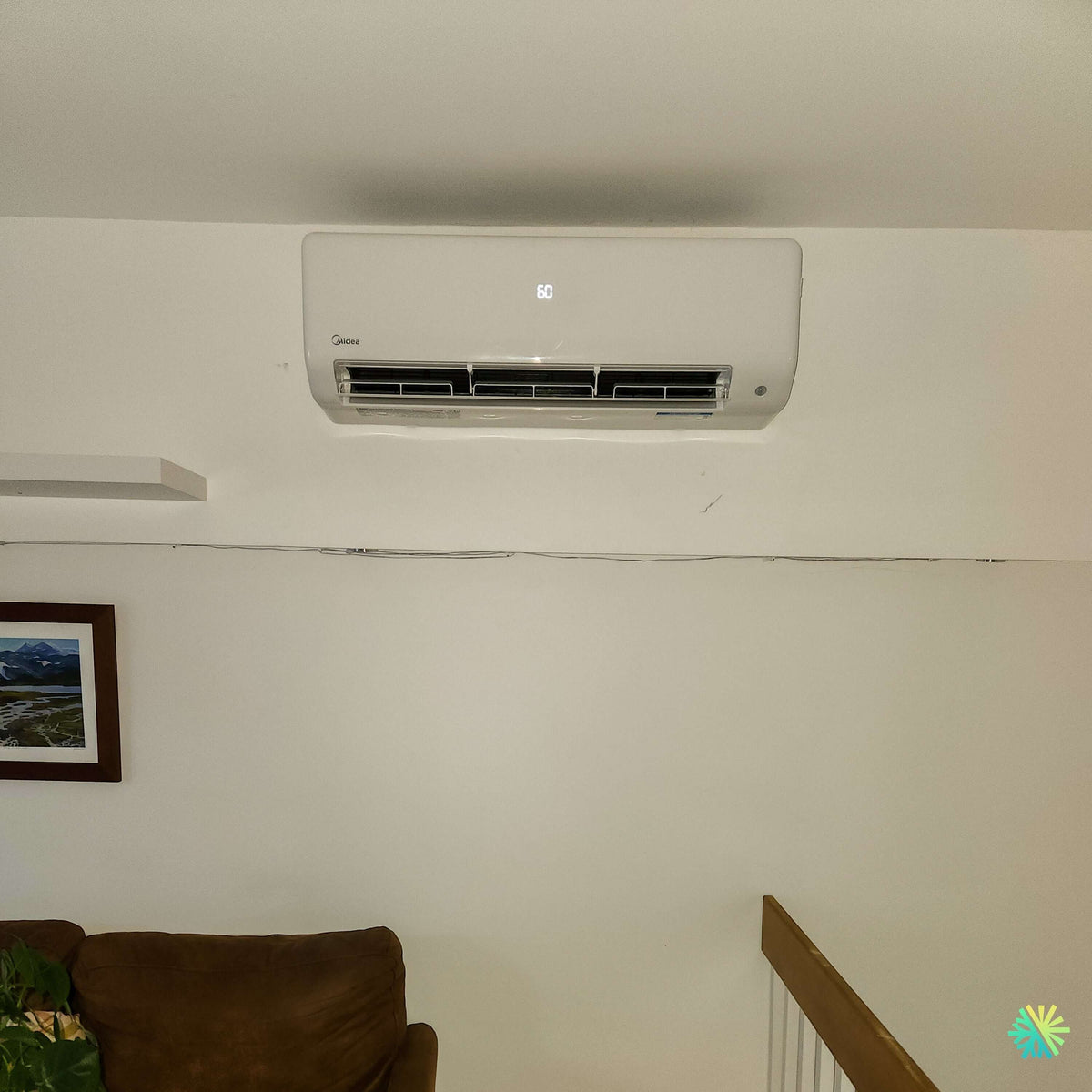
In Pointe-Calumet, our AirGreen team installed a MIDEA35 18,000 BTU wall-mounted heat pump, a mini split system designed to offer excellent comfort in both air conditioning and heating. This project was distinguished by a very visible element in the photo: the indoor unit was installed high up, above an open living space, near a staircase and an area where the air volume is not that of a standard room.
This type of configuration requires real expertise in HVAC installation. When a wall-mounted unit is placed above a living room, near a staircase, or in an area with a high ceiling, the goal is not just to "blow cold or hot air." It is essential to understand how air moves in the room, how heat rises, how air conditioning falls, how the staircase can create natural air movement between levels, and how to avoid uncomfortable zones.
In this Pointe-Calumet residence, the MIDEA35 18,000 BTU wall-mounted heat pump was chosen for its more robust capacity, better suited for an open air volume than a smaller model. A 12,000 BTU unit might have seemed sufficient at first glance in a classic living room, but here, the analysis had to consider the height, air circulation, proximity to the staircase, open area, and how comfort should be felt throughout the zone.
In the photo, we also notice that the unit is running and displays a visible temperature on the front. The louvers are open, which shows the blowing direction and the importance of precise positioning. In an environment like this, the angle of the airflow plays an important role: if directed too far downwards, it can create an uncomfortable direct sensation; if too horizontal, it can limit the reach in the room. Our job is to find the balance between performance, quietness, comfort, and appearance.
Why the MIDEA35 18,000 BTU was a logical choice for this project
The MIDEA35 18,000 BTU is particularly interesting for homeowners looking for an effective solution for a larger residential space, an open area, a partially open ground floor, or an area where air conditioning and heating need to cover a larger volume than that of a single room.
In this project in Pointe-Calumet, the choice of the 18,000 BTU allowed us to meet several needs at once:
- improve summer comfort in a space that can accumulate heat;
- provide auxiliary or primary heating depending on conditions and house configuration;
- reduce the use of electric baseboards for a large part of the cold season;
- better distribute air in an open area;
- maintain stable operation without overworking the unit;
- achieve a clean visual result despite a high-up installation.
The MIDEA35 range is renowned for its excellent energy efficiency. For an 18,000 BTU model, desired features generally include very good seasonal efficiency, inverter technology, precise power modulation, quiet operation at low speed, and heating capacity adapted to Quebec winters. Depending on the available configurations, the MIDEA35 can integrate advanced features such as Wi-Fi control, remote control temperature sensing mode, and comfort functions to adapt operation to occupants' habits.
For customers located in Montreal, Laval, Longueuil, on the North Shore or the South Shore, this type of wall-mounted air conditioner with heating function becomes a highly sought-after solution, as it addresses two priorities: reducing energy consumption and improving daily comfort.
A high-up installation: more demanding than a standard wall mount
The image clearly shows a unit installed above a living space, with a sofa underneath, a nearby staircase, and a clear wall. This configuration is interesting because it allows the unit to cover a larger area, but it requires a very careful installation.
Installing a wall-mounted heat pump high up requires particular attention to several details:
Ceiling clearance
The unit must have enough space to properly draw air from above. If the unit is too close to the ceiling, efficiency may be reduced, noise may increase, and maintenance may become more difficult. In this project, our team positioned the unit to maintain functional clearance while maintaining a consistent aesthetic line with the wall.
Access for HVAC maintenance
A high-mounted unit must remain accessible for filter cleaning and future interventions. HVAC maintenance should never be an afterthought. Even when the ideal location is above a passageway or living room, we always plan the installation so that access remains realistic.
Blowing direction
In an open-plan area with a staircase, the orientation of the louvers directly influences comfort. In air conditioning, cool air naturally descends; in heating, warm air tends to remain higher. Adjusting the louvers and selecting the ventilation mode therefore become essential for achieving a uniform temperature.
Wall mounting
An 18,000 BTU unit is larger than a small wall-mounted model. The mounting must be solid, level, and adapted to the structure behind the wall. An approximate installation can cause vibrations, noise, or drainage problems. In this project, the unit was installed with particular attention to stability and alignment.
The reality of homes in Pointe-Calumet: summer comfort and efficient heating
Pointe-Calumet, like several areas on the North Shore, has many homes where living spaces have been developed, expanded, or modified over time. These include open living rooms, central staircases, areas with higher ceilings, interconnected rooms, and sometimes less conventional configurations than in new constructions.
These specificities directly influence the choice of an HVAC system. A wall-mounted heat pump installed in an open area must be able to process a real air volume, not just a theoretical surface area. At AirGreen, we always analyze:
- ceiling height;
- natural air circulation;
- sun exposure;
- number of windows;
- quality of insulation;
- staircase position;
- distance between the indoor unit and the areas to be treated;
- occupants' living habits;
- the priority need: air conditioning, heating, or both.
In this residence, the MIDEA35 18,000 BTU provided a balanced solution. It was not only chosen for its nominal power, but for its ability to modulate its operation according to needs. This is one of the significant advantages of inverter technology: the unit does not simply operate in on-off mode. It adjusts its power to maintain a more stable temperature, with fewer fluctuations and better efficiency.
The technical and practical details that make the difference in an AirGreen installation
An installation like this can seem simple once completed, but the final result relies on a series of technical decisions. Each step must be executed with precision to ensure durability, efficiency, and customer satisfaction.
The importance of well-planned line routing
Behind a clean HVAC installation always lies rigorous planning of the refrigerant line routing, condensate drain, and electrical supply. The indoor unit is only the visible part of the system. For the whole to function correctly, the connections must be installed according to best practices.
In this type of project, our team plans the routing to:
- limit unnecessary lengths;
- protect conduits;
- maintain adequate drainage slope;
- reduce visual impacts indoors;
- ensure a reliable connection to the outdoor unit;
- facilitate access in case of future maintenance.
Poor planning can lead to problems later: water leaks, loss of efficiency, noise, vibration, or maintenance difficulties. That's why we pay as much attention to what isn't seen as to what is visible in the photo.
Condensate management: a critical point often underestimated
When a wall-mounted air conditioner operates in summer, it removes humidity from the air. This water must be properly evacuated. In a residential space, poorly designed drainage can cause significant damage. The high-up location makes the slope and routing of the drain even more important.
For this installation in Pointe-Calumet, we paid particular attention to condensate management to ensure reliable evacuation. A well-installed system must operate discreetly, without drips, odors, or constant customer intervention.
Sound level: essential in a living room
The indoor unit is placed above a living space. Acoustic comfort was therefore an important criterion. A modern wall-mounted heat pump like the MIDEA35 can operate at a low sound level when the demand load is low, but installation also plays a decisive role.
A well-secured, level, and correctly connected unit reduces the risk of vibration. Customers often notice the difference between a quick installation and a professional installation: the system seems more stable, less intrusive, and more pleasant to use daily.
An 18,000 BTU unit: when this capacity becomes relevant
The choice of a MIDEA35 18,000 BTU should never be automatic. This capacity is suitable for larger or more demanding spaces, but it must be confirmed by a real assessment. In this installation, the volume to be treated and the open configuration justified a more robust unit.
An 18,000 BTU can be relevant when:
- the space is open;
- the ceiling is higher than average;
- the living room communicates with a staircase;
- heat accumulates quickly in summer;
- the area to be heated or air-conditioned exceeds the needs of a small appliance;
- the client wants a better capacity reserve;
- the goal is to cover a main area rather than a single closed room.
Conversely, a poorly chosen 18,000 BTU in a small closed room could create short cycles and less stable comfort. That's why AirGreen never recommends an appliance based solely on a simplified rule. We adapt the capacity to the actual space.
Subsidies and energy efficiency: a topic to validate before purchase
Homeowners in Pointe-Calumet, like those in Montreal, Laval, Longueuil, on the North Shore and South Shore, are very interested in the subsidies available for heat pumps. Energy efficiency programs, including those associated with Hydro-Québec, can represent a significant financial advantage when the installed model is eligible.
The MIDEA35 is one of the models often sought after for its high performance, but final eligibility always depends on the exact combination installed, the certification number, the criteria of the current program, and the documents submitted. At AirGreen, we help our clients understand the important steps:
- keep the final invoice;
- verify the exact model information;
- ensure that the installation is carried out by a qualified company;
- comply with the applicable program criteria;
- submit documents within the required deadlines.
We favor a clear and realistic approach: we provide the necessary information, but we always invite clients to validate the applicable conditions at the time of application, as programs can be modified.
Common mistakes to avoid in a similar project
This installation in Pointe-Calumet illustrates several mistakes homeowners should avoid when planning the installation of a mini split.
Choosing capacity based solely on price
A cheaper but underpowered unit can become more costly in the long run if it constantly runs at full capacity. An overpowered unit can also reduce comfort. The right choice relies on analyzing the space.
Ignoring the role of the staircase
A staircase can greatly alter air circulation. In heating, warm air can rise to another level. In air conditioning, cool air can move differently depending on the openness of the house. Positioning must take this dynamic into account.
Installing the unit too low or too high without consideration
A unit too low can blow directly on occupants. A unit too high can complicate maintenance or reduce air intake. The chosen location must be functional and comfortable.
Neglecting visual finish
In a living room, the appliance is visible every day. A clean, well-aligned, and discreet installation completely changes the customer's experience.
Forgetting maintenance
Even an excellent appliance will lose efficiency if filters are never cleaned or if the outdoor unit is obstructed. Good HVAC maintenance protects the investment.
Customer experience: a system that's simple to use daily
After commissioning, our team always explains the essential functions to the client. The goal is for the appliance to be used correctly from day one. For a MIDEA35 wall-mounted heat pump, we particularly cover:
- choosing between heating or cooling mode;
- setting the temperature;
- using the vanes;
- the importance of not setting an unnecessarily extreme temperature;
- cleaning the filters;
- signs to look out for;
- best practices in winter;
- efficient use during heatwaves.
An efficient system performs best when used correctly. For example, in air conditioning, it is often better to maintain a stable temperature than to wait until the house is very hot before starting the unit at full power. In heating, gradual and constant use can improve comfort and efficiency.
Why AirGreen is often chosen for wall-mounted installations on the North Shore
AirGreen performs installations of wall-mounted heat pumps, wall-mounted air conditioners, and mini-split systems throughout the greater metropolitan area: Montreal, Laval, Longueuil, the North Shore, and the South Shore. Our experience allows us to handle both simple installations and more delicate projects, like this one, where high-level positioning and air circulation needed careful analysis.
Our approach is based on several principles:
- recommending equipment suited to actual needs;
- clearly explaining the options;
- avoiding unnecessary oversizing;
- protecting interior aesthetics;
- respecting installation standards;
- ensuring complete commissioning;
- offering post-installation service;
- providing practical advice on use and maintenance.
This installation of a MIDEA35 18,000 BTU in Pointe-Calumet perfectly reflects our working method: precise analysis, clean execution, and a result designed for the client's lasting comfort.
An effective, discreet, and home-adapted final result
The result visible in the photo is a well-positioned wall-mounted unit, cleanly installed above a living space, with a discreet presence despite its 18,000 BTU capacity. The unit integrates well with the wall, the airflow is directed towards the area to be treated, and its location allows for efficient air distribution in an open configuration.
For the client, this installation represents a concrete improvement in comfort: better temperature control, more efficient air conditioning during summer heatwaves, useful heating capacity during the cold season, and an easy-to-use appliance for everyday life.
The MIDEA35 18,000 BTU is an excellent example of a modern HVAC solution for homes in Pointe-Calumet and on the North Shore, especially when the area to be treated requires more than a small wall-mounted unit. Well-chosen, well-installed, and well-maintained, a wall-mounted heat pump can transform how a home is heated and cooled, while also improving energy efficiency.
At AirGreen, we view each project as a combination of technical expertise, experience, and attention to detail. This installation clearly demonstrates it: the final comfort depends as much on the quality of the appliance as on the precision with which it is installed.
The unit on this job, in figures
The range as published on airgreen.ca: pick a size to see its capacity in deep cold.
| Size | Heating at −8 °C | Heating at −15 °C | Coldest certified point | COP at −15 °C | SEER | HSPF | Indicative LogisVert aid |
|---|---|---|---|---|---|---|---|
| Midea Série 35 9 000 | 11,000 | 13,500 | −30 °C: 7,500 | 2.0 | 33.3 | 14.6 | – |
| Midea Série 35 12 000 | 11,000 | 13,500 | −30 °C: 7,500 | 2.0 | 29.4 | 12.7 | $1,320 |
| Midea Série 35 18 000 | 19,300 | 22,600 | −30 °C: 11,900 | 2.34 | 25.6 | 16.2 | $2,316 |
According to NEEP, its certified maximum capacity at −30 °C (−22 °F) is 7,500 BTU/h, 83% of its nominal 9,000 BTU size.
At 8 °C, its certified maximum capacity reaches 17,200 BTU/h, 91% more than its nominal 9,000 BTU size.
According to NEEP, its certified heating capacity at −15 °C (5 °F) is 13,500 BTU/h, 150% of its nominal 9,000 BTU size. Its COP there is 2.00.
According to NEEP, its certified maximum capacity at −30 °C (−22 °F) is 7,500 BTU/h, 62% of its nominal 12,000 BTU size.
At 8 °C, its certified maximum capacity reaches 17,200 BTU/h, 43% more than its nominal 12,000 BTU size.
According to NEEP, its certified heating capacity at −15 °C (5 °F) is 13,500 BTU/h, 112% of its nominal 12,000 BTU size. Its COP there is 2.00.
According to NEEP, its COP at −15 °C is 2.34: the highest of the Série 35 line, which ranges from 2.00 to 2.00 at that temperature.
According to NEEP, its certified maximum capacity at −30 °C (−22 °F) is 11,900 BTU/h, 66% of its nominal 18,000 BTU size.
At 8 °C, its certified maximum capacity reaches 29,700 BTU/h, 65% more than its nominal 18,000 BTU size.
Data read live from the airgreen.ca page of each size (NEEP / AHRI certified performance). When the title names the installed size, it is highlighted; otherwise the whole range is shown. The aid shown is today’s, using Hydro-Québec’s rule ($120 per 1,000 BTU/h at −8 °C); amounts quoted in the article date from its publication. Only Hydro-Québec confirms the assistance granted.A dash in the aid column: amount to be confirmed for this model.
The big day, step by step
The main steps of this kind of job at AirGreen. Every house has its quirks: the estimate brings them out.
We look at the room, the outside wall, the line route and where the outdoor unit will go. That is where the capacity gets chosen.
Model, capacity and price, in writing. We also check whether the model qualifies for assistance programs.
Floors and furniture protected, wall plate position marked level, wall opening located.
A single opening, with the slope the drain needs to flow outside.
Set on a stand raised above the snow, with the clearances the manufacturer requires.
Connected, insulated and protected. The opening is then sealed against water, cold air and insects.
A dedicated circuit and an accessible disconnect near the outdoor unit.
Leak test, vacuum, then start-up and a check of heating and cooling.
Remote, modes, filters: we show you the essentials before we leave.
- The on-site estimateWe look at the room, the outside wall, the line route and where the outdoor unit will go. That is where the capacity gets chosen.
- The quoteModel, capacity and price, in writing. We also check whether the model qualifies for assistance programs.
- Getting readyFloors and furniture protected, wall plate position marked level, wall opening located.
- The wall openingA single opening, with the slope the drain needs to flow outside.
- The outdoor unitSet on a stand raised above the snow, with the clearances the manufacturer requires.
- Lines, cable and drainConnected, insulated and protected. The opening is then sealed against water, cold air and insects.
- The electrical workA dedicated circuit and an accessible disconnect near the outdoor unit.
- Tests and start-upLeak test, vacuum, then start-up and a check of heating and cooling.
- The walkthroughRemote, modes, filters: we show you the essentials before we leave.
What would it look like at your place?
Two quick checks with real numbers: what heat costs, and what your current heaters add up to in BTU/h.
Baseboards and electric furnaces turn 1 kWh of electricity into 1 kWh of heat. A heat pump delivers more: that is its COP. At Hydro-Québec’s rate D (11.142¢/kWh above 40 kWh a day, since 1 April 2026):
Hydro-Québec: a heat pump can be up to three times more efficient than baseboards for heating in the colder months.
Estimate per kWh of heat, at the chosen temperature, using the certified COP from the product page. Taxes, access charge and backup heat not included.
Conversion: 1 W = 3.412 BTU/h. An indication, not a load calculation: baseboards and furnaces are often stronger than the real need, and they can stay as backup. AirGreen confirms the capacity on site.
Four mistakes we do not make
Flip each card to see what we do instead.
Your own project, step by step
What to do, season by season
Three habits per season for this unit. They take a few minutes and prevent many calls.
- Clean the indoor unit's filters.
- Clear leaves and debris left on the outdoor unit by winter.
- Test cooling before the first hot days.
- Clean the filters more often when the unit runs a lot.
- Keep plants away from the outdoor unit.
- Check that no water drips from the indoor unit.
- Rake the leaves around the outdoor unit.
- Test heating before the first cold days.
- Book periodic maintenance before winter.
- Keep snow away from the stand and the front of the unit.
- Let the unit defrost: it is normal.
- Never hit the ice on the fins; call us if the unit stays iced up.
Is your home ready?
Check what applies at your place. A "no" is not a refusal: it is what we sort out during the estimate.
Four statements: true or false?
It all comes down to details you have just seen.
1. In heating mode, the outdoor unit can produce water.
During defrost cycles. That water must drain away without forming ice.
2. You pick the capacity with a simple square-footage rule.
Windows, insulation, orientation and how the room is used all count. Capacity is chosen on site.
3. A multi-zone connects several indoor heads to a single condenser.
One head per room, all on the same condenser. Each room keeps its own temperature.
4. The disconnect can sit behind the patio furniture.
It must stay accessible: it is what shuts the unit off for service.
0 / 4 right answers
What people ask us about this kind of work
Does a wall-mounted heat pump heat in winter?
Wall-mounted or multi-zone: how do I choose?
Where does the outdoor unit go?
Are there grants?
Do I need a permit?
How cold can it heat?
How much can I save?
How is the LogisVert assistance calculated?
Is it noisy?
The outdoor unit is covered in ice: is that normal?
Does AirGreen hold the required licences?
Is the estimate free?
No question matches. Write to us: we answer.
More jobs to see, near you
By town, by equipment or by region: browse more than 4,700 published projects.
Each dot: a town where AirGreen has published projects. The glowing dot: this job.
Every house has its constraints. We see them before we install.
The on-site estimate is free and the quote follows within 24 hours.
Text and photo: a real AirGreen Climatisation & Chauffage job. The diagrams are generic illustrations of the type of installation, not a survey of this job site. Sources of the added figures: airgreen.ca product pages (NEEP / AHRI performance), Hydro-Québec (Heat pumps page, LogisVert, read on 13 October 2026), Régie de l’énergie (rate D as of 1 April 2026).