
Installation of a Sharp ZU1 wall-mounted heat pump in Ahuntsic-Cartierville
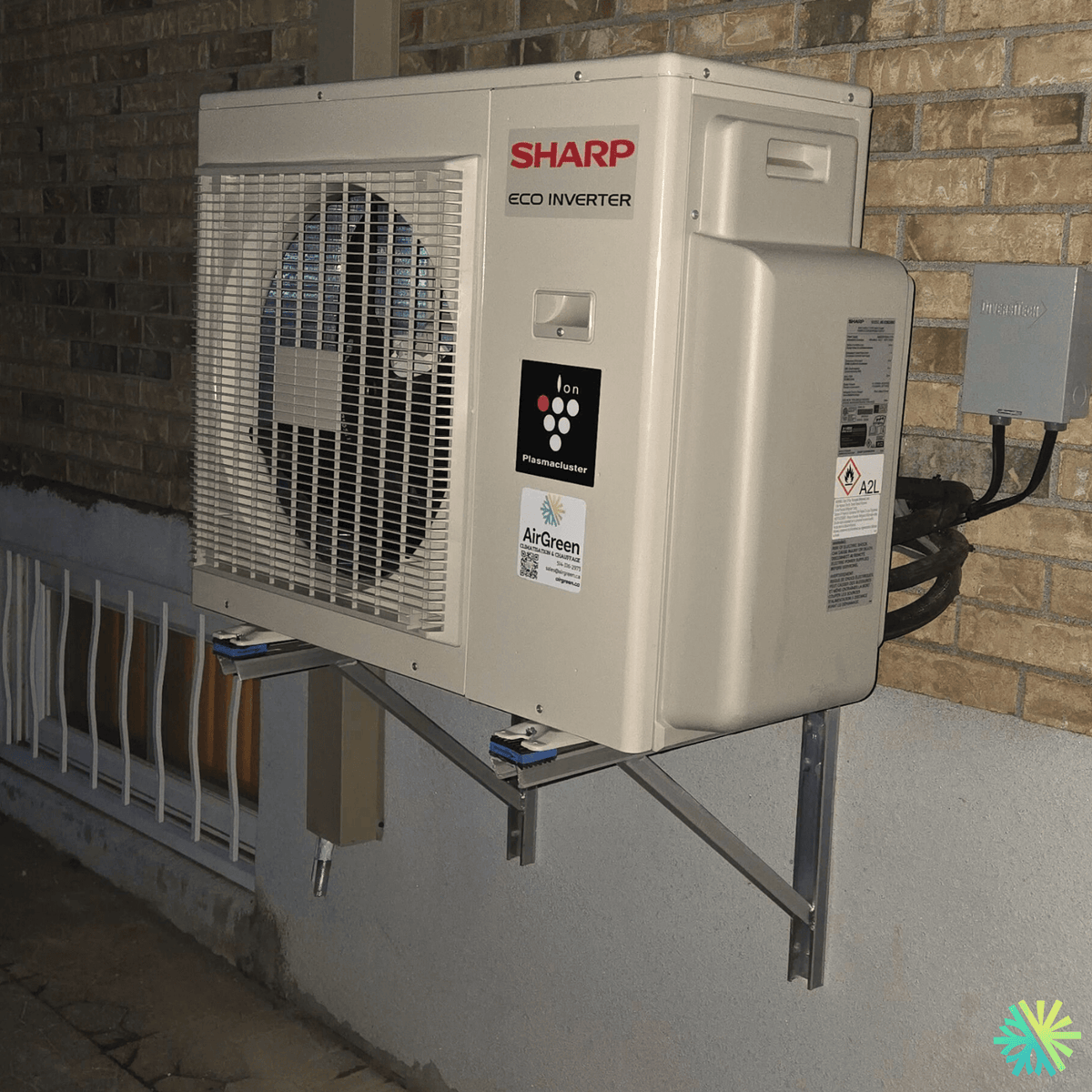
In Ahuntsic-Cartierville, AirGreen installed a Sharp wall-mounted heat pump with an outdoor unit mounted on a wall bracket: robust brick mounting, vibration damping, accessible electrical panel, and clearance designed for Quebec winters. Four-season comfort, durable installation.
- City
- Region
- Equipment
- Brand
- Challenges
- Published
The job on one screen
The unit’s data sheet
The range as published on airgreen.ca: pick a size to see its capacity in deep cold.
| Size | Heating at −8 °C | Heating at −15 °C | Coldest certified point | COP at −15 °C | SEER | HSPF | Indicative LogisVert aid |
|---|---|---|---|---|---|---|---|
| Sharp ZU1 12 000 | 14,500 | 12,000 | −27 °C: 7,200 | 2.11 | 22.0 | 11.0 | $1,740 |
| Sharp ZU1 15 000 | 18,100 | 15,300 | −27 °C: 10,100 | 2.1 | 24.0 | 11.0 | $2,172 |
| Sharp ZU1 18 000 | 22,000 | 18,000 | −27 °C: 11,500 | 2.2 | 24.0 | 11.0 | $2,640 |
| Sharp ZU1 24 000 | 22,400 | 19,000 | −27 °C: 12,300 | 2.2 | 22.0 | 11.0 | $2,688 |
According to NEEP, it delivers 14,500 BTU/h at −8 °C (17 °F), more than at 8 °C (14,000 BTU/h). It heats as hard in moderate cold as in mild weather.
According to NEEP, its certified maximum capacity at −27 °C (−17 °F) is 7,200 BTU/h, 60% of its nominal 12,000 BTU size.
At 8 °C, its certified maximum capacity reaches 17,100 BTU/h, 42% more than its nominal 12,000 BTU size.
According to NEEP, it delivers 18,100 BTU/h at −8 °C (17 °F), more than at 8 °C (18,000 BTU/h). It heats as hard in moderate cold as in mild weather.
According to NEEP, its certified maximum capacity at −27 °C (−17 °F) is 10,100 BTU/h, 67% of its nominal 15,000 BTU size.
At 8 °C, its certified maximum capacity reaches 21,800 BTU/h, 45% more than its nominal 15,000 BTU size.
According to NEEP, it delivers 22,000 BTU/h at −8 °C (17 °F), more than at 8 °C (21,600 BTU/h). It heats as hard in moderate cold as in mild weather.
According to NEEP, its COP at −27 °C is 1.88: the highest of the ZU1 line, which ranges from 1.79 to 1.82 at that temperature.
According to NEEP, its certified maximum capacity at −27 °C (−17 °F) is 11,500 BTU/h, 64% of its nominal 18,000 BTU size.
At −27 °C, its certified minimum capacity is 3,200 BTU/h (5,500 at 8 °C). It slows down instead of cycling on and off.
According to NEEP, its certified heating capacity at −15 °C (5 °F) is 19,000 BTU/h, 79% of its nominal 24,000 BTU size. Its COP there is 2.20.
Data read live from the airgreen.ca page of each size (NEEP / AHRI certified performance). When the title names the installed size, it is highlighted; otherwise the whole range is shown. The aid shown is today’s, using Hydro-Québec’s rule ($120 per 1,000 BTU/h at −8 °C); amounts quoted in the article date from its publication. Only Hydro-Québec confirms the assistance granted.
The article, chapter by chapter
In Ahuntsic-Cartierville , wall-mounted heat pumps are very often installed on brick facades, in narrow side passages, with little ground clearance, and winters where snow and ice necessitate smart choices. The photo shows a typical Montreal configuration: a Sharp Eco Inverter outdoor unit (with Plasmacluster technology) mounted on a wall bracket , securely anchored to the masonry, with a dedicated power supply and protected refrigerant lines.
At AirGreen , this type of installation is part of our daily routine: the objective is simple — stable performance , controlled noise , and a durable installation that withstands Quebec's freeze/thaw cycles.
The installed system: Sharp mini-split (wall-mounted heat pump)
The visible unit is the outdoor unit of a wall-mounted heat pump (mini-split) . This is the most popular format for residential use in Montreal because it allows for:
-
efficient heating for much of the winter (and excellent comfort in the mid-seasons),
-
powerful air conditioning in the summer,
-
a ductless installation, ideal for duplexes, triplexes, townhouses and condos.
Brand
Sharp (brand name provided manually and used as an absolute reference)
Model (consistent with the visual)
The " Eco Inverter " marking and the presence of the Plasmacluster ion logo indicate a wall-mounted heat pump from the Sharp ZU1 range (a model compatible with this type of recent outdoor unit). The A2L safety label visible on the side also indicates compatibility with modern, next-generation refrigerants used in several current systems.
Why this wall mount is a true “Montreal” choice
In neighborhoods like Ahuntsic-Cartierville, installing the outdoor unit on the ground is not always ideal: accumulated snow, ice banks, runoff, snow removal, lack of space… Here, wall-mounted installation provides very concrete advantages.
1) Protection against snow and ice
By raising the unit:
-
This reduces the risk of snow obstruction.
-
The bottom of the appliance is protected during defrost cycles.
-
We limit exposure to stagnant water and splashes.
2) Optimized airflow
A heat pump needs to breathe. A properly sized wall bracket allows:
-
good airflow at the rear and sides,
-
improved heating/cooling efficiency,
-
less recirculation of cold air in winter.
3) Stability and vibration reduction
We can see anti-vibration pads (silent blocks) placed on the rails. This is a key detail for:
-
reduce the vibrations transmitted to the structure,
-
improve the acoustic comfort inside,
-
to limit mechanical stress on the fixings in the long term.
Visible installation details: this makes for a clean (and durable) installation
This photo shows several elements that we like to find on our construction sites.
Robust galvanized bracket, anchoring to masonry
The support is solid, triangulated, designed to bear the weight and absorb vibrations. On a brick facade, this requires serious fixing (appropriate anchoring) and rigorous alignment.
Electrical box nearby
There is an electrical box/service switch visible on the wall. This is important because:
-
security,
-
the interview,
-
compliance and maintenance (quick access to sectioning).
Protected pipe passage
The pipes exit to the right towards the wall: typically, we make sure that:
-
The insulation is complete and UV resistant.
-
The path is clean (solid attachments, curves not crushed),
-
The wall penetration is sealed to prevent water, air and insect infiltration.
Everyday performance: what you gain with a Sharp inverter
A properly sized and installed Sharp inverter wall-mounted heat pump provides very tangible comfort:
-
Stable temperature (fewer fluctuations, more consistency)
-
Better controlled consumption (the compressor adjusts to the actual need)
-
Reliable summer comfort even during heatwaves
-
Efficient heating in autumn, spring, and a good part of winter
And because the installation is externally well designed (wall mount + clearance + anti-vibration), the machine is also protected… so the performance remains more stable over time .
The points that we at AirGreen always validate for this type of outdoor unit
For an installation like this, our method remains the same: zero improvisation.
-
Height and position in relation to snow, drainage and obstacles
-
Clearances (airflow, service, accessibility)
-
Unit level (essential for defrosting and stability)
-
Anti-vibration devices (noise and structural transmission reduction)
-
Pipe sealing and protection
-
Commissioning : testing, parameter setting, validation of operation in heating/cooling modes
A typical Ahuntsic-Cartierville project: brick, side passage, maximum efficiency
This area combines many brick buildings and layouts where every centimeter counts. A ground-mounted outdoor unit can quickly become a problem (snow, maintenance, clearance). Here, the choice of wall bracket and the clean organization of the installation make the system more reliable , more discreet , and better suited to the realities of Montreal .
At AirGreen, we install this type of heat pump all over Montreal , as well as in Laval , on the North Shore and the South Shore , with the same requirement: a clean, logical, and durable installation.
The job tools
Two quick checks with real numbers: what heat costs, and what your current heaters add up to in BTU/h.
Baseboards and electric furnaces turn 1 kWh of electricity into 1 kWh of heat. A heat pump delivers more: that is its COP. At Hydro-Québec’s rate D (11.142¢/kWh above 40 kWh a day, since 1 April 2026):
Hydro-Québec: a heat pump can be up to three times more efficient than baseboards for heating in the colder months.
Estimate per kWh of heat, at the chosen temperature, using the certified COP from the product page. Taxes, access charge and backup heat not included.
Conversion: 1 W = 3.412 BTU/h. An indication, not a load calculation: baseboards and furnaces are often stronger than the real need, and they can stay as backup. AirGreen confirms the capacity on site.
How the job unfolds
The main steps of this kind of job at AirGreen. Every house has its quirks: the estimate brings them out.
We look at the room, the outside wall, the line route and where the outdoor unit will go. That is where the capacity gets chosen.
Model, capacity and price, in writing. We also check whether the model qualifies for assistance programs.
Floors and furniture protected, wall plate position marked level, wall opening located.
A single opening, with the slope the drain needs to flow outside.
Set on a stand raised above the snow, with the clearances the manufacturer requires.
Connected, insulated and protected. The opening is then sealed against water, cold air and insects.
A dedicated circuit and an accessible disconnect near the outdoor unit.
Leak test, vacuum, then start-up and a check of heating and cooling.
Remote, modes, filters: we show you the essentials before we leave.
- The on-site estimateWe look at the room, the outside wall, the line route and where the outdoor unit will go. That is where the capacity gets chosen.
- The quoteModel, capacity and price, in writing. We also check whether the model qualifies for assistance programs.
- Getting readyFloors and furniture protected, wall plate position marked level, wall opening located.
- The wall openingA single opening, with the slope the drain needs to flow outside.
- The outdoor unitSet on a stand raised above the snow, with the clearances the manufacturer requires.
- Lines, cable and drainConnected, insulated and protected. The opening is then sealed against water, cold air and insects.
- The electrical workA dedicated circuit and an accessible disconnect near the outdoor unit.
- Tests and start-upLeak test, vacuum, then start-up and a check of heating and cooling.
- The walkthroughRemote, modes, filters: we show you the essentials before we leave.
What we check on a job like this one
Each number is a point we check on site. Switch between summer and winter to watch air and heat move.
In summer, the outdoor unit rejects the house's heat outside.
Generic illustration of this type of installation, not a survey of this job site. Tap a number.
Mounted level on a wall plate, high enough for the air to reach the whole room, with enough space around it to slide the filters out easily.
The refrigerant lines, the communication cable and the drain go through the wall in a single opening, sealed against water, cold air and insects.
Two insulated copper pipes connect the two units. Outside, a line cover can protect them from sun, knocks and weather.
A shut-off switch near the outdoor unit isolates it safely for service. It must stay accessible at all times.
The compressor and the fan. In heating mode it captures heat from the outdoor air, even in winter, and moves it inside.
On the ground or on the wall, it keeps the unit above accumulated snow. The unit stays clear and defrost water can drain away.
The fan needs to blow freely. Storage, a fence or a wall too close, and efficiency drops while noise goes up.
Is your home ready?
Check what applies at your place. A "no" is not a refusal: it is what we sort out during the estimate.
Good habits, once the unit is in place
Six simple habits that keep the unit going. Your list stays on this device.
What to do, season by season
Three habits per season for this unit. They take a few minutes and prevent many calls.
- Clean the indoor unit's filters.
- Clear leaves and debris left on the outdoor unit by winter.
- Test cooling before the first hot days.
- Clean the filters more often when the unit runs a lot.
- Keep plants away from the outdoor unit.
- Check that no water drips from the indoor unit.
- Rake the leaves around the outdoor unit.
- Test heating before the first cold days.
- Book periodic maintenance before winter.
- Keep snow away from the stand and the front of the unit.
- Let the unit defrost: it is normal.
- Never hit the ice on the fins; call us if the unit stays iced up.
The right pages, at the right time
Four statements: true or false?
It all comes down to details you have just seen.
1. In heating mode, the outdoor unit can produce water.
During defrost cycles. That water must drain away without forming ice.
2. You pick the capacity with a simple square-footage rule.
Windows, insulation, orientation and how the room is used all count. Capacity is chosen on site.
3. A multi-zone connects several indoor heads to a single condenser.
One head per room, all on the same condenser. Each room keeps its own temperature.
4. The disconnect can sit behind the patio furniture.
It must stay accessible: it is what shuts the unit off for service.
0 / 4 right answers
What people ask us about this kind of work
Does a wall-mounted heat pump heat in winter?
Wall-mounted or multi-zone: how do I choose?
Where does the outdoor unit go?
Are there grants?
Do I need a permit?
How cold can it heat?
How much can I save?
How is the LogisVert assistance calculated?
Is it noisy?
The outdoor unit is covered in ice: is that normal?
Does AirGreen hold the required licences?
Is the estimate free?
No question matches. Write to us: we answer.
More jobs to see, near you
By town, by equipment or by region: browse more than 4,700 published projects.
Each dot: a town where AirGreen has published projects. The glowing dot: this job.
An on-site estimate, the right capacity, the right equipment.
The on-site estimate is free and the quote follows within 24 hours.
Text and photo: a real AirGreen Climatisation & Chauffage job. The diagrams are generic illustrations of the type of installation, not a survey of this job site. Sources of the added figures: airgreen.ca product pages (NEEP / AHRI performance), Hydro-Québec (Heat pumps page, LogisVert, read on 13 October 2026), Régie de l’énergie (rate D as of 1 April 2026).