
Installation of a Sharp ZU1 wall-mounted heat pump in Rosemont–La Petite-Patrie (Montreal)
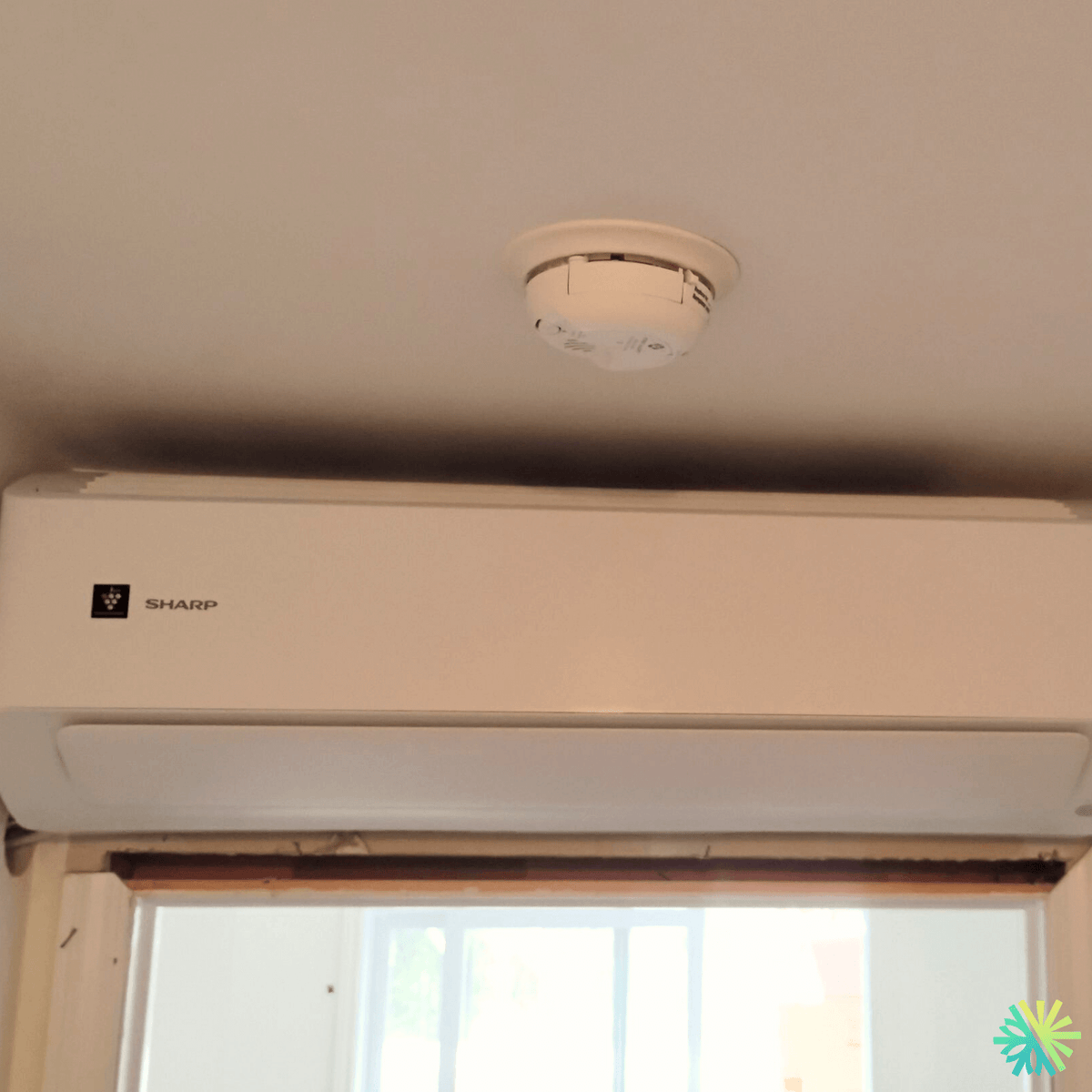
AirGreen installed a Sharp wall-mounted heat pump (type ZU1 ) in Rosemont–La Petite-Patrie, with precise placement above a window and minimal ceiling clearance, for four-season comfort and clean integration in a Montreal residential setting.
Take a tour of the installation
Each number is a point we check on site. Switch between summer and winter to watch air and heat move.
In summer, the outdoor unit rejects the house's heat outside.
Generic illustration of this type of installation, not a survey of this job site. Tap a number.
Mounted level on a wall plate, high enough for the air to reach the whole room, with enough space around it to slide the filters out easily.
The refrigerant lines, the communication cable and the drain go through the wall in a single opening, sealed against water, cold air and insects.
Two insulated copper pipes connect the two units. Outside, a line cover can protect them from sun, knocks and weather.
A shut-off switch near the outdoor unit isolates it safely for service. It must stay accessible at all times.
The compressor and the fan. In heating mode it captures heat from the outdoor air, even in winter, and moves it inside.
On the ground or on the wall, it keeps the unit above accumulated snow. The unit stays clear and defrost water can drain away.
The fan needs to blow freely. Storage, a fence or a wall too close, and efficiency drops while noise goes up.
In Rosemont–La Petite-Patrie, you often find homes where every detail counts: windows close to the ceiling, load-bearing walls that must be respected, air circulation that needs optimizing in rooms that are sometimes long and narrow, and a clear need for year-round comfort without major renovations. For this project, we installed aSharp wall-mounted heat pump , a very logical choice to improve both summer air conditioning and supplemental (or primary, depending on the layout) heating.
From the photo, it is clearly a wall-mounted indoor unit (mini-split) , installed just above a window , with minimal clearance to the ceiling — a typical scenario in Montreal residential buildings where one has to work with the existing architecture.
The installed system: Sharp wall-mounted heat pump (ZU1 series)
Since the brand name is provided manually, we are referring to a Sharp wall-mounted heat pump . In terms of model, the assembly and dimensions are a perfect match for a Sharp ZU1 (R-32) installation, a residential series known for offering a modern and efficient solution in homes where:
-
heat and cool with the same device;
-
to achieve rapid and stable comfort ;
-
limit the bulk (without ducts);
-
maintain a clean aesthetic .
In Rosemont, this type of mural is particularly appreciated because it integrates well into living spaces and allows for better management of temperature differences between zones (direct sunlight, living room area, bedroom, etc.).
Why install the indoor unit above a window?
It's no coincidence that the unit is placed above the window. In many homes, it's often one of the few walls that allows for:
-
A logical air distribution towards the center of the room (rather than blowing directly onto a bed or sofa).
-
A space saving : we avoid sacrificing an entire wall that could be used for storage or layout.
-
A “clean” installation : the refrigeration lines and the drain can be discreetly routed to the side.
-
Improved comfort in summer : fresh air can counteract the heat gain near windows and balance the room faster.
However, this type of location requires rigorous execution: perfect level, clearances respected, and above all planning to avoid “surprises” (condensation, vibration, or poorly directed airflow).
Visible installation details (and what they reveal about a job well done)
1) Very tight ceiling clearance: precision required
The photo shows that the unit is installed very close to the ceiling. In this context, it is absolutely essential to respect the recommended clearances for:
-
ensure good air intake ;
-
prevent the device from "straining" unnecessarily;
-
maintain quiet operation;
-
maintain access to the panels for maintenance.
At AirGreen, when installing "high on wall" with a tight clearance, we plan the alignment and fixing to avoid any twisting of the frame, which can cause noise, vibration or creaking over time.
2) Installation above a frame: finish and sturdiness
Note the top of the window and the frame just below the unit. This is an area where the structure can vary (lintel, mullions, woodwork). A durable installation requires:
-
a secure attachment to the appropriate structure;
-
a perfectly level support;
-
Attention to aesthetics so that the unit appears “integrated”, not “quickly hung”.
3) Real-life context: smoke detector nearby
The ceiling-mounted detector confirms a typical residential environment. In this type of room, we always take care to ensure that the installation does not interfere with safety features (access, maintenance, clearances), while optimizing air circulation.
Optimizing performance in a Montreal home: what to do after installation
A wall-mounted heat pump isn't "perfect" just because it's attached to the wall: the settings matter a great deal. After installation, we typically optimize:
-
the orientation of the fins to avoid blowing directly on the occupants;
-
ventilation speed (comfort vs. mixing);
-
the operating mode according to the season (heating/air conditioning/dehumidification);
-
the comfort strategy in the mid-seasons (very frequent in Montreal).
In Rosemont, this is often the key: avoiding the “too hot / too cold” effect, and obtaining a stable temperature even when the weather changes rapidly.
Common mistakes when installing above a window (and how to avoid them)
Poorly managed condensation
In air conditioning systems, condensation must be properly drained. If the drain is poorly designed, you can end up with water stains, odors, or damage. Our approach:
-
actual and tested slope;
-
secure connections;
-
a route that minimizes long-term risks.
Poorly directed air diffusion
Above a window, air can "bounce" depending on the arrangement. The angles and modes are adjusted so that the air is evenly distributed throughout the room.
Poor finishing
A renovated or well-maintained home deserves a clean finish. The goal is for the installation to remain beautiful… even after many years.
What the customer actually gains
After this type of Sharp installation, the benefit is immediate:
-
rapid comfort in heating and air conditioning;
-
reduction of uncomfortable areas near windows;
-
better humidity management in summer (depending on use);
-
a modern and efficient solution without the need for pipework.
AirGreen in Montreal: a clean installation, designed to last
Our signature is installations that respect both performance and aesthetics. In neighborhoods like Rosemont–La Petite-Patrie, where each dwelling has its own unique characteristics, we focus on:
-
precise installation (level, solidity, clearances);
-
clean routing of links and drainage;
-
intelligent settings for stable comfort;
-
a local, human, and sustainability-oriented service.
The unit on this job, in figures
The range as published on airgreen.ca: pick a size to see its capacity in deep cold.
| Size | Heating at −8 °C | Heating at −15 °C | Coldest certified point | COP at −15 °C | SEER | HSPF | Indicative LogisVert aid |
|---|---|---|---|---|---|---|---|
| Sharp ZU1 12 000 | 14,500 | 12,000 | −27 °C: 7,200 | 2.11 | 22.0 | 11.0 | $1,740 |
| Sharp ZU1 15 000 | 18,100 | 15,300 | −27 °C: 10,100 | 2.1 | 24.0 | 11.0 | $2,172 |
| Sharp ZU1 18 000 | 22,000 | 18,000 | −27 °C: 11,500 | 2.2 | 24.0 | 11.0 | $2,640 |
| Sharp ZU1 24 000 | 22,400 | 19,000 | −27 °C: 12,300 | 2.2 | 22.0 | 11.0 | $2,688 |
According to NEEP, it delivers 14,500 BTU/h at −8 °C (17 °F), more than at 8 °C (14,000 BTU/h). It heats as hard in moderate cold as in mild weather.
According to NEEP, its certified maximum capacity at −27 °C (−17 °F) is 7,200 BTU/h, 60% of its nominal 12,000 BTU size.
At 8 °C, its certified maximum capacity reaches 17,100 BTU/h, 42% more than its nominal 12,000 BTU size.
According to NEEP, it delivers 18,100 BTU/h at −8 °C (17 °F), more than at 8 °C (18,000 BTU/h). It heats as hard in moderate cold as in mild weather.
According to NEEP, its certified maximum capacity at −27 °C (−17 °F) is 10,100 BTU/h, 67% of its nominal 15,000 BTU size.
At 8 °C, its certified maximum capacity reaches 21,800 BTU/h, 45% more than its nominal 15,000 BTU size.
According to NEEP, it delivers 22,000 BTU/h at −8 °C (17 °F), more than at 8 °C (21,600 BTU/h). It heats as hard in moderate cold as in mild weather.
According to NEEP, its COP at −27 °C is 1.88: the highest of the ZU1 line, which ranges from 1.79 to 1.82 at that temperature.
According to NEEP, its certified maximum capacity at −27 °C (−17 °F) is 11,500 BTU/h, 64% of its nominal 18,000 BTU size.
At −27 °C, its certified minimum capacity is 3,200 BTU/h (5,500 at 8 °C). It slows down instead of cycling on and off.
According to NEEP, its certified heating capacity at −15 °C (5 °F) is 19,000 BTU/h, 79% of its nominal 24,000 BTU size. Its COP there is 2.20.
Data read live from the airgreen.ca page of each size (NEEP / AHRI certified performance). When the title names the installed size, it is highlighted; otherwise the whole range is shown. The aid shown is today’s, using Hydro-Québec’s rule ($120 per 1,000 BTU/h at −8 °C); amounts quoted in the article date from its publication. Only Hydro-Québec confirms the assistance granted.
The big day, step by step
The main steps of this kind of job at AirGreen. Every house has its quirks: the estimate brings them out.
We look at the room, the outside wall, the line route and where the outdoor unit will go. That is where the capacity gets chosen.
Model, capacity and price, in writing. We also check whether the model qualifies for assistance programs.
Floors and furniture protected, wall plate position marked level, wall opening located.
A single opening, with the slope the drain needs to flow outside.
Set on a stand raised above the snow, with the clearances the manufacturer requires.
Connected, insulated and protected. The opening is then sealed against water, cold air and insects.
A dedicated circuit and an accessible disconnect near the outdoor unit.
Leak test, vacuum, then start-up and a check of heating and cooling.
Remote, modes, filters: we show you the essentials before we leave.
- The on-site estimateWe look at the room, the outside wall, the line route and where the outdoor unit will go. That is where the capacity gets chosen.
- The quoteModel, capacity and price, in writing. We also check whether the model qualifies for assistance programs.
- Getting readyFloors and furniture protected, wall plate position marked level, wall opening located.
- The wall openingA single opening, with the slope the drain needs to flow outside.
- The outdoor unitSet on a stand raised above the snow, with the clearances the manufacturer requires.
- Lines, cable and drainConnected, insulated and protected. The opening is then sealed against water, cold air and insects.
- The electrical workA dedicated circuit and an accessible disconnect near the outdoor unit.
- Tests and start-upLeak test, vacuum, then start-up and a check of heating and cooling.
- The walkthroughRemote, modes, filters: we show you the essentials before we leave.
What would it look like at your place?
Two quick checks with real numbers: what heat costs, and what your current heaters add up to in BTU/h.
Baseboards and electric furnaces turn 1 kWh of electricity into 1 kWh of heat. A heat pump delivers more: that is its COP. At Hydro-Québec’s rate D (11.142¢/kWh above 40 kWh a day, since 1 April 2026):
Hydro-Québec: a heat pump can be up to three times more efficient than baseboards for heating in the colder months.
Estimate per kWh of heat, at the chosen temperature, using the certified COP from the product page. Taxes, access charge and backup heat not included.
Conversion: 1 W = 3.412 BTU/h. An indication, not a load calculation: baseboards and furnaces are often stronger than the real need, and they can stay as backup. AirGreen confirms the capacity on site.
Four mistakes we do not make
Flip each card to see what we do instead.
Your own project, step by step
What to do, season by season
Three habits per season for this unit. They take a few minutes and prevent many calls.
- Clean the indoor unit's filters.
- Clear leaves and debris left on the outdoor unit by winter.
- Test cooling before the first hot days.
- Clean the filters more often when the unit runs a lot.
- Keep plants away from the outdoor unit.
- Check that no water drips from the indoor unit.
- Rake the leaves around the outdoor unit.
- Test heating before the first cold days.
- Book periodic maintenance before winter.
- Keep snow away from the stand and the front of the unit.
- Let the unit defrost: it is normal.
- Never hit the ice on the fins; call us if the unit stays iced up.
Is your home ready?
Check what applies at your place. A "no" is not a refusal: it is what we sort out during the estimate.
Four statements: true or false?
It all comes down to details you have just seen.
1. In heating mode, the outdoor unit can produce water.
During defrost cycles. That water must drain away without forming ice.
2. You pick the capacity with a simple square-footage rule.
Windows, insulation, orientation and how the room is used all count. Capacity is chosen on site.
3. A multi-zone connects several indoor heads to a single condenser.
One head per room, all on the same condenser. Each room keeps its own temperature.
4. The disconnect can sit behind the patio furniture.
It must stay accessible: it is what shuts the unit off for service.
0 / 4 right answers
What people ask us about this kind of work
Does a wall-mounted heat pump heat in winter?
Wall-mounted or multi-zone: how do I choose?
Where does the outdoor unit go?
Are there grants?
Do I need a permit?
How cold can it heat?
How much can I save?
How is the LogisVert assistance calculated?
Is it noisy?
The outdoor unit is covered in ice: is that normal?
Does AirGreen hold the required licences?
Is the estimate free?
No question matches. Write to us: we answer.
More jobs to see, near you
By town, by equipment or by region: browse more than 4,700 published projects.
Each dot: a town where AirGreen has published projects. The glowing dot: this job.
Every house has its constraints. We see them before we install.
The on-site estimate is free and the quote follows within 24 hours.
Text and photo: a real AirGreen Climatisation & Chauffage job. The diagrams are generic illustrations of the type of installation, not a survey of this job site. Sources of the added figures: airgreen.ca product pages (NEEP / AHRI performance), Hydro-Québec (Heat pumps page, LogisVert, read on 13 October 2026), Régie de l’énergie (rate D as of 1 April 2026).