
Midea wall-mounted heat pump installation in Ville-Marie (Montreal): discreet comfort, four-season performance
In Ville-Marie, AirGreen installed a Midea wall-mounted heat pump (mini-split type) with a discreet design, optimized for a condo: uniform diffusion, quiet comfort, four-season performance and maintenance recommendations.
- City
- Region
- Equipment
- Brand
- Challenges
- Published
The job on one screen
The article, chapter by chapter
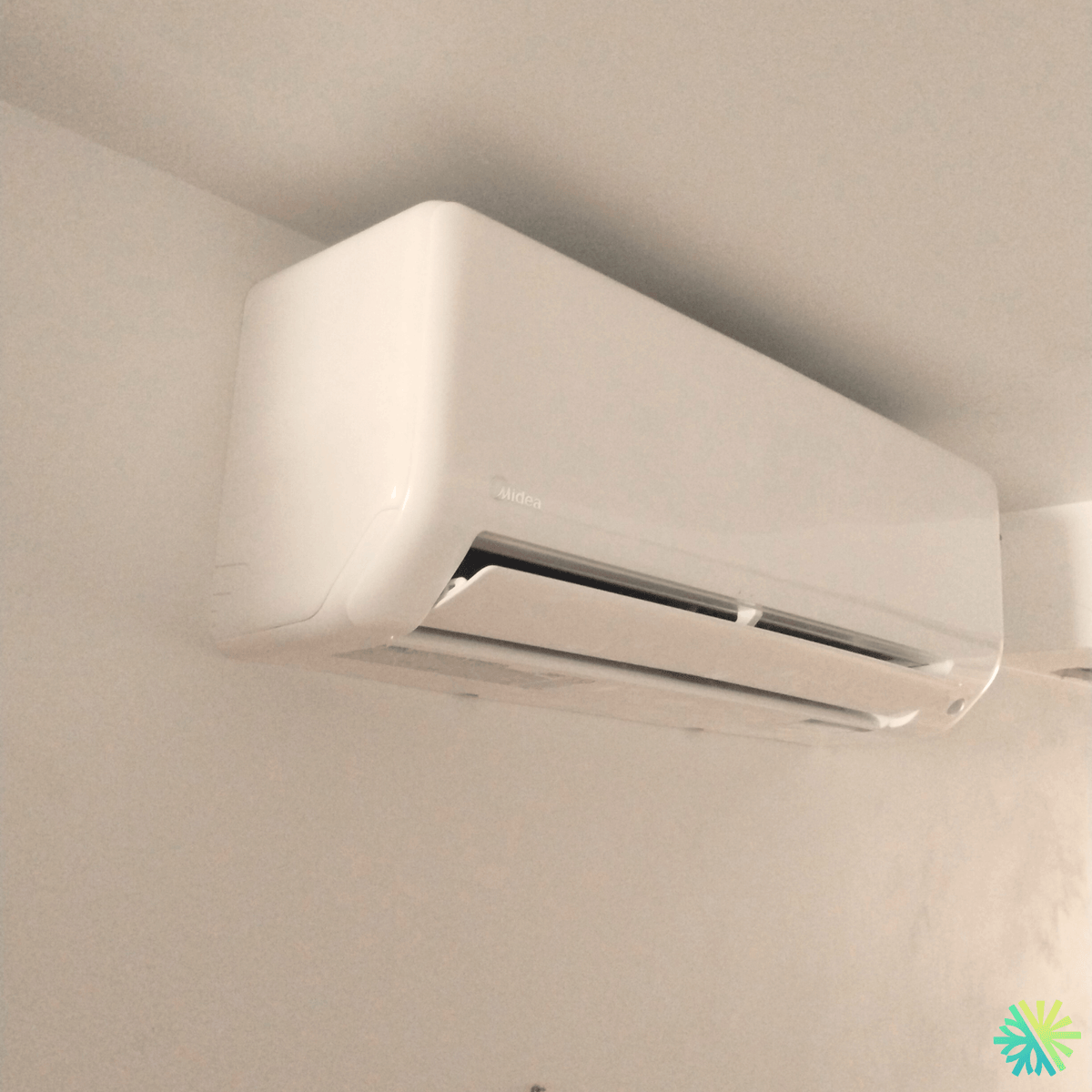
In a Ville-Marie condo, every detail counts: aesthetics, quietness, wall space… and above all, comfort in both summer and winter. This is precisely the context for this recent installation by AirGreen : aMidea wall-mounted heat pump installed high up, near the ceiling, for uniform air distribution and the cleanest possible visual integration.
The photo clearly shows a wall-mounted indoor unit with a clean, minimalist design, typical of modern residential installations in downtown Montreal: clean lines, a glossy white surface, and a high placement to optimize air circulation. This type of environment (smooth walls, a condo-style layout, and few visible elements) is perfectly suited to a well-sized mini-split system.
In this project, we directed the choice towards a solution from the Midea range, and more specifically a model consistent with urban needs: Midea28 (new generation wall-mounted heat pump), renowned for its ability to maintain excellent comfort even when the Quebec winter makes itself felt.
Why a Midea wall-mounted heat pump in Ville-Marie?
Ville-Marie is a unique mix: condo towers, heritage buildings, high-end renovations, sometimes compact spaces, and a distinctly Montreal reality— noise and the need for careful temperature control . A wall-mounted heat pump (mini-split) is often the best solution to these challenges because it allows for:
-
efficient heating without major ductwork work;
-
stable air conditioning during periods of heat and humidity;
-
a targeted comfort zone (living room/open area, master bedroom, etc.);
-
an excellent compromise between performance, discretion and operating cost .
And in a condo, the goal is not just to “heat/cool”: it is to do it quietly , evenly , and with a clean installation (visually and technically).
The type of machine installed: wall-mounted heat pump (mini-split)
In this case, it is a wall-mounted heat pump , composed of:
-
an indoor unit (visible in the photo)
-
an outdoor unit (condenser)
-
refrigerant lines + power supply + condensation drainage
This configuration is very common in Montreal (Plateau-Mont-Royal, Rosemont–La Petite-Patrie, Verdun, Ville-Marie, Griffintown/neighboring areas), because it avoids demolishing and rebuilding conduits, while offering superior comfort compared to many conventional electrical solutions.
Selected model: Midea28 (consistent with a four-season residential installation)
When the exact model isn't visible in a photo of an indoor unit, we remain realistic and consistent with the ranges actually installed in Greater Montreal. Here, the most logical solution is a Midea28 , particularly appreciated for its winter-oriented design and modern approach (efficiency, control, comfort).
What we are specifically looking for with a Midea28 in a condo
-
Stable heating during cold periods (important even in urban areas, where winds and temperature variations are frequent)
-
Good energy efficiency to reduce the bill
-
Consistent comfort (fewer variations, fewer "drafts")
-
Low noise level , especially in the evening and at night
-
Precise control (temperature, ventilation, modes, sometimes via app depending on configuration)
Observable installation details: a "clean" and efficient integration
Several elements stand out in the photo and clearly indicate how the installation was conceived:
1) Positioning at a height, near the ceiling
This is a key point. A high-mounted indoor unit:
-
improves air circulation in the room;
-
reduces hot/cold zones;
-
limits the visual impact to eye level;
-
optimizes wall space (very useful in condos).
2) Alignment and aesthetics
The unit is installed in such a way as to remain discreet , with a “minimalist” finish: no unnecessary visible accessories, no imposing cable trays on the visible section, and a clean alignment that respects the interior architecture.
3) Pipe and drainage management
Even though the back of the unit is not visible, an installation of this type implies:
-
a precise passage of refrigerant lines to the outside (often through the wall behind the unit);
-
condensation drain management (essential in air conditioning mode);
-
a solid attachment to the structure to prevent vibrations.
In Ville-Marie, these details are crucial: concrete walls, co-ownership, balcony access, internal regulations… everything must be planned and executed properly.
Our AirGreen approach: installing for comfort… and for real life in Montreal
A wall-mounted heat pump in a condo isn't just about "hanging a unit." At AirGreen, we work based on actual usage:
Everyday comfort
-
Reduced humidity in summer (a real plus in several downtown buildings)
-
Stable temperature in open areas
-
Possibility of keeping a room cooler for sleeping
Silence and perceived air quality
Condos can sometimes amplify noise (hard surfaces, ceilings, open spaces). Therefore, we pay particular attention to:
-
the quality of the anchoring;
-
the air trajectory (avoid direct airflow onto a sofa or bed);
-
ventilation settings for gentle comfort.
Performance in Quebec winter
Even in Ville-Marie, winter is still winter: cold spells, rapid temperature changes, and winds. A well-chosen and properly installed heat pump should be able to heat efficiently without giving the impression of constantly "working hard."
Common mistakes we avoid (and that make all the difference)
Here are some things we often correct during repairs or service calls in Greater Montreal:
-
Poorly placed indoor unit : direct airflow into a living area, constant discomfort.
-
Improvised drainage : risks of drips, stains, and moisture.
-
Approximate sizing : cycles too short, noise, unstable temperature.
-
Poor visual finish : misaligned cable trays, visible drilling, sloppy integration.
-
Difficult access for maintenance : forgotten filters, clogged unit, falling performance.
In this project in Ville-Marie, the installation was designed to avoid these pitfalls from the outset.
Recommended maintenance for a Midea wall-mounted heat pump in a condo
To maintain efficiency and air quality:
-
Filter cleaning : every 4 to 6 weeks (more often if pets, dust, work).
-
Seasonal check : before the heat of summer and before winter.
-
Complete maintenance (annual or as used): deeper cleaning, drainage check, general inspection.
Regular maintenance means less risk of bad odors, less noise, and a longer lifespan.
Conclusion: a Midea solution perfectly suited to Ville-Marie
This Midea wall-mounted heat pump installation in Ville-Marie perfectly illustrates what many condo owners in Montreal are looking for: four-season comfort , an aesthetically pleasing installation , and performance that doesn't sacrifice either silence or efficiency.
At AirGreen , we install this type of solution daily in Ville-Marie , as well as in Outremont, Westmount, Verdun, Le Sud-Ouest, Rosemont–La Petite-Patrie , Laval , and on the South Shore . Each project is different, but our goal remains the same: a clean, sustainable installation designed for your lifestyle.
The job tools
Two quick checks with real numbers: what heat costs, and what your current heaters add up to in BTU/h.
Conversion: 1 W = 3.412 BTU/h. An indication, not a load calculation: baseboards and furnaces are often stronger than the real need, and they can stay as backup. AirGreen confirms the capacity on site.
How the job unfolds
The main steps of this kind of job at AirGreen. Every house has its quirks: the estimate brings them out.
We look at the room, the outside wall, the line route and where the outdoor unit will go. That is where the capacity gets chosen.
Model, capacity and price, in writing. We also check whether the model qualifies for assistance programs.
Floors and furniture protected, wall plate position marked level, wall opening located.
A single opening, with the slope the drain needs to flow outside.
Set on a stand raised above the snow, with the clearances the manufacturer requires.
Connected, insulated and protected. The opening is then sealed against water, cold air and insects.
A dedicated circuit and an accessible disconnect near the outdoor unit.
Leak test, vacuum, then start-up and a check of heating and cooling.
Remote, modes, filters: we show you the essentials before we leave.
- The on-site estimateWe look at the room, the outside wall, the line route and where the outdoor unit will go. That is where the capacity gets chosen.
- The quoteModel, capacity and price, in writing. We also check whether the model qualifies for assistance programs.
- Getting readyFloors and furniture protected, wall plate position marked level, wall opening located.
- The wall openingA single opening, with the slope the drain needs to flow outside.
- The outdoor unitSet on a stand raised above the snow, with the clearances the manufacturer requires.
- Lines, cable and drainConnected, insulated and protected. The opening is then sealed against water, cold air and insects.
- The electrical workA dedicated circuit and an accessible disconnect near the outdoor unit.
- Tests and start-upLeak test, vacuum, then start-up and a check of heating and cooling.
- The walkthroughRemote, modes, filters: we show you the essentials before we leave.
What we check on a job like this one
Each number is a point we check on site. Switch between summer and winter to watch air and heat move.
In summer, the outdoor unit rejects the house's heat outside.
Generic illustration of this type of installation, not a survey of this job site. Tap a number.
Mounted level on a wall plate, high enough for the air to reach the whole room, with enough space around it to slide the filters out easily.
The refrigerant lines, the communication cable and the drain go through the wall in a single opening, sealed against water, cold air and insects.
Two insulated copper pipes connect the two units. Outside, a line cover can protect them from sun, knocks and weather.
A shut-off switch near the outdoor unit isolates it safely for service. It must stay accessible at all times.
The compressor and the fan. In heating mode it captures heat from the outdoor air, even in winter, and moves it inside.
On the ground or on the wall, it keeps the unit above accumulated snow. The unit stays clear and defrost water can drain away.
The fan needs to blow freely. Storage, a fence or a wall too close, and efficiency drops while noise goes up.
Is your home ready?
Check what applies at your place. A "no" is not a refusal: it is what we sort out during the estimate.
Good habits, once the unit is in place
Six simple habits that keep the unit going. Your list stays on this device.
What to do, season by season
Three habits per season for this unit. They take a few minutes and prevent many calls.
- Clean the indoor unit's filters.
- Clear leaves and debris left on the outdoor unit by winter.
- Test cooling before the first hot days.
- Clean the filters more often when the unit runs a lot.
- Keep plants away from the outdoor unit.
- Check that no water drips from the indoor unit.
- Rake the leaves around the outdoor unit.
- Test heating before the first cold days.
- Book periodic maintenance before winter.
- Keep snow away from the stand and the front of the unit.
- Let the unit defrost: it is normal.
- Never hit the ice on the fins; call us if the unit stays iced up.
The right pages, at the right time
Four statements: true or false?
It all comes down to details you have just seen.
1. In heating mode, the outdoor unit can produce water.
During defrost cycles. That water must drain away without forming ice.
2. You pick the capacity with a simple square-footage rule.
Windows, insulation, orientation and how the room is used all count. Capacity is chosen on site.
3. A multi-zone connects several indoor heads to a single condenser.
One head per room, all on the same condenser. Each room keeps its own temperature.
4. The disconnect can sit behind the patio furniture.
It must stay accessible: it is what shuts the unit off for service.
0 / 4 right answers
What people ask us about this kind of work
Does a wall-mounted heat pump heat in winter?
Wall-mounted or multi-zone: how do I choose?
Where does the outdoor unit go?
Are there grants?
Do I need a permit?
How cold can it heat?
How much can I save?
How is the LogisVert assistance calculated?
Is it noisy?
The outdoor unit is covered in ice: is that normal?
Does AirGreen hold the required licences?
Is the estimate free?
No question matches. Write to us: we answer.
More jobs to see, near you
By town, by equipment or by region: browse more than 4,700 published projects.
Each dot: a town where AirGreen has published projects. The glowing dot: this job.
An on-site estimate, the right capacity, the right equipment.
The on-site estimate is free and the quote follows within 24 hours.
Text and photo: a real AirGreen Climatisation & Chauffage job. The diagrams are generic illustrations of the type of installation, not a survey of this job site. Sources of the added figures: airgreen.ca product pages (NEEP / AHRI performance), Hydro-Québec (Heat pumps page, LogisVert, read on 13 October 2026), Régie de l’énergie (rate D as of 1 April 2026).