
Installation of a GREE FreeMatch R32 2-head heat pump in Noyan (Haut-Richelieu RCM)
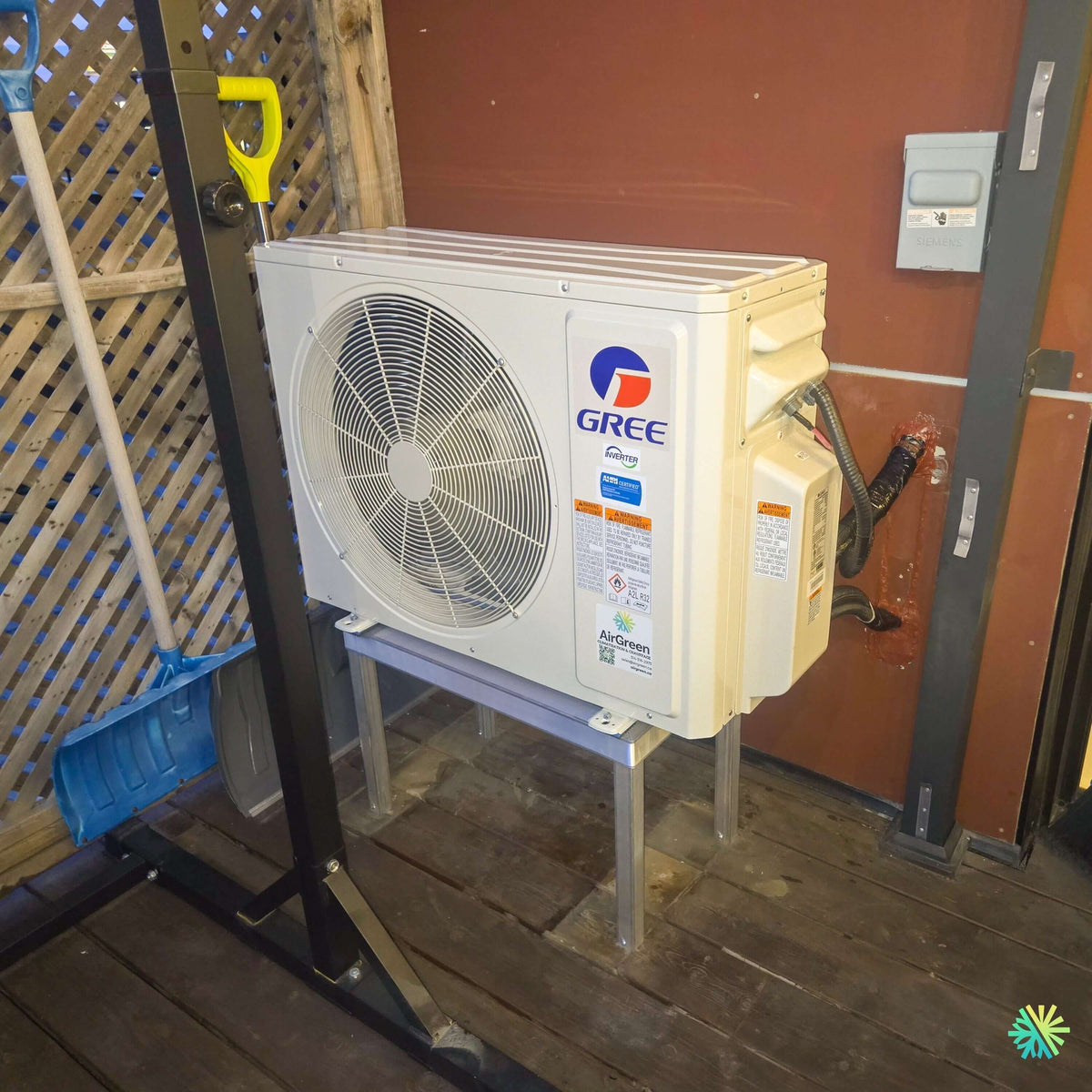
In Noyan, the border runs at the end of the road. Can you buy your heat pump in Vermont? Five verified obstacles, and customs is the easiest one. Plus: a GREE FreeMatch R32 GWHD(30) installed on a wooden deck enclosed by lattice.
In summer, the outdoor unit rejects the house's heat outside.
Generic illustration of this type of installation, not a survey of this job site. Tap a number.
Mounted level on a wall plate, high enough for the air to reach the whole room, with enough space around it to slide the filters out easily.
The refrigerant lines, the communication cable and the drain go through the wall in a single opening, sealed against water, cold air and insects.
Two insulated copper pipes connect the two units. Outside, a line cover can protect them from sun, knocks and weather.
A shut-off switch near the outdoor unit isolates it safely for service. It must stay accessible at all times.
The compressor and the fan. In heating mode it captures heat from the outdoor air, even in winter, and moves it inside.
On the ground or on the wall, it keeps the unit above accumulated snow. The unit stays clear and defrost water can drain away.
The fan needs to blow freely. Storage, a fence or a wall too close, and efficiency drops while noise goes up.
In Noyan, the border runs at the end of the concession road: what crosses it, and what does not
The municipality of Noyan has a feature shared by few Quebec villages: its southern boundary is the international border. Vermont begins where the farmland ends. Its best-known cheese producer, Fromagerie Fritz Kaiser, on Chemin de la 4e Concession, even named its most award-winning cheese—grand champion at the 2004 Canadian Cheese Grand Prix—“Le Douanier”, and produces another that simply bears the name Noyan.
This proximity raises a question we hear here more often than elsewhere, and almost never in Montreal or Laval: “The same heat pump costs less on the other side. Can I buy it there and ask you to install it?”
The answer deserves better than a blunt “no.” We checked the five real obstacles, one by one, against government sources. The result is counterintuitive: customs is the easiest of the five.
Five obstacles—and the one everyone thinks of is the least serious
1. The rebate hinges on the invoice, not the machine
This is the clearest point, and it settles the question before any technical considerations. Hydro-Québec's LogisVert residential program participation guide requires, among the eligibility conditions for an efficient heat pump, that the equipment must:
“to have been purchased from a store in Quebec or online from a company with an address in Quebec”
In other words: equipment purchased in Vermont is disqualified under the purchase requirement, even if the identical model appears on the list of efficient heat pumps. This is not a question of efficiency, AHRI certification, or performance. It is about where the invoice originated.
Two other eligibility requirements from the same guide are worth knowing:
- The installing company must be registered with the Registraire des entreprises du Québec and hold the appropriate RBQ licences, “taking into account the work to be performed”;
- The invoice must include the invoice number and date, installation date, customer's name, installation address, and the name of the company that carried out the work.
A recent condition has also been added: heat pumps installed on or after November 26, 2025, must be ENERGY STAR certified to be eligible. The guide dated August 25, 2025, did not include it—this is a typical example of a program moving faster than the blog posts describing it.
2. Refrigerant is not a commodity; it is a qualification-controlled substance
Even if the appliance gets through, it must be commissioned. In Quebec, however, the Halocarbon Regulation is explicit:
- its section 43 reserves the act of “servicing, charging, transferring or evacuating the halocarbon charge” of an appliance to persons holding the required certificate;
- its section 51 requires anyone who sells or supplies halocarbons to ensure that the buyer holds this certificate or employs someone who does.
The Quebec government summarizes the consequence in one sentence: “Only persons holding this qualification may purchase or otherwise obtain halocarbons.” Certificate H is issued as part of the environmental qualification for halocarbons.
What this means in practical terms: a homeowner cannot legally purchase R-32 in Quebec, and no one can legally sell it to them. These sections concern the act performed in Quebec, not the origin of the appliance. The origin of the unit does not change the qualification required to charge it.
3. “It works on 240 volts” is not the right test
This is the most elegant trap in the case. The North American electrical system is the same on both sides: 208/230 V, 60 Hz. The machine purchased in Vermont will start. It will heat. It will cool.
And that is not the issue.
Section 2-024 of the Quebec Construction Code, Chapter V – Electricity requires all electrical equipment used in an installation to be approved, and prohibits using unapproved equipment or permanently connecting it. The RBQ clarifies what approved means: the equipment bears “a label or mark proving that it has been tested and recognized as complying with the applicable Canadian standard” by a recognized organization. Recognized marks appear in their Canadian form: CSA, ULC, cUL, cETL, and other accredited marks.
Consequently—and we present it as a consequence of the rule, not as a quotation from the RBQ: two physically identical machines, one bearing the cUL mark and the other bearing only the UL mark, are not the same object under the Quebec Code. Unit-by-unit approval procedures by an accredited organization do exist; we have not verified the process or cost for a residential appliance, and therefore will not describe them.
4. The RBQ licence: it is not one, but several
Section 46 of the Building Act is unambiguous:
“No one may perform the functions of a construction contractor, take that title, or lead others to believe that they are a construction contractor, unless they hold a licence in force for that purpose.”
The same section prohibits a contractor from using the services of another unlicensed contractor.
What most homeowners do not realize is that the work is not covered by a single subcategory. Subcategory 15.10 – Refrigeration Contractor covers “any refrigeration system, including those relating to air conditioning”; subcategory 15.8 – Ventilation Contractor covers air circulation and distribution systems, excluding electrical connections and connections to refrigeration systems. The competency profile for 15.10 even specifies that a refrigeration contractor may work on the heating appliances of a forced-air or hydronic system only if they also hold the relevant subcategories.
Hence the exact wording used by subsidy programs: “the appropriate licences, considering the work to be performed”. A reader checking a licence must therefore not merely confirm that a number exists: they must check the subcategories.
The concrete protection one loses by going without it has a name: the licence bond, which the RBQ describes as “an amount intended to compensate its clients in the event of harm.” We will leave it at that. It is often said that an unlicensed contractor voids home insurance or a warranty plan; we found no government source stating this, and therefore we will not write it.
5. The warranty follows a network, not a machine
Here, honesty requires a nuance that works against the easy argument.
The limited warranty statement published by GREE for the U.S. market excludes products “installed outside the United States or Canada”—which therefore does not exclude installation in Quebec—and requires installation by a licensed contractor in accordance with applicable codes. The same document states that the registration requirement within ninety days does not apply in Quebec, or in jurisdictions that prohibit conditioning a warranty on registration.
We therefore will not tell Quebec readers that they lose their warranty for failing to register. What remains true, and what we observe in the workshop, is more prosaic: warranty service goes through the authorized distribution network in the country of installation. Equipment acquired outside that network has no local file, no local parts channel, and no local contact when an electronic board fails in January. The FreeMatch brochure itself ties the two-year extension to registration with the distributor.
Two corrections that almost every article gets wrong
Since we had opened the documents, we might as well correct two widespread errors:
- Rénoclimat no longer funds heat pumps. The participant guide states: “Since May 1, 2024, financial assistance for geothermal heating systems or air-source heat pumps is no longer provided through the Rénoclimat program.” Comparators that still list it are copying an outdated page.
- Canadian counter-tariffs do not apply to HVAC equipment. The list published by the Department of Finance Canada contains no entries for these appliances, and Canada removed its counter-tariffs on most U.S. imports on September 1, 2025, with steel, aluminum, and automobiles being the exceptions. This is a volatile matter: recheck it on the date of reading.
And customs, for that matter
The federal regulations on ozone-depleting substances and halocarbons do not work the way one might imagine. For bulk HFCs, it is a permit and allocation system. For products containing HFCs, it is a ban based on global warming potential for listed products—with an explicit exemption for a product intended for residential use if it is a personal effect of the person importing it.
We were unable to consult the current consolidated version of the annex listing the products covered, and we therefore will not state whether or not a residential wall-mounted heat pump is included. What remains is the ordinary customs process, which is well documented by the Canada Border Services Agency: all goods acquired abroad must be declared; the published personal exemptions are C$200 after 24 hours and C$800 after 48 hours or 7 days; and a heat pump exceeds these thresholds in every realistic scenario—so GST and QST become payable at the border, on top of the U.S. price.
The paradox can be summed up in one sentence: the border is the most crossable obstacle of the five. It is the invoice, the refrigerant, the certification seal, and the licence that stop the project.
The floor is part of the installation
The second aspect of this project is physical, and it involves a configuration we often encounter at cottages: the outdoor unit rests neither on the ground, nor on a slab, nor on a wall bracket, but on a wooden deck, itself enclosed by a trellis that turns it into a small enclosure.
We have already published the essentials surrounding this situation, and we are not going to rewrite them:
- the deck as a drainage plane, the hose-versus-free-drainage trade-off, the joist beneath the drip line, and the question “how old is this deck?” asked at the time of quoting — Brossard;
- the load of a verified, not assumed, wooden deck, supports placed close to the wall, no anchoring into the decking, compatible hardware — Lachine and Kahnawà:ke;
- the physics of screening: free area, a box that recirculates its own air, a defrost plume that freezes on the screen, material ratings, and the five AirGreen rules — Westmount;
- the microclimate of an enclosure, “a deck skirt counts as a fence,” and the solution of installing a single louvered panel beforehand rather than afterward — Oka.
What none of these pages addressed, because none had the opportunity, is the floor. Throughout the series, the unit was above the ground, above a membrane, above a slab, suspended from a wall, or under a deck. Here, it is resting on a floor that people use for something else. This changes three things.
The Fifth Face
An enclosure is ordinarily assessed on four sides: the wall of the house, the panels, and the opening. We published at Ange-Gardien that wall + deck skirt + trellis form a box that no one intended to build.
A deck adds the face that this reasoning did not count: the underside is closed. On a stone bed, gravel, or lawn, some of the air still sweeps around the frame at ground level. On a solid deck, this low-level circulation disappears, and the laden air descending along the panels has nowhere to go.
The rule we apply is simple to state and strict to follow: count the open faces before choosing the location, and the floor counts as a closed face. As a reminder, this cabinet blows forward and draws air in from the rear and sides — the clearance that matters is the open area for lateral and rear intake, not the space above. A trellis that closes a third vertical face, on a floor that already closes one, leaves the air with only one direction to flow.
The clearance that is crossed every week
Here is the second discrepancy, and it is human rather than thermodynamic.
Clearance around an outdoor unit is, in the vast majority of cases, a space that no one walks through: a stone bed, a strip of lawn, a strip of gravel. On a porch, it is the opposite: it is a service floor, and it is already in use. In the case at hand, a wheeled bin is kept there permanently, along with two shovels in winter.
We have already written that nothing is stored beneath a unit (Ahuntsic-Cartierville), that a clearance rarely disappears by decision and almost always through neglect (Sainte-Hélène-de-Bagot), and that no one voluntarily trims a shrub leaning against a running unit (Ville-Marie). The point specific to an enclosed porch is this: objects do not accumulate there; they circulate.
- The wheeled bin is not set down once: it is taken out and brought back every week, across the clearance area, by someone who is not thinking about the unit. A bin also contains organic matter, less than one meter from a side that draws air in.
- The shovels appear in November and disappear in April. A clearance measured with a tape measure in July no longer exists in January—and that is not negligence; it is the normal life of a porch.
The remedy is not technical; it is administrative, and we borrow it from Sainte-Hélène-de-Bagot while making it stricter: the enclosure is identified as a “service area” in the acceptance file, with its clearances on each side, and the question asked every year during maintenance is “what has been placed here since last year, and what passes through here every week?” The second half of the question is new, and it is the one that matters on a porch.
The floor is an accumulation surface that no one clears of snow
Third discrepancy—and this is the one that brings us full circle with the shovels.
A courtyard is cleared of snow. A driveway is blown clear. A roof is monitored. An enclosed porch screened with lattice is neither cleared of snow nor blown clear: snow enters through the slats, accumulates against the frame, and no one has any reason to go looking for it until the unit heats less effectively. On top of that, defrost water drips onto the same spot on a wooden floor all season.
And the only available tool is right there, stored fifty centimeters away: the shovel. Yet that is precisely the tool that must never be brought near a coil—one pass flattens the fins, and the loss of capacity is permanent, with no error code to report it.
So, in the client file, we spell it out: snow in an enclosure is removed by hand or with a soft broom, never with the shovel sitting beside it. And the frame height is chosen based on the accumulation observed in the enclosure, not the accumulation in the yard.
The selected equipment: GREE FreeMatch R32, GWHD(30)ND6MO outdoor unit
Installed unit specification sheet
| Data | Value |
|---|---|
| Outdoor model | GWHD(30)ND6MO |
| AHRI numbers | 214931588 (non-ducted) / 214931594 (ducted) / 214931598 (mixed) |
| Connectable indoor units | 2 to 4 |
| Rated cooling capacity | 8,300 W — 28,400 BTU/h (range 8,190 to 34,100 BTU/h) |
| Rated heating capacity | 8,800 W — 30,000 BTU/h (range 8,190 to 40,900 BTU/h) |
| SEER2 / HSPF2 / EER2 | 21 / 10 / 12,5 |
| Operating range | −30 °C to 48 °C in cooling, −30 °C to 24 °C in heating |
| Power supply | 208/230 V — MCA 23 A / MOCP 35 A |
| Refrigerant | R32, 2,200 g (77.6 oz) factory charge |
| Precharged length | 40 m — add 20 g/m beyond that |
| Maximum total length / maximum elevation difference | 80 m / 25 m |
| Airflow | 3,413 cu ft/min |
| Dimensions (W × H × D) | 1,020 × 826 × 427 mm |
| Net weight | 66 kg |
| ENERGY STAR | Yes |
Two wall-mounted units on this project: 24,000 BTU/h for the open area on the ground floor, 12,000 BTU/h for the primary bedroom. Total installed: 36,000 BTU/h, or 120% of the rated heating capacity.
Why 24,000 + 12,000, and not 24,000 + 9,000
The second head could have been smaller. It is not, and the reason is arithmetic.
The GWHD(30)'s modulation floor is 2,400 W, or 8,190 BTU/h, and this is a property of the system: it is not divided by the number of heads. When the bedroom calls on its own at night, this floor determines whether the unit modulates or cycles.
- A standalone 12,000 head is 46% above the floor. It modulates comfortably.
- A 9,000 head is 10% above it. Technically acceptable, with no margin.
- A 6,000 head would be below the floor. No setting can correct that.
The margin above the floor, not the room's load, is what determined the size of the second head. It is also why the question “why not smaller in a bedroom?” has a different answer for each compressor in the range.
It is also worth noting a feature unique to this model: its rated capacities differ by operating mode—28,400 BTU/h in cooling and 30,000 in heating. The 120% ratio is therefore based on heating and rises to 127% in cooling. The two zones never call for their maximum output at the same time—the open-plan area operates during the day and the bedroom at night—and this is documented in the file rather than left implicit.
21 metres total, and not a gram of R32 added
The runs measure 7 m and 14 m, for 21 m total—well below the GWHD(30)'s 40 m factory charge allowance, the most generous in the range after the 42,000 BTU model. No refrigerant was therefore added, and the A2L minimum room-size check was based on the factory charge of 2,200 g.
This is worth mentioning because it is the exception rather than the rule: with the small compressors in the same family, precharged for ten metres, a typical installation almost always requires a weighed-in additional charge. Here, the choice of compressor made the issue moot.
Finally, this model supports two to four indoor units. By connecting only two, two ports remain available for a future expansion—a topic we have already covered and will not revisit here, except to say that these ports were deliberately left unused, not by chance.
Noyan: what you need to know before installing a system
The name comes from Pierre-Jacques Payen de Noyan et de Chavoy (1695–1771), an officer in the colonial Marine Corps, to whom the seigneury was granted in 1733 and ratified in 1745—and who, according to the Commission de toponymie, never took possession of it or lived there. The present-day territory actually encompasses two seigneuries, Noyan and Foucault, the latter later known as Caldwell Manor. It was Henry Caldwell, a British officer, who leased the Foucault seigneury in 1774 and attracted Loyalists starting in 1783.
This origin explains a feature that the Commission de toponymie still notes today: a population divided roughly equally between French- and English-speakers, and an economy split between dairy farming and tourism. The municipality's history follows the same thread: established in 1845 under the name Foucault, re-established in 1855 as Saint-Thomas-de-Foucault, then renamed Noyan in 1976.
Three current reference points, published with their dates because they change:
- 1,576 residents, estimated by the Institut de la statistique du Québec as of July 1, 2025, as established by the population decree published in the Gazette officielle du Québec in December 2025;
- a territory bordered to the west by the Richelieu River and to the south by the Québec–Vermont border, served by Route 202 and by concession roads;
- a summer population significantly higher than the permanent population, according to the municipality itself—which, for an installer, means buildings occupied very unevenly throughout the year.
A useful clarification, because it regularly causes confusion: Noyan does not border Missisquoi Bay. Its waterfront is along the Richelieu River, to the west. The bay belongs to Clarenceville—a neighbouring, distinct municipality, renamed in 2022; the former name of Saint-Georges-de-Clarenceville is still widely used—and to Venise-en-Québec.
The bylaws we were unable to read
Here we apply the method we have already published for Saint-Mathias-sur-Richelieu and Mont-Saint-Grégoire, and we name it rather than presenting it as new: publish what has been verified, identify what has not, and turn the gap into questions to ask.
The municipality's official website publishes a page on municipal bylaws and special provisions, a page on the municipal inspector and permits, a page on the planning advisory committee, as well as a page devoted to the flood-zone map and description of the area affected by the ZIS and a page on flood monitoring. All our attempts to automatically read these pages failed for technical reasons related to the tool, not the website.
Consequently, and without beating around the bush: we will publish no setback, mandatory screen, maximum height, decibel threshold, or issuance timeframe for Noyan. Nor will we say that no permit is required—we simply do not know. A contractor who recites these figures from memory is reciting those of another municipality.
The four questions to ask the municipal inspector before ordering the equipment:
- Is a permit or authorization certificate required for a permanent heat pump, and under which regulation?
- Is my lot wholly or partly affected by the flood zone or the ZIS, and does this change the work permitted or the procedure?
- What setbacks apply to mechanical equipment in the side and rear yards, and is a screen required? This is the question that physically relocates the equipment, and therefore the piping and the price.
- What is the issuance time frame, and from what point is the application considered complete?
And the commercial rule that follows from it, without exception: the installation date is set after the permit is issued, never before.
The flood-prone area
We know that the municipality publishes a current page on the subject. That is enough to require question 2 above, and it does not authorize us to infer anything else.
The technical decisions associated with installing equipment in a flood-prone area—the base elevation established using a known elevation rather than a standard value, the disconnect switch and wiring above that line, and what must absolutely not be done with equipment that has been submerged—have already been published in detail on our Ormstown, Sainte-Marthe-sur-le-Lac, and Sainte-Anne-de-Sorel pages. We refer you to them rather than rewriting everything, and we reiterate the only point that applies in every case: an installation elevation belongs to the building and the lot, never to the municipality as a whole.
Let us simply note, without making it an argument, that installing the unit on a deck already places it above ground level.
The mistakes we correct most often
- Buy first, ask questions later. Of five obstacles, four can be resolved before purchase and only one afterward.
- Verify that a licence exists without checking the subcategories.
- Count the clear sides of an enclosure while forgetting the floor.
- Measure clearances in July, on a deck that stores shovels from November to April.
- Store the wheeled bin on the side that remains clear, that is, in front of the side that draws air in.
- Clear snow from the enclosure with the shovel kept there.
- Address the permit issue after ordering the equipment.
Grants, warranty, and documentation
The installed unit is ENERGY STAR certified. Three administrative rules matter more than any amount of money: the declared AHRI reference must match the combination actually installed—the same outdoor model may have three different references depending on whether it is paired with ductless, ducted, or mixed indoor units; the model must appear on the list applicable to the program in question, as these lists are revised periodically; and the invoice must include the statements required by the program, otherwise a technically flawless application fails administratively. The Canadian and U.S. lists of ENERGY STAR-certified products are almost identical, but distinct—a model listed on one is not automatically listed on the other.
Our other projects in the area
We have been publishing GREE FreeMatch R32 projects in the Haut-Richelieu RCM from Saint-Bernard-de-Lacolle, and most recently in Mont-Saint-Grégoire. We also maintain pages for GREE FLEXX R32—a central ducted heat pump—in Venise-en-Québec, Saint-Sébastien, and Noyan itself.
This is the point that makes the comparison useful, because both pages discuss the same municipality. However, the reversal is not what one would expect: the FLEXX page addresses what the building requires—a duct network, static pressure, and a volume to move through. This one addresses where the unit comes from and who is authorized to work on it. The wall, framing, and piping are not the issues at stake; the file is.
Our teams serve the entire South Shore, Montréal, Laval, Longueuil, North Shore, and Montérégie, including Clarenceville, Henryville, Lacolle, and Saint-Jean-sur-Richelieu.
What we take away from this project
An HVAC installation in a border village adds a layer that others do not: before discussing wire gauges, clearances, and flooring, you need to know where the machine comes from and who is authorized to work on it. The five points reviewed above are not protectionism; they are eligibility, qualification, and certification requirements, all public and all verifiable.
For a wall-mounted heat pump, wall-mounted air conditioner, or HVAC maintenance project in Noyan, the Haut-Richelieu RCM, or elsewhere in Montérégie, our teams travel to the site, measure the enclosure's open sides before choosing the position, and provide a handover file identifying the service space and its clearances. Everything else—the model, wire gauges, and developed length—is decided afterward.
How it goes, from the first call to the end
The main steps of this kind of job at AirGreen. Every house has its quirks: the estimate brings them out.
We look at the room, the outside wall, the line route and where the outdoor unit will go. That is where the capacity gets chosen.
Model, capacity and price, in writing. We also check whether the model qualifies for assistance programs.
Floors and furniture protected, wall plate position marked level, wall opening located.
A single opening, with the slope the drain needs to flow outside.
Set on a stand raised above the snow, with the clearances the manufacturer requires.
Connected, insulated and protected. The opening is then sealed against water, cold air and insects.
A dedicated circuit and an accessible disconnect near the outdoor unit.
Leak test, vacuum, then start-up and a check of heating and cooling.
Remote, modes, filters: we show you the essentials before we leave.
- The on-site estimateWe look at the room, the outside wall, the line route and where the outdoor unit will go. That is where the capacity gets chosen.
- The quoteModel, capacity and price, in writing. We also check whether the model qualifies for assistance programs.
- Getting readyFloors and furniture protected, wall plate position marked level, wall opening located.
- The wall openingA single opening, with the slope the drain needs to flow outside.
- The outdoor unitSet on a stand raised above the snow, with the clearances the manufacturer requires.
- Lines, cable and drainConnected, insulated and protected. The opening is then sealed against water, cold air and insects.
- The electrical workA dedicated circuit and an accessible disconnect near the outdoor unit.
- Tests and start-upLeak test, vacuum, then start-up and a check of heating and cooling.
- The walkthroughRemote, modes, filters: we show you the essentials before we leave.
And at your place?
Two quick checks with real numbers: what heat costs, and what your current heaters add up to in BTU/h.
Conversion: 1 W = 3.412 BTU/h. An indication, not a load calculation: baseboards and furnaces are often stronger than the real need, and they can stay as backup. AirGreen confirms the capacity on site.
What to do, season by season
Three habits per season for this unit. They take a few minutes and prevent many calls.
- Clean the indoor unit's filters.
- Clear leaves and debris left on the outdoor unit by winter.
- Test cooling before the first hot days.
- Clean the filters more often when the unit runs a lot.
- Keep plants away from the outdoor unit.
- Check that no water drips from the indoor unit.
- Rake the leaves around the outdoor unit.
- Test heating before the first cold days.
- Book periodic maintenance before winter.
- Keep snow away from the stand and the front of the unit.
- Let the unit defrost: it is normal.
- Never hit the ice on the fins; call us if the unit stays iced up.
Which type of equipment for your project?
Pick what looks like your need.
Four mistakes we do not make
Flip each card to see what we do instead.
What people ask us about this kind of work
Does a wall-mounted heat pump heat in winter?
Wall-mounted or multi-zone: how do I choose?
Where does the outdoor unit go?
Are there grants?
Do I need a permit?
How cold can it heat?
How much can I save?
How is the LogisVert assistance calculated?
Is it noisy?
The outdoor unit is covered in ice: is that normal?
Does AirGreen hold the required licences?
Is the estimate free?
No question matches. Write to us: we answer.
Useful pages for what comes next
More jobs to see, near you
By town, by equipment or by region: browse more than 4,700 published projects.
Each dot: a town where AirGreen has published projects. The glowing dot: this job.
Tell us about your house. We come and see it for free.
The on-site estimate is free and the quote follows within 24 hours.
Text and photo: a real AirGreen Climatisation & Chauffage job. The diagrams are generic illustrations of the type of installation, not a survey of this job site. Sources of the added figures: airgreen.ca product pages (NEEP / AHRI performance), Hydro-Québec (Heat pumps page, LogisVert, read on 13 October 2026), Régie de l’énergie (rate D as of 1 April 2026).