
Heat pumps: your 77 questions, answered and verified.
Wall-mounted or central, LogisVert, noise, permits, the 6-year warranty: short, sourced, up-to-date answers for Montréal, Laval, Longueuil, the South Shore and the North Shore. Type a word and the answer appears.
Bill 29: the 6-year warranty on your heat pump, explained simply
Who owes it to you, what it covers, for how long and how to claim. A 30-second checker, the law's sections in plain English and an owner's kit to print.
Read the Bill 29 guideSix answers to read before you shop for a heat pump.
The questions that decide a project: how much you get back, what size to buy, where it goes and what the law guarantees you.
How much does LogisVert pay for my heat pump?
The formula fits on one line, with a real example: the 18,000 BTU/h Sharp ZHU1 gets $2,712.
Read the answer Choosing and comparingHow do I choose the right size of wall-mounted heat pump for my space?
Hydro-Québec's benchmark: about 12,000 BTU/h per 750 sq. ft. Then we fine-tune on site.
Read the answer Choosing and comparingWall-mounted or central heat pump: which one should I choose?
It all comes down to your ducts. Here's how to decide in a minute.
Read the answer Performance and comfortHow much noise does a wall-mounted heat pump make, and is it suitable for bedrooms?
20 to 38 dB on low across our featured units: about a whisper.
Read the answer Maintenance, warranty and serviceWhat is the 6-year warranty of good working order?
In force since October 5, 2026: parts, labour and reasonable transport for 6 years.
Read the answer Installation and permitsAre there any specific permits required for installing a wall-mounted heat pump in Montreal?
It depends on your city, not on LogisVert. What to check before installation.
Read the answerA heat pump doesn’t make heat: it moves it.
Switch the season and the type of system, then tap a number to see what each part does.
Winter: the heat pump draws heat from the outdoor air, even in deep cold, and carries it inside through the refrigerant.Summer: it pulls heat and humidity out of the house and releases them outside.
Your project in four steps, worked out with real numbers.
Choose, finance, install, maintain: each step has its tool and its questions.
- Can I install a wall-mounted heat pump in a multi-unit residential building?
- How much noise does a wall-mounted heat pump make, and is it suitable for bedrooms?
- What types of wall-mounted heat pumps does AirGreen install?
- How much does LogisVert pay for my heat pump?
- Are there any specific permits required for installing a wall-mounted heat pump in Montreal?
A starting point only: insulation, windows and ceilings change the number, and our estimator confirms it on site. For LogisVert, the outdoor unit must be at least 12,000 BTU/h.
Note: the outdoor unit must be at least 12,000 BTU/h (nominal) to qualify. A small unit may get nothing.


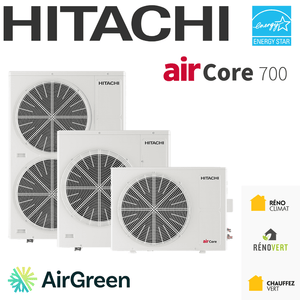
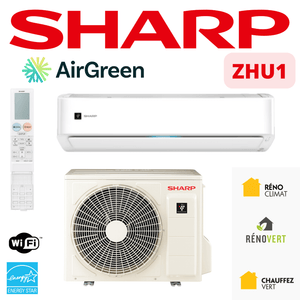
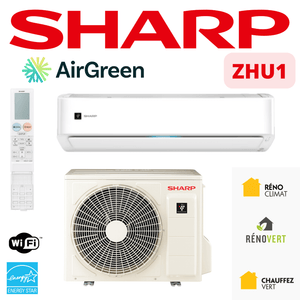
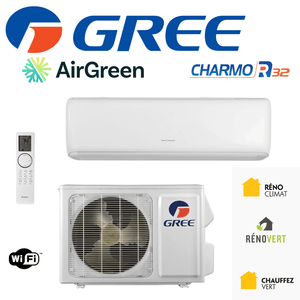
 Sharp ZHU1 18 000 BTU/hAHRI 213246052See the product page
Indicative amount: only Hydro-Québec confirms the grant. No combination is guaranteed; confirm it at 1 833 396-1888.
LogisVert, model by model
Capacity at -8 °C × $120 per 1,000 BTU/h. Tap a bar to calculate it.
| Program | Status | What to know |
|---|---|---|
| LogisVert (Hydro-Québec) | Open | $120 per 1,000 BTU/h at -8 °C (cold climate), $50 (ENERGY STAR); apply within 9 months of installation. |
| Chauffez vert (conversion) | Ended March 31, 2026 | The oil or propane conversion component no longer accepts applications. |
| Oil to Heat Pump Affordability (federal) | Registrations closed July 31, 2026 | Files already registered follow their own deadlines. |
| Greener Homes (federal) | Closed | Grant and loan closed to new applications. |
| Warranty of good working order (law) | In force since October 5, 2026 | 6 years for a new heat pump bought since that date, from delivery: parts, labour, reasonable transport. |
The actual date is set with the deposit; it depends mostly on unit availability and the weather.
Dates calculated from today.
For a new heat pump bought since October 5, 2026: 6 years of good working order guaranteed by law from delivery, including parts, labour and reasonable transport. Only normal maintenance, damage caused by abuse by the consumer, and accessories are excluded.
Source: CPA, ss. 38.1 to 38.9 · All about Bill 29
According to Hydro-Québec, a poorly maintained unit can use up to 25% more electricity.
Eight things people often say. Which ones are true?
Answer: the truth appears with its source, and each card leads to the full answer.
LogisVert pays $6,700 for any heat pump.
The grant is based on capacity at -8 °C: $120 per 1,000 BTU/h for a cold-climate model. A 12,000 BTU/h wall unit gets more like $1,008 to $2,268.
A wall air conditioner on its own qualifies for LogisVert.
Only ENERGY STAR heat pumps of 12,000 BTU/h or more qualify. An air conditioner that doesn't heat does not.
R-410A has been banned in Canada since 2025.
The 2025 rule is American. In Canada, R-410A can still be sold and installed, even as the market moves to R-32 and R-454B.
A good heat pump still heats at -25 °C.
Hydro-Québec says so: high-efficiency models perform very well down to -25 °C and even -30 °C.
You need a municipal permit to get LogisVert.
LogisVert requires an RBQ-licensed contractor. A municipal permit depends on your city or borough.
You have up to 9 months after installation to apply for LogisVert.
The LogisVert guide sets the limit at 9 months after the unit is put in place.
A clogged filter can cost up to 30% in efficiency.
According to Hydro-Québec, a clogged filter makes heating 10 to 30% less efficient. Clean it every month.
A new heat pump bought since October 5, 2026 has a 6-year legal warranty.
The warranty of good working order covers parts, labour and reasonable transport for 6 years from delivery, for new units bought since that date.
Savings, noise, wall-mounted or central: the numbers, side by side.
What you save on heating
The heating part of your yearly bill, with baseboards. Hydro-Québec puts the drop at 25 to 30%.
Estimate: the real gap depends on insulation, the model and your settings.
Noise, in real decibels
From our product pages. Benchmark: 10 dB more sounds about twice as loud; a whisper is about 30 dB.
| Criterion | Wall-mounted heat pump | Central heat pump |
|---|---|---|
| Ducts | No ducts needed | Uses existing ducts |
| Best for | Condo, plex, house heated with baseboards | House with ducts in good shape |
| Distribution | Room by room or by zone | The whole house, evenly |
| Indicative installed price | $3,000 to $7,000 | From $5,500 |
| Indicative LogisVert | $1,008 to $2,712 (our featured 12,000 to 18,000 BTU/h units) | $3,240 to $4,320 (3 tons), up to $6,480 (5 tons) |
| Efficiency | 19 to 31.5 SEER2 · 8.5 to 13.7 HSPF2 | 15.2 to 19.5 SEER2 · 7.8 to 10.5 HSPF2 (3 tons) |
| Outdoor noise | 49 to 59 dB | 54 to 64 dB |
| Installation time | A few hours to a day | One to two days |
| Average lifespan | 10 to 15 years | 10 to 15 years |
The highlighted column follows your profile (Choose step). Indicative prices before taxes and grants; your exact price comes from the quote.
77 answers, sorted by topic. Each one says where it comes from.
77 answers
Choosing and comparing
It comes down to your ductwork. With no ducts (condo, plex, house heated with baseboards), a wall-mounted unit is the simple answer: one unit per room or zone, installed in a day or less. If the house already has ducts in good shape, a central heat pump spreads heat and cooling evenly through every room.
Hydro-Québec gives a starting point: about 12,000 BTU/h per 750 sq. ft. A condo usually needs 12,000 to 24,000 BTU/h. Insulation, windows, sun exposure and ceiling height all move that number, which is exactly what our estimator checks on site, for free. The calculator in the Your project section gives you a starting figure.
According to Hydro-Québec, a bungalow usually needs 24,000 to 48,000 BTU/h (2 to 4 tons) and a two-storey house can need up to 65,000 BTU/h. One ton equals 12,000 BTU/h. The right choice also depends on insulation and on the size of your existing ducts, which we check during the estimate.
Five things make the difference: heating capacity at -8 °C and -15 °C (it also sets your LogisVert amount), efficiency (SEER2 and HSPF2), noise in decibels, the manufacturer's warranty, and parts and service support in Québec. Add installation cost and customer reviews. Every product page on our site shows these figures, and the Compare tool puts them side by side.
We carry a wide selection, and we especially like Sharp, FUJITSU AIRSTAGE, HAXXAIR and Gree: reliable, strong in deep cold and well supported in Québec. The right model then depends on your room, your budget and how you use it.
We recommend a model based on the size of your home, your budget and the efficiency you're after. In general, we really like working with FUJITSU AIRSTAGE, HAXXAIR and Gree, and we also install other brands, including Hitachi and TCL, shown in our catalogue.
Single-zone systems (one indoor unit) and multi-zone systems (several indoor heads on one outdoor unit, each with its own temperature), from several manufacturers. For special cases we also install cassettes, consoles and ducted units. The full range is on our website; contact us for current offers.
It heats and cools with the same unit, and it moves heat instead of making it: according to Hydro-Québec, it uses up to three times less energy than a baseboard heater for the same heat. Compared with a central system, it needs no ducts but serves one room or zone at a time.
Yes, compared with electric resistance heating (baseboards, an electric furnace on its own), because it transfers heat instead of generating it. Hydro-Québec estimates a heat pump cuts heating-related electricity by 25 to 30% compared with baseboards alone. It also cools the whole house in summer.
An air conditioner only cools. A heat pump reverses its cycle and heats too, which lowers your winter bill. Another difference that matters: an air conditioner on its own does not qualify for LogisVert, while an ENERGY STAR heat pump of 12,000 BTU/h or more does.
It's an ENERGY STAR heat pump certified to stay efficient in deep cold: at -15 °C it must keep at least 70% of its capacity at 8 °C, with a COP of at least 1.75. For LogisVert the difference is clear: $120 per 1,000 BTU/h of capacity at -8 °C instead of $50.
No. The 2025 rule limiting R-410A in new equipment is American (EPA). In Canada, R-410A equipment can still be sold and installed. The market is still moving to R-32 and R-454B, whose global warming potential is 68% and 78% lower than R-410A.
Since 2023 the ratings are SEER2 (cooling) and HSPF2 (heating), stricter than the old SEER and HSPF. Our featured wall units range from 19 to 31.5 SEER2 and 8.5 to 13.7 HSPF2. The higher the number, the less the unit uses.
On our 3-ton central units, from 15.2 to 19.5 SEER2 and 7.8 to 10.5 HSPF2 depending on the model. To be ENERGY STAR, a central unit needs at least 15.2 SEER2 and 7.8 HSPF2; the cold-climate version needs at least 8.1 HSPF2.
Often, yes: offices, shops, clinics. An on-site assessment sets the right solution based on occupancy, opening hours and the heat given off by equipment. For larger spaces, we also offer commercial solutions.
Yes, for many building types, as long as the system and ducts are sized for how the space is really used. Beyond residential work, we carry out commercial projects across Greater Montréal.
Yes. Our best references are our Google reviews, where customers comment on the quality of our service: 4.9 out of 5 from 530 reviews as of September 22, 2026. You can also browse more than 5,900 published projects across Greater Montréal.
Grants
The math fits on one line: heating capacity at -8 °C ÷ 1,000 × $120 for an ENERGY STAR cold-climate heat pump ($50 if it's ENERGY STAR only). Example: the 18,000 BTU/h Sharp ZHU1 delivers 22,600 BTU/h at -8 °C, so $2,712. The grant never exceeds 100% of the purchase and installation cost before taxes.
The owner, for a new heat pump bought in Québec, ENERGY STAR certified, with an outdoor unit of at least 12,000 BTU/h, installed by a company holding the required RBQ licences. AirGreen holds licences 15.8, 15.10 and 16 (RBQ 5645-9605-01).
Online at logisvert.ca, no later than 9 months after the unit is put in place. Hydro-Québec quotes 10 to 12 weeks of processing. Keep your detailed invoice and the unit's AHRI number, shown on every product page of our site.
It's a Hydro-Québec slogan, not a guaranteed amount: your grant depends on the unit's capacity at -8 °C. Among our featured 12,000 BTU/h wall units, it ranges from $1,008 to $2,268; our 3-ton central units get $3,240 to $4,320, and a 5-ton TCL APEX XS reaches $6,480.
No. The Chauffez vert conversion component ended on March 31, 2026, and the Canada Oil to Heat Pump Affordability grant closed registrations on July 31, 2026. The federal Greener Homes programs are also closed. LogisVert remains the main program for a heat pump.
Never assume it. The LogisVert guide bars another application for the same equipment with Hydro-Québec or a government body after approval. Before counting on a combination, confirm it with LogisVert at 1 833 396-1888.
Yes. The main program is Hydro-Québec's LogisVert: for an ENERGY STAR cold-climate wall unit, $120 per 1,000 BTU/h of capacity at -8 °C, for example $2,268 for a 12,000 BTU/h Sharp ZHU1. Our Grants page covers every program, open and closed.
Yes, LogisVert also covers central heat pumps, with the same formula. On our 3-ton cold-climate central units the grant ranges from $3,240 to $4,320, and up to $6,480 for a 5-ton TCL APEX XS. Every program is on our Grants page.
Installation and permits
It depends on the borough or city: some require a permit, others mainly regulate where the outdoor unit goes (front yard, distance from property lines). A municipal permit has nothing to do with warranties or with LogisVert, which requires a licensed contractor instead. AirGreen holds the Régie du bâtiment du Québec licences for air conditioning, ventilation and heating: 15.8 Ventilation, 15.10 Refrigeration and 16 Electricity (RBQ 5645-9605-01).
Same logic as a wall unit: requirements vary from one municipality to the next, mainly for where the outdoor unit goes. Our team tells you the rules for your area, and AirGreen holds RBQ licences 15.8 Ventilation, 15.10 Refrigeration and 16 Electricity (RBQ 5645-9605-01).
Consultation and on-site estimate, free. Choosing the unit. A detailed quote within 24 hours, then acceptance and a one-third deposit, which sets the date and locks in the unit's price. Installation, then full system testing. We then help you with your LogisVert application.
An initial consultation, system design, sending and accepting the quote, delivery of equipment and materials, installation, testing, and a final walkthrough with you. The interactive calendar in the Your project section shows the dates, all the way to the LogisVert application.
Anywhere from a few hours to a full day, depending on the complexity and requirements of the project. The wait before installation depends mostly on unit availability and the weather: the date is set when you pay the deposit.
Usually one day, two at most, depending on the complexity of the installation and the specifics of your home.
Room size, sun exposure and airflow guide the choice. The indoor unit goes where air can move freely; the outdoor unit must stay clear of snow, ice and leaves, and respect your municipality's setbacks. An on-site assessment is recommended.
Call us at 514 316-2973 or fill out the contact form. The in-home estimate is free and nothing is signed during the visit; you then receive a detailed quote within 24 hours.
Yes, it's common. You often need to coordinate with the condo board or building management, since the outdoor unit affects the façade, balcony or roof, and follow the declaration of co-ownership for condensate drainage. Get approval before signing; each product's spec sheets support your request.
The refrigerant is recovered by a qualified technician, as regulations require, and the materials are sent for recycling. The terms for removing the old unit are set out in your quote.
We follow regulations and best practices: refrigerant recovery by a qualified technician, then responsible recycling of materials. The removal terms are set out in your quote.
Prices and savings
As a guide, $3,000 to $7,000, depending on capacity, model and installation complexity. Your exact price comes in a detailed quote within 24 hours, after the free estimate. Then subtract your LogisVert grant, and spread the rest with Financeit if you like.
The price depends on the size of your home, the model you choose, the ductwork and labour; it starts at $5,500. Ask for a personalized quote: the in-home estimate is free.
Hydro-Québec estimates a heat pump cuts heating-related electricity by 25 to 30% compared with baseboards alone. The real gap depends on climate, insulation, your settings and electricity prices. The calculator in the By the numbers section applies it to your bill.
Same benchmark: 25 to 30% less heating electricity than baseboards alone, according to Hydro-Québec, and up to three times less energy for the same heat. If you're replacing an older central system, the gain depends mostly on how efficient it is today.
Yes, with our Canadian partner Financeit: automatic monthly payments, no penalty for paying off early, flexible terms, and rates as low as 0% depending on current offers.
Under Rate D in effect April 1, 2026: 7.065¢/kWh for the first 40 kWh per day, 11.142¢/kWh beyond that, plus a 46.154¢ daily access charge. Because a heat pump delivers more heat than the electricity it uses, every kWh heats more than with a baseboard.
Performance and comfort
Yes, with the right model. According to Hydro-Québec, high-efficiency heat pumps perform very well down to -25 °C and even -30 °C. In our catalogue, the heating limit listed by manufacturers ranges from -25 °C to -35 °C depending on the model. Output drops as the cold deepens: keep your baseboards as backup for extreme nights.
Four habits, according to Hydro-Québec: keep it in Heat mode (not Auto) at around 21 °C, set your baseboards 2 to 3 °C lower as backup, clean the filters every month and keep the outdoor unit clear of snow and ice. Good insulation and a yearly inspection do the rest.
Set a steady temperature rather than turning it down and back up often, have it serviced every year, keep the filters clean and the outdoor unit clear. Good insulation reduces the load in deep cold.
Proper sizing, insulation, climate, location and maintenance. A clogged filter, for example, makes heating 10 to 30% less efficient, according to Hydro-Québec.
The system's size, installation quality, the condition and tightness of the ducts, the home's insulation and maintenance. A poorly maintained unit can use up to 25% more electricity, according to Hydro-Québec.
It is: on low speed, our featured wall units run at 20 to 38 dB indoors, about the level of a whisper (around 30 dB). Useful benchmark: 10 dB more is heard as roughly twice as loud. Outdoors, expect 49 to 59 dB depending on the model.
The outdoor central units in our catalogue range from 54 to 64 dB depending on the model. Placement matters as much as the number: away from bedroom windows, on a stable base, well clear.
Hydro-Québec suggests about 21 °C on the heat pump in winter, with baseboards 2 to 3 °C lower so they only act as backup, and 23 °C for cooling in summer. Use Heat mode in winter and Cool mode in summer rather than Auto.
Yes. In cooling mode, air passing over the cold coil loses its moisture, which drains away; that's true for wall units and central systems alike. Most wall units also have a Dry mode for humid days that aren't hot.
It filters and circulates air while holding temperature and humidity, as long as you clean the filters every month. Sharp wall units add a Plasmacluster ionizer which, according to Sharp, purifies the air by reducing bacteria, mould and allergens. Bringing in fresh air is the job of an air exchanger.
All the air in the house goes through the unit's filter, which traps dust and pollen, and humidity drops in cooling mode. A clean filter and yearly service keep that benefit.
Yes, most recent models can be controlled through an app over Wi-Fi, built in or optional depending on the brand. That's the case for the Sharp, FUJITSU AIRSTAGE and Gree units we offer; every product page says whether Wi-Fi is included.
Often, yes: smart thermostat, remote control and energy management, with possible integration with other connected devices. Compatibility depends on the model and thermostat you choose.
An outdoor unit (compressor, fan, coil), an indoor wall unit, insulated copper refrigerant lines, a condensate drain and the electrical connection. The diagram in the How it works section shows them in place.
An outdoor unit, an indoor unit (air handler or a coil on the furnace), the ducts that carry the air, and a thermostat. See them on the interactive diagram in the How it works section.
It moves heat instead of making it. In winter it draws heat from the outdoor air, even when it's cold, and brings it inside; in summer it pulls heat out of the house and releases it outside. The How it works diagram shows both cycles.
Less energy for the same heat, and electricity that is over 99% renewable in Québec, according to Hydro-Québec: replacing fuel-based heating sharply cuts greenhouse gas emissions. R-32 and R-454B refrigerants also have a global warming potential 68% and 78% lower than R-410A.
Lower energy use, fewer greenhouse gas emissions, especially when it replaces fuel, and better-filtered air throughout the house. In Québec, over 99% of electricity comes from renewable sources, according to Hydro-Québec.
Units include electronic protection against overcurrent, overheating and abnormal pressure, plus automatic defrost. At installation, a disconnect switch lets you cut power near the outdoor unit; the electrical hookup is done under our RBQ 16 Electricity licence.
Safety switches, overload protection and, on several recent R-32 or R-454B models, a refrigerant leak detector. The outdoor disconnect and electrical hookup are installed under our RBQ 16 Electricity licence.
Maintenance, warranty and service
Have it inspected by a professional once a year, as Hydro-Québec recommends, and clean the filters yourself every month. A poorly maintained unit can use up to 25% more electricity.
Remove the indoor filters, wash them in lukewarm water or vacuum them, let them dry completely, then put them back. Do it every month in season, more often with pets or a lot of dust: a clogged filter makes heating 10 to 30% less efficient. A central system's disposable filter is replaced as the manufacturer recommends.
Three layers. The 6-year legal warranty of good working order (parts, labour and reasonable transport), for a new unit bought since October 5, 2026: it runs from delivery, and you can claim it from the merchant or the manufacturer, your choice. The manufacturer's warranty, depending on the model and the part, shown on each product page: we register it for you, free. And AirGreen's promise, separate from the law: every new heat pump we supply and install on or after October 5, 2026 is covered for 6 all-inclusive years (parts, labour and travel), from the installation date, per the conditions and exclusions of our written warranty. Heat pump installed by AirGreen before October 5, 2026: the written warranties in your contract and invoice apply, in addition to the legal warranties.
The warranty the Consumer Protection Act has required since October 5, 2026. For a new heat pump or air conditioner bought since that date, good working order is guaranteed for 6 years from delivery: parts, labour and reasonable transport costs. Only normal maintenance, damage caused by abuse by the consumer, and accessories are excluded. You can claim it from the merchant or the manufacturer, your choice.
We do, if we supplied and installed your heat pump. Call or write to us, with photos or video if you can: we diagnose, order the part, fill out the manufacturer's forms and return the faulty part. One call: we handle the steps with the distributor and the manufacturer. You keep the right to go directly to the manufacturer.
The merchant or the manufacturer, at the customer's choice: the 6-year warranty of good working order (parts, labour and reasonable transport) is an obligation of either one, and the merchant can't require you to go to the manufacturer. The distributor too: when the manufacturer has no establishment in Canada, the law treats its importer or distributor as the manufacturer. General information, not legal advice.
Not by the warranty of good working order: it covers units bought since October 5, 2026. For a unit bought before that date, the manufacturer's labour coverage is whatever its own warranty sheet says, usually none (0 years). The written warranties in your contract and invoice apply, and the basic legal warranties (ss. 37 and 38) still apply, against the merchant or the manufacturer (ss. 53 and 54). AirGreen's promise, separate from the law: every new heat pump we supply and install on or after October 5, 2026 is covered for 6 all-inclusive years, from the installation date, per the conditions and exclusions of our written warranty. General information, not legal advice.
The law excludes only three things: normal maintenance (for example cleaning a clogged unit or a blocked drain), damage caused by abuse by the consumer, and accessories. The law doesn't require maintenance to keep the warranty; it only excludes its cost. But a breakdown caused by neglect could be argued to be abuse by the consumer: have the maintenance done and keep the invoices.
Yes, for a repair covered by the warranty: the merchant or the manufacturer must “carry out the repairs to the goods and assume their cost” (s. 38.5(b), official English text), on top of “the reasonable transportation or shipping costs” (s. 38.5(a), official English text). You can't be charged for labour on that repair. A visit that reveals an excluded cause (maintenance, abuse by the consumer, accessory) isn't a covered repair.
Yes. The next owner, if they buy as a consumer, gets the years that are left (s. 38.6). The period always runs from the first delivery of the new unit. Keep the original invoice: it proves that date.
Send a written request (formal notice) giving a sufficient deadline; if you plan to have the repair done elsewhere at their expense should they refuse, say so in the letter. If the merchant takes part in Parle consommation, the free online negotiation platform of the Office de la protection du consommateur, you can look for an agreement there. You can also file a complaint with the Office de la protection du consommateur: it can take action, but it does not refund you. After that, the Court of Québec, Small Claims Division, hears claims of up to $15,000, not counting interest. Don't wait: a claim is generally prescribed after 3 years.
It's your call, knowing what the law already gives you: 6 years of good working order, at no cost. Before offering you a paid extended warranty (the law says “additional warranty”), the merchant must tell you out loud about the existence and duration of the warranty of good working order, except for a written offer at a distance (s. 228.2; regulation, s. 91.12). You can cancel it by written notice within 10 days after the contract, without cost or penalty; that period becomes 1 year if a mandatory notice was skipped or if the warranty's duration wasn't shown near the price. Exception: a warranty underwritten by an authorized insurer (s. 228.3).
Yes, especially during cold snaps and heat waves: several teams, and priority for heating breakdowns in mid-winter, particularly for customers we installed. We're not open 24/7: Monday to Thursday 8 a.m. to 6 p.m., Friday 8 a.m. to 4 p.m., at 514 316-2973 or through the service call request.
10 to 15 years on average, sometimes longer with regular maintenance. A yearly inspection and clean filters extend the compressor's life.
10 to 15 years on average, and longer with regular maintenance and proper care. When it's time to repair or replace, we weigh the age, the failed part, efficiency and available grants with you.
Try a simpler word (noise, price, warranty) or ask our team.
Our guides for going deeper.
 How to choose a heat pump in Québec: Mini-splits vs Central units
  Calculating the Right Wall Heat Pump Size (2026 Guide)
 Where to Install a Wall-Mounted Heat Pump: 2026 Placement Guide
 Ductless Mini-Splits or a Central Heat Pump: Which Is Best? (2026 Guide)
 What Is SEER? (Heat Pump Guide 2026)
 What Is a Good SEER for a Heat Pump? SEER2 Guide 2026
 Are Wall-Mounted Mini Split Heat Pumps Noisy? 2026 Guide
 Should I leave my heat pump on all the time? (Guide 2026)
Your question isn’t on the list? Ask someone who installs heat pumps every day.
Free on-site estimate, detailed quote within 24 hours, help with LogisVert. Nothing to sign during the visit.
Email: sales@airgreen.ca
Monday to Thursday 8 a.m. to 6 p.m., Friday 8 a.m. to 4 p.m.
4951 Sainte-Catherine Street East, Montréal · Showroom: 1370 Joliot-Curie Street, Unit 712, Boucherville
Watch out for scams: Hydro-Québec does no phone or door-to-door solicitation for LogisVert. If in doubt, call LogisVert at 1 833 396-1888.
Sources verified September 22, 2026; warranty of good working order verified October 13, 2026.
- Hydro-Québec, LogisVert Residential Participation Guide, v1.10 (September 15, 2026): rate per 1,000 BTU/h at -8 °C, cap, eligibility, 9-month deadline, combining grants (p. 8).
- Hydro-Québec, Energy Wise tips (capacity, winter use, seven ways to save, air conditioning, our energy), consulted September 22, 2026.
- Hydro-Québec, Rate D in effect April 1, 2026.
- Consumer Protection Act, ss. 1(g), 37, 38, 38.1 to 38.9, 53, 54 and 228.1 to 228.3, Regulation respecting the application of the Consumer Protection Act, ss. 79.21 and 91.9 to 91.13, and Office de la protection du consommateur: warranty of good working order, in force since October 5, 2026. All about Bill 29
- Civil Code of Québec, arts. 1595, 1602 and 2925 · Code of Civil Procedure, art. 536.
- ENERGY STAR heat pump specification v6.2 (cold-climate criteria); Natural Resources Canada (SEER2, M1 test method).
- Québec.ca (Chauffez vert, updated July 6, 2026); Natural Resources Canada (Oil to Heat Pump Affordability, updated September 17, 2026).
- airgreen.ca product pages (capacities, AHRI, noise, warranties) and Google reviews (4.9 / 5, 530 reviews), recorded September 22, 2026.
Amounts shown are estimates; only the responsible agencies confirm the grant awarded.
General information, not legal advice. If anything differs, the official text of the law prevails.