

Shoulder season · Hydro-Québec peak events in 68 days
2026 guide · wall-mounted and central heat pumps
Should I leave my heat pump on all the time?
Yes. In winter, let it run non-stop in Heat mode at a steady temperature, and set your baseboard heaters 2 to 3°C lower. In summer, keep it in Cool mode between 22 and 25°C. Turn it off and your baseboards do the heating, using up to three times more electricity for the same heat.
Recommendations from Hydro-Québec and Natural Resources CanadaBy AirGreen Climatisation & ChauffagePublished April 11, 2023Updated September 24, 2026Answer in 30 seconds, full read in 18 min

Your setting todayFall
Thursday, September 24, 2026Mode · Heat or Cool depending on the day, never Auto
Setpoint · Steady
Watch for · Book the yearly inspection before the heating season
Peak period starts December 1, 2026, in 68 days
3×less electricity than baseboards for the same heatHydro-Québec
2°Csetback at most, at night or while you are awayNRCan
18 to 19°Cfor the baseboards when the heat pump is at 21°CHydro-Québec
25 to 40%less heating consumption than with baseboards aloneHydro-Québec
01 · Your setting
Winter, summer, night, vacation: the right heat pump setting in three clicks.
Three choices, one answer, based on Hydro-Québec and Natural Resources Canada recommendations.
1 · The season
2 · The moment
3 · Your system
The season sets itself from today’s date; change it to see the other settings.
Spring, fall · At home · Wall-mountedONAs needed, in the right mode.
ModeHeat on cool days, Cool on hot days, never Auto
SetpointSteady
Mild weatherFan mode may be enough
Why. Auto mode can start cooling on a sunny morning, or heating on a cool evening.
Trap to avoid. Changing the setpoint every hour: the unit works harder and wears faster.
Source: Hydro-Québec02 · Pros and cons
Pros, cons and tips: what still holds in 2026.
It is one of the questions we get most: can you leave it on all the time without driving up the bill? The 2023 version of this guide listed pros, cons and six tips. We kept all 14 of its statements and checked each one against Hydro-Québec and Natural Resources Canada.
6 confirmed6 nuanced2 correctedout of 14 statements in the 2023 guide
The 2023 guide said2026 verdictWhat we know today
Pro“You won’t have to turn it on and off throughout the day.”
Confirmed
It is actually Hydro-Québec’s recommendation: let it run non-stop at a steady temperature. That is when it is most efficient.Source: Hydro-Québec
Pro“With pets or a multi-storey home, it helps keep an even temperature.”
Confirmed
A steady setpoint keeps the house at the same temperature, and a heat pump works best at a constant temperature.Source: Hydro-Québec
Pro“Newer systems are designed to run efficiently for long periods.”
Confirmed
A variable-speed compressor adjusts its output and stays efficient at low load. Compared with baseboards alone, a heat pump cuts heating consumption by 25 to 40%.Source: NRCan · Hydro-Québec
Con“It can put unnecessary strain on the system and lead to breakdowns.”
Corrected
It is the reverse: repeated adjustments are what strain the unit and can shorten its life. An inverter compressor that runs non-stop, slowing down at the setpoint, is working normally.Source: Hydro-Québec · AirGreen 2026 warranty
Con“It is wasteful to leave it on when you are not home.”
Nuanced
In winter, don’t turn it off: lower it by 2°C at most and schedule the warm-up before you get back. Turned off, the house cools down and the baseboards do the warm-up.Source: NRCan · Hydro-Québec
Con“It is wasteful in mild weather, when you don’t need it.”
Nuanced
In mild weather, a variable-speed unit idles along on its own. In the shoulder season, Fan mode may be enough; just avoid Auto mode.Source: NRCan · Hydro-Québec
Con“It is wasteful at night while you sleep.”
Nuanced
Leave it on. If you turn it down at night, 2°C at most, and keep the baseboards below the night setpoint.Source: NRCan
Tip“Invest in a programmable thermostat that adjusts the temperature to your schedule.”
Nuanced
Useful, on one condition: a setback of 2°C at most, or a smart thermostat that restarts the heat ahead of time. A heat pump warms back up more slowly than a furnace.Source: NRCan
Tip“Choose a Wi-Fi heat pump, like the Sharp or the Gree, that you adjust in the mobile app.”
Confirmed
Still true: the app lets you schedule the warm-up before you get home and pre-heating before a peak event, even from a distance.Source: Hydro-Québec · airgreen.caSharp wall-mounted heat pumpsGree wall-mounted heat pumps
Tip“Set it to turn on a few minutes before you get home or wake up.”
Nuanced
In winter, it doesn’t get turned off: schedule the warm-up early enough instead, because a heat pump warms back up more slowly than a furnace.Source: NRCan
Tip“Use it with ceiling fans or other air circulation devices.”
Confirmed
In summer, a fan helps cool air reach rooms the unit does not serve. Leave room doors open too.Source: Hydro-Québec
Tip“Close doors and windows when you are cooling the house.”
Nuanced
Windows closed and curtains drawn on the sunny side. Indoors, on the other hand, keep room doors open so the cool air can circulate.Source: Hydro-Québec
Tip“Have it maintained regularly by an AirGreen professional.”
Confirmed
Filters every month during heavy use, a yearly inspection by a professional. Poorly maintained, a unit can use up to 25% more electricity.Source: Hydro-QuébecWall-mounted heat pump cleaningContact an AirGreen professional
Conclusion“You can leave it on all the time, but it is not always the best option.”
Corrected
In winter, it is the best option: “Don’t turn off the heat pump: let it run continuously,” Hydro-Québec writes. In summer too, between 22 and 25°C. The only exception: a long absence in summer, if humidity stays between 30 and 50%.Source: Hydro-Québec · Health Canada
03 · Who heats your home?
Set the heat pump below your baseboards, and the baseboards do the heating.
Enter your two setpoints, then simulate the night or an absence. The rule fits on one line: the night setpoint stays above the baseboard setpoint.
Your usual daytime setting.
Hydro-Québec: 2 to 3°C below the heat pump.
At night or while you are away
NRCan: 2°C at most.
10°C14182226°C
Baseboards 18°C
Heat pump 21°C
Night 19°C
The heat pump does the work.
A setback of 2°C, within the 2°C limit, and the baseboards stay in reserve for extreme cold.
For 10 kWh of heat, who pays whatRate D, second tier: 11.142¢ per kWh (April 1, 2026). Ratio of 3: “up to three times less electricity”, Hydro-Québec. Indicative estimate.
Baseboards$1.1110 kWh of electricity
Heat pump$0.373.3 kWh, “up to three times less”
Chart · the price of 10 kWh of heat
Even at −8°C, a heat pump heats for less than baseboards.
Electric baseboards1 kWh of electricity per kWh of heat
$1.11
Heat pump, 8°C outsideCOP of 2.0 to 5.4
$0.21 to $0.56
Heat pump, −8°C outsideCOP of 1.1 to 3.7
$0.30 to $1.01
From the most efficient model to the leastBaseboard price
Rate D second-tier price: 11.142¢ per kWh (April 1, 2026). COP ranges published by Natural Resources Canada for air-source heat pumps; even the lowest COP, 1.1 at −8°C, beats the baseboards’ COP of 1. Your model’s COP is on its product sheet. Indicative estimate.04 · What turning it off costs
What a heat pump turned off in winter costs you.
Hydro-Québec puts it at 25 to 40% less heating than baseboards alone. Here is what that means in your home.
In kWh per year.
Hydro-Québec benchmark: 54% for heating and cooling combined in an electrically heated household. Adjust to your bill.
Current heating
Your annual consumption is on your bill and in your Hydro-Québec Customer Space. The starting value is an example, not an average.
What turning it off would cost you$301 to $481per year, at April 1, 2026 prices.Indicative estimate. Saved kWh are counted at the Rate D second-tier price, which applies above an average of 40 kWh per day over the billing period. Below that threshold, the price is 7.065¢.
Heating (54% of 20,000 kWh)10,800 kWh
Savings of 25 to 40%2,700 to 4,320 kWh
At the second-tier price, 11.142¢$301 to $481
If it all stayed below 40 kWh per day, 7.065¢$191 to $305
Baseboards only · 10,800 kWh
With a heat pump · 6,480 to 8,100 kWh
Chart · where the electricity goes
In an electrically heated household, more than half of the electricity goes to heating and cooling.
That is the share a heat pump goes after: 25 to 40% less heating consumption than baseboards alone. It is also the starting benchmark of the calculator above.
Source: Hydro-Québec, guide “Utilisation et entretien d’une thermopompe” (French), March 16, 2026Heating and cooling54%
Hot water20%
Appliances and electronics18%
Lighting5%
Other3%
05 · The remote and the app
Mode, setpoint, fan, louvers: the four settings that make the difference.
Pick the season, then tap a remote button or a card: the recommended setting lights up.
HEATWinter setting
21°C
Louvers down
The Wi-Fi app
Warm-up and pre-heating, scheduled ahead, even from a distance.
The 2023 tip still holds: a Wi-Fi heat pump, like the Sharp or the Gree, is set from your phone. Schedule a 1 to 2°C warm-up before you get home, and pre-heating in the two hours before a peak event.
Keep one limit in mind: 2°C of setback at most. Beyond that, the baseboards do the warm-up.
Source: Hydro-Québec · NRCan
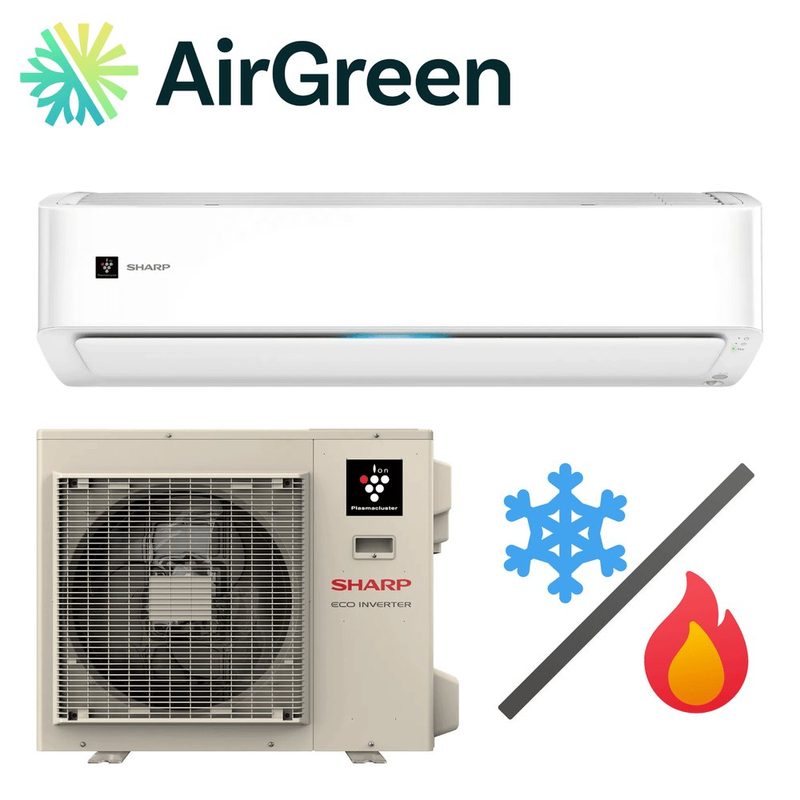
Sharp wall-mounted heat pumpsAdjustable from your phone with the Wi-Fi app.See the Sharp models

Gree wall-mounted heat pumpsAdjustable from your phone with the Wi-Fi app.See the Gree models
06 · A typical day
One day, three scenarios, the same rule: you don’t turn it off.
Pick the type of day, then slide the hour. The curve shows the setpoints; the text shows what to do at that moment.
Heat pump setpointBaseboard setpoint
16:00 · DaytimeSteady setpoint; curtains open on the sunny side.
The sun gives the heating a free boost.
Source: Hydro-Québec07 · Rate D or Flex D
Flex D rewards households that keep the heat pump on and turn the baseboards down during peaks.
Off-peak, a kWh costs less than on Rate D; during an event, it costs 46.463¢. The table, the hour-by-hour plan, then your winter in numbers.
Table · the price of a kWh in 20262026 electricity rates, in effect April 1, 2026 (3% increase for residential rates). Rate Flex D winter period: December 1 to March 31, events from 6 to 10 a.m. or 4 to 8 p.m., notice the day before.
Rate DRate Flex D, in winter
First 40 kWh per day7.065¢4.886¢
off-peak
off-peak
Above 40 kWh per day11.142¢9.103¢
off-peak
off-peak
During a peak eventRegular price46.463¢
up to 120 h per winter
up to 120 h per winter
April 1 to November 30Rate D pricesRate D prices
The plan for a peak eventNext period: starts December 1, 2026, in 68 days
- 14:00Pre-heatingRaise the heat pump by 1 to 2°C, for example from 21 to 22.5°C.
- 16:00StartTurn the baseboards down, especially in empty rooms. The heat pump stays on.
- 16:00 to 20:00DuringNo space heater or dryer; bathroom fan and range hood as little as possible.
- 20:00EndBack to your usual setpoint, without going higher to “catch up”.
Simulator · your winter
In kWh per day, December 1 to March 31.
Hydro-Québec: 120 hours at most, up to 30 events.
In kWh per event hour.
The heat pump stays on; it is the baseboards you turn down.
Starting values: an example, not an average. Your hourly consumption is in your Hydro-Québec Customer Space.
Your winter on Rate Flex D−$97saved on winter energy, compared with Rate D.Winter from December 1, 2026 to March 31, 2027 (121 days), 2026 energy prices; system access charges not counted. Energy not used during peaks is shifted off-peak, never removed. First-winter protection: Hydro-Québec refunds the difference if Flex D costs you more. Indicative estimate.
Winter energy9,680 kWh
During peaks, after reduction288 kWh at 46.463¢
Off-peak, first tier4,840 kWh at 4.886¢
Off-peak, the rest4,552 kWh at 9.103¢
Rate D$881energy, 121 days
Rate Flex D$785energy, 121 days
30 · 120 hevents and hours at most per winter
46.463¢per kWh during an event
$150average savings on Rate Flex D, winter 2025-2026, with smart thermostats
$90average savings on Rate Flex D, without a smart thermostat
Source: Hydro-Québec, 2026 rates and Rate Flex D page
08 · Extreme cold
How cold can your heat pump keep heating? It depends on the model.
Slide the temperature. Each product sheet gives the manufacturer’s limit: above it, let the heat pump work; below it, backup heat takes over on its own.
Models still heating: 4 of 4
Or pick
Gree Clivia R32 12,000
AHRI 21603243611,000 BTU/hrated at −15°C
Heats down to −30°CSee the product
Gree Charmo R32 12,000
AHRI 2154022369,100 BTU/hrated at −15°C
Heats down to −25°CSee the product
Sharp TU 12,000 (R-410A)
AHRI 8740799—cold capacity not published on the sheet
Heats down to −20°CSee the product
Source: airgreen.ca product sheetsSource: Hydro-QuébecHeating capacities published on the airgreen.ca product sheets (read September 24, 2026).
09 · Defrost
Steam outside, a stop of a few minutes: that is the defrost cycle, step by step.
It is the question we get most often in January. Follow the cycle in four steps.
When buying. Natural Resources Canada recommends a unit with demand defrost: it only defrosts when needed, and uses less energy.
1. Frost forms
In cold, humid weather, moisture in the air freezes on the outdoor coil. Frost hurts heat transfer: it has to go.
Source: NRCan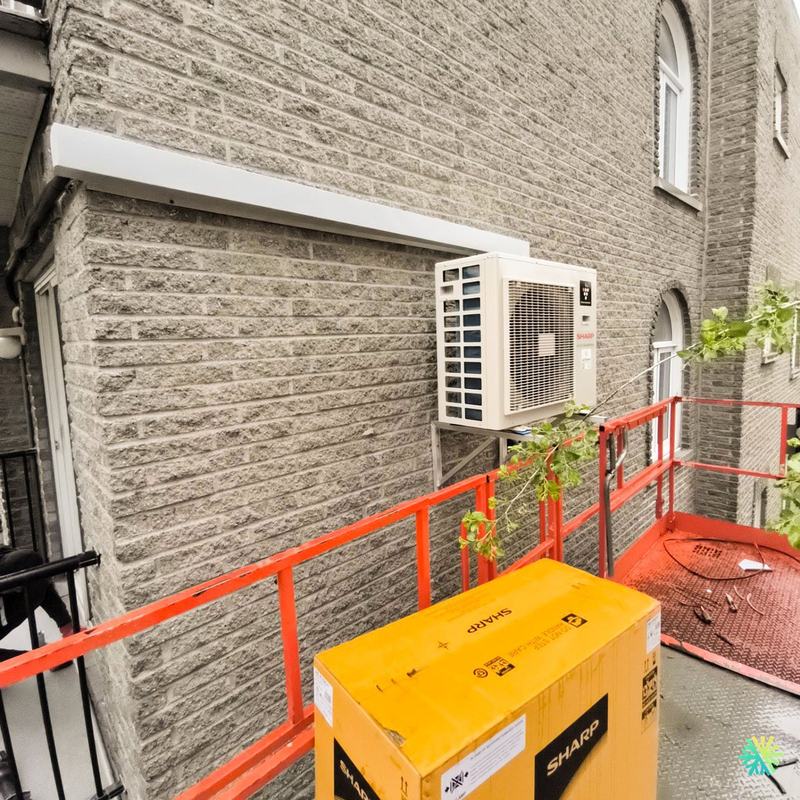
What you will see outside in winter
Three normal signs of a defrost.
NormalSteam. It comes out of the outdoor unit for a few minutes.
NormalWater. It drains under the unit: that is the melted frost.
NormalSilence. The fans stop, outside and inside, then start again.
Source: NRCan · GREE service manual · AirGreen 2026 warranty
10 · Summer
Running the air conditioning non-stop: your installer was right.
A reader asked us in 2024. Here is the answer, in three reasons and a diagram.
“For cooling, why run it all the time, as the installer of our new heat pump told us to?”
1
It slows down instead of stopping.A variable-speed compressor adjusts its output to the demand and stays efficient at low load.NRCan
2
It dehumidifies without a break.Air keeps passing over the cold coil. Set the fan to low to dehumidify better; aim for 30 to 50% humidity.NRCan · Health Canada
3
It wears less.A steady setpoint is more efficient; repeated adjustments strain the unit and can shorten its life.Hydro-Québec
The temperature stays close to the setpoint: the compressor slows down instead of stopping, and air keeps passing over the cold coil, which removes humidity.
22 to 25°Csummer setpoint
Lowfan
Upwardlouvers
30 to 50%target humidity
11 · The year
Twelve months, one principle: the heat pump stays on, in the right mode.
The current month is selected. Tap another month to see its settings and maintenance.
Winter, heatingShoulder seasonSummer, cooling
SeptemberFall
ModeHeat or Cool depending on the day, never Auto
SetpointSteady
Watch forBook the yearly inspection before the heating season
MaintenanceFilters: as needed
12 · True or false
Six common beliefs about leaving a heat pump on. You decide.
Answer, then read the explanation.
Statement 1« Leaving your heat pump on wears it out faster. »
Statement 2« Some heat pumps still heat at −30°C. »
Statement 3« Turning the heat back up after a setback cancels the savings. »
Statement 4« Auto mode is the most economical. »
Statement 5« Steam is coming out of the outdoor unit: it is broken. »
Statement 6« With a heat pump, you keep the baseboards, set lower. »
Your score shows here.
13 · Is this normal?
Steam, silence, crackling: most winter signs are normal.
Pick what you see or hear. We tell you if it is normal, what to do, and when to call us.
Normal
Steam or water is coming out of the outdoor unit
What is happening
That is the defrost cycle: the unit briefly reverses and sends hot gas through the outdoor coil to melt the frost.
What to do
Let it finish. Heating resumes on its own after a few minutes.
Source: NRCan
14 · Maintenance
Heat pump maintenance: four steps, and it keeps its efficiency.
The 2023 tip still holds: regular maintenance. Check off what is done; the dates count from today, and we take care of the rest.
Your maintenance0 / 4
Next filter cleaning: October 24, 2026Best time for the inspection: before December 1, 2026, in 68 days
The cost of forgetting, in your homeUp to $226more per year, at worst, if the unit is poorly maintained: up to 25% more electricity (Hydro-Québec), applied to your heating as calculated in section 04.
Wall-mounted heat pump cleaning by AirGreen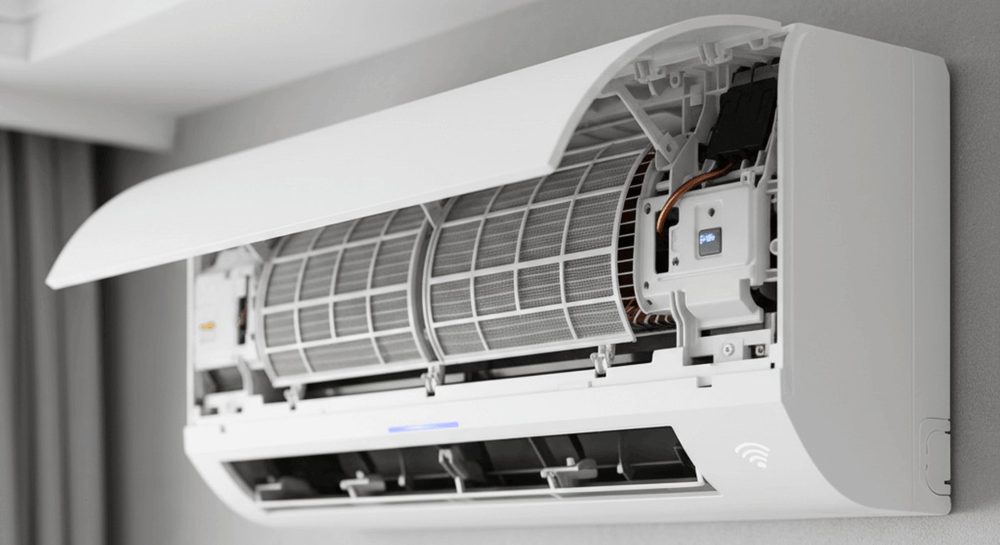
Photo · the filters
The filters sit behind the front panel of the indoor unit.
Lift the front panel, remove them, rinse them with room-temperature water, no detergent, and let them dry completely in the shade before putting them back. A clogged filter can cost 10 to 30% of efficiency.
Source: Hydro-Québec, guide dated March 16, 2026
Drawing · a properly cleared outdoor unit
1Top and sides clear : air must flow all around the unit.
2Nothing in front of the grille : no snow, no leaves, no plants.
3Underside clear : defrost water must be able to drain away.
4Snow cleared : after every storm, around and under the unit.
5Fins intact : never chip at the ice; if it stays, call us.
Source: Hydro-Québec · NRCan · AirGreen 2026 warranty
Calendar · your next seven dates, counted from today
- October 15, 2026Dead leaves around the outdoor unitClear it before the snow; it is also the time to book the inspection.
- October 24, 2026Clean the indoor filtersThen every month during heavy use: room-temperature water, no detergent, dry in the shade.
- Before December 1, 2026Yearly inspectionBy a professional, before the heating season.
- December 1, 2026Start of the peak periodIf you are on Rate Flex D: pre-heat by 1 to 2°C before an event, baseboards turned down during it.
- After every stormClear the outdoor unitSnow and ice around and under the unit, without hitting the fins.
- March 31, 2027End of the peak periodBack to Rate D prices for Rate Flex D customers.
- May 1, 2027Switch to Cool mode on hot daysNever Auto; setpoint between 22 and 25°C, fan on low.
15 · Frequently asked questions
The 17 questions we get most about leaving a heat pump on.
Yes, and that is what Hydro-Québec recommends in winter: let it run non-stop in Heat mode at a steady temperature. Turn it off and your baseboards do the heating, using up to three times more electricity for the same heat.
Source: Hydro-QuébecAirGreen · Montréal, Laval, Longueuil, North Shore, South Shore
Set right, maintained, left on: if yours does not behave as this guide says, an AirGreen technician comes to check.
Cleaning, repair or a new installation: an AirGreen technician comes to your home. We answer Monday to Thursday from 8 a.m. to 6 p.m., and Friday from 8 a.m. to 4 p.m.
RBQ licence 5645-9605-01Subclasses 15.8 Ventilation, 15.10 Refrigeration and 16 Electricity.
Free on-site estimateFor a new installation, in Montréal, Laval, Longueuil, the North Shore and the South Shore.
Written quote within 24 hoursThe final price, in writing, before the work.
Cleaning and repairWall-mounted and central heat pumps, air conditioners, air exchangers.
Sources
Sources checked September 24, 2026. Amounts shown are estimates; only Hydro-Québec confirms your bill, and only the manufacturer’s sheet is authoritative for your unit.
- Hydro-Québec · “Utiliser sa thermopompe en hiver pour économiser” (French)consulted September 24, 2026
- Hydro-Québec · “Thermopompe : sept astuces pour économiser toute l’année” (French)consulted September 24, 2026
- Hydro-Québec · “Utilisation et entretien d’une thermopompe”, guide (French)version 1, March 16, 2026
- Hydro-Québec · “Baisser puis remonter le chauffage” and “Événements de pointe : huit erreurs” (French)consulted September 24, 2026
- Hydro-Québec · 2026 electricity rates and Rate Flex D pagein effect April 1, 2026
- Hydro-Québec · “Six astuces pour mieux consommer cet été” (French)consulted September 24, 2026
- Natural Resources Canada · “Heating and cooling with a heat pump”modified December 24, 2025
- Natural Resources Canada · “Keeping the Heat In”, section 9thermostats and setbacks
- Health Canada · “Addressing moisture and mould in your home”modified April 9, 2020
- GREE · FLEXX Ultra service manual, defrostgreehvac.ca
- AirGreen · 2026 warranty, “Normal behaviour” sectioncustomer document
- airgreen.ca · Sharp CHU, Gree Clivia, Gree Charmo and Sharp TU product sheets (12,000 BTU)read September 24, 2026
- airgreen.ca · 2023 article “Can I leave my mini split on all the time?”; Sharp and Gree collectionspublished April 11, 2023, reviewed September 24, 2026
2 comments
Pour la climatisation, pourquoi la faire fonctionner tout le temps, comme nous a demandé l’installateur de notre nouvelle thermopompe?
Une espace de bureau à Montréal: j’ai besoin une maintenance de system hVAC