2 in 1
It heats in winter and cools in summer
Reversible cycle: in summer, it pulls heat out of the room and releases it outside. In winter, it captures heat from the outdoor air and brings it inside.
Source: NRCan, Dec. 24, 2025

514-316-2973
sales@airgreen.ca
A wall unit heats and cools without a single duct, and LogisVert can pay back a good part of it. It also has its limits. It’s all here, numbers and sources included.
The best choice to heat and cool without ducts, especially with electric baseboards. With several floors or closed rooms, plan one head per zone.
Check for my home →We won’t recommend a wall unit if it doesn’t make sense for your home. Tap one answer per row: the verdict updates as you go.
The verdict builds as you go: the setup that makes sense for your home, the advantages that count and the points to plan for.
Two units joined by two small lines: a head on the wall, a unit outside. That’s it.
Also called a wall system or ductless mini-split, a wall-mounted heat pump heats and cools the air in one room or a series of rooms, drawing heat from the outdoor air in winter and releasing it outside in summer.
A single head is enough for one room or a large open area; some open-concept houses are heated almost entirely this way. As soon as there are several zones or floors, you move to several heads: separate wall units or a multi-zone system.
Its small size and the lack of ducts make it the ideal option where there are no ducts, or where building them would be complicated. That’s why so many homeowners and builders choose it.
Temperatures shown for illustration. Tap the numbered points.
A wall-mounted heat pump looks like an air conditioner, but its reversing valve lets it run the cycle backwards and heat. In summer, it pulls heat out of the room and releases it outside; in winter, it captures heat from the outdoor air and brings it inside.
| Window air conditioner | PTAC | Wall-mounted heat pump | Central heat pump | |
|---|---|---|---|---|
| Heats in winter | No cooling only | Resistance or heat pump in mild weather | Yes heat pump down to -26 to -30°C depending on the model | Yes heat pump + backup |
| Where the compressor is | In the window | In the room’s wall | Outside | Outside |
| Opening required | The whole window | A 42 × 16 in. sleeve in the wall | A 65 to 75 mm hole | Existing ducts or ducts to build |
| Compressor noise in the room | Yes | Yes | No | No |
| Rooms served | One | One | One per head, or 2 to 4 with multi-zone | The whole home, through the ducts |
| Ducts | None | None | None | Required |
In Quebec, a heat pump is a better deal than air conditioning alone: it works twelve months a year, it cuts electric heating, and LogisVert pays back part of it. Federal programs, on the other hand, are closed in Quebec.
See the 2026 rebatesEach one with its proof. After the test, the ones that matter for you are marked.
Reversible cycle: in summer, it pulls heat out of the room and releases it outside. In winter, it captures heat from the outdoor air and brings it inside.
Ideal where there are no ducts, or where adding them would be complicated: electric baseboards, plexes, condos. No ducts to build means that much less work.
A single 65 to 75 mm opening, per the manufacturer’s manual, for the lines, the cable and the drain. No demolition, nothing hidden in the walls.
771 wall-mounted heat pump listings in our catalogue, each with its AHRI number and its estimated LogisVert amount.
At -8°C, the COP ranges from 1.1 to 3.7: up to 3.7 kWh of heat for every 1 kWh you pay for. At 8°C, from 2.0 to 5.4. A baseboard gives 1 kWh for 1 kWh.
At their lowest, our 12,000 BTU wall units run from 17 to 30 dB. A quiet room measures 40 dB(A); a bedroom should stay under 30 dB.
White, black or mirror finishes depending on the series (SHARP CHU-B, LG ART COOL MIRROR). Outside, the lines run under a cover that blends into the wall.
Each head has its own setpoint. Cooler bedrooms, a warmer living room, without heating empty rooms.
Unlike a PTAC or a window air conditioner, the compressor can be installed farther away, within the line length the manufacturer allows.
The compressor is outside. The window closes again, and its noise stays outdoors.
$120 per 1,000 BTU/h of capacity at -8°C for a cold-climate model. A SHARP CHU 12,000 BTU gets $2,268.
Wi-Fi included on most of our models (SHARP, FUJITSU AIRSTAGE, SAMSUNG, GREE). Warm up or cool down the house before you get home.
Real AirGreen installs, not catalogue pictures: GREE, SHARP, MIDEA, HITACHI, LG and PANASONIC. Tap a photo to read the project. All our projects
 GREE CHARMO R32Laval-Ouest, Laval
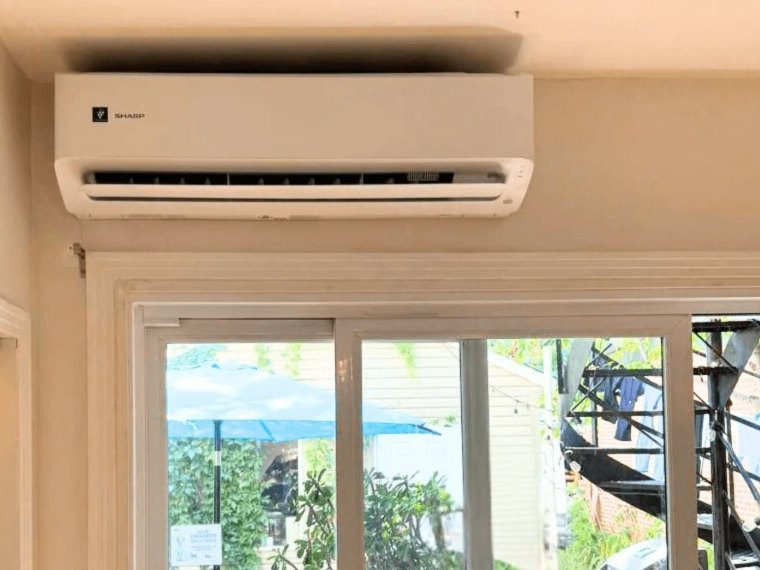 SHARP ZHU above the patio doorCandiac, South Shore
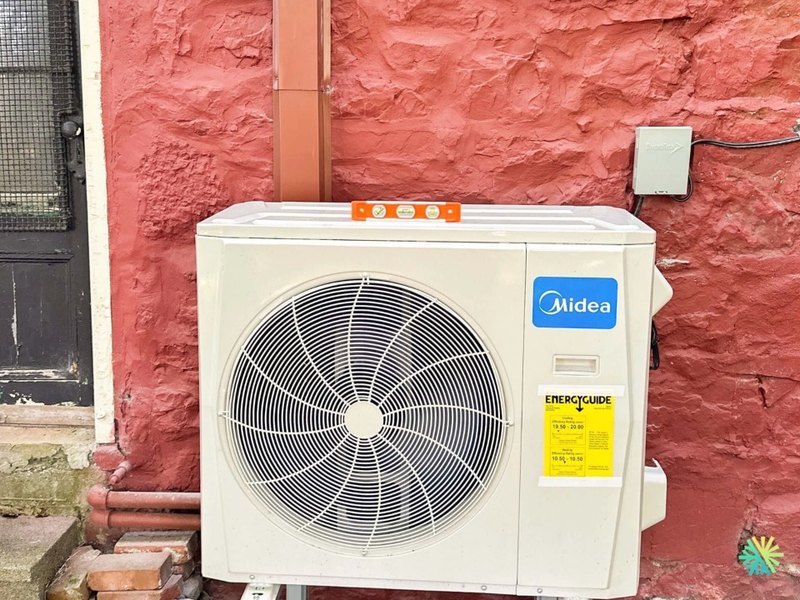 MIDEA MIDEA28, outdoor unit set perfectly levelTerrasse-Vaudreuil, Vaudreuil-Soulanges
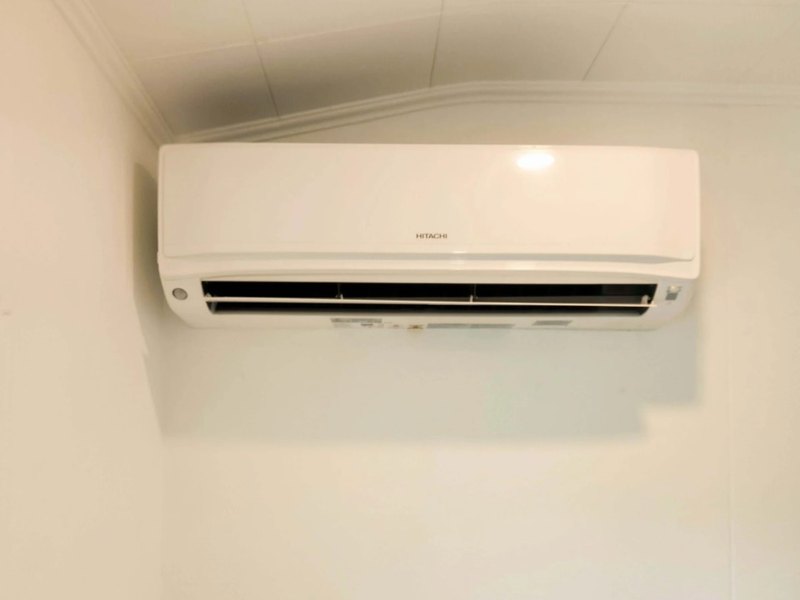 HITACHI airHome 600Saint-Eustache, North Shore
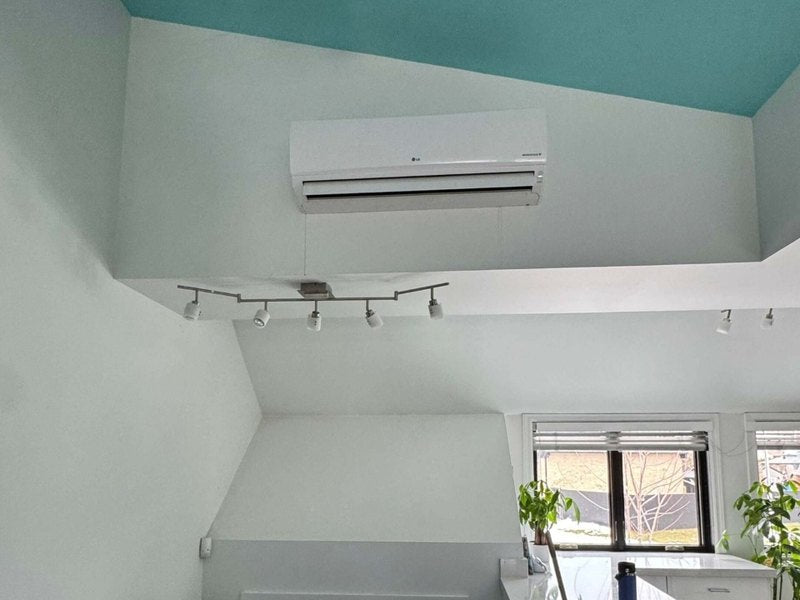 LG Dual Inverter under a cathedral ceilingLe Plateau-Mont-Royal, Montreal
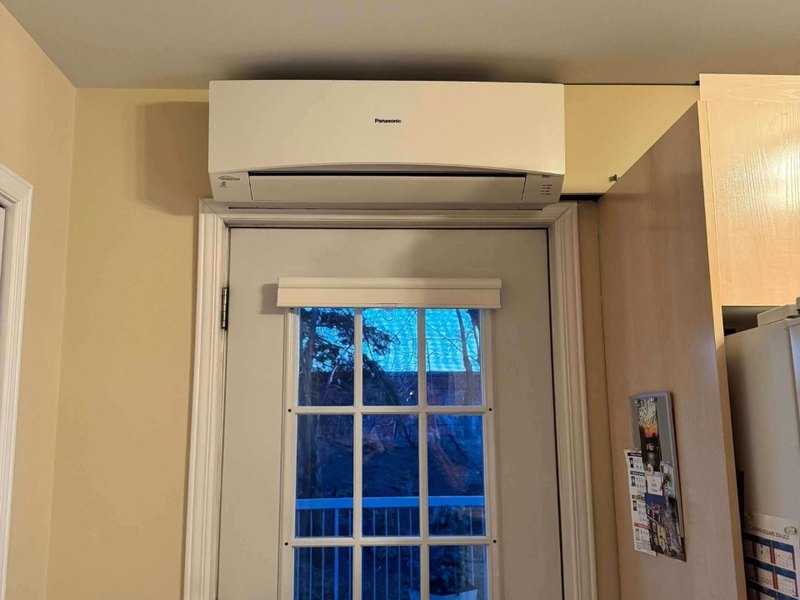 PANASONIC above the doorRosemont–La Petite-Patrie, Montreal
None of them rules out a good install. You just need to know them before you sign. Our warranty in detail
Air doesn’t travel well past closed doors and up stairs.
Below your home’s balance point, and during defrost, a backup heating system takes over.
Filters every 2 to 3 months, a full cleaning once a year, condensate drain kept clear.
Clearance, snow, noise: several Montreal boroughs set a 50 dB limit at the property line, and some require a permit. In a condo, the syndicate usually has a say.
And the lines run outside, under a cover. Nothing is hidden in the walls.
LogisVert requires an outdoor unit of at least 12,000 BTU/h in cooling.
If it stops, all the heads stop. With separate units, a breakdown only affects one room.
In some multi-storey homes, connecting the outdoor unit to the heads or to the electrical panel takes more work. These cases are rare.
A wall unit can be repaired, as long as the company still provides service after the installation.
Three tabs, your numbers. Every result shows its calculation and its source.
In your Hydro-Québec customer account, the winter consumption above your summer consumption is mostly heating.
NRCan: COP of 2.0 to 5.4 at 8°C and 1.1 to 3.7 at -8°C. Choose conservatively.
at most, at the second-tier price of Rate D
Rate D in effect April 1, 2026. Winter heating mostly drives up the second tier (above 40 kWh per day). An estimate, not a promise: your home, your insulation and your habits decide.
COP of 1.1 to 3.7. This is the temperature at which Hydro-Québec measures capacity to calculate the rebate.
Outside, several Montreal boroughs set a 50 dB limit at the property line. All about noise
One outdoor unit for several heads, or one unit per head: both make sense. Here are the numbers.
A multi-zone (multi-split) system isn’t very different from a single-zone wall unit: several indoor units are paired with a single outdoor unit to heat and cool several rooms in a large home.
It’s often ideal when the layout keeps air from circulating everywhere, for example with several large floors. Each head is controlled separately and can be set to a different temperature.
“A multi-zone breaks down very often, is it better to install one compressor per indoor unit?”
Hydro-Québec’s calculation: heating capacity at -8°C, divided by 1,000, multiplied by $120 for a cold-climate model. The program in detail · All 2026 rebates
Capacities at -8°C from ENERGY STAR, by AHRI number (Sept. 24, 2026). Tap a bar for details.
Your gut against our sources. Answer, and the explanation appears.
In an open area on a single floor, one properly sized head can be enough. As soon as there are closed rooms or several floors, a head mostly heats the room where it’s installed: plan one head per zone, as separate units or a multi-zone system.
Phone consultation and on-site estimate, 100% free. We come see your home, tell you how many heads and which model, and you get your personalized quote in less than 24 hours.
The amounts shown are estimates; only the responsible organizations confirm the aid granted.
1 comment
Bravo pour votre site. Je magasine une thermopompe avec 3 unité a l’intérieur car je possède un cottage, Mais une question me revient souvent et les mauvais commentaires, comme quoi un multi-zone brise très souvent et qu’il est mieux d’installer un compresseur par unité intérieur. Pouvez-vous éclairer mes lanternes s.v.p. Merci et bonne continuité