
Installation of a Gree Flexx Electric Furnace in Brossard, South Shore
Beat the heat with our Gree Flexx installation in Brossard – where advanced technology meets expert installation in the tightest spaces!
Take a tour of the installation
Each number is a point we check on site. Switch between summer and winter to watch air and heat move.
In summer, the outdoor unit rejects the house's heat outside.
Generic illustration of this type of installation, not a survey of this job site. Tap a number.
It captures or rejects heat outside. It sits on a level base, above the snow, with free space all around.
The insulated refrigerant lines enter the house through a sealed opening and run to the indoor coil.
A shut-off switch near the outdoor unit isolates it safely for service.
Sitting on the indoor module, it moves heat between the house air and the refrigerant.
Electric furnace or air handler: its fan pushes air through the ducts. The electric backup takes over in extreme cold.
Supply ducts bring air to the rooms; returns bring it back to the unit. Their condition matters as much as the unit's.
It protects the coil and the fan. A dirty filter cuts airflow, so it gets checked regularly.
It runs the heat pump and the backup heat. It must be compatible with the installed system.
The Challenge of Space and Heat: A Tale of Attic Installation
Setting the Scene
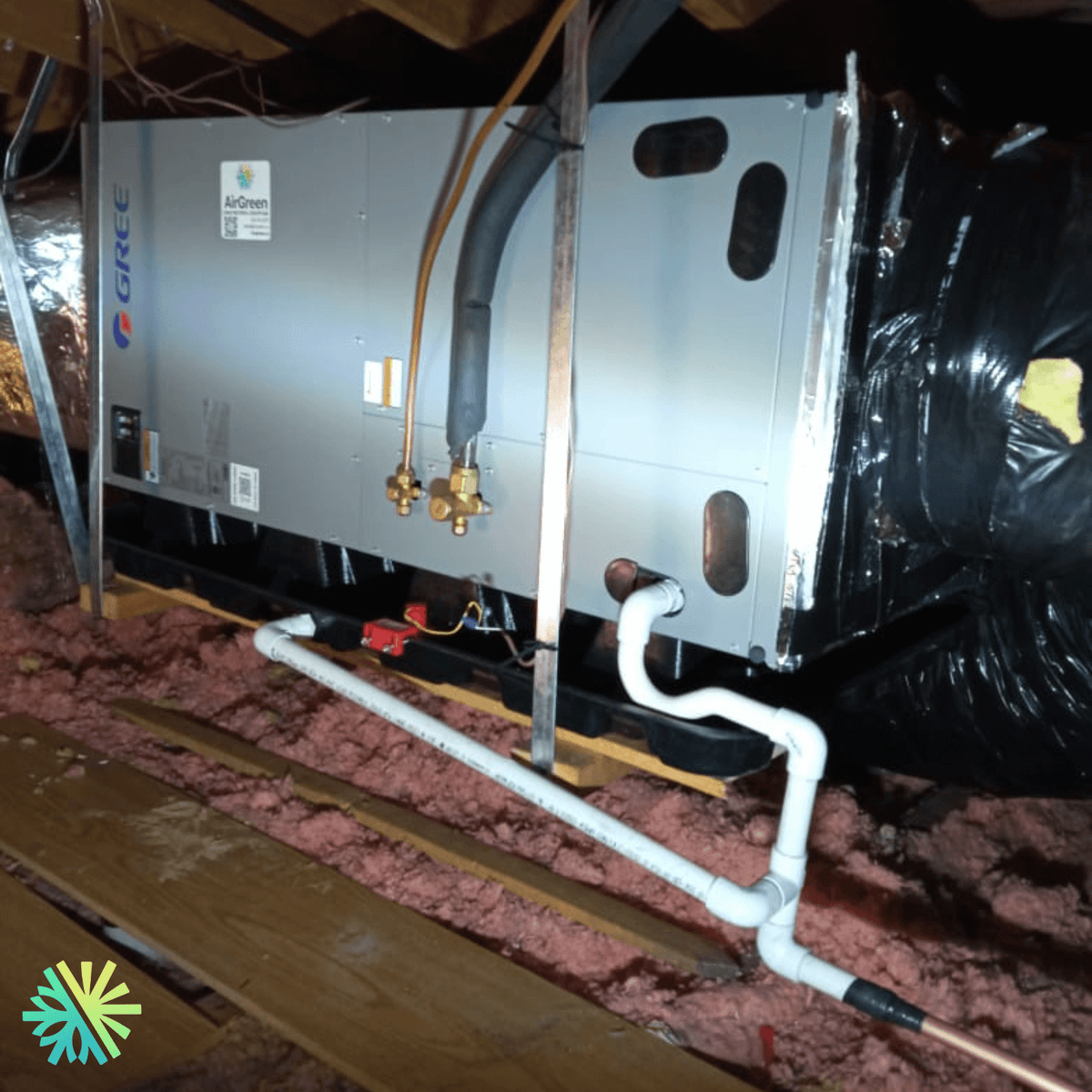
Imagine the sweltering heat of a summer day in Brossard, with temperatures making even the simplest tasks feel Herculean. Now, picture installing a high-tech Gree Flexx electric furnace in an attic, where the space is not just cramped but also blisteringly hot. This is the story of AirGreen, a dedicated HVAC company, and our recent formidable installation challenge on the South Shore.
Why the Gree Flexx Electric Furnace?
Before diving into the nitty-gritty of the installation process, let's explore why the homeowner chose the Gree Flexx electric furnace. This machine isn’t just another heating system; it's a state-of-the-art solution for enduring cold winters, boasting a heating capacity robust enough to function effectively at temperatures as low as -30°C. With features like up to 20 SEER energy efficiency, eco mode, and low ambient heating, the Gree Flexx is designed to provide comfort without compromising on efficiency.

Installation Journey
Preparation and Challenges
The installation day was marked by temperatures climbing above 30°C, making the attic a challenging workspace. The task was set: install a 3-ton, Gree Flexx model, known for its hefty size and sophisticated technology. The dimensions—21.25 x 48.25 x 21.25 inches—meant that maneuvering this behemoth in the restricted space of an attic was like solving a complex puzzle.
Our technicians, armed with years of experience and a toolbox ready for any challenge, approached the job with a strategic mindset. They had to ensure not only that the furnace fit perfectly in the allocated space but also that it remained accessible for future maintenance. Every step, from positioning the unit to connecting the electrical and ductwork, required precision and patience under the oppressive heat.
Technical Ingenuity
One of the remarkable aspects of this installation was the integration of the furnace with the existing home system. The Gree Flexx, equipped with a powerful mode of operation and automatic changeover capabilities, was seamlessly connected, ensuring that the entire system operated efficiently. The installation also included setting up a new Wi-Fi control thermostat, which allows the homeowners to control their home temperature remotely, adding a layer of convenience and modernity.
Post-Installation Triumph
Despite the physical constraints and the intense heat, our team completed the installation with finesse. The furnace was tested, and all systems were green-lighted for optimal performance. The homeowners were not only relieved but thoroughly impressed by the quiet operation and the immediate improvement in their home's comfort levels.
Enduring Benefits
The Gree Flexx installation in this Brossard home is more than just another job completed; it represents a significant upgrade in the homeowners' quality of life. The system's energy efficiency and low sound pressure mean lower utility bills and a quieter home. Furthermore, the eligibility for provincial and federal grants up to $5,000 makes this an economically wise choice as well.
In Conclusion
This installation story is a testament to AirGreen’s commitment to providing top-notch HVAC solutions, even in the face of daunting physical challenges. It showcases our ability to deliver not just a product, but a comprehensive comfort solution that stands the test of time and temperature.

The big day, step by step
The main steps of this kind of job at AirGreen. Every house has its quirks: the estimate brings them out.
We look at the ducts, the current indoor module, the electrical panel and the planned spot for the outdoor unit.
The equipment combination, capacity and price, in writing. We check whether the combination qualifies for assistance programs.
Access protected, old unit disconnected and removed when it is being replaced.
Electric furnace or air handler, with its coil, connected to the supply and return ducts.
On a level base, raised above the snow, with free space all around.
Insulated, they enter through a sealed opening and run to the indoor coil.
Dedicated circuits, accessible disconnect, a thermostat that works with the heat pump and the backup heat.
Leak test, vacuum, start-up, airflow check and a test of both modes.
Filter, thermostat, backup heat in extreme cold: what to know before winter.
- The on-site estimateWe look at the ducts, the current indoor module, the electrical panel and the planned spot for the outdoor unit.
- The quoteThe equipment combination, capacity and price, in writing. We check whether the combination qualifies for assistance programs.
- Getting readyAccess protected, old unit disconnected and removed when it is being replaced.
- The indoor moduleElectric furnace or air handler, with its coil, connected to the supply and return ducts.
- The outdoor unitOn a level base, raised above the snow, with free space all around.
- The refrigerant linesInsulated, they enter through a sealed opening and run to the indoor coil.
- Electrical and thermostatDedicated circuits, accessible disconnect, a thermostat that works with the heat pump and the backup heat.
- Tests and start-upLeak test, vacuum, start-up, airflow check and a test of both modes.
- The walkthroughFilter, thermostat, backup heat in extreme cold: what to know before winter.
What would it look like at your place?
Two quick checks with real numbers: what heat costs, and what your current heaters add up to in BTU/h.
Conversion: 1 W = 3.412 BTU/h. An indication, not a load calculation: baseboards and furnaces are often stronger than the real need, and they can stay as backup. AirGreen confirms the capacity on site.
Four mistakes we do not make
Flip each card to see what we do instead.
Your own project, step by step
What to do, season by season
Three habits per season for this unit. They take a few minutes and prevent many calls.
- Check the indoor module's filter.
- Clear winter debris from the outdoor unit.
- Test cooling before the heat arrives.
- Check the filter more often in peak season.
- Keep registers and returns clear.
- Watch condensate drainage near the coil.
- Change or clean the filter.
- Test heating and backup heat before the cold.
- Book periodic maintenance.
- Clear snow around the outdoor unit.
- Store nothing in front of the indoor module.
- Note any unusual noise or smell and call us.
Is your home ready?
Check what applies at your place. A "no" is not a refusal: it is what we sort out during the estimate.
Four statements: true or false?
It all comes down to details you have just seen.
1. A central heat pump uses the house's ducts.
It connects to the existing ducts to heat and cool everywhere.
2. In extreme cold, electric backup heat can take over.
The indoor module (furnace or air handler) works with the heat pump and takes over in extreme cold.
3. The filter only gets changed when the unit breaks down.
A dirty filter cuts airflow. It gets checked regularly.
4. You can reuse the old unit's size without checking.
The house may have changed: insulation, windows, added rooms. Capacity is confirmed on site.
0 / 4 right answers
What people ask us about this kind of work
Can I keep my current ducts?
What happens in extreme cold?
Furnace, air handler, ducted: what is the difference?
Are there grants?
Do I need a permit?
How much can I save?
How is the LogisVert assistance calculated?
Will my current thermostat work?
Central or wall units: which one?
Does AirGreen hold the required licences?
Is the estimate free?
No question matches. Write to us: we answer.
More jobs to see, near you
By town, by equipment or by region: browse more than 4,700 published projects.
Each dot: a town where AirGreen has published projects. The glowing dot: this job.
Every house has its constraints. We see them before we install.
The on-site estimate is free and the quote follows within 24 hours.
Text and photo: a real AirGreen Climatisation & Chauffage job. The diagrams are generic illustrations of the type of installation, not a survey of this job site. Sources of the added figures: airgreen.ca product pages (NEEP / AHRI performance), Hydro-Québec (Heat pumps page, LogisVert, read on 13 October 2026), Régie de l’énergie (rate D as of 1 April 2026).
1 comment
Bonjour,
Je viens de voir votre poste sur une installation de fournaise dans l’entre toit a Brossard.
On a nous même une installation d’une fournaise (Trane) et voudrions la faire inspecter car elle ne donne plus assez de chauffage,
Et aussi estimer un potentiel remplacement en y ajoutant une thermopompe.
Pour info: J’ai deja fait l’inspection Reno Climat.
En vous remerciant.