
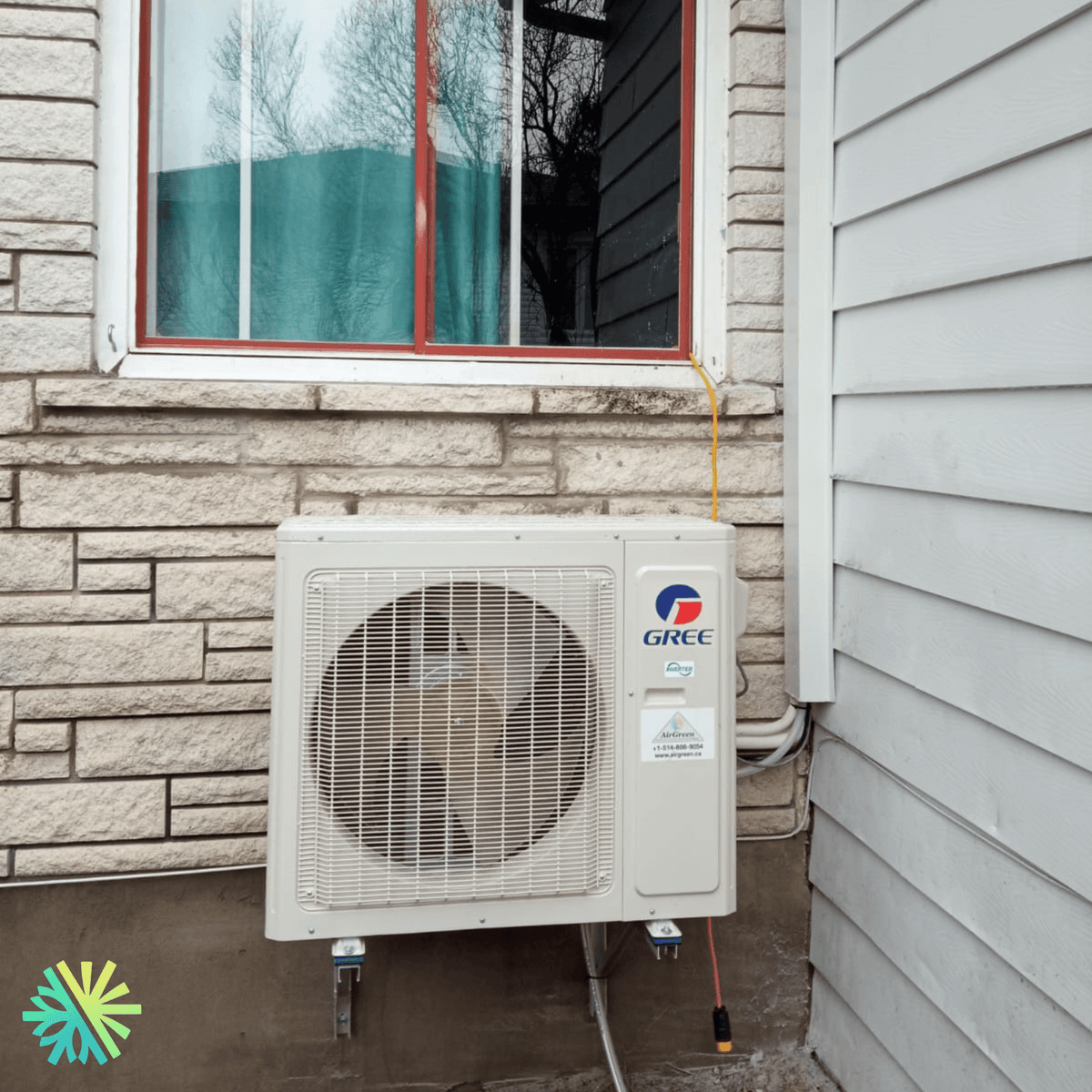
Installation of a Gree Multi GEN2 DoubleZone Heat Pump in Côte-des-Neiges-Notre-Dame-de-Grâce, Montréal
Witness the unique challenge of a dual-unit heat pump installation turned into a triumph of ingenuity and customer satisfaction by AirGreen in Montréal.
- City
- Region
- Equipment
- Brand
- Challenges
- Published
The job on one screen
The article, chapter by chapter
The Tale of Two Units: A Unique Challenge Overcome with Ingenious Solutions
Introduction
In the heart of Côte-des-Neiges-Notre-Dame-de-Grâce, Montréal, AirGreen has once again demonstrated its prowess in the HVAC industry with the installation of a Gree Multi GEN2 DoubleZone heat pump. This project not only highlights our technical expertise but also showcases our commitment to providing energy-efficient and innovative solutions to our clients.
Project Overview
The installation site presented a medium-level difficulty, primarily due to the unique positioning of the indoor units and the complexity of routing the piping system. The Gree Multi GEN2 model, known for its high efficiency and dual 18,000 BTU indoor units, was an ideal choice for this residential setting. The system’s compressor, boasting 36,000 BTU, complements the dual units, ensuring optimal temperature control and comfort throughout the home.
Unique Installation Challenges
The project involved installing one of the indoor units directly on the same wall as the compressor, simplifying the installation process for that unit. However, the placement of the second indoor unit on the opposite side of the house introduced a complex challenge. Our team navigated this by devising an ingenious solution to extend the piping across two additional rooms, avoiding the need for a drain pump by integrating the drainage system directly into the home’s plumbing.
Innovative Solutions and Customer Satisfaction
Our approach to avoiding the use of a drain pump, when possible, is a testament to our commitment to innovative and customer-centric solutions. For this installation, we successfully connected the drainage of the second indoor unit to the house’s plumbing system, eliminating the need for an additional pump. This solution not only streamlined the installation process but also enhanced the system's efficiency and reliability.
Features of the Gree Multi GEN2 DoubleZone Heat Pump
The Gree Multi GEN2 stands out for its exceptional features:
- Energy Efficiency: With a 22.0 SEER rating and Energy Star® certification, this model is designed to deliver optimal performance while minimizing energy consumption.
- Connectivity and Convenience: The inclusion of WiFi capabilities allows homeowners to easily control their heating and cooling system remotely, providing unparalleled convenience and flexibility.
- Low Noise Operation: The outdoor unit’s sound pressure level is maintained at a discreet 63.0 dB(A), ensuring a quiet and comfortable environment.
- Robust Performance: Designed to withstand extreme temperatures, the system offers reliable heating capabilities down to -30°C, making it ideal for the Canadian climate.
- Eco-Friendly Refrigerant: Utilizing R-410A refrigerant, the Gree Multi GEN2 is not only efficient but also environmentally friendly, aligning with modern sustainability standards.
Benefit of Provincial Grant
The installation qualified for a $3,696 provincial grant, providing the homeowner with significant savings and making this high-efficiency solution even more accessible. This financial incentive underscores our commitment to promoting energy-efficient heating and cooling solutions in the region.
Why Choose AirGreen?
Our latest project in Côte-des-Neiges-Notre-Dame-de-Grâce is a testament to AirGreen’s dedication to excellence, innovation, and customer satisfaction. We take pride in overcoming installation challenges with creative solutions, ensuring our clients receive the best possible service and support. Choosing AirGreen means partnering with a leader in the HVAC industry, committed to delivering high-quality, efficient, and sustainable heating and cooling solutions.
The job tools
Two quick checks with real numbers: what heat costs, and what your current heaters add up to in BTU/h.
Conversion: 1 W = 3.412 BTU/h. An indication, not a load calculation: baseboards and furnaces are often stronger than the real need, and they can stay as backup. AirGreen confirms the capacity on site.
How the job unfolds
The main steps of this kind of job at AirGreen. Every house has its quirks: the estimate brings them out.
We look at the room, the outside wall, the line route and where the outdoor unit will go. That is where the capacity gets chosen.
Model, capacity and price, in writing. We also check whether the model qualifies for assistance programs.
Floors and furniture protected, wall plate position marked level, wall opening located.
A single opening, with the slope the drain needs to flow outside.
Set on a stand raised above the snow, with the clearances the manufacturer requires.
Connected, insulated and protected. The opening is then sealed against water, cold air and insects.
A dedicated circuit and an accessible disconnect near the outdoor unit.
Leak test, vacuum, then start-up and a check of heating and cooling.
Remote, modes, filters: we show you the essentials before we leave.
- The on-site estimateWe look at the room, the outside wall, the line route and where the outdoor unit will go. That is where the capacity gets chosen.
- The quoteModel, capacity and price, in writing. We also check whether the model qualifies for assistance programs.
- Getting readyFloors and furniture protected, wall plate position marked level, wall opening located.
- The wall openingA single opening, with the slope the drain needs to flow outside.
- The outdoor unitSet on a stand raised above the snow, with the clearances the manufacturer requires.
- Lines, cable and drainConnected, insulated and protected. The opening is then sealed against water, cold air and insects.
- The electrical workA dedicated circuit and an accessible disconnect near the outdoor unit.
- Tests and start-upLeak test, vacuum, then start-up and a check of heating and cooling.
- The walkthroughRemote, modes, filters: we show you the essentials before we leave.
What we check on a job like this one
Each number is a point we check on site. Switch between summer and winter to watch air and heat move.
In summer, the outdoor unit rejects the house's heat outside.
Generic illustration of this type of installation, not a survey of this job site. Tap a number.
Mounted level on a wall plate, high enough for the air to reach the whole room, with enough space around it to slide the filters out easily.
The refrigerant lines, the communication cable and the drain go through the wall in a single opening, sealed against water, cold air and insects.
Two insulated copper pipes connect the two units. Outside, a line cover can protect them from sun, knocks and weather.
A shut-off switch near the outdoor unit isolates it safely for service. It must stay accessible at all times.
The compressor and the fan. In heating mode it captures heat from the outdoor air, even in winter, and moves it inside.
On the ground or on the wall, it keeps the unit above accumulated snow. The unit stays clear and defrost water can drain away.
The fan needs to blow freely. Storage, a fence or a wall too close, and efficiency drops while noise goes up.
Is your home ready?
Check what applies at your place. A "no" is not a refusal: it is what we sort out during the estimate.
Good habits, once the unit is in place
Six simple habits that keep the unit going. Your list stays on this device.
What to do, season by season
Three habits per season for this unit. They take a few minutes and prevent many calls.
- Clean the indoor unit's filters.
- Clear leaves and debris left on the outdoor unit by winter.
- Test cooling before the first hot days.
- Clean the filters more often when the unit runs a lot.
- Keep plants away from the outdoor unit.
- Check that no water drips from the indoor unit.
- Rake the leaves around the outdoor unit.
- Test heating before the first cold days.
- Book periodic maintenance before winter.
- Keep snow away from the stand and the front of the unit.
- Let the unit defrost: it is normal.
- Never hit the ice on the fins; call us if the unit stays iced up.
The right pages, at the right time
Four statements: true or false?
It all comes down to details you have just seen.
1. In heating mode, the outdoor unit can produce water.
During defrost cycles. That water must drain away without forming ice.
2. You pick the capacity with a simple square-footage rule.
Windows, insulation, orientation and how the room is used all count. Capacity is chosen on site.
3. A multi-zone connects several indoor heads to a single condenser.
One head per room, all on the same condenser. Each room keeps its own temperature.
4. The disconnect can sit behind the patio furniture.
It must stay accessible: it is what shuts the unit off for service.
0 / 4 right answers
What people ask us about this kind of work
Does a wall-mounted heat pump heat in winter?
Wall-mounted or multi-zone: how do I choose?
Where does the outdoor unit go?
Are there grants?
Do I need a permit?
How cold can it heat?
How much can I save?
How is the LogisVert assistance calculated?
Is it noisy?
The outdoor unit is covered in ice: is that normal?
Does AirGreen hold the required licences?
Is the estimate free?
No question matches. Write to us: we answer.
More jobs to see, near you
By town, by equipment or by region: browse more than 4,700 published projects.
Each dot: a town where AirGreen has published projects. The glowing dot: this job.
An on-site estimate, the right capacity, the right equipment.
The on-site estimate is free and the quote follows within 24 hours.
Text and photo: a real AirGreen Climatisation & Chauffage job. The diagrams are generic illustrations of the type of installation, not a survey of this job site. Sources of the added figures: airgreen.ca product pages (NEEP / AHRI performance), Hydro-Québec (Heat pumps page, LogisVert, read on 13 October 2026), Régie de l’énergie (rate D as of 1 April 2026).