
FANTECH VHR 70 Air Exchanger Greater Montreal
Is it the right size for your home?
It delivers 59 cfm net, enough to ventilate 700 to 1,100 sq ft. Choose your home's living area.
It's the right size.
For a condo or a home under 900 sq ft, about 37 cfm of air needs to be renewed continuously. This unit delivers 59 cfm net — enough for the house, with extra capacity to boost ventilation for the bathroom and kitchen.
Calculation: 0.35 air changes per hour over the living volume, with 9 ft ceilings. Our estimator sets the exact airflow room by room, following CSA F326.
What it does, in numbers
$40.99
Electricity per year
Less than a 60 W light bulb
Bulbs left on day and night. Same calculation for every line: wattage × 8,760 h × 11.142 ¢/kWh.
Meets the Québec Construction Code for Greater Montréal. The Code requires 54% at −25 °C below 6,000 degree-days (Montréal, Laval, Longueuil and both shores) and 60% above that. This unit is rated at 57% at 66 cfm.
Airflow and efficiency at 0 °C and −25 °C: HVI directory, Section III. Cost: 42 W over 8,760 h at Hydro-Québec's Rate D second tier (11.142 ¢/kWh).
What you should know about this one
Published, verifiable facts, not brochure claims.
10.25 inFantech's most compact full-featured HRV
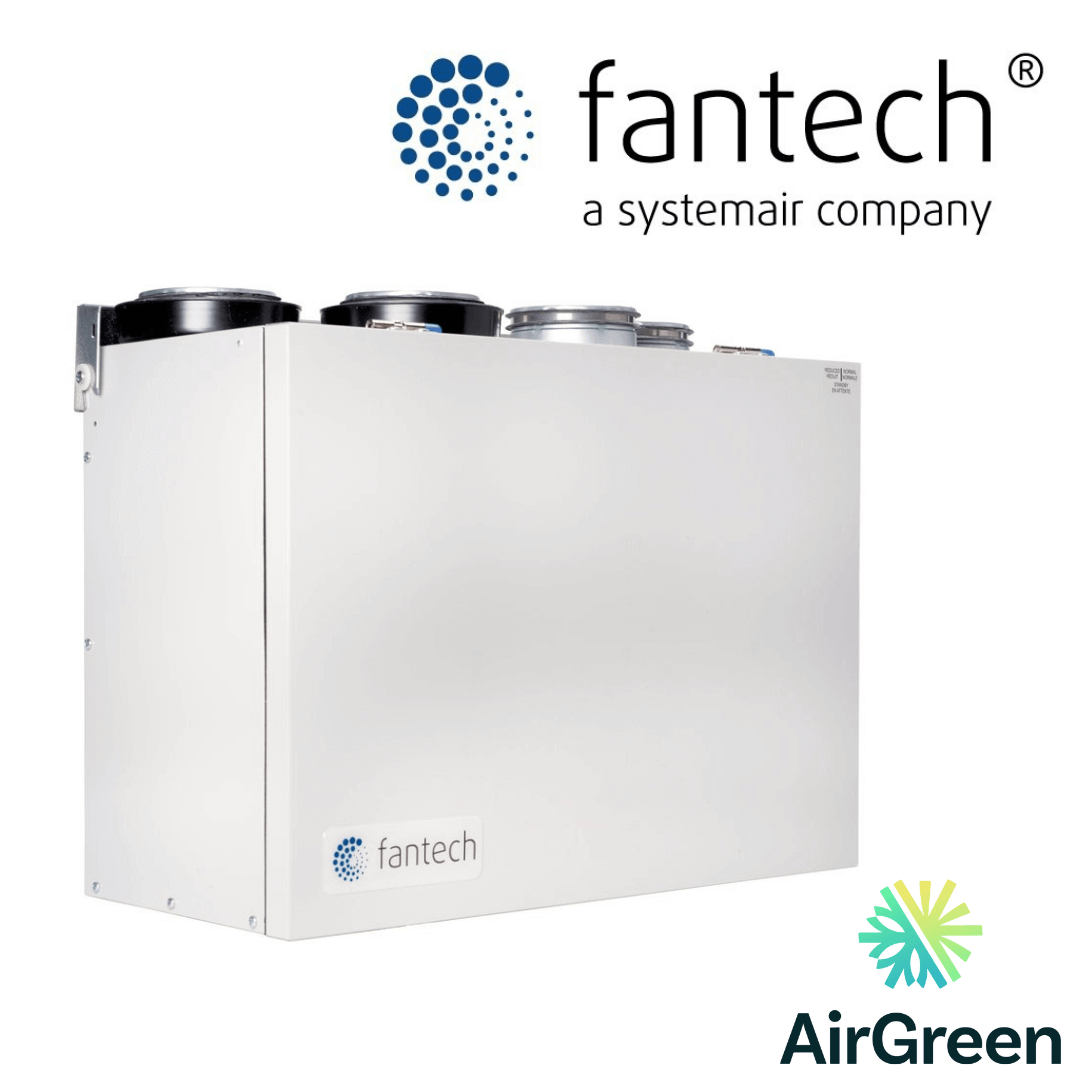
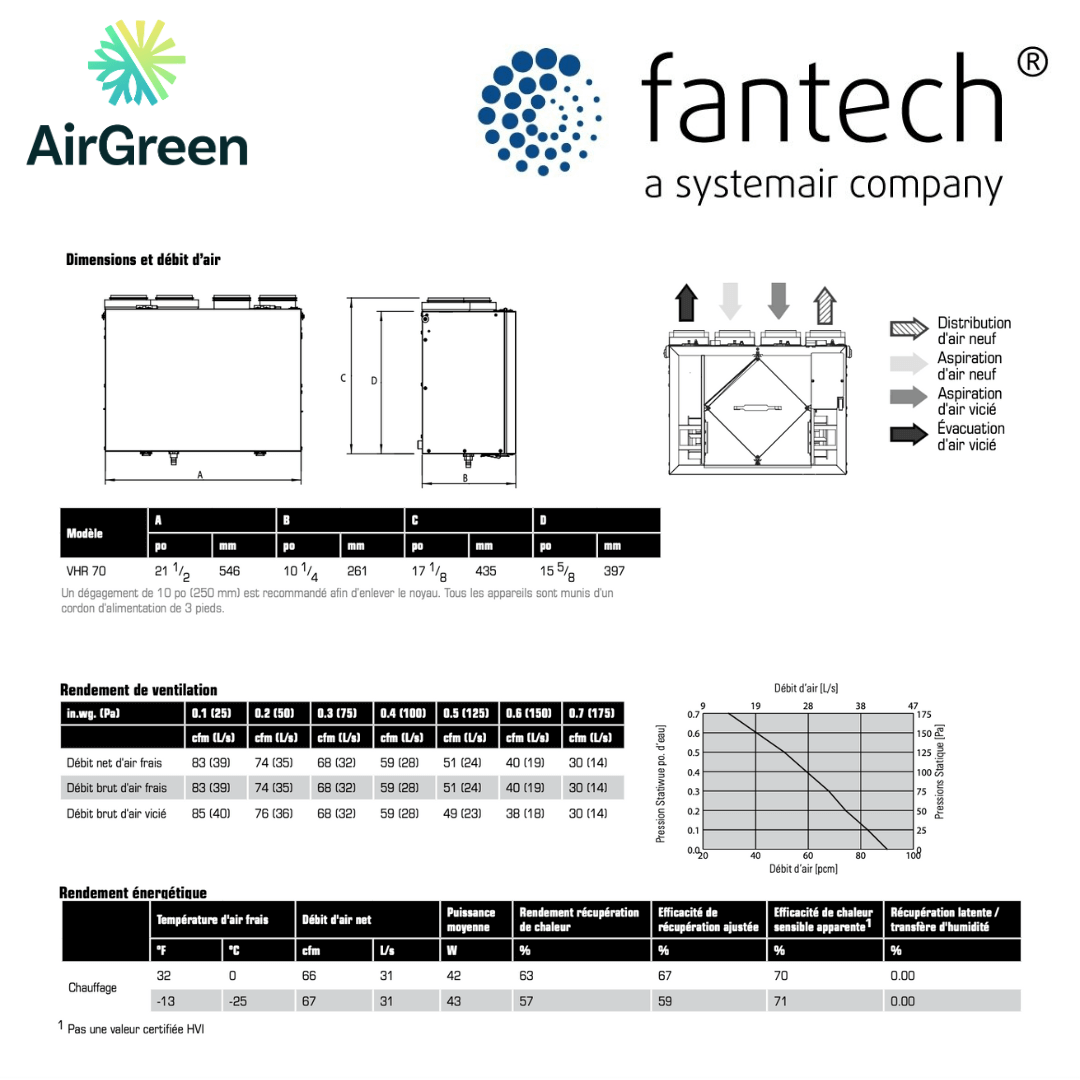
Fantech calls it its most compact full-featured HRV: 21.5 in wide and only 10.25 in deep, with top ports. It hangs on the wall with the included bracket, and the core slides out with 10 in of clearance.
SwitchMIN / AUTO / MAX selector right on the unit
A three-position rocker switch on the unit keeps ventilation running continuously at low (MIN) or high (MAX) speed, with no wall control. The VHR 70 remains compatible with all Fantech controls.
57%What it still recovers at −25 °C
The only efficiency figure that matters for a Québec winter, and the one the Code uses. An efficiency quoted without its temperature means nothing; this one is measured at a test airflow of 66 cfm.
ExhaustIt defrosts by pausing the fresh air for a few minutes
In cold weather, the supply fan stops for a few minutes while the exhaust keeps running, so warm indoor air thaws the core. During the cycle the house is briefly under negative pressure; if you have a fireplace or a naturally vented combustion appliance, mention it to our estimator.
HRVIt recovers heat, not moisture
Excess moisture leaves the house. In Québec, that's the right choice in most cases: in winter, the problem is almost always too much humidity, not too little.
2505191Its HVI certification number
Listed in Section III of the Home Ventilating Institute's certified products directory. Anyone can check it, and it's the first condition for the Rénoclimat grant.
−15 cfmWhat the ducts cost it
Between a nearly unrestricted test bench (0.2 in) and a real duct system (0.4 in), it drops from 74 to 59 cfm. Most spec sheets show only the first number, precisely because it looks better.
42 WMeasured at the airflow it actually runs at
Its 63% at 0 °C is certified at 66 cfm, the continuous airflow of a typical home. At that setting it draws 42 W, or about 368 kWh a year.
LifetimeThe core warranty
The core does the work and is the most expensive part to replace. Motors: 7 years. Parts: 5 years. We register the warranty in your name at commissioning.
4 inWhat it needs on site
4 in ducts, top connection and a condensate drain. It weighs 31 lb, and it needs enough clearance to slide the core out once a year.
Rénoclimat: $500 to install or replace an HRV or ERV
First condition met: HVI Section III certified, No. 2505191. Second: your EnerGuide rating must improve between the two evaluations. Québec warns that an air exchanger installed on its own can increase a home's energy use; that's why we balance it to the calculated airflow rather than running it at full speed.
What it needs on site
In a condo with no floor drain, or with little ceiling clearance, we usually look at a side-port model instead. Our estimator checks the location, the drain and the duct route before ordering.
Complete spec sheetData and cited sources
- Net airflow at 0.2 in. w.g.
- 74 cfm
- Net airflow at 0.4 in. w.g.
- 59 cfm
- SRE at 0 °C (66 cfm)
- 63%
- SRE at −25 °C (66 cfm)
- 57%
- ASE at 0 °C
- 70%
- Power draw
- 42 W
- Efficacy
- 1.5 cfm/W
- Type
- HRV
- Connection
- Top ports
- Duct collars
- 4 in
- Condensate drain
- Required
- Defrost cycle
- Exhaust only (supply fan off)
- Filters
- 2 washable electrostatic panel filters (8.5 × 8 in)
- Dimensions (L × D × H)
- 21.5 × 10.25 × 15.63 in
- Weight
- 31 lb
- Power supply
- 120 V
- HVI certification (Section III)
- 2505191
- Warranty — core
- Lifetime
- Warranty — motors
- 7 years
- Warranty — parts
- 5 years
Net airflow, efficiency at 0 °C and −25 °C, and power draw: Home Ventilating Institute certified products directory, Section III (HVID 2505191). Annual consumption calculated at 42 W running continuously for 8,760 h, at Hydro-Québec's Rate D second tier (11.142 ¢/kWh), in effect since April 1, 2026.
The next model down and up

Talk to an HVAC technician before you choose
We calculate the airflow room by room, check the location and the drain, and give you an installed price. Balancing is measured at commissioning, not estimated.
Comprehensive Guide to Fantech VHR 70 Air Exchanger: A Product Review
Introducing the Fantech VHR 70 Air Exchanger
The Fantech VHR 70 Air Exchanger is a top-tier, high performing, and compact Heat Recovery Ventilator (HRV) that ensures a balanced air exchange in homes. As a leading product in Fantech’s impressive lineup, it is meticulously designed to maintain a healthy indoor climate, supplying fresh air into your home and eliminating an equivalent amount of stale air. With its advanced features and reliable performance, the VHR 70 is an excellent addition to any home in Montreal and beyond.
Airflow and Efficiency
Boasting an airflow of up to 57 cfm @ 0.4” w.g, the VHR 70 stands as a formidable solution to stale indoor air problems. This compact machine is designed to provide optimum ventilation control, making it the perfect air exchange solution for homes with 1-3 bedrooms. The top port design allows the VHR 70 to fit into tight spaces, ensuring minimal intrusion into your living area.
This unit ensures an efficient and effective exchange of air, thereby improving the indoor air quality. It does this by recovering energy from the extracted air and using it to temper the incoming fresh air. This process optimizes the energy required to pre-cool or pre-heat the newly introduced air, making the VHR 70 a highly energy-efficient solution.
Year-round Functionality
Regardless of the season, the VHR 70 remains functional thanks to its automatic defrost mechanisms. This functionality ensures that you can use your HRV all year round, maintaining a constant supply of fresh, quality air in your home. No worries about freezing conditions affecting your unit; the VHR 70 has got it covered.
Technical Specifications of Fantech VHR 70 Air Exchanger
Basic Product Information
The Fantech VHR 70 operates on a nominal voltage of 120V, with a frequency of 60Hz and single phase power supply. It has an input power of 48W and an input current of 0.4A. It has a static pressure of 0.4 in.wg and an air flow rate of 48 cfm. In terms of certification, the VHR 70 meets the stringent standards of CSA and HVI, assuring you of its quality and safety.
The Heat Exchanger
At the heart of the Fantech VHR 70 Air Exchanger is a high-efficiency heat recovery exchanger. This exchanger is responsible for harnessing energy from the outgoing air and using it to heat the incoming fresh air.
Weight and Installation
Weighing just 31.3 lb, the VHR 70 is relatively light for its class. This makes for easy transportation and installation. It is designed for a vertical installation type, ensuring it fits seamlessly into your home setup.
Performance Metrics
When it comes to performance, the VHR 70 delivers impressive results. At a supply temperature of 32 °F (0 °C), it delivers a net airflow of 66 cfm (31 L/s), consumes 42W of power, and achieves a sensible recovery efficiency of 63% and an adjusted sensible recovery efficiency of 67%. In colder conditions of -13 °F (-25 °C), the VHR 70 still performs impressively with a net airflow of 67 cfm (31 L/s), consumes 43W of power, and has a sensible recovery efficiency of 57% and an adjusted sensible recovery efficiency of 59%.
A Closer Look at the Fantech VHR 70 Air Exchanger Features
Compact Size and Design
The VHR 70's compact size is one of its most distinctive features. Despite its small size, it does not compromise on functionality or performance. It features a top port design that fits into tight spaces, making it ideal for homes where space is a premium.
Included Easy-Mount Wall Bracket
The inclusion of an easy-mount wall bracket with the VHR 70 simplifies the installation process. This component makes it convenient for users to mount the device securely in an appropriate location within the home.
Aluminum Heat Recovery Core
This air exchanger boasts an aluminum heat recovery core. This core is designed to maximize energy efficiency by recovering energy from the outgoing air and using it to temper the incoming fresh air. This process greatly reduces the energy required to heat or cool the incoming air, leading to energy savings for homeowners.
No Balancing Required
Unlike some air exchangers, the VHR 70 requires no balancing. This feature eliminates the need for regular adjustments, thus making it easier for homeowners to maintain the unit.
Easy Access Service Door
For quick and easy maintenance, the VHR 70 includes an easy access service door. This feature allows homeowners or service personnel to easily access the unit's interior components, simplifying the maintenance process.
Multi-Speed Operation
Depending on the ventilation needs of your home, the VHR 70 can operate at multiple speeds. This flexibility ensures optimal air exchange and energy efficiency at all times.
Optional Controls of Fantech VHR 70
Fantech provides several optional controls that can be paired with the VHR 70 for enhanced functionality. These include:
- ECO-TouchIAQ: A programmable touch screen wall control for easy operation.
- ECO-Feel: An automatic IAQ control that adjusts the operation of the VHR 70 based on indoor air quality.
- EDF7: An electronic multi-function dehumidistat that helps to maintain optimal humidity levels within the home.
- EDF1: A multi-function control offering more options for the operation of the VHR 70.
- RTS-W: A wireless 20/40/60 minute timer offering convenient control over the operation of the VHR 70.
- RTS5: A 20/40/60 minute override control.
- RTS2: A 20-minute override control.
- MDEH1: A dehumidistat for controlling the humidity levels within the home.
Fantech VHR 70: Certifications and Compliance
The Fantech VHR 70 complies with UL 1812, regulating the construction and installation of Heat Recovery Ventilators. It also complies with CSA C22.2, a standard applicable to ventilators, and CSA F326, which regulates the installation of HRVs. Its technical data was obtained from published results of tests relating to CSA C439 Standards, and it's HVI certified. This level of certification and compliance is a testament to the VHR 70's reliability, quality, and safety.
Conclusion
In summary, the Fantech VHR 70 Air Exchanger is a top-performing, energy-efficient, and compact HVAC solution. It's ideal for homeowners looking for a simple, reliable way to maintain a fresh and healthy indoor climate. With its advanced features, optional controls, and compliance with key industry standards, the VHR 70 is certainly a wise investment for any homeowner.
Trust AirGreen, your local HVAC company in Montréal, for all your Fantech VHR 70 installation and maintenance needs. We are committed to delivering top-notch services that guarantee your comfort and satisfaction. Contact us today and let's make your home a haven of fresh and healthy air.