
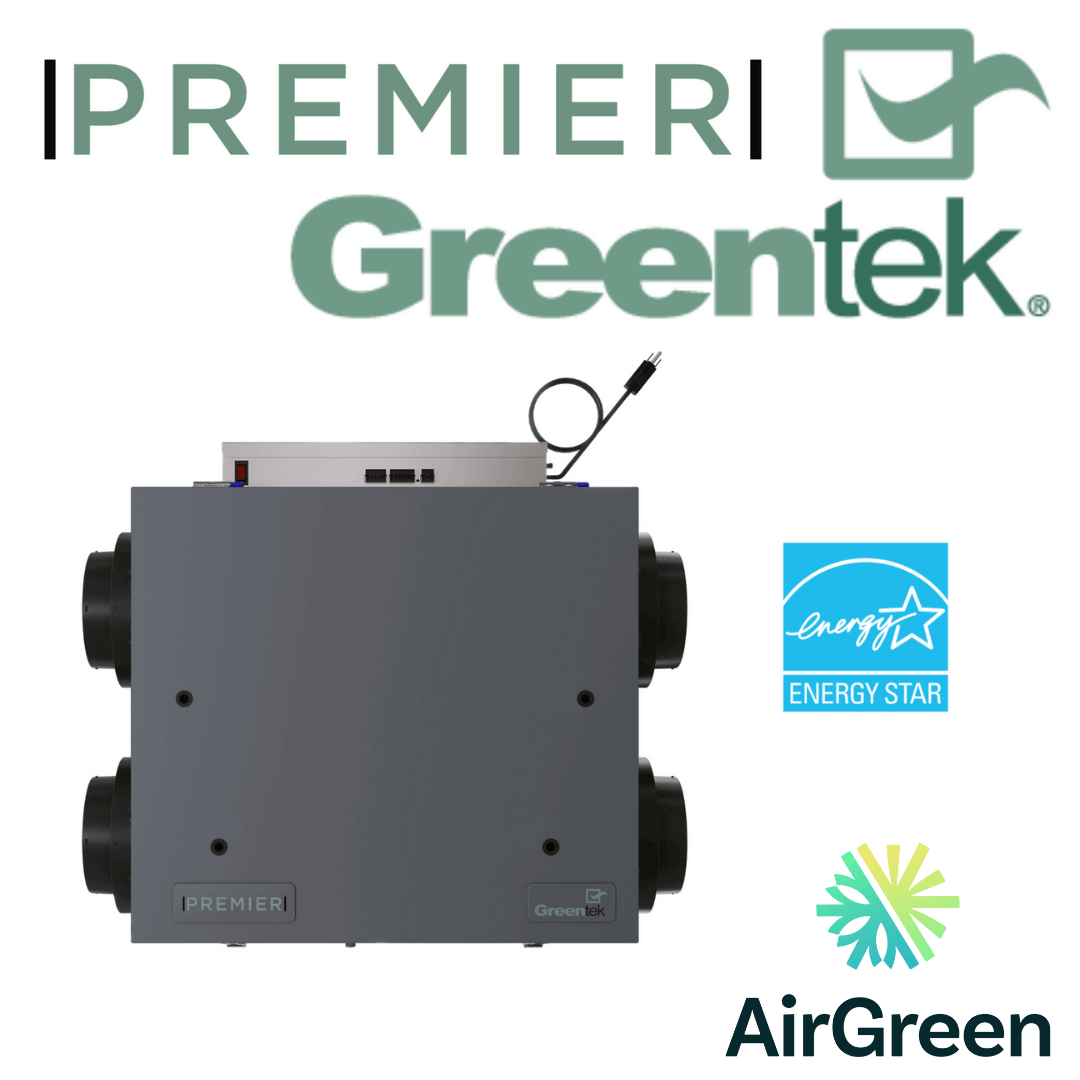
GreenTek PREMIER PRS 1.5E Air Exchanger Greater Montreal
Is it the right size for your home?
It delivers 161 cfm net, enough to ventilate 1,900 to 3,000 sq ft. Choose your home's living area.
It's the right size.
For a 2,500 to 3,200 sq ft home, about 150 cfm of air needs to be renewed continuously. This unit delivers 161 cfm net — enough for the house, with extra capacity to boost ventilation for the bathroom and kitchen.
Calculation: 0.35 air changes per hour over the living volume, with 9 ft ceilings. Our estimator sets the exact airflow room by room, following CSA F326.
What it does, in numbers
$50.75
Electricity per year
Less than a 60 W light bulb
Bulbs left on day and night. Same calculation for every line: wattage × 8,760 h × 11.142 ¢/kWh.
Meets the Québec Construction Code everywhere in the province. The Code requires 54% at −25 °C below 6,000 degree-days (Montréal, Laval, Longueuil and both shores) and 60% above that. This unit is rated at 60% at 64 cfm.
Airflow and efficiency at 0 °C and −25 °C: HVI directory, Section III. Cost: 52 W over 8,760 h at Hydro-Québec's Rate D second tier (11.142 ¢/kWh).
What you should know about this one
Published, verifiable facts, not brochure claims.
−10 °CDefrost only kicks in at −10 °C (14 °F)
Its membrane core is freeze tolerant, so defrost only starts at −10 °C, versus −5 °C for the PREMIER 1.5H and 2.0H HRVs. During the cycle the supply fan stops and the exhaust fan runs at high speed.
WashableWater-washable core certified against mould
The polymer energy recovery core can be washed with water and is certified for mould and bacteria resistance. It also transfers moisture: 58% latent transfer at 0 °C and 64 cfm per the spec sheet.
60%What it still recovers at −25 °C
The only efficiency figure that matters for a Québec winter, and the one the Code uses. An efficiency quoted without its temperature means nothing; this one is measured at a test airflow of 64 cfm.
ExhaustIt defrosts by pausing the fresh air for a few minutes
In cold weather, the supply fan stops for a few minutes while the exhaust keeps running, so warm indoor air thaws the core. During the cycle the house is briefly under negative pressure; if you have a fireplace or a naturally vented combustion appliance, mention it to our estimator.
ERVIt moves moisture too, not just heat
An ERV transfers some moisture between the two airstreams. Useful in a house that gets too dry in winter or takes on a lot of humidity in summer. The trade-off: it generally recovers less heat than a comparable HRV.
2005258Its HVI certification number
Listed in Section III of the Home Ventilating Institute's certified products directory. Anyone can check it, and it's the first condition for the Rénoclimat grant.
−28 cfmWhat the ducts cost it
Between a nearly unrestricted test bench (0.2 in) and a real duct system (0.4 in), it drops from 189 to 161 cfm. Most spec sheets show only the first number, precisely because it looks better.
52 WMeasured at the airflow it actually runs at
Its 75% at 0 °C is certified at 64 cfm, the continuous airflow of a typical home. At that setting it draws 52 W, or about 456 kWh a year.
5 yearsThe core warranty
The core does the work and is the most expensive part to replace. Motors: 7 years. Parts: 5 years. We register the warranty in your name at commissioning.
6 inWhat it needs on site
6 in ducts, side connection. It weighs 46 lb, and it needs enough clearance to slide the core out once a year.
Rénoclimat: $500 to install or replace an HRV or ERV
First condition met: HVI Section III certified, No. 2005258. Second: your EnerGuide rating must improve between the two evaluations. Québec warns that an air exchanger installed on its own can increase a home's energy use; that's why we balance it to the calculated airflow rather than running it at full speed.
What it needs on site
In a condo with no floor drain, or with little ceiling clearance, we usually look at a side-port model instead. Our estimator checks the location, the drain and the duct route before ordering.
Complete spec sheetData and cited sources
- Net airflow at 0.2 in. w.g.
- 189 cfm
- Net airflow at 0.4 in. w.g.
- 161 cfm
- SRE at 0 °C (64 cfm)
- 75%
- SRE at −25 °C (64 cfm)
- 60%
- Power draw
- 52 W
- Efficacy
- 1.2 cfm/W
- Type
- ERV
- Connection
- Side ports
- Duct collars
- 6 in
- Defrost cycle
- Exhaust only (supply fan off)
- Filters
- 2 washable electrostatic MERV 3 panel filters (10 × 11.9 in)
- Dimensions (L × D × H)
- 23.88 × 11.94 × 21.44 in
- Weight
- 46 lb
- Power supply
- 120 V
- HVI certification (Section III)
- 2005258
- Warranty — core
- 5 years
- Warranty — motors
- 7 years
- Warranty — parts
- 5 years
Net airflow, efficiency at 0 °C and −25 °C, and power draw: Home Ventilating Institute certified products directory, Section III (HVID 2005258). Annual consumption calculated at 52 W running continuously for 8,760 h, at Hydro-Québec's Rate D second tier (11.142 ¢/kWh), in effect since April 1, 2026.
The next model down and up

Talk to an HVAC technician before you choose
We calculate the airflow room by room, check the location and the drain, and give you an installed price. Balancing is measured at commissioning, not estimated.
Excellence in Ventilation: The GreenTek Premier PRS 1.5E
The GreenTek Premier PRS 1.5E is the pinnacle of energy recovery ventilator (ERV) technology, offering unparalleled efficiency and performance in improving the air quality of your home. Designed and manufactured by Greentek, a leader in air exchanger technology, the Premier PRS 1.5E ensures that your home's ventilation is in excellent hands.
Specifications
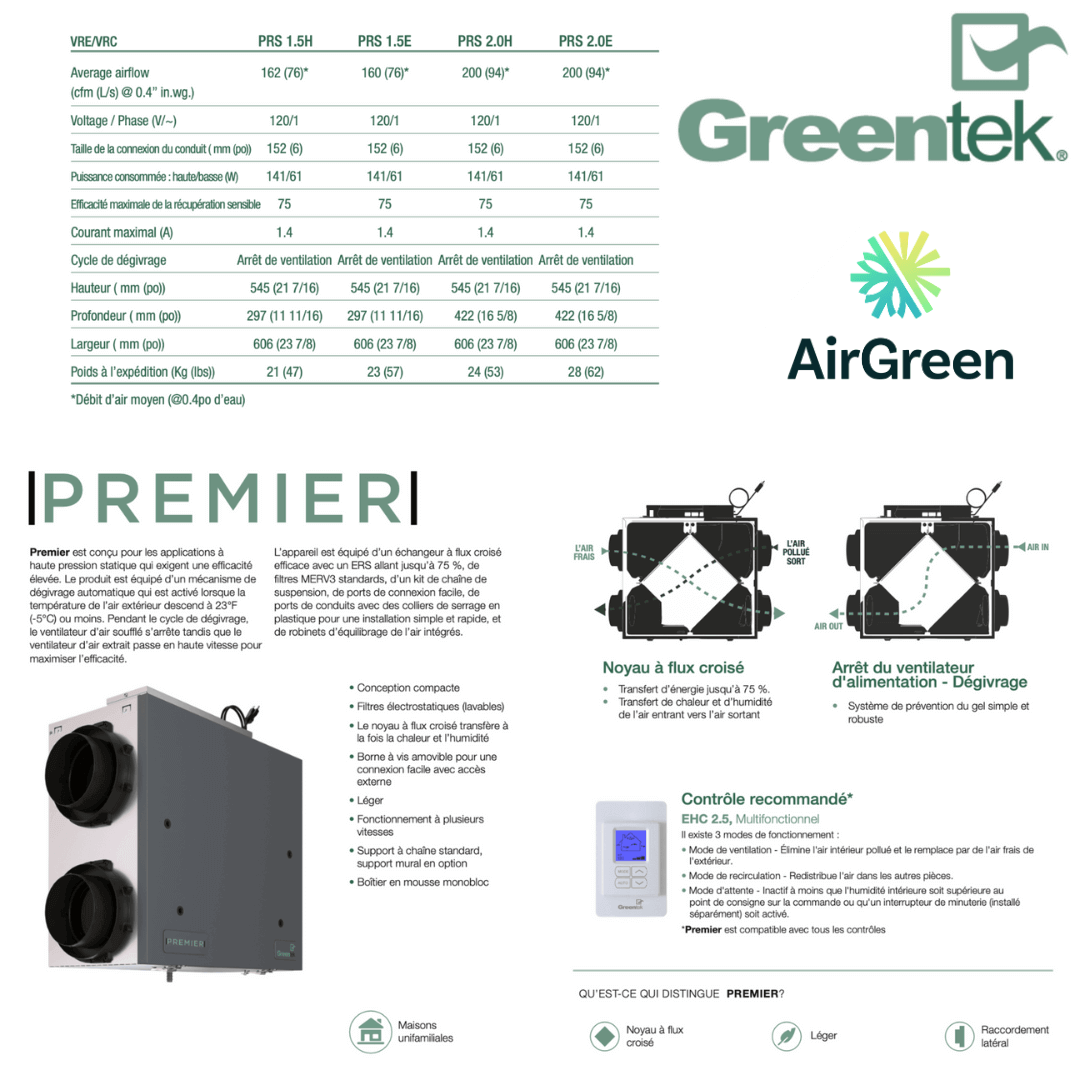
The Premier PRS 1.5E is an ERV with a Part Number: 463922. It offers a Ventilation Performance of 160 cfm @0.4 in. wg, making it equivalent to the Fantech model ATMO 150E 463890. Its Core Type is an Energy Recovery Ventilator (ERV) and it uses FAN Defrost as its defrost type. The Motor Type is PSC. The Heat Recovery Rate (SRE) is 75% and the Moisture Transfer rate is 60%. The unit does not come with a wall controller included.
Performance
The Premier PRS 1.5E consistently supplies 161 cfm of fresh, filtered air while removing an equal amount of stale air from your home. The controlled ventilation ensures the highest level of comfort for all home occupants. As much as 75% of the heat from the extracted air is recovered by the energy exchanger and used to temper the fresh air coming from outside.
Design Features
The unit comes with a 6" side port duct connection and is capable of up to 161 cfm @ 0.4 in.wg. It includes integrated air-balancing taps and has a multi-speed operation. The automatic defrost is provided through an external electrical box. The unit is lightweight and ENERGY STAR® listed, proving its commitment to energy efficiency.
Advanced Functionality
The Premier PRS 1.5E is designed for high static pressure applications that demand high efficiency. It is equipped with an automatic defrost mechanism that is activated when the outdoor air temperature drops to 14F (-10C) or lower. During the defrost cycle, the supply air fan shuts down while the exhaust air fan switches to high speed to maximize effectiveness.
This air appliance features an efficient crossflow energy exchanger with SRE up to 75%, standard MERV3 filters, and a hanging chain kit. It has easy connect ports, integrated air balancing taps, and duct ports with plastic collar shrouds for simple and quick installation.
Warranty and Certifications
The unit comes with a limited warranty (5 years on the exchanger, 7 years on motors, and 5 years on parts). It has been tested in accordance with the Home Ventilating Institute (HVI) Certification Program to ensure it meets HVI ratings for airflow and energy, and is ENERGY STAR® listed.
Special Installation Notes
If you are using the Premier PRS 1.5E for a simplified installation, for instance, connecting the supply air duct to a furnace's return air duct, the appliance must operate continuously. Otherwise, the furnace will continue to draw in outdoor air directly into the furnace without re-heating or re-cooling. If the appliance is installed in such a way that the homeowner may turn it off during the cold or hot seasons, a motorized damper ADC6 is recommended to be installed between the appliance’s supply air and the furnace's return air duct. The damper will close when the appliance is not operating to ensure efficient energy use.