
Lifebreath 350 DCS HRV Air Exchanger | Montreal, Laval, Longueuil, South Shore and North Shore
Is it the right size for your home?
It delivers 371 cfm net, enough to ventilate 4,400 to 7,000 sq ft. Choose your home's living area.
It's the right size.
For a home over 5,000 sq ft, about 315 cfm of air needs to be renewed continuously. This unit delivers 371 cfm net — enough for the house, with extra capacity to boost ventilation for the bathroom and kitchen.
Calculation: 0.35 air changes per hour over the living volume, with 9 ft ceilings. We set the exact airflow during our on-site assessment.
What it does, in numbers
Airflow and efficiency: manufacturer's published data.
What you should know about this one
Published, verifiable facts, not brochure claims.
4 coresFour cores: two in parallel, two in series
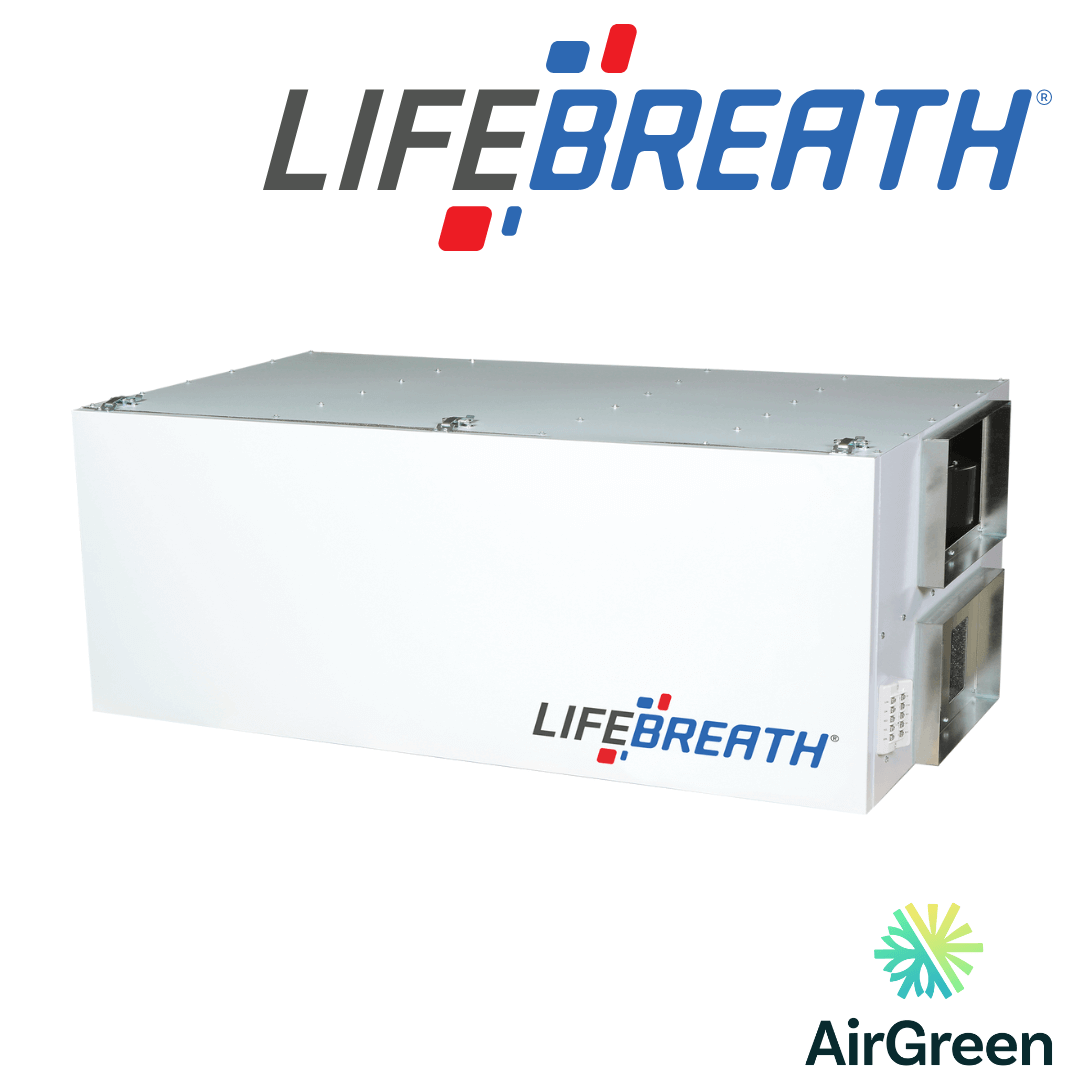
It uses four aluminum cross-flow cores, two in parallel and two in series, for very high efficiency. The low-profile cabinet is designed to sit above a suspended ceiling on brackets and threaded rods (not included).
14 × 8 inFour rectangular 14 × 8 in duct connections
Ducts connect to four rectangular 14 × 8 in openings instead of round collars. Plan for 30 in of service clearance as well.
DamperIt defrosts with indoor air
In cold weather, a motorized damper closes the outdoor air intake and recirculates indoor air through the core to thaw it. During the cycle, no outdoor air comes in through the unit.
HRVIt recovers heat, not moisture
Excess moisture leaves the house. In Québec, that's the right choice in most cases: in winter, a house almost always has too much humidity, not too little.
−55 cfmWhat the ducts cost it
Between a nearly unrestricted test bench (0.2 in) and a real duct system (0.4 in), it drops from 426 to 371 cfm. Most spec sheets show only the first number, precisely because it looks better.
15 yearsThe core warranty
The core does the work and is the most expensive part to replace. Motors and parts: 2 years.
14 x 8 inWhat it needs on site
14 x 8 in ducts, side connection and a condensate drain. It weighs 160 lb, and it needs enough clearance to slide the core out for cleaning.
What it needs on site
In a condo with no floor drain, or with little ceiling clearance, we usually look at a side-port model instead. Our estimator checks the location, the drain and the duct route before ordering.
Complete spec sheetData and cited sources
- Net airflow at 0.2 in. w.g.
- 426 cfm
- Net airflow at 0.4 in. w.g.
- 371 cfm
- Type
- HRV
- Connection
- Side ports
- Duct collars
- 14 x 8 in
- Condensate drain
- Required
- Defrost cycle
- Recirculation (motorized damper)
- Filters
- Washable MERV 6 filters (exhaust and supply); MERV 13 upgrade (65-192-6R)
- Dimensions (L × D × H)
- 49 × 28.25 × 18.75 in
- Weight
- 160 lb
- Power supply
- 120 V
- Warranty — core
- 15 years
- Warranty — motors
- 2 years
- Warranty — parts
- 2 years
Airflow and efficiency: manufacturer's published data. The manufacturer doesn't publish an efficiency at −25 °C for this model; we don't make one up.
The next model down and up

Talk to an HVAC technician before you choose
We assess your needs on site, check the location and the drain, and give you an installed price. Balancing is measured at commissioning, not estimated.
Lifebreath 350 DCS: a high-capacity, four-core HRV for installation above a suspended ceiling
At AirGreen, we install the Lifebreath 350 DCS, a heat recovery ventilator (HRV) that Lifebreath describes as a highly efficient double core system, housed in a low-profile cabinet designed for installation above suspended ceilings. According to its spec sheet, it delivers 426 cfm net at 0.2 in. and still 371 cfm at 0.4 in. of static pressure, well above the 261 cfm net at 0.4 in. that the HVI directory gives the 267 MAX. It is therefore meant for a large home whose fresh-air needs exceed what the latter delivers, provided a suspended ceiling or a service space can take its 49 × 28 1/4 × 18 3/4 in. cabinet.
Four Cores, in Parallel and in Series
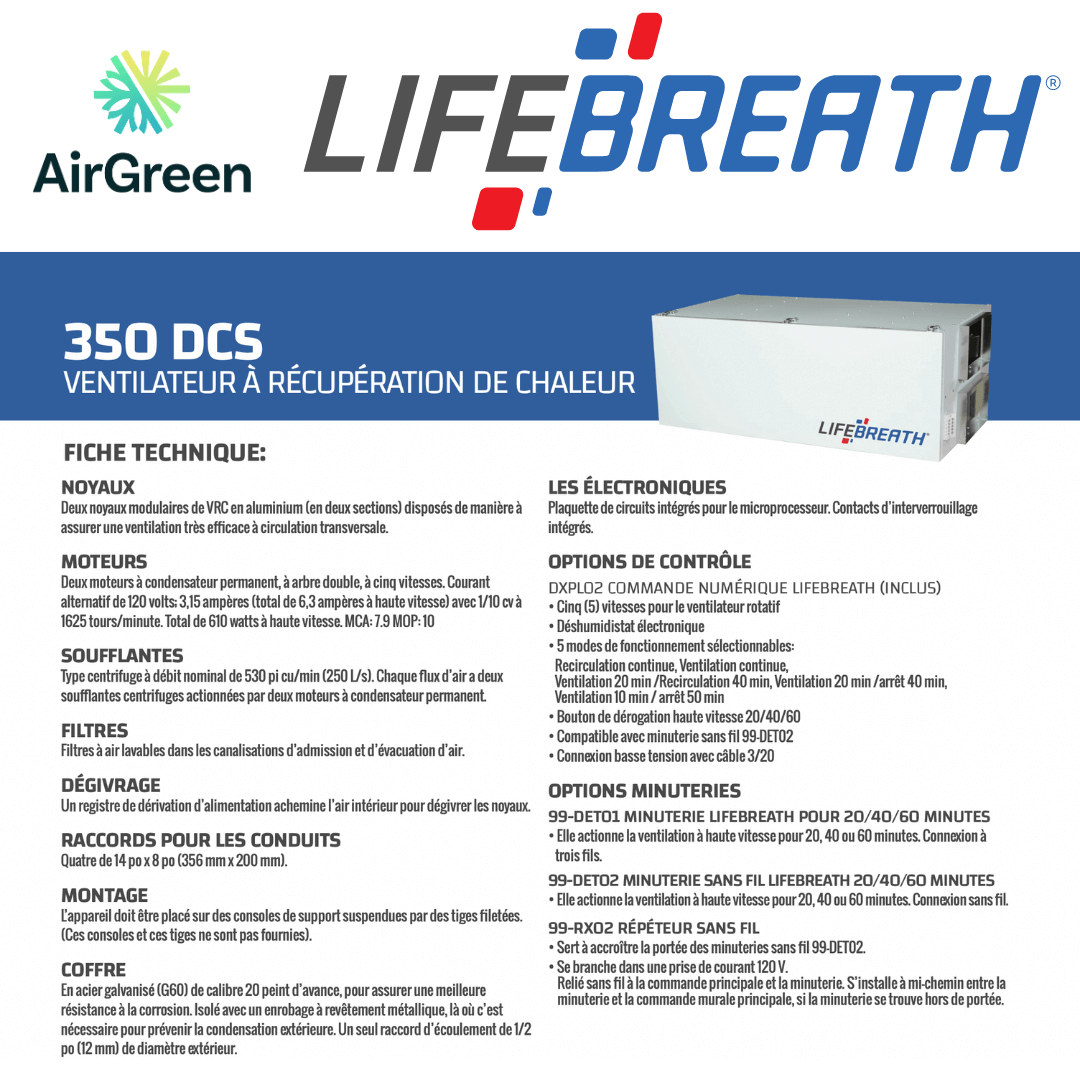
The 350 DCS has two modular, two-section aluminum cores, for a total of four cross-flow cores: two work in parallel and two in series, an arrangement Lifebreath uses for very high efficiency. The 350 DCS is not listed in the HVI directory, however: no certified efficiency is published for this model.
Motors and Blowers
Two double-shafted, 5-speed PSC motors, rated 1/10 hp at 1,625 RPM, drive the centrifugal blowers: each airstream has two of them. Lifebreath rates them at 530 cfm (250 L/s) free air delivery. Powered at 120 V, the unit draws 187 W on low speed and 610 W on high speed, for a total current of 6.3 A on high speed, and it comes with a standard 120 V residential plug.
Cabinet, Filters and Defrost
On the cabinet side: corrosion-resistant 22-gauge prepainted galvanized steel and insulation that prevents exterior condensation. Washable MERV 6 filters treat the stale air and the fresh air alike; part 65-192-6R replaces them with MERV 13 filters. The balancing ports are on the door, and condensation leaves through two drain spouts (outside diameter: 12 mm, or 1/2 in.). For defrost, a supply bypass damper sends indoor air into the cores; according to the installation manual, the unit switches to defrost mode on its own when the temperature drops below freezing. An integrated microprocessor circuit board and interlock contacts round out the electronics.
The Included DXPL03 Control
The 350 DCS comes with the DXPL03 digital wall control, which offers 5 speeds and 4 operating modes. Its features include:
- an electronic dehumidistat;
- a button that switches the unit to high speed for 20, 40 or 60 minutes;
- a back-lit LCD screen;
- compatibility with the 99-DET02 wireless timer (20, 40 or 60 minutes), which the 350 DCS installation manual names.
The Code and Certification
The Québec Construction Code (art. 9.36.3.9) requires, for the principal ventilation system of a dwelling, a unit whose efficiency at −25°C is certified: with no HVI listing and no published efficiency at that temperature, the 350 DCS cannot demonstrate it. For a project covered by this article, we therefore steer the choice toward a Lifebreath HRV listed with HVI.
Installation by AirGreen
Before recommending the 350 DCS, we assess the home's ventilation needs on site (bedrooms, bathrooms, kitchen, basement), then we choose with you where to put its 160 lb, keeping the 30 in. of clearance in front of the unit that Lifebreath calls for to allow servicing.
The 350 DCS is installed level, a condition Lifebreath sets so that water drains properly. It sits on support brackets hung from threaded rods, or on a saddle of U-channels suspended from rods, with vibration isolators; Lifebreath supplies neither the brackets nor the rods. The galvanized sheet-metal ducts connect to its four 14 × 8 in. (356 × 200 mm) openings through flexible duct connectors. Outdoors, the two hoods must be at least 10 ft (3 m) apart, and Lifebreath wants them at least 18 in. (46 cm) above the ground or the snow. The drain runs through a P-trap made of 1/2 in. hose (not included); trap and tubing sit below the level of the bottom of the door, and the tubing drops 1/4 in. per foot as it runs away from the unit. At start-up, the unit runs on high speed and we measure each airflow with a pitot tube in the ducts, then we reduce the stronger one with a damper installed on site, as the 350 DCS manual describes.
For a free quote, call 514 316-2973 or write to sales@airgreen.ca: we will call you back. We install the 350 DCS in Montreal, Laval, Longueuil, the North Shore and the South Shore, with our team, under AirGreen's RBQ licence 5645-9605-01.