
Installation of a Frigidaire wall-mounted air conditioner in Rosemont–La Petite-Patrie
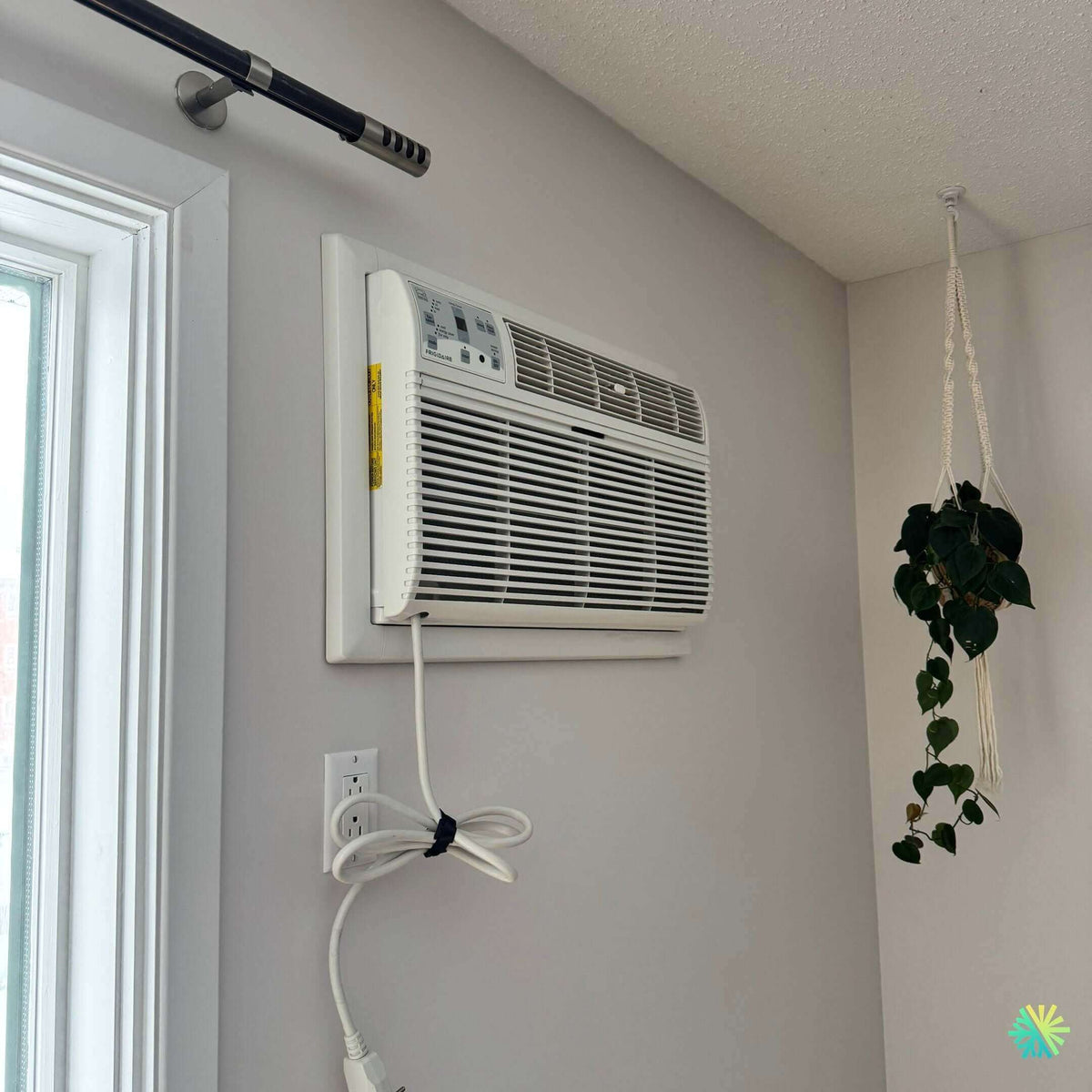
Installation of a Frigidaire wall-mounted air conditioner in a condo in Rosemont–La Petite-Patrie. AirGreen, HVAC specialist in Montreal and the surrounding area, offers comfort and expertise.
Take a tour of the installation
Each number is a point we check on site. Switch between summer and winter to watch air and heat move.
In summer, the outdoor unit rejects the house's heat outside.
Generic illustration of this type of installation, not a survey of this job site. Tap a number.
Mounted level on a wall plate, high enough for the air to reach the whole room, with enough space around it to slide the filters out easily.
The refrigerant lines, the communication cable and the drain go through the wall in a single opening, sealed against water, cold air and insects.
Two insulated copper pipes connect the two units. Outside, a line cover can protect them from sun, knocks and weather.
A shut-off switch near the outdoor unit isolates it safely for service. It must stay accessible at all times.
The compressor and the fan. In heating mode it captures heat from the outdoor air, even in winter, and moves it inside.
On the ground or on the wall, it keeps the unit above accumulated snow. The unit stays clear and defrost water can drain away.
The fan needs to blow freely. Storage, a fence or a wall too close, and efficiency drops while noise goes up.
A compact and efficient solution for an urban condo
At AirGreen , we regularly meet clients looking for a simple and affordable air conditioning solution for their condo in Montreal. In this project, located in the heart of the Rosemont–La Petite-Patrie neighborhood, we installed a Frigidaire wall-mounted air conditioner directly embedded in a partition facing the exterior. This type of installation is perfectly suited to condos and apartments where space is limited and where the management of technical outlets must be optimized.
Choosing the Frigidaire wall-mounted air conditioner
Frigidaire is a recognized leader in home appliances and residential air conditioning. Their line of wall-mounted air conditioners offers an excellent compromise between performance, simplicity, and cost. While this type of unit doesn't have all the features of more recent wall-mounted heat pumps (efficient heating in winter, superior energy efficiency), it remains an effective solution for summer comfort .
Technical details of the installation
In this condo, the appliance was installed in such a way as to combine practicality and aesthetics:
-
Machine type: built-in wall-mounted air conditioner.
-
Brand: Frigidaire.
-
Location: fixed to the exterior wall, near a French window, allowing direct exit to the outside.
-
Power supply: Dedicated wall outlet with secure cord.
-
Drain management: internal drain managed by the positioning of the unit.
-
Wall frame: finishing panel allowing for clean, seamless visual integration.
This choice of layout allows for the optimization of airflow in the main room of the condo, while respecting the structural constraints of the building.
The challenges encountered
Our technicians had to deal with certain constraints linked to the building:
-
Exterior wall thickness: a precise adjustment was necessary to embed the appliance and prevent any air infiltration.
-
Electrical wiring management: installation of a nearby outlet to avoid the use of extension cords, ensuring safety and electrical compliance.
-
Interior aesthetics: the finish had to remain neat, without visible cables or rough cuts, in order to preserve the visual harmony of the condo.
Benefits for the customer
The owner now benefits from:
-
Immediate comfort in summer with rapid cooling.
-
A compact and discreet installation , perfectly suited to your condo.
-
An affordable solution , with a reduced initial investment compared to wall-mounted heat pumps.
-
Better indoor air quality , thanks to the integrated and easy-to-clean filter.
Limitations and recommendations
It is important to remember that this type of wall-mounted air conditioner:
-
Does not provide heating in winter , unlike wall-mounted heat pumps .
-
Offers more modest energy efficiency, but remains sufficient for occasional air conditioning needs.
-
Generally not eligible for provincial subsidies , unlike high-efficiency heat pumps.
We recommend this type of unit when the budget or the building structure does not allow for the installation of a heat pump. However, for four-season comfort and maximum energy savings, a wall-mounted heat pump remains the most advantageous choice.
Customer Testimonial
The customer, satisfied with his installation, shared with us:
"My condo quickly became uncomfortable in the summer. With this new Frigidaire wall-mounted air conditioner, the temperature remains cool and comfortable, and the installation was carried out quickly and cleanly by the AirGreen team."
AirGreen: Your HVAC Expert in Greater Montreal
At AirGreen, we tailor our solutions to the real needs of our customers. Whether it's for a wall-mounted air conditioner , a wall-mounted heat pump , or a central HVAC system, our expertise covers all of Greater Montreal: Montreal, Laval, Longueuil, the North Shore, and the South Shore . Our goal is to offer quality, durable installations that are perfectly suited to each type of residence.
The big day, step by step
The main steps of this kind of job at AirGreen. Every house has its quirks: the estimate brings them out.
We look at the room, the outside wall, the line route and where the outdoor unit will go. That is where the capacity gets chosen.
Model, capacity and price, in writing. We also check whether the model qualifies for assistance programs.
Floors and furniture protected, wall plate position marked level, wall opening located.
A single opening, with the slope the drain needs to flow outside.
Set on a stand raised above the snow, with the clearances the manufacturer requires.
Connected, insulated and protected. The opening is then sealed against water, cold air and insects.
A dedicated circuit and an accessible disconnect near the outdoor unit.
Leak test, vacuum, then start-up and a check of heating and cooling.
Remote, modes, filters: we show you the essentials before we leave.
- The on-site estimateWe look at the room, the outside wall, the line route and where the outdoor unit will go. That is where the capacity gets chosen.
- The quoteModel, capacity and price, in writing. We also check whether the model qualifies for assistance programs.
- Getting readyFloors and furniture protected, wall plate position marked level, wall opening located.
- The wall openingA single opening, with the slope the drain needs to flow outside.
- The outdoor unitSet on a stand raised above the snow, with the clearances the manufacturer requires.
- Lines, cable and drainConnected, insulated and protected. The opening is then sealed against water, cold air and insects.
- The electrical workA dedicated circuit and an accessible disconnect near the outdoor unit.
- Tests and start-upLeak test, vacuum, then start-up and a check of heating and cooling.
- The walkthroughRemote, modes, filters: we show you the essentials before we leave.
What would it look like at your place?
Two quick checks with real numbers: what heat costs, and what your current heaters add up to in BTU/h.
Conversion: 1 W = 3.412 BTU/h. An indication, not a load calculation: baseboards and furnaces are often stronger than the real need, and they can stay as backup. AirGreen confirms the capacity on site.
Four mistakes we do not make
Flip each card to see what we do instead.
Your own project, step by step
What to do, season by season
Three habits per season for this unit. They take a few minutes and prevent many calls.
- Clean the indoor unit's filters.
- Clear leaves and debris left on the outdoor unit by winter.
- Test cooling before the first hot days.
- Clean the filters more often when the unit runs a lot.
- Keep plants away from the outdoor unit.
- Check that no water drips from the indoor unit.
- Rake the leaves around the outdoor unit.
- Test heating before the first cold days.
- Book periodic maintenance before winter.
- Keep snow away from the stand and the front of the unit.
- Let the unit defrost: it is normal.
- Never hit the ice on the fins; call us if the unit stays iced up.
Is your home ready?
Check what applies at your place. A "no" is not a refusal: it is what we sort out during the estimate.
Four statements: true or false?
It all comes down to details you have just seen.
1. In heating mode, the outdoor unit can produce water.
During defrost cycles. That water must drain away without forming ice.
2. You pick the capacity with a simple square-footage rule.
Windows, insulation, orientation and how the room is used all count. Capacity is chosen on site.
3. A multi-zone connects several indoor heads to a single condenser.
One head per room, all on the same condenser. Each room keeps its own temperature.
4. The disconnect can sit behind the patio furniture.
It must stay accessible: it is what shuts the unit off for service.
0 / 4 right answers
What people ask us about this kind of work
Does a wall-mounted heat pump heat in winter?
Wall-mounted or multi-zone: how do I choose?
Where does the outdoor unit go?
Are there grants?
Do I need a permit?
How cold can it heat?
How much can I save?
How is the LogisVert assistance calculated?
Is it noisy?
The outdoor unit is covered in ice: is that normal?
Does AirGreen hold the required licences?
Is the estimate free?
No question matches. Write to us: we answer.
More jobs to see, near you
By town, by equipment or by region: browse more than 4,700 published projects.
Each dot: a town where AirGreen has published projects. The glowing dot: this job.
Every house has its constraints. We see them before we install.
The on-site estimate is free and the quote follows within 24 hours.
Text and photo: a real AirGreen Climatisation & Chauffage job. The diagrams are generic illustrations of the type of installation, not a survey of this job site. Sources of the added figures: airgreen.ca product pages (NEEP / AHRI performance), Hydro-Québec (Heat pumps page, LogisVert, read on 13 October 2026), Régie de l’énergie (rate D as of 1 April 2026).