
Installation of a Carrier central heat pump in Saint-Laurent
Installation of a Carrier central heat pump in Saint-Laurent by AirGreen, HVAC experts in Greater Montreal. A reliable and efficient solution for heating and air conditioning.
- City
- Region
- Equipment
- Brand
- Challenges
- Published
The job on one screen
The article, chapter by chapter
A residential project designed for comfort and sustainability
At AirGreen , we know that a central heat pump installation is more than just an equipment upgrade: it's an investment in a home's daily comfort and energy efficiency. We recently had the pleasure of installing a central heat pump for a single-family home in Saint-Laurent , a Montreal neighborhood where heating and cooling needs are particularly high due to the significant seasonal variations.
Our client chose a Carrier central heat pump , renowned for its reliability, performance, and compatibility with energy efficiency programs available in Quebec. This project perfectly illustrates the importance of a well-designed installation carried out by a team of specialists.
The special features of the Carrier heat pump
The Carrier brand is recognized worldwide as a pioneer in the field of HVAC. The model installed in this home offers:
-
A heating and air conditioning capacity perfectly adapted to the size of the house.
-
Reliable performance, even during periods of extreme cold in Montreal.
-
Compatibility with existing ducts, thus avoiding heavy additional work.
-
Energy efficiency to reduce electricity costs, while providing stable and constant comfort.
Technical details and installation approach
During this installation, several technical points caught our attention:
Reinforced wall bracket
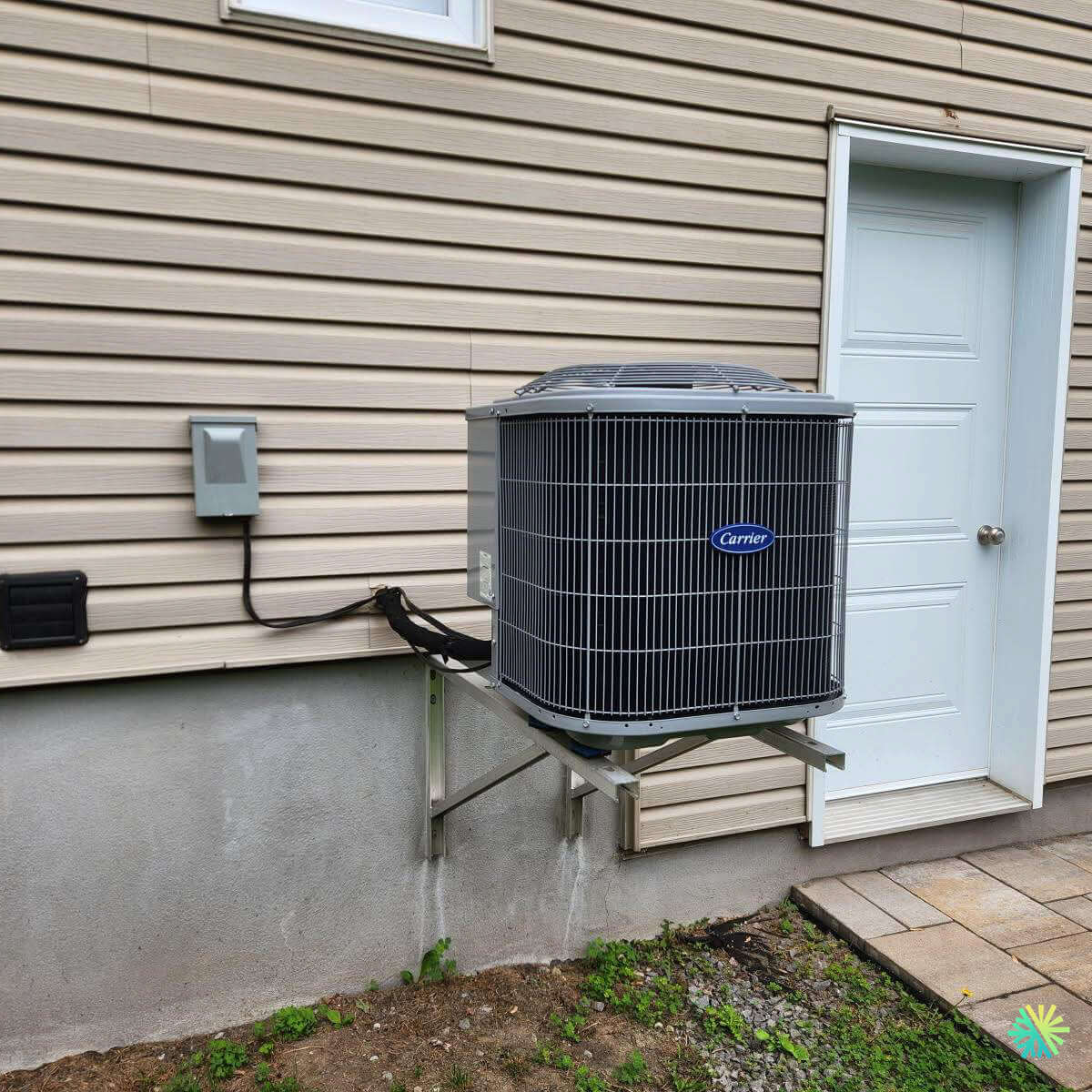
The outdoor condenser was mounted on sturdy wall brackets , slightly raised off the ground. This approach protects the unit from water infiltration, snow accumulation in winter and ensures better air circulation around the unit.
Electrical connection
We have positioned an electrical disconnect box directly near the device, in accordance with RBQ and CSA standards, thus allowing quick and safe access for any future maintenance.
Refrigerant lines and insulation
The refrigerant lines have been carefully insulated to avoid any loss of energy efficiency. Their discreet route ensures a harmonious integration with the aesthetics of the house.
Drainage and maintenance
The wall-mounted configuration makes drainage of the unit easier. The customer benefits from a durable, low-maintenance solution that is easy for our technicians to access during annual inspections.
Challenges encountered and solutions provided
As with any project, there were some challenges to overcome. In this case:
-
Proximity to an exterior door : The condenser had to be positioned next to a secondary access point to the house. We opted for a secure wall mount, allowing both to maintain a clear passage and to ensure the stability of the unit.
-
Management of available space : the installation on a wall support made it possible to preserve floor space, an advantage for the client who wanted to keep the area free for landscaping.
These solutions illustrate AirGreen's ability to adapt each installation to the specific constraints of the site.
Why choose AirGreen for your central heat pump installation?
By entrusting their project to AirGreen, our clients benefit from:
-
Recognized local expertise : dozens of successful installations in Greater Montreal, including Saint-Laurent, Laval, Longueuil, on the North Shore and the South Shore.
-
Complete support : from selecting the right Carrier model to commissioning and operating instructions.
-
A service focused on reliability : respect for deadlines, compliance with standards and attention to detail at every stage.
-
Grant tips : Maximizing savings through government programs for energy-efficient HVAC systems.
Results and customer satisfaction
Following the installation, the customer now benefits from optimal comfort in both summer and winter , with improved energy efficiency and peace of mind thanks to a professional and guaranteed installation. The choice of the Carrier central heat pump proved to be a sustainable solution adapted to the specific needs of the house.
Recommended maintenance and follow-up
As with any central heat pump installation, we recommend annual HVAC maintenance in order to:
-
Check the refrigerant pressure.
-
Clean the outdoor condenser.
-
Check the integrity of the duct insulation.
-
Ensure energy performance and extend the life of the appliance.
Our specialized technicians are available throughout Montreal, Laval, Longueuil as well as on the North Shore and the South Shore to ensure rigorous monitoring.
Conclusion
This Carrier central heat pump installation in Saint-Laurent perfectly illustrates AirGreen's expertise. Through meticulous planning, careful execution, and a client-centric approach, we delivered a sustainable and efficient solution while optimizing the residence's outdoor space.
For any request for installation, maintenance or replacement of HVAC systems in Greater Montreal, trust AirGreen, your partner in air conditioning and heating .
The job tools
Two quick checks with real numbers: what heat costs, and what your current heaters add up to in BTU/h.
Conversion: 1 W = 3.412 BTU/h. An indication, not a load calculation: baseboards and furnaces are often stronger than the real need, and they can stay as backup. AirGreen confirms the capacity on site.
How the job unfolds
The main steps of this kind of job at AirGreen. Every house has its quirks: the estimate brings them out.
We look at the ducts, the current indoor module, the electrical panel and the planned spot for the outdoor unit.
The equipment combination, capacity and price, in writing. We check whether the combination qualifies for assistance programs.
Access protected, old unit disconnected and removed when it is being replaced.
Electric furnace or air handler, with its coil, connected to the supply and return ducts.
On a level base, raised above the snow, with free space all around.
Insulated, they enter through a sealed opening and run to the indoor coil.
Dedicated circuits, accessible disconnect, a thermostat that works with the heat pump and the backup heat.
Leak test, vacuum, start-up, airflow check and a test of both modes.
Filter, thermostat, backup heat in extreme cold: what to know before winter.
- The on-site estimateWe look at the ducts, the current indoor module, the electrical panel and the planned spot for the outdoor unit.
- The quoteThe equipment combination, capacity and price, in writing. We check whether the combination qualifies for assistance programs.
- Getting readyAccess protected, old unit disconnected and removed when it is being replaced.
- The indoor moduleElectric furnace or air handler, with its coil, connected to the supply and return ducts.
- The outdoor unitOn a level base, raised above the snow, with free space all around.
- The refrigerant linesInsulated, they enter through a sealed opening and run to the indoor coil.
- Electrical and thermostatDedicated circuits, accessible disconnect, a thermostat that works with the heat pump and the backup heat.
- Tests and start-upLeak test, vacuum, start-up, airflow check and a test of both modes.
- The walkthroughFilter, thermostat, backup heat in extreme cold: what to know before winter.
What we check on a job like this one
Each number is a point we check on site. Switch between summer and winter to watch air and heat move.
In summer, the outdoor unit rejects the house's heat outside.
Generic illustration of this type of installation, not a survey of this job site. Tap a number.
It captures or rejects heat outside. It sits on a level base, above the snow, with free space all around.
The insulated refrigerant lines enter the house through a sealed opening and run to the indoor coil.
A shut-off switch near the outdoor unit isolates it safely for service.
Sitting on the indoor module, it moves heat between the house air and the refrigerant.
Electric furnace or air handler: its fan pushes air through the ducts. The electric backup takes over in extreme cold.
Supply ducts bring air to the rooms; returns bring it back to the unit. Their condition matters as much as the unit's.
It protects the coil and the fan. A dirty filter cuts airflow, so it gets checked regularly.
It runs the heat pump and the backup heat. It must be compatible with the installed system.
Is your home ready?
Check what applies at your place. A "no" is not a refusal: it is what we sort out during the estimate.
Good habits, once the unit is in place
Six simple habits that keep the unit going. Your list stays on this device.
What to do, season by season
Three habits per season for this unit. They take a few minutes and prevent many calls.
- Check the indoor module's filter.
- Clear winter debris from the outdoor unit.
- Test cooling before the heat arrives.
- Check the filter more often in peak season.
- Keep registers and returns clear.
- Watch condensate drainage near the coil.
- Change or clean the filter.
- Test heating and backup heat before the cold.
- Book periodic maintenance.
- Clear snow around the outdoor unit.
- Store nothing in front of the indoor module.
- Note any unusual noise or smell and call us.
The right pages, at the right time
Four statements: true or false?
It all comes down to details you have just seen.
1. A central heat pump uses the house's ducts.
It connects to the existing ducts to heat and cool everywhere.
2. In extreme cold, electric backup heat can take over.
The indoor module (furnace or air handler) works with the heat pump and takes over in extreme cold.
3. The filter only gets changed when the unit breaks down.
A dirty filter cuts airflow. It gets checked regularly.
4. You can reuse the old unit's size without checking.
The house may have changed: insulation, windows, added rooms. Capacity is confirmed on site.
0 / 4 right answers
What people ask us about this kind of work
Can I keep my current ducts?
What happens in extreme cold?
Furnace, air handler, ducted: what is the difference?
Are there grants?
Do I need a permit?
How much can I save?
How is the LogisVert assistance calculated?
Will my current thermostat work?
Central or wall units: which one?
Does AirGreen hold the required licences?
Is the estimate free?
No question matches. Write to us: we answer.
More jobs to see, near you
By town, by equipment or by region: browse more than 4,700 published projects.
Each dot: a town where AirGreen has published projects. The glowing dot: this job.
An on-site estimate, the right capacity, the right equipment.
The on-site estimate is free and the quote follows within 24 hours.
Text and photo: a real AirGreen Climatisation & Chauffage job. The diagrams are generic illustrations of the type of installation, not a survey of this job site. Sources of the added figures: airgreen.ca product pages (NEEP / AHRI performance), Hydro-Québec (Heat pumps page, LogisVert, read on 13 October 2026), Régie de l’énergie (rate D as of 1 April 2026).
1 comment
Mon système de fournaise(partie de chauffage) est brisé ;
Je ne sais pas si je peux seulement remplacer la résistance (le system chauffage seulment)ou s’il faut changer tout le système.