
Installation of a Daikin wall-mounted heat pump in Rosemont–La Petite-Patrie
AirGreen installs a Daikin wall-mounted heat pump in Rosemont–La Petite-Patrie: integration above a patio door, uniform distribution, covered connections, and HVAC maintenance. Four-season comfort in Greater Montreal.
Take a tour of the installation
Each number is a point we check on site. Switch between summer and winter to watch air and heat move.
In summer, the outdoor unit rejects the house's heat outside.
Generic illustration of this type of installation, not a survey of this job site. Tap a number.
Mounted level on a wall plate, high enough for the air to reach the whole room, with enough space around it to slide the filters out easily.
The refrigerant lines, the communication cable and the drain go through the wall in a single opening, sealed against water, cold air and insects.
Two insulated copper pipes connect the two units. Outside, a line cover can protect them from sun, knocks and weather.
A shut-off switch near the outdoor unit isolates it safely for service. It must stay accessible at all times.
The compressor and the fan. In heating mode it captures heat from the outdoor air, even in winter, and moves it inside.
On the ground or on the wall, it keeps the unit above accumulated snow. The unit stays clear and defrost water can drain away.
The fan needs to blow freely. Storage, a fence or a wall too close, and efficiency drops while noise goes up.
Careful integration above a patio door for seamless comfort in a Montreal condo
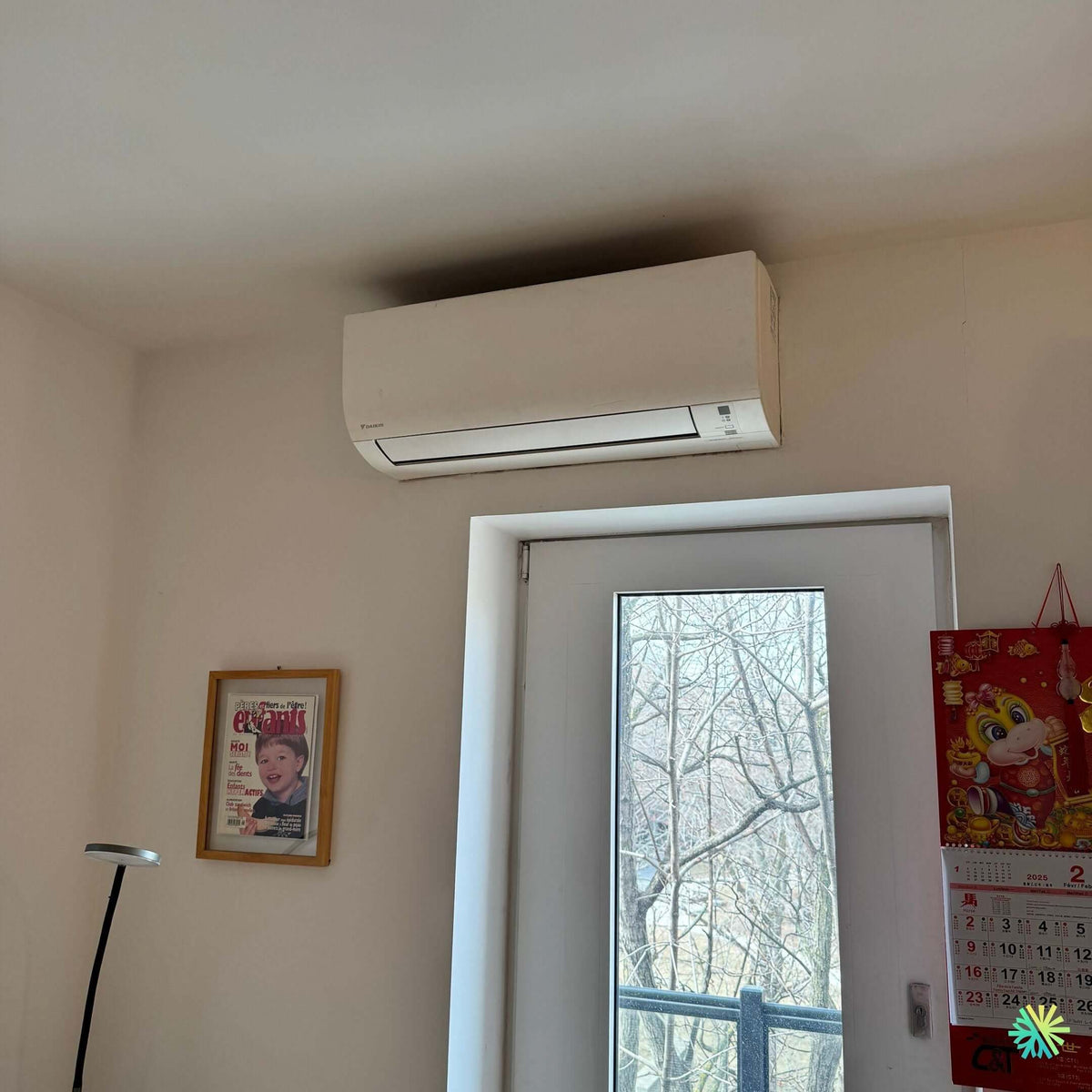
At AirGreen , we support co-owners and occupants of Rosemont–La Petite-Patrie who want to modernize their comfort while optimizing their energy consumption. This project highlights the installation of a Daikin wall-mounted heat pump installed at the top of the wall, just above a patio door opening onto a tree-lined balcony. The objective: to provide efficient supplemental heating in winter and quiet air conditioning in summer , without encroaching on the floor space, while respecting the constraints of urban housing.
Context, objectives and sizing
The owner was looking for a solution:
-
compact and discreet , not obstructing traffic or furniture;
-
effective at low temperatures , to reduce the use of electric baseboards;
-
quiet , compatible with the neighborhood and open-plan living.
After a survey and load calculation (glazed surfaces, orientation, infiltration, ceiling height), we validated a capacity of around 9,000 to 12,000 BTU/h for the main living area. The Inverter modulation specific to Daikin wall units allows the power to be finely adjusted to actual demand, guaranteeing thermal stability and savings.
Technical details and best practices applied
Inner head positioning
-
Height : the device is placed at the top, centered above the patio door, in order to increase the blowing range and avoid obstacles.
-
Clearances : we ensure sufficient clearance from the ceiling and side returns to prevent air recirculation and facilitate maintenance.
-
Diffusion : The louver is set to sweep the living area without creating a direct draft on the occupants. In this type of configuration, a slight downward tilt improves mixing and reduces convection traces on the ceiling.
Route of the connections and crossing
-
Wall feed-through in the immediate vicinity of the unit, on the door hinge side, to reduce the length of unnecessary piping.
-
Protection : The insulated refrigeration lines, communication cable, and power supply are externally capped to protect them from UV rays and water. The bending radii are respected to preserve the integrity of the flares and insulation.
-
Waterproofing : installation of a bulkhead and a facade-compatible sealant, in order to ensure air/water tightness and the energy performance of the accommodation.
Condensate management
-
Preferred gravity drain , with a continuous slope towards the outside. When the configuration requires it (long length or reverse slope), we offer a silent micro-condensate pump , with safety cutouts. Here, the elevation of the head above the door naturally facilitates drainage.
Power supply and safety
-
Dedicated circuit sized according to the appliance nameplate.
-
External disconnect box placed within visual range of the condenser, waterproof whip and clear identification on the panel.
-
Torque tightening of terminal blocks, protected routing and continuity/insulation test.
Refrigeration commissioning
-
Nitrogen pressure test , then deep vacuum until stabilization, in order to eliminate humidity and residual air.
-
Control of intensities , temperature differences and Inverter parameters in cooling/heating modes.
-
Noise and vibration checks at different power levels to ensure acoustic discretion.
Site features and solutions
-
Patio doors and balconies : this context requires free swing of the leaf and attention to the stratification near the bay window. We adjust the instructions and the direction of the blowing to limit cold spots.
-
Interior finish : discreet trim and aligned passage, in order to maintain the aesthetics of the wall and the flatness around the frames.
-
Simplified maintenance : front access to washable filters , regular cleaning advice and reminder of the importance of clearance around the device.
Why Daikin in a Rosemont condo?
-
Extended modulation : The inverter compressor expands the operating range and limits on/off cycles.
-
High seasonal efficiencies (SEER/HSPF) depending on the series, useful for eligibility of subsidy programs when the reference is approved.
-
Reliability in cold climates : defrost management and capacity maintenance in negative temperatures (depending on model).
-
Careful acoustics : optimized fans and internal enclosures limiting vibrations.
Result: perceived comfort and savings in use
The living area now benefits from consistent comfort : gradual temperature rise in winter, regular cooling in summer and better controlled humidity . Modulation reduces consumption and perceived noise, particularly during quiet evenings on the balcony.
Daily usage tips
-
Maintain a stable setpoint and play on the 1°C gap rather than large jumps.
-
Keep the filters clean (rinse every 4 to 8 weeks, depending on dust and animals).
-
Leave the shutters blowing horizontally to distribute the air; lower them slightly in very cold weather to counteract stratification near the patio door.
-
Clear service access for annual maintenance.
HVAC Maintenance by AirGreen
We offer maintenance visits including: cleaning of exchangers, drain check, electrical check, pressure/temperature reading, parameter updates and personalized advice. A maintained device retains its performance and lifespan .
Grants and Eligibility
Several programs are available in Greater Montreal depending on the exact reference (certifications, low temperature performance): we support our clients in Montreal, Laval, Longueuil, North Shore and South Shore in verifying criteria, preparing documents and compliant detailed invoicing.
Common pitfalls avoided by our team
-
Insufficient ceiling clearance leading to recirculation and dust deposits above the unit: we adjust the position and settings of the shutters to limit ceiling marking.
-
Drain counter-slope : we check the useful slope and, if necessary, install a micro-pump with a safety shut-off device.
-
Too tight bending radius of the connections: we follow the recommendations to avoid micro-leaks and whistling.
-
Leaky holes : we use bulkheads and sealants adapted to differential movements between masonry and joinery.
Why AirGreen in Rosemont–La Petite-Patrie
Our team is familiar with the typical constraints of Montreal plexes and condos : shared walls, narrow balconies, limited ductwork, and demanding co-ownerships. We guarantee:
-
clear planning (quotes, appointments, advice on capacity selection);
-
clean and compliant execution (electricity, refrigeration, finishing);
-
long-term support (HVAC maintenance, usage advice, seasonal support).
Conclusion
This Daikin wall-mounted heat pump installation in Rosemont–La Petite-Patrie illustrates our approach: rigorous thermal analysis , respectful integration of the interior architecture, protected connection paths and meticulous commissioning . The result is measurable comfort, energy savings and a solution ready for Montreal winters as well as the hot summers of the metropolis. We operate with the same high standards in Montreal, Laval, Longueuil, on the North Shore and the South Shore .
The big day, step by step
The main steps of this kind of job at AirGreen. Every house has its quirks: the estimate brings them out.
We look at the room, the outside wall, the line route and where the outdoor unit will go. That is where the capacity gets chosen.
Model, capacity and price, in writing. We also check whether the model qualifies for assistance programs.
Floors and furniture protected, wall plate position marked level, wall opening located.
A single opening, with the slope the drain needs to flow outside.
Set on a stand raised above the snow, with the clearances the manufacturer requires.
Connected, insulated and protected. The opening is then sealed against water, cold air and insects.
A dedicated circuit and an accessible disconnect near the outdoor unit.
Leak test, vacuum, then start-up and a check of heating and cooling.
Remote, modes, filters: we show you the essentials before we leave.
- The on-site estimateWe look at the room, the outside wall, the line route and where the outdoor unit will go. That is where the capacity gets chosen.
- The quoteModel, capacity and price, in writing. We also check whether the model qualifies for assistance programs.
- Getting readyFloors and furniture protected, wall plate position marked level, wall opening located.
- The wall openingA single opening, with the slope the drain needs to flow outside.
- The outdoor unitSet on a stand raised above the snow, with the clearances the manufacturer requires.
- Lines, cable and drainConnected, insulated and protected. The opening is then sealed against water, cold air and insects.
- The electrical workA dedicated circuit and an accessible disconnect near the outdoor unit.
- Tests and start-upLeak test, vacuum, then start-up and a check of heating and cooling.
- The walkthroughRemote, modes, filters: we show you the essentials before we leave.
What would it look like at your place?
Two quick checks with real numbers: what heat costs, and what your current heaters add up to in BTU/h.
Conversion: 1 W = 3.412 BTU/h. An indication, not a load calculation: baseboards and furnaces are often stronger than the real need, and they can stay as backup. AirGreen confirms the capacity on site.
Four mistakes we do not make
Flip each card to see what we do instead.
Your own project, step by step
What to do, season by season
Three habits per season for this unit. They take a few minutes and prevent many calls.
- Clean the indoor unit's filters.
- Clear leaves and debris left on the outdoor unit by winter.
- Test cooling before the first hot days.
- Clean the filters more often when the unit runs a lot.
- Keep plants away from the outdoor unit.
- Check that no water drips from the indoor unit.
- Rake the leaves around the outdoor unit.
- Test heating before the first cold days.
- Book periodic maintenance before winter.
- Keep snow away from the stand and the front of the unit.
- Let the unit defrost: it is normal.
- Never hit the ice on the fins; call us if the unit stays iced up.
Is your home ready?
Check what applies at your place. A "no" is not a refusal: it is what we sort out during the estimate.
Four statements: true or false?
It all comes down to details you have just seen.
1. In heating mode, the outdoor unit can produce water.
During defrost cycles. That water must drain away without forming ice.
2. You pick the capacity with a simple square-footage rule.
Windows, insulation, orientation and how the room is used all count. Capacity is chosen on site.
3. A multi-zone connects several indoor heads to a single condenser.
One head per room, all on the same condenser. Each room keeps its own temperature.
4. The disconnect can sit behind the patio furniture.
It must stay accessible: it is what shuts the unit off for service.
0 / 4 right answers
What people ask us about this kind of work
Does a wall-mounted heat pump heat in winter?
Wall-mounted or multi-zone: how do I choose?
Where does the outdoor unit go?
Are there grants?
Do I need a permit?
How cold can it heat?
How much can I save?
How is the LogisVert assistance calculated?
Is it noisy?
The outdoor unit is covered in ice: is that normal?
Does AirGreen hold the required licences?
Is the estimate free?
No question matches. Write to us: we answer.
More jobs to see, near you
By town, by equipment or by region: browse more than 4,700 published projects.
Each dot: a town where AirGreen has published projects. The glowing dot: this job.
Every house has its constraints. We see them before we install.
The on-site estimate is free and the quote follows within 24 hours.
Text and photo: a real AirGreen Climatisation & Chauffage job. The diagrams are generic illustrations of the type of installation, not a survey of this job site. Sources of the added figures: airgreen.ca product pages (NEEP / AHRI performance), Hydro-Québec (Heat pumps page, LogisVert, read on 13 October 2026), Régie de l’énergie (rate D as of 1 April 2026).