
Installation of a Daikin VRV (VRF system) in Le Sud-Ouest
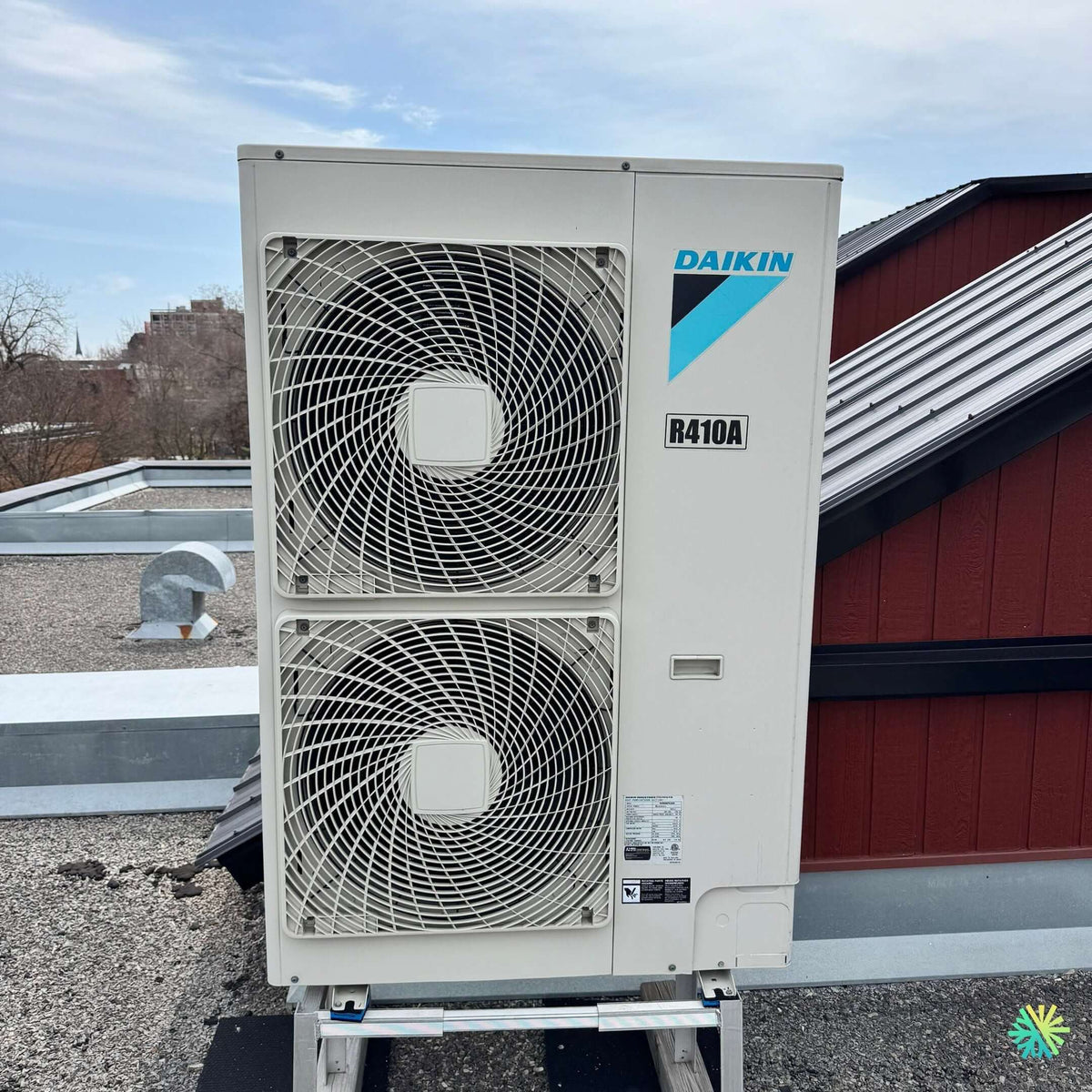
On a flat roof in Le Sud-Ouest , AirGreen installs a Daikin VRF (VRV) : multi-zone central heat pump, raised structure, nitrogen testing and vacuum draw. Your turnkey HVAC project for Montreal, Laval, Longueuil, North Shore and South Shore.
Take a tour of the installation
Each number is a point we check on site. Switch between summer and winter to watch air and heat move.
In summer, the outdoor unit rejects the house's heat outside.
Generic illustration of this type of installation, not a survey of this job site. Tap a number.
It captures or rejects heat outside. It sits on a level base, above the snow, with free space all around.
The insulated refrigerant lines enter the house through a sealed opening and run to the indoor coil.
A shut-off switch near the outdoor unit isolates it safely for service.
Sitting on the indoor module, it moves heat between the house air and the refrigerant.
Electric furnace or air handler: its fan pushes air through the ducts. The electric backup takes over in extreme cold.
Supply ducts bring air to the rooms; returns bring it back to the unit. Their condition matters as much as the unit's.
It protects the coil and the fan. A dirty filter cuts airflow, so it gets checked regularly.
It runs the heat pump and the backup heat. It must be compatible with the installed system.
A central rooftop heat pump designed for urban buildings
On a flat roof of a building in Le Sud-Ouest , our team is installing a Daikin VRF system (VRV family) to provide heating and cooling for several indoor areas using a single dual-fan outdoor unit. The configuration meets the client's priorities: reliability in Montreal's climate, low-temperature performance, a small footprint, and easy access for maintenance. The outdoor module, using R410A refrigerant , is integrated into a raised structure that preserves the roof membrane and ensures proper clearances around the exchangers.
The building combines residential and light office spaces. The goal is to provide precise temperature control by zone, limit operating costs, and extend the life of the envelope by avoiding unnecessary drilling. VRF is the ideal solution here: an inverter compressor continuously sizes the power, each indoor unit receives exactly the required capacity, and the operator monitors its energy zone by zone.
Technical details and commissioning: the AirGreen approach
Choosing a VRF system for multi-zone comfort
-
Machine type : VRF central heat pump (Daikin VRV ) for several indoor units (wall-mounted, 4-way cassettes and some ducted units for corridors).
-
Modulation : high-precision inverter technology; gradual load increase to avoid current draws and stabilize comfort.
-
Operating range : efficient heating at low temperatures, essential for winter in Montreal .
-
Acoustics : double large diameter fan, profiled blades and rigid casing limiting vibrations transmitted to the building.
Rooftop installation: structure, clearances and longevity
-
Raised structure : galvanized Unistrut rails on flat roof density rubber pads , distributing the loads and protecting the membrane.
-
Calculated height : clearance under chassis for frost drainage in defrost mode; no water stagnation around the device.
-
Clearances : standard setbacks at the front and rear for undisturbed air flow , essential for maintaining seasonal yields.
-
Fasteners : stainless steel bolts, sealing washers and controlled tightening torque; prevailing wind prevention plan (orientation and screens if required).
Refrigeration path and sealing
-
Route : entry/exit of lines via a metal technical chimney ; no crushing of the insulation; curvature radius respected to limit pressure losses.
-
Brazing : with nitrogen to prevent internal oxidation; immediate cleaning rings and caps after cutting.
-
Tests : high pressure nitrogen application , leak detection using an electronic detector, then deep vacuum (< 500 microns) with stabilization.
-
Refrigerant charge : adjusted according to equivalent lengths and risers; clear labeling on the unit and junction box.
Power supply and safety
-
Disconnect in the immediate vicinity of the unit; wiring sized according to nominal current; measured grounding .
-
Overcurrent management : circuit breaker dedicated to the TGBT, circuit identification and single-line diagram provided to the operator.
-
Cable trays : galvanized walkways, watertight cable glands and clean bends; no possible abrasion of the sheath.
Drainage, frost and Montreal winter
-
The flat roof requires particular vigilance regarding frost flow :
-
Free clearance under the casing for defrost water,
-
Rejection away from passage areas,
-
Gravity route to the drain without overloading the gutters.
-
-
In windy areas, we provide a weather kit (probe and anti-icing logic) to maintain reliability in very cold weather.
Inside: Zoned comfort and control
-
Indoor units : cassettes above common areas, wall-mounted in offices, discreet ducted units for circulation areas.
-
Regulation : local thermostats, lockable settings, centralized time slots.
-
Air quality : possibility of integrating a dedicated air exchanger on the fresh air intakes, with humidity control adjusted to usage.
Commissioning and performance protocols
-
Checks : pressures, evaporation/condensation temperatures, superheat and subcooling ; flow balancing by zone.
-
Electrical measurement : phase intensities, power factor; log of the first cycles to detect any drift.
-
Documentation : commissioning report, serial numbers, setpoints, maintenance plan.
-
Training : operator handling, seasonal modes, good HVAC maintenance practices (filters, condensate trays, battery verification).
What the customer gains with this Daikin VRF
-
Multi-zone comfort without overheating or cold spots, thanks to continuous modulation.
-
Significant energy savings compared to constant flow systems; optimized partial load.
-
Flexibility of layout : addition or replacement of indoor units possible without complete overhaul of the unit.
-
Silence and discretion, adapted to a dense neighborhood of Greater Montreal .
-
Easy maintenance : roof access, standard clearances, clear cable trays and labeling.
Grants and Compliance
Depending on the chosen configuration and the seasonal performance of the system, the project may be eligible for energy efficiency programs intended for multi-unit buildings or small businesses in Greater Montreal . Our team validates the criteria (low temperature operating ranges, performance indices, controls) and prepares technical files and detailed invoices for the optimization of aid in Montreal, Laval, Longueuil, North Shore and South Shore .
Common pitfalls avoided
-
Device placed directly on the membrane : premature aging and vibrations → Raised chassis with pads.
-
Insufficient clearances in front of fans → Respect distances to maintain nominal capacity.
-
Uncompensated refrigerated lengths → Precise calculation of additional loads and branch balancing.
-
Leaky holes → Sleeved penetrations, flashings and mastic compatible with roofing.
-
Lack of winter plan → Frost management, heights and controlled water discharge.
Recommended (preventative) maintenance
-
Biannual inspection : electrical tightening, battery cleaning, pressure and residual vacuum check.
-
Filtration : replacement/maintenance of indoor unit filters according to use.
-
Surveillance : visual inspection after storms (debris, blown snow).
-
Checking the supports : condition of the pads, level of the rails, possible corrosion.
Why AirGreen for your HVAC VRF installation in Montreal?
We combine roofing engineering , compliance with electrical codes , and careful execution. Our planning reduces downtime, and our after-sales service ensures continuous performance. We operate throughout Montreal, Laval, Longueuil, on the North Shore and the South Shore with teams trained in VRF protocols and roof safety.
Are you considering a rooftop central heat pump or a multi-zone VRF system ? We will conduct a load study , propose installation options (roof, technical slab, mezzanine), evaluate the refrigeration lengths and provide a clear quote, ready for approval by your condominium association or property manager.
The big day, step by step
The main steps of this kind of job at AirGreen. Every house has its quirks: the estimate brings them out.
We look at the ducts, the current indoor module, the electrical panel and the planned spot for the outdoor unit.
The equipment combination, capacity and price, in writing. We check whether the combination qualifies for assistance programs.
Access protected, old unit disconnected and removed when it is being replaced.
Electric furnace or air handler, with its coil, connected to the supply and return ducts.
On a level base, raised above the snow, with free space all around.
Insulated, they enter through a sealed opening and run to the indoor coil.
Dedicated circuits, accessible disconnect, a thermostat that works with the heat pump and the backup heat.
Leak test, vacuum, start-up, airflow check and a test of both modes.
Filter, thermostat, backup heat in extreme cold: what to know before winter.
- The on-site estimateWe look at the ducts, the current indoor module, the electrical panel and the planned spot for the outdoor unit.
- The quoteThe equipment combination, capacity and price, in writing. We check whether the combination qualifies for assistance programs.
- Getting readyAccess protected, old unit disconnected and removed when it is being replaced.
- The indoor moduleElectric furnace or air handler, with its coil, connected to the supply and return ducts.
- The outdoor unitOn a level base, raised above the snow, with free space all around.
- The refrigerant linesInsulated, they enter through a sealed opening and run to the indoor coil.
- Electrical and thermostatDedicated circuits, accessible disconnect, a thermostat that works with the heat pump and the backup heat.
- Tests and start-upLeak test, vacuum, start-up, airflow check and a test of both modes.
- The walkthroughFilter, thermostat, backup heat in extreme cold: what to know before winter.
What would it look like at your place?
Two quick checks with real numbers: what heat costs, and what your current heaters add up to in BTU/h.
Conversion: 1 W = 3.412 BTU/h. An indication, not a load calculation: baseboards and furnaces are often stronger than the real need, and they can stay as backup. AirGreen confirms the capacity on site.
Four mistakes we do not make
Flip each card to see what we do instead.
Your own project, step by step
What to do, season by season
Three habits per season for this unit. They take a few minutes and prevent many calls.
- Check the indoor module's filter.
- Clear winter debris from the outdoor unit.
- Test cooling before the heat arrives.
- Check the filter more often in peak season.
- Keep registers and returns clear.
- Watch condensate drainage near the coil.
- Change or clean the filter.
- Test heating and backup heat before the cold.
- Book periodic maintenance.
- Clear snow around the outdoor unit.
- Store nothing in front of the indoor module.
- Note any unusual noise or smell and call us.
Is your home ready?
Check what applies at your place. A "no" is not a refusal: it is what we sort out during the estimate.
Four statements: true or false?
It all comes down to details you have just seen.
1. A central heat pump uses the house's ducts.
It connects to the existing ducts to heat and cool everywhere.
2. In extreme cold, electric backup heat can take over.
The indoor module (furnace or air handler) works with the heat pump and takes over in extreme cold.
3. The filter only gets changed when the unit breaks down.
A dirty filter cuts airflow. It gets checked regularly.
4. You can reuse the old unit's size without checking.
The house may have changed: insulation, windows, added rooms. Capacity is confirmed on site.
0 / 4 right answers
What people ask us about this kind of work
Can I keep my current ducts?
What happens in extreme cold?
Furnace, air handler, ducted: what is the difference?
Are there grants?
Do I need a permit?
How much can I save?
How is the LogisVert assistance calculated?
Will my current thermostat work?
Central or wall units: which one?
Does AirGreen hold the required licences?
Is the estimate free?
No question matches. Write to us: we answer.
More jobs to see, near you
By town, by equipment or by region: browse more than 4,700 published projects.
Each dot: a town where AirGreen has published projects. The glowing dot: this job.
Every house has its constraints. We see them before we install.
The on-site estimate is free and the quote follows within 24 hours.
Text and photo: a real AirGreen Climatisation & Chauffage job. The diagrams are generic illustrations of the type of installation, not a survey of this job site. Sources of the added figures: airgreen.ca product pages (NEEP / AHRI performance), Hydro-Québec (Heat pumps page, LogisVert, read on 13 October 2026), Régie de l’énergie (rate D as of 1 April 2026).