
Installation of a MIDEA EVOX G3 2-ton electric furnace with a central Air Handler system in Sainte-Rose, Laval
AirGreen installs a 2-ton MIDEA EVOX G3 electric furnace in Sainte-Rose, Laval: Central Air Handler system, custom duct fittings, lasting comfort, and local HVAC expertise.
- City
- Region
- Equipment
- Brand
- Challenges
- Published
The job on one screen
The article, chapter by chapter
A compact, clean, central installation well-suited to the mechanical realities of a home in Sainte-Rose
In Sainte-Rose, in the northern sector of Laval, our AirGreen team recently installed a MIDEA EVOX G3 2-ton electric furnace, configured as a central system with Air Handler. This type of HVAC installation is particularly appealing to homeowners who want to improve overall home comfort without multiplying wall-mounted units, while benefiting from uniform air distribution through existing ducts.
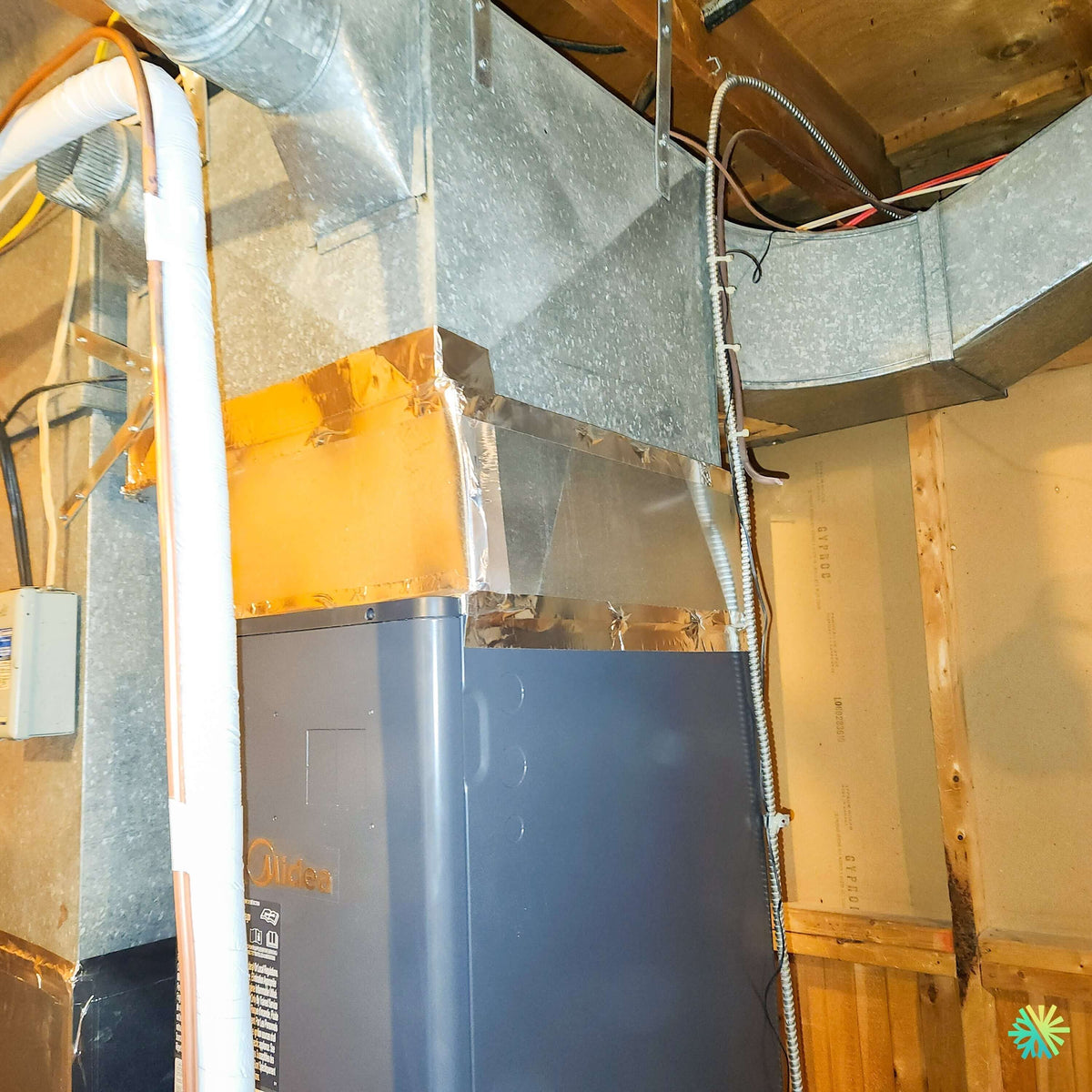
For this project, the objective was clear: replace or upgrade the existing central equipment with a reliable, compact solution compatible with the residence's actual needs. The photo taken on-site clearly shows the typical technical environment of a residential mechanical basement in Laval: galvanized ducts already in place, exposed wood structure, rigid insulation panel on the wall, electrical wiring passage, insulated refrigeration piping, and limited space around the unit. It is precisely in this type of context that the experience of a specialized HVAC installation contractor in Laval makes all the difference.
The electric furnace installed here is not just a device that is plugged in and connected. It must integrate correctly into the entire ventilation network, comply with required clearances, allow future access for HVAC maintenance, and ensure efficient airflow through existing ducts. In this Sainte-Rose home, our intervention thus combined mechanical precision, custom adaptation of duct transitions, electrical verification, and careful finishing around the central unit.
Why a MIDEA EVOX G3 2-ton for this residence?
The MIDEA EVOX G3 2-ton is a popular central solution for homes seeking a good balance between comfort, energy efficiency, and discreet integration. In a residence equipped with ducts, a central Air Handler type system allows heated or cooled air to be distributed to multiple rooms from a single mechanical point, unlike a wall-mounted solution which concentrates air treatment more in a specific area.
In this case, the 2-ton capacity corresponds to a sizing adapted to a moderately sized home, depending on the building's configuration, its insulation, its duct network, and heating and cooling needs. At AirGreen, we always emphasize this point: choosing an electric furnace or a central system should never be limited to a brand or a price. The right choice also depends on the required air volume, the network's static pressure, the quality of the ducts, the available electrical panel, and how the house reacts to temperature differences between floors.
Midea's EVOX G3 series is often selected for residential projects where one wants to modernize a central system with a more efficient and comfortable solution. It integrates well into central heat pump projects, electric furnaces with compatible coils, or existing distribution network improvements. For homeowners in Montreal, Laval, Longueuil, on the North Shore or the South Shore, this type of equipment represents a serious option when one wants to avoid compromises between performance, budget, and mechanical integration.
What the image reveals about the project's real complexity
The photo of the installation in Sainte-Rose highlights several important technical elements. First, it shows the Midea electric furnace installed under an existing duct network, with a custom-fabricated and adjusted metal transition. This transition is essential: it properly connects the unit's air outlet to the main plenum to limit pressure losses, air leaks, and unnecessary turbulence.
We also note the use of specialized metal tape on duct joints. This finish is not decorative: it serves to improve the network's airtightness and reduce air losses in the mechanical room. In a central system, an air leak at the plenum or a transition can decrease comfort in distant rooms, make the fan run longer, and undermine the overall efficiency of the installation.
The insulated piping visible on the left also indicates potential integration with a central air conditioning or heat pump system. The white insulation around the refrigerant line plays an important role in limiting thermal gains or losses, controlling condensation, and protecting system performance. The routing of electrical cables and conduits, meanwhile, illustrates the importance of well-coordinated work between unit positioning, electrical supply, and service access.
Finally, the available space around the unit requires real planning. In many homes in Sainte-Rose and Laval, mechanical rooms were not originally designed to accommodate more powerful modern equipment. It is therefore necessary to contend with joists, already installed ducts, partially finished walls, insulation panels, drains, wires, and access constraints. Our role is to make the installation clean, safe, and durable despite these constraints.
A custom-fabricated duct transition to ensure proper airflow
One of the most important aspects of this installation was adapting the connection between the MIDEA EVOX G3 electric furnace and the existing duct network. A central unit can only deliver its full performance if air circulates correctly. A poor transition, too abrupt or poorly sealed, can cause several problems:
- excessive noise in the ducts;
- loss of flow in certain rooms;
- excessive static pressure;
- premature wear of the fan motor;
- discomfort between floors;
- decrease in heating or cooling performance.
For this project, our team therefore took the time to create a clean and functional metal connection, taking into account the unit's width, the position of the existing plenum, and the available ceiling clearance. The use of galvanized sheet metal parts and quality metal tape creates a more airtight and durable connection than an improvised adaptation.
This step is often underestimated by homeowners who only compare the prices of an electric furnace installation. However, the quality of the duct connection directly influences the comfort felt in the home. Two identical units can yield very different results depending on the quality of the installation.
The importance of a well-sized central system in Laval
In Sainte-Rose, as in many neighborhoods in Laval, homes have very varied profiles: bungalows, cottages, renovated houses, properties with finished basements, rear extensions, attached garages, and more or less insulated attics. This diversity makes HVAC sizing particularly important.
A MIDEA EVOX G3 2-ton electric furnace may be suitable for certain configurations, but it must be evaluated according to the building's characteristics. A system that is too small risks running for a long time without achieving the desired comfort. A system that is too large can cycle too quickly, create temperature differences, and reduce the efficiency of air distribution.
At AirGreen, we particularly look at:
- the area served by the central network;
- the condition of existing ducts;
- the number of supply registers and return air grilles;
- the insulation of the building envelope;
- the presence of large windows;
- sun exposure;
- the occupants' heating and cooling habits;
- electrical compatibility;
- accessibility for future maintenance.
This analysis allows us to recommend a solution that matches the home, not just a spec sheet.
An installation designed for future maintenance
A good HVAC project is not limited to the day of installation. It must also facilitate future interventions: filter replacement, electrical component verification, fan inspection, coil maintenance, connection checks, and adjustments as needed.
In this installation in Sainte-Rose, the location of the electric furnace and the connections were arranged to maintain reasonable access to the service panels. This is an essential detail in compact mechanical rooms. A poorly positioned unit can make maintenance longer, more expensive, and sometimes even discourage regular checks.
We always recommend homeowners maintain clear access around the central unit. It is important to avoid storing boxes, tools, or materials directly in front of service panels. For a central system, regular maintenance not only preserves performance but also helps detect early signs of air restriction, abnormal noise, or stressed components.
Mistakes to avoid when installing a central electric furnace
This Midea installation in Sainte-Rose illustrates several mistakes that homeowners should avoid when planning a central system replacement or upgrade.
Choosing the unit without checking the ducts
An old, poorly sized, or partially obstructed duct network can limit the performance of a new unit. Before investing in an electric furnace or a central heat pump, ensure that the ducts can distribute air correctly.
Neglecting the airtightness of connections
Air leaks at the plenum or transitions can impair comfort and increase energy losses. Careful finishing with appropriate materials is essential.
Underestimating the space needed around the unit
Even if the unit seems to physically fit into the mechanical room, access to panels, connections, filters, and internal components must be planned.
Comparing only the final price
A cheaper installation can sometimes hide shortcuts: poorly adjusted transition, incomplete sealing, lack of checks, poor cable management, or lack of finish. In a central system, these details have a real impact on lifespan and performance.
Forgetting compatibility with subsidies
Certain central systems may be eligible for financial assistance programs depending on the complete configuration, energy efficiency, model numbers, and current criteria. Programs like Hydro-Québec's LogisVert should always be verified at the time of quotation, as amounts and conditions can vary depending on models and installation dates.
Subsidies and energy efficiency: what to check
For an installation like this MIDEA EVOX G3 2-ton, eligibility for a subsidy generally depends on the entire installed system, particularly if the unit is combined with an eligible central heat pump, if the model numbers are listed in recognized databases, and if the installation meets program requirements.
At AirGreen, we assist clients in validating the applicable criteria. For homeowners in Montreal, Laval, Longueuil, on the North Shore and the South Shore, this step is particularly important, as a subsidy can significantly impact the net cost of the project.
However, a common mistake must be avoided: purchasing a device assuming it will automatically be eligible. Eligibility is confirmed with exact models, technical documents, program requirements, and the installed configuration. In the case of a central system, the combination of the indoor unit, outdoor unit, and performance characteristics must be precisely analyzed.
The comfort of a central system in a family home
One of the major advantages of a central solution like the MIDEA EVOX G3 is its uniform air distribution. In a Sainte-Rose home, this can represent a significant gain in comfort, especially when rooms are spread over several levels or when certain areas are more difficult to balance.
A well-installed central system allows for:
- a more constant temperature from one room to another;
- better air circulation;
- fewer visible units in living spaces;
- discreet integration into the existing network;
- centralized maintenance;
- possible compatibility with enhanced filtration solutions.
In several projects carried out by AirGreen in Laval and on the North Shore, clients often tell us that they are looking for a simple-to-use solution, without multiplying remote controls or wall units. The central system meets this need well when properly designed and installed.
An intervention representative of AirGreen's expertise
This installation in Sainte-Rose reflects an approach that we apply to all our HVAC projects: analyze the existing environment, adapt connections, protect unit performance, and deliver a clean result. The real work of an HVAC contractor is not just about installing a machine; it is about integrating a technical solution into a real home, with its constraints, surprises, and specificities.
In this project, the mechanical space required careful coordination. The presence of existing ducts above the unit demanded a precisely adjusted transition. Insulated lines and electrical connections had to remain organized. Everything had to be solid enough to last, while allowing access to internal components.
It is this level of detail that distinguishes a professional installation from a simple equipment replacement. In Laval, as in Montreal, Longueuil, on the North Shore and the South Shore, we often encounter installations where the chosen appliance is good, but its performance is limited by a rushed connection or poor adaptation to the ducts. Our priority is to avoid this type of problem from the outset.
Practical tips for homeowners considering a similar installation
For homeowners in Sainte-Rose or another sector of Laval considering a central electric furnace installation, a few checks can facilitate the project.
Have the mechanical space inspected before choosing the appliance
Available height, existing ducts, electrical access, and clearances directly influence the type of appliance recommended. A technical visit helps reduce surprises.
Plan for access to the filter and service panels
A high-performing system must remain easy to maintain. Access to the filter should never require disassembling important elements or moving heavy objects.
Request a clear explanation of the duct connection
The transition between the appliance and the plenum is a critical point. A good contractor should be able to explain how they plan to connect the unit and why this method is suitable for the existing network.
Check central heat pump options
An electric furnace can be integrated into a broader strategy with a central heat pump, depending on heating and cooling needs. This combination can improve comfort and reduce reliance on pure electric heating during certain periods.
Keep installation documents
Invoice, model numbers, proof of installation, and technical documents are important for maintenance, warranty, and grant applications.
A reliable central solution for Sainte-Rose, installed with precision
This installation of a MIDEA EVOX G3 2-ton electric furnace with Air Handler in Sainte-Rose demonstrates the importance of well-planned HVAC work. The appliance itself matters, but its performance heavily depends on the quality of its integration: duct connection, sealing, positioning, service access, wiring, and adaptation to the existing space.
For homeowners looking to modernize their central system in Laval, this project is an excellent example of a compact, clean, and efficient solution. It also shows that a successful installation is not just about replacing one metal box with another. Each house has its own constraints, and every detail influences the final comfort.
At AirGreen, we put our expertise at the service of homeowners in Montreal, Laval, Longueuil, on the North Shore and the South Shore to design durable, high-performing HVAC installations adapted to the reality of the building. Whether it's an electric furnace, a central heat pump, a wall-mounted air conditioner, a complete replacement, or an energy improvement project, our approach remains the same: recommend the right solution, install it correctly, and ensure a result that stands the test of time every day.
The job tools
Two quick checks with real numbers: what heat costs, and what your current heaters add up to in BTU/h.
Conversion: 1 W = 3.412 BTU/h. An indication, not a load calculation: baseboards and furnaces are often stronger than the real need, and they can stay as backup. AirGreen confirms the capacity on site.
How the job unfolds
The main steps of this kind of job at AirGreen. Every house has its quirks: the estimate brings them out.
We look at the ducts, the current indoor module, the electrical panel and the planned spot for the outdoor unit.
The equipment combination, capacity and price, in writing. We check whether the combination qualifies for assistance programs.
Access protected, old unit disconnected and removed when it is being replaced.
Electric furnace or air handler, with its coil, connected to the supply and return ducts.
On a level base, raised above the snow, with free space all around.
Insulated, they enter through a sealed opening and run to the indoor coil.
Dedicated circuits, accessible disconnect, a thermostat that works with the heat pump and the backup heat.
Leak test, vacuum, start-up, airflow check and a test of both modes.
Filter, thermostat, backup heat in extreme cold: what to know before winter.
- The on-site estimateWe look at the ducts, the current indoor module, the electrical panel and the planned spot for the outdoor unit.
- The quoteThe equipment combination, capacity and price, in writing. We check whether the combination qualifies for assistance programs.
- Getting readyAccess protected, old unit disconnected and removed when it is being replaced.
- The indoor moduleElectric furnace or air handler, with its coil, connected to the supply and return ducts.
- The outdoor unitOn a level base, raised above the snow, with free space all around.
- The refrigerant linesInsulated, they enter through a sealed opening and run to the indoor coil.
- Electrical and thermostatDedicated circuits, accessible disconnect, a thermostat that works with the heat pump and the backup heat.
- Tests and start-upLeak test, vacuum, start-up, airflow check and a test of both modes.
- The walkthroughFilter, thermostat, backup heat in extreme cold: what to know before winter.
What we check on a job like this one
Each number is a point we check on site. Switch between summer and winter to watch air and heat move.
In summer, the outdoor unit rejects the house's heat outside.
Generic illustration of this type of installation, not a survey of this job site. Tap a number.
It captures or rejects heat outside. It sits on a level base, above the snow, with free space all around.
The insulated refrigerant lines enter the house through a sealed opening and run to the indoor coil.
A shut-off switch near the outdoor unit isolates it safely for service.
Sitting on the indoor module, it moves heat between the house air and the refrigerant.
Electric furnace or air handler: its fan pushes air through the ducts. The electric backup takes over in extreme cold.
Supply ducts bring air to the rooms; returns bring it back to the unit. Their condition matters as much as the unit's.
It protects the coil and the fan. A dirty filter cuts airflow, so it gets checked regularly.
It runs the heat pump and the backup heat. It must be compatible with the installed system.
Is your home ready?
Check what applies at your place. A "no" is not a refusal: it is what we sort out during the estimate.
Good habits, once the unit is in place
Six simple habits that keep the unit going. Your list stays on this device.
What to do, season by season
Three habits per season for this unit. They take a few minutes and prevent many calls.
- Check the indoor module's filter.
- Clear winter debris from the outdoor unit.
- Test cooling before the heat arrives.
- Check the filter more often in peak season.
- Keep registers and returns clear.
- Watch condensate drainage near the coil.
- Change or clean the filter.
- Test heating and backup heat before the cold.
- Book periodic maintenance.
- Clear snow around the outdoor unit.
- Store nothing in front of the indoor module.
- Note any unusual noise or smell and call us.
The right pages, at the right time
Four statements: true or false?
It all comes down to details you have just seen.
1. A central heat pump uses the house's ducts.
It connects to the existing ducts to heat and cool everywhere.
2. In extreme cold, electric backup heat can take over.
The indoor module (furnace or air handler) works with the heat pump and takes over in extreme cold.
3. The filter only gets changed when the unit breaks down.
A dirty filter cuts airflow. It gets checked regularly.
4. You can reuse the old unit's size without checking.
The house may have changed: insulation, windows, added rooms. Capacity is confirmed on site.
0 / 4 right answers
What people ask us about this kind of work
Can I keep my current ducts?
What happens in extreme cold?
Furnace, air handler, ducted: what is the difference?
Are there grants?
Do I need a permit?
How much can I save?
How is the LogisVert assistance calculated?
Will my current thermostat work?
Central or wall units: which one?
Does AirGreen hold the required licences?
Is the estimate free?
No question matches. Write to us: we answer.
More jobs to see, near you
By town, by equipment or by region: browse more than 4,700 published projects.
Each dot: a town where AirGreen has published projects. The glowing dot: this job.
An on-site estimate, the right capacity, the right equipment.
The on-site estimate is free and the quote follows within 24 hours.
Text and photo: a real AirGreen Climatisation & Chauffage job. The diagrams are generic illustrations of the type of installation, not a survey of this job site. Sources of the added figures: airgreen.ca product pages (NEEP / AHRI performance), Hydro-Québec (Heat pumps page, LogisVert, read on 13 October 2026), Régie de l’énergie (rate D as of 1 April 2026).